September 2

What was advertised in a revolutionary American newspaper 250 years ago today?
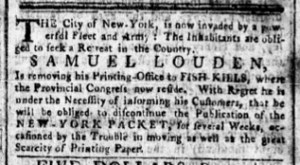
New-York Gazette and Weekly Mercury (September 2, 1776).

“THE City of New-York, is now invaded by a powerful Fleet and Army.”

Samuel Loudon summarized recent events in the first line of his advertisement in the September 2, 1776, edition of the New-York Gazette and Weekly Mercury.  Residents of the city and nearby towns already knew that the British had captured New York.  Most other readers likely learned about the British occupation of New York before reading Loudon’s advertisement, probably hearing about it before reading about it in any newspaper.

Still, delivering the news was an important precursor for what Loudon needed to share with subscribers to his newspaper, the New York Packet.  Due to the occupation, the “Inhabitants [of New York] are obliged to seek a Retreat in the Country.”  Among those who sight refuge in the countryside, Loudon “remov[ed] his Printing-Office to FISH KILLS, where the Provincial Congress now reside.”  That location offered safety as well as access to news about the state government, once he managed to open a printing office there.  “With regret,” Loudon continued, “he is under the Necessity of Informing his Customers, that he will be obliged to discontinue the Publication of the NEW-YORK PACKET, for several Weeks, occasioned. By the Trouble of moving as well as the great Scarcity of Printing Paper.”

Loudon had been publishing the New York Packet for only eight months before circumstances caused him to retreat to Fishkill.  He distributed the first issue on January 4, 1776, and suspended it with the August 29 edition, just before the British entered the city.  It took longer than he anticipated to resume publication.  According to Clarence S. Brigham, “The first Fishkill issue was undoubtedly that of Jan. 16, 1777, vol. 1, no. 36, but the earliest located is that of Feb. 6, 1777, vol. 1, no. 39.”[1]  Loudon continued the volume and issue numbering uninterrupted despite the suspension and relocation.  The British occupied New York throughout the remainder of the war.  Loudon remained in Fishkill, publishing his newspaper there until the end of August 1783.  He then returned to New York and continued the newspaper without changing the volume numbering in November 1783.  The war disrupted publication of the New York Packet, yet Loudon persevered.  He managed to continue supplying subscribers and other readers with news (and advertisements) despite the challenges of “removing his Printing-Office” beyond occupied New York.

**********

[1] Clarence S. Brigham, History and Bibliography of American Newspapers, 1690-1820 (Worcester, Massachusetts: American Antiquarian Society, 1947), 570.
February 5

What was advertised in a revolutionary American newspaper 250 years ago today?

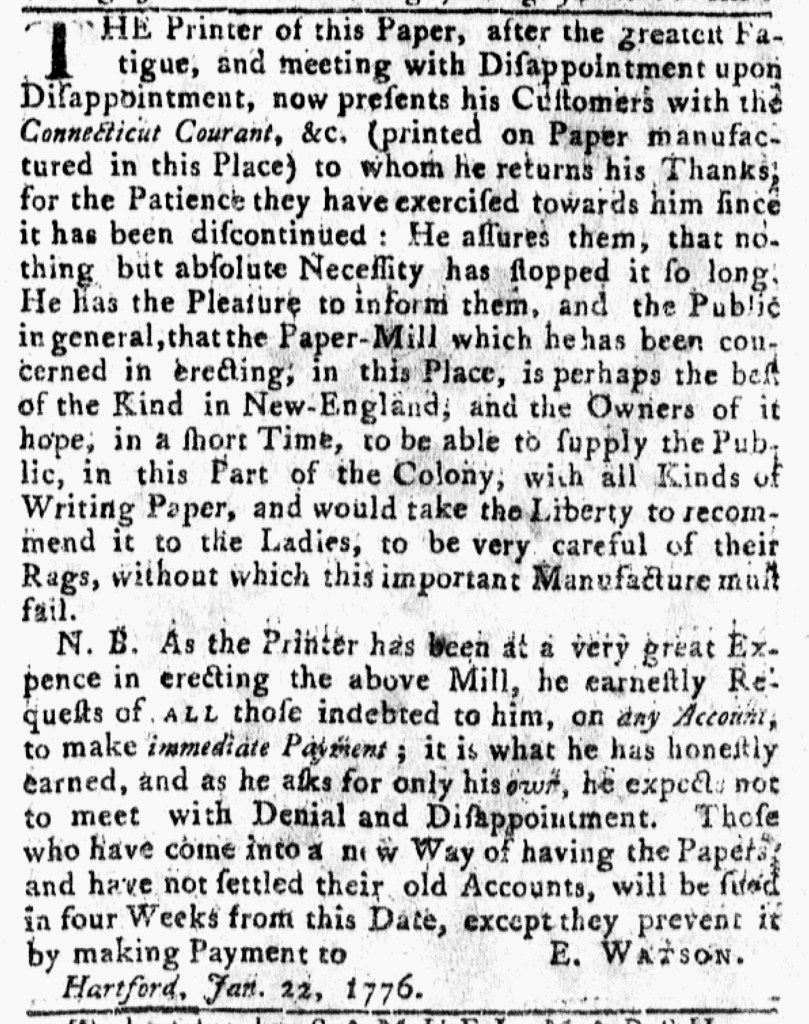
Connecticut Courant (February 5, 1776).

“The Paper-Mill which he has been concerned in erecting … is perhaps the best of the Kind in New-England.”

Ebenezer Watson, the printer of the Connecticut Courant and Hartford Weekly Intelligencer, briefly suspended publication of that newspaper due to a lack of paper in late December 1775 and early January 1776.  The issue for December 11, “NUMBER 572,” was the last for over a month.  The next known issue had neither a date nor a number in the masthead, but the news from Hartford on the final page bore the date January 15.  The issue for January 22, “NUMB. 574,” had both a date and number in the masthead.  A handwritten note at the bottom of the first page of the December 11 edition digitized for the America’s Historical Newspapers database states, “There appears to be an interruption of four weeks,” consistent with the issue numbering.

Watson inserted a notice about the suspension in the January 22 edition and the next two issues.  “THE Printer of this Paper, after the greatest Fatigue, and meeting with Disappointment upon Disappointment,” he explained, “now presented his Customers with the Connecticut Courant, &c. (printed on Paper manufactured in this Place).”  That made the Connecticut Courant yet another newspaper that experienced difficulties due to lack of paper during the first year of the Revolutionary War.  Watson expressed appreciation “for the Patience [his subscribers] have exercised toward him since it has been discontinued” while simultaneously “assur[ing] them, that nothing but absolute Necessity has stopped is so long.”  During the newspaper’s hiatus, Watson had been “concerned in erecting” a paper mill.  Perhaps it produced the paper that allowed him to resume publishing the Connecticut Courant.  He anticipated that “in a short Time” the mill, “perhaps the best of the Kind in New-England, would “be able to supply the Public, in this Part of the Colony, with all Kinds of Writing Paper.”  For that to happen, he recruited the assistance of “the Ladies, to be very careful of their Rags without which this important Manufacture must fail.”  In other words, the paper mill needed clean linen rags to recycle into paper to use in writing letters and publishing newspapers.  In addition to rags, Watson needed to cover “the very great Expence in erecting the above Mill,” so he called on “ALL those indebted to him, on any Account, to make immediate Payment.”  Watson aimed to continue disseminating news about the momentous events occurring in the colonies, but he needed the cooperation of both women saving rags and customers paying off accounts to make that possible.