February 28

What was advertised in a colonial American newspaper 250 years ago today?

Connecticut Journal (February 28, 1772).

“Advertisements.”

Among the many primary sources that I incorporate into my classes about early American history, eighteenth-century newspapers are among my favorites.  Despite the decline of print editions of newspapers in the internet age, students still have expectations about what a newspaper looks like and how it should be organized.  Working with eighteenth-century newspapers gives us many opportunities to identify change over time.

We consult digitized copies of newspapers via several databases.  Students quickly discover that colonial printers distributed new editions only once a week, not daily.  Printers chose which day of the week to publish their own newspapers, most of them opting for Mondays or Thursdays, but none of them published newspapers on Sundays.  The Sunday edition celebrated today did not exist in early America.

Moving beyond the calendar of publication to the newspapers themselves, students learn that the standard issue for most newspapers consisted of only four pages produced by printing two pages on each side of a broadsheet and then folding it in half.  On occasion, some printers also distributed supplements or extraordinaries, but for the most part subscribers received only four pages of news and other content each week.

Upon examining the contents, students express surprise over the organization and lack of headlines for most news articles.  In modern newspapers, advertisements usually do not appear on the front page, but that was common practice in eighteenth-century newspapers.  Consider the February 28 edition of the Connecticut Journal and New-Haven Post-Boy.  Immediately below the masthead, a header for “Advertisements” announced what sort of content appeared in that column.

The header itself was relatively unique; running advertisements on the first page was not.  Indeed, some printers filled the entire front page with advertising.  The production process played a role in that decision.  In order to create a four-page issue out of a single broadsheet, printers first printed the front and back pages on one side of the sheet.  After the ink dried, they printed the second and third pages on the other side of the sheet.  They saved the second and third pages for the most current news.  That meant they first printed advertisements, many of them with type already set because they ran in previous issues.

In the eighteenth century, readers knew to open their newspapers to the second and third pages to find the most current news.  Doing so seems quite foreign and counterintuitive to students accustomed to the appearance and organization of print editions of newspapers in the twenty-first century.  Discovering this on their own provides valuable opportunities to critically engage with primary sources, examining not only their format but also the production process and how readers engaged with newspapers as material texts.

February 21

What was advertised in a colonial American newspaper 250 years ago today?

Connecticut Journal (February 21, 1772).

Can be afforded cheaper than if purchased in Boston or New York.”

In February 1772, Isaac Beers and Elias Beers took to the pages of the Connecticut Journal and New-Haven Post-Boy to advertise “a small Assortment of GOODS” they recently imported from London.  They listed some textiles, promising as well “a general Assortment of Articles in the Cloathing Way.”  They concluded their advertisement with a note that they sold their wares “at the very lowest Rates.”  A manicule drew attention to that proclamation.

The shopkeepers provided additional commentary about price intended to convince prospective customers to shop at their store rather than seek out alternatives.  “As we imported the above Goods immediately from London,” they explained, “they undoubtedly can be afforded cheaper than if purchased in Boston or New York.”  Residents of New Haven and nearby towns did not need to visit one of the bustling port cities or send away to shopkeepers there in order to benefit from the best bargains.  The higher volume of shipping that arrived in Boston and New York did not necessarily mean that consumers in those cities had access to better deals, at least not according to the Beerses.  In addition, they managed to keep prices low at their store in New Haven because they did not acquire their merchandise via wholesalers in Boston and New York.  Receiving their goods “immediately from London” eliminated a round of markups.

Readers did not need to look beyond New Haven for the best prices.  The Beerses underscored that point when they asserted that they “are determined to sell [the above Goods] as low as they possibly can be afforded.”  They were not the only entrepreneurs to make appeals to price in Connecticut Journal, but they did provide the most extensive explanation to demonstrate how they managed to keep prices low for their customers.  In so doing, they acknowledged that consumers assessed the claims made in newspaper advertisements and made careful choices when shopping.

January 24

What was advertised in a colonial American newspaper 250 years ago today?

Connecticut Journal (January 24, 1772).

“Garnet topaz amethyst and emeral’d ring stones.”

Abel Buell, a goldsmith in New Haven, placed advertisements in the Connecticut Journal to promote his business in the early 1770s.  He made brief appeals to quality and price, pledging that his wares were “all of the best sort” and that he sold them “very reasonably,” but he devoted much more space to listing his merchandise.  Advertisers throughout the colonies often did so, demonstrating the range of choices available to consumers.

Yet that was not the only purpose of publishing such lists.  Advertisers also sought to help prospective customers imagine the possibilities, hoping that would entice them to make more purchases.  Buell, for instance, could have simply stated that he had on hand a variety of jewelry certain to satisfy the tastes who visited his shop.  Instead, he listed “ROUND, square and oval cypher’d button cristals with cyphers, cypher’d and brilliant ear-ring tops and drops, round oval and square brilliant button stones, paste ear-ring tops and drops, cypher’d and brilliant paste for buttons, garnet topaz amethyst and emeral’d ring stones, mock garnets for rings and buttons, [and] garnet cristal and paste ring sparks,” along with other items.

That list served as Buell’s catalog.  Each entry introduced prospective customers to yet another item they might acquire. As readers perused the list, they likely imagined themselves wearing many of the items.  Buell intended for the list to cultivate desire for various buttons, earrings, stones, and other jewelry as consumers made quick decisions whether they might wear each item.  In many cases, they may not have given much thought to certain items until presented with the possibilities that Buell described.  Offering choices, such as “garnet topaz amethyst and emeral’d ring stones,” encouraged prospective customers to imagine which they desired the most, which might look best on them, or which complemented other items they already owned.  That likely brought consumers one step closer to making purchases.  Buell probably intended for his list to make the possibilities more vivid and more tangible to prospective customers who could be convinced to make purchases with a little bit of encouragement.

January 17

What was advertised in a colonial American newspaper 250 years ago today?

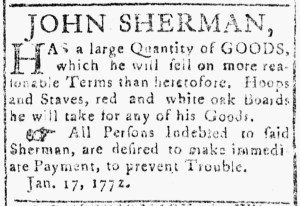
Connecticut Journal (January 17, 1772).

“All Persons Indebted to said Sherman, are desired to make immediate Payment, to prevent Trouble.”

John Sherman had two purposes in placing an advertisement in the Connecticut Journal and New-Haven Post-Boy in January 1772.  He aimed to attract customers for the “large Quantity of GOODS” available at his shop, but he also wished to collect on debts.  As was often the case in colonial newspapers, he pursued both goals in a single advertisement rather than placing multiple notices with distinct purposes.  This may have been a strategy to avoid paying for more than one notice, depending on how the printer set advertising rates, but it also suggests that advertisers expected readers to closely examine the content of advertisements as well as news articles, letters, and editorials that appeared elsewhere in newspapers.

In a slightly longer advertisement, Roger Sherman addressed three different purposes.  Like John, he marketed textiles and “a general Assortment of other GOODS.”  He also demanded that “those indebted to him by Book or Note … make immediate Payment to avoid Trouble.”  That threat of legal action echoed the language deployed in John’s advertisement. Finally, he made a much more specific request: “The Person who has his Province Law-Book is desired to return it.” Rather than place a separate advertisement solely about returning the book, he expected that readers would peruse his entire notice.

Such was the case among colonizers who placed advertisements in other newspapers.  On the same day that these advertisements ran in the Connecticut Journal and New-Haven Post-Boy, Samuel Noyes, a jeweler, ran a notice in the New-London Gazette.  He devoted the vast majority of it to listing items available at his shop, including shoe and knee buckles, rings, and lockets.  At the very end, he also announced that he “Wanted a likely Boy as an Apprentice to the Goldsmith’s Business.”  Not completely trusting readers to closely examine the conclusion of the advertisement, the compositor used a slightly larger font to draw attention, but that was not usually the case in advertisements with multiple purposes.  Neither of the notices in the Connecticut Journal and New-Haven Post-Boy featured variations in font size except for the names of the advertisers (which also served as headlines).

January 3

What was advertised in a colonial American newspaper 250 years ago today?

Connecticut Journal (January 3, 1772).

“He will sell … at least as cheap as any of his Neighbours.”

In 1772, James Lockwood began the new year by placing an advertisement in the Connecticut Journal and New-Haven Post-Boy “to inform the Public, That he is now opening, at a new Store …, a great Assortment of English & India GOODS, BOOKS, and all kinds of STATIONARY.”  The merchant marketed these items “Wholesale or Retail,” seeking both retailers and consumers as customers.  To compete with other merchants and shopkeepers in town, he proclaimed that he set prices “as cheap as any of his Neighbours.”  In other words, he would not be undersold … and might even offer some bargains better than buyers would find anywhere else in New Haven.

In this brief advertisement, Lockwood deployed two of the most common advertising strategies of the era:  an appeal to price and an appeal to consumer choice.  Elsewhere in the same issue, other merchants and shopkeepers did the same.  Roger Sherman, for instance, promoted a “general assortment” of goods, noting that he sold them “cheap.”  Henry Daggett similarly carried a “large Assortment of English and India GOODS” as well as a “Quantity of Queen’s WARE, gilt and plain.”  He also declared that his prices were “cheap,” a word commonly used to mean “low” rather than “lacking in quality.”  None of these advertisers published extensive lists of their merchandise, a common strategy for demonstrating choices to readers, but they used words and phrases like “great assortment,” “general assortment,” “quantity,” and “all kinds” to suggest the choices that awaited consumers.  They also did not elaborate much on price, though Lockwood did attempt to distinguish his store from the others when he asserted that he sold his merchandise “at least as cheap as any of his Neighbours.”

To modern eyes accustomed to much more sophisticated marketing strategies, newspaper notices like the ones placed by Lockwood, Sherman, and Daggett may appear to have been nothing but announcements that they had goods for sale.  Though their advertisements were indeed rudimentary, these merchants and shopkeepers did make some effort to incite demand and entice consumers to shop at their stores.  Each of them underscored choices and promised low prices.  Lockwood even experimented with the appeal to price in his advertisement, assuring prospective customers that if they did some comparison shopping around town that they would not be disappointed with his prices.

November 22

What was advertised in a colonial American newspaper 250 years ago today?

Connecticut Journal (November 22, 1771).

“Whoever will bring said Saddle to the Printers hereof … shall be fully rewarded.”

Most likely the type for the rest of the newspaper had already been set when the copy for a notice about a missing saddle arrived at the printing office of the Connecticut Journal and New-Haven Post-Boy.  That would explain the unusual placement of an advertisement that ran in the right margin of the November 22, 1771, edition.  The advertiser, eager to recover lost property, apparently felt some urgency to publish the notice and did not want to wait an entire week until the next issue.  To accommodate the advertiser, the compositor placed the notice in the only empty space still available, the margin.  As a result, the text ran perpendicular to the masthead and the three columns containing news.  To make it fit, the compositor also divided the advertisement into four short columns, the first two featuring three lines and the last two with two lines.  Each of those short columns was the same width as the standard columns, allowing the compositor to gather all of them together to republish the advertisement in the next issue without having to start over with setting the type.

It was a common strategy deployed by printers and compositors throughout the colonies when they wanted to work additional items into newspapers, though most such notices usually appeared on the second or third pages rather than on the first.  The advertiser may have negotiated for a spot most likely to attract attention in hopes of recovering a “SADDLE, not entirely new, yet whole and sound” that had been “LOST out of the Shop of Captain John Mix.”  The notice offered a reward to whoever brought the saddle to the printing office (rather than the shop where it had been lost or perhaps stolen) or provided information about where it could be found.  Beyond publishing the advertisement, the printers of the Connecticut Journal would play a role in recovering the saddle if anyone wished to collect the reward.  They facilitated the transaction, just as they did for the sale of a “Likely, strong NEGRO LAD” described in an advertisement placed by an unnamed enslaver who instructed interested parties to “Enquire at the Printing Office.”  Squeezing the advertisement about the missing saddle into the newspaper as soon as they received it was one of multiple services offered by the printers.  They not only agreed to broker information in print but also to act as agents on behalf of the advertiser if anyone brought any leads or the saddle itself to the printing office.

November 15

What was advertised in a colonial American newspaper 250 years ago today?

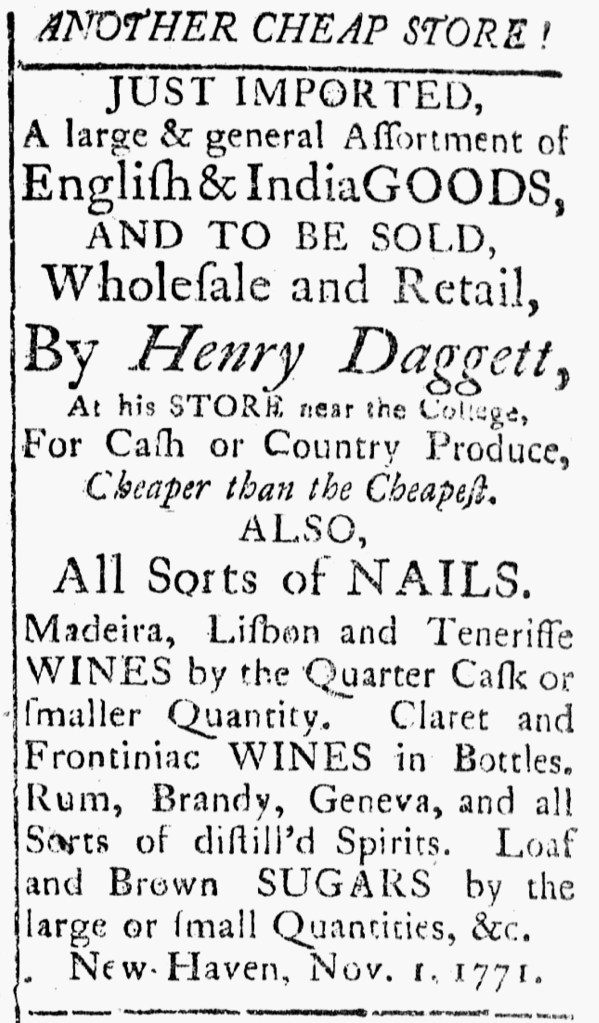
Connecticut Journal (November 15, 1771).

Cheaper than the Cheapest.”

In the fall of 1771, Henry Daggett advertised a “large & general Assortment of English & India GOODS” in the Connecticut Journal.  His advertisement in the November 15 edition also listed several different kinds of wines and spirits as well as “Loaf and Brown SUGARS by the large or small Quantities” available at his store near Yale College in New Haven.  He offered all of his inventory “Wholesale and Retail,” supplying shopkeepers and selling directly to consumers.

Most purveyors of goods and services made appeals to price when they placed advertisements in eighteenth-century newspapers, but Daggett emphasized low prices to an extent not seen in most other notices in the Connecticut Journal and other publications.  John Sherman informed prospective customers that he sold his “large Assortment of GOODS … very reasonably.”  Similarly, John Atwater stocked a “general Assortment of English Goods” that readers could acquire “very cheap.”  Sherman and Atwater embedded appeals to price within their notices; in comparison, Daggett crafted a headline that presented his establishment as “ANOTHER CHEAP STORE!”  He deployed price as a means of framing the rest of his advertisement.  In the middle of the advertisement, he further elaborated, proclaiming that he set prices “Cheaper than the Cheapest.”  Customers might have found some of the same imported goods at Sherman’s store or Atwater’s store, but Daggett suggested that his competitors did not match the bargains he offered.

Eighteenth-century newspaper advertisements might not appear very sophisticated compared to marketing campaigns of the twentieth and twenty-first centuries, but those notices should not be dismissed as mere announcements.  Daggett attempted to incite demand for his goods by emphasizing low prices, hoping that the promise of good deals would convince customers to make purchases and buy in greater quantities if he could convince them that they were getting the better end of the transaction.  Even the wording and format incorporated innovation as Daggett deviated from standardized language concerning prices to promote “Cheaper than the Cheapest” goods and inserted a headline describing his “CHEAP STORE!”  At a glance, Daggett’s advertisement may look like all the others to modern readers, but on closer examination it becomes clear that Daggett sought to create a distinctive notice that would garner greater attention.

October 18

What was advertised in a colonial American newspaper 250 years ago today?

Connecticut Journal (October 18, 1771).

“Much cheaper to the buyer than can be purchased at Retail in Boston or New-York.”

Several purveyors of goods inserted advertisements in the October 18, 1771, edition of the Connecticut Journal and New-Haven Post-Boy.  Each of them made some sort of appeal to price in their attempts to entice consumers into acquiring goods from their shops.  Levi Ives of Derby, for instance, advised readers that he stocked a “good Assortment of GOODS, which he will sell on very moderate Terms.”  Most advertisers made even bolder claims about their price.

That was the case for John Sherman.  He “acquaint[ed] the PUBLIC” that he had just received a “fresh supply of GOODS … which he intends to sell at the very lowest advance.”  Unlike the “moderate Terms” offered by Ives, this pledge implicitly suggested to prospective customers that they would not find better bargains in the vicinity.  The partnership of Morgan and Shipman made a similar statement, declaring that they were “determined to sell as cheap as any Person in Town.”  They matched the prices set by Sherman and other competitors in New Haven.

The estate of Stephen Whitehead Hubbard did not limit their comparison to the prices set by local merchants and shopkeepers.  That advertisement commenced with a pronouncement that the “English and India GOODS” would be sold “at PRIME COST.”  In a nota bene, the executors proclaimed that because the goods “were bought on the best Terms by Wholesale, consequently [they] will be afforded much cheaper to the buyer than can be purchased at Retail in Boston or New-York.”  The estate acknowledged that it operated within a regional marketplace in which consumers and retailers both looked to major ports for the best deals.

Price was one of the most common marketing appeals made in eighteenth-century newspaper advertisements, but advertisers devised a variety of means of deploying the strategy.  Sometimes they simply promoted reasonable prices, but other times they implicitly or explicitly made comparisons to local and regional competitors as they sought to convince consumers to visit their shops instead of others.

September 13

What was advertised in a colonial American newspaper 250 years ago today?

Connecticut Journal (September 13, 1771).

“STAGE-COACH … to pass thro’ this Coolony.”

Nicholas Brown aimed to improve the infrastructure that connected the major towns in New England in the early 1770s, establishing his own stagecoach service between Hartford and New Haven to supplement other routes already in existence.  In the summer of 1771, for instance, John Stavers placed advertisements in the Massachusetts Gazette and Boston Weekly News-Letter and the New-Hampshire Gazette to promote “Stage-Coach, Number One” that ran between Boston and Portsmouth.  Stavers sought to ward off competition from a competitor who had only recently established service along the same route.

Brown, on the other hand, added a new route in hopes of better connecting the region.  To that end, he acquired “an elegant, and convenient Stage Coach and four Horses” to cover a route between Hartford and New Haven once a week. He anticipated that another operator would soon set up service from Hartford to Boston, allowing “Gentlemen from the Southern Provinces” to pass through Connecticut on their way to Boston rather than “go by Water from New-York to Providence” and then continue overland to Boston.  New routes meant more options for transporting passengers and freight.

In an advertisement in the September 13, 1771, edition of the Connecticut Journal, Brown framed his endeavor as an investment opportunity and a service that merited the support of local benefactors.  He mentioned “a low and moderate Price,” but did not specify which days his stagecoach ran between Hartford and New Haven or where to meet it in either town.  Instead, he focused primarily on the “great Expence” he already incurred, requesting that “all Gentlemen disposed to countenance the Undertaking” would leave their names and “such Sum … as their Generosity shall dictate” at the printing office.  In addition to accepting donations to make stagecoach service between Hartford and New Haven viable, Brown also invited “any Gentleman … disposed to share with him the Loss or Gain of the Undertaking” to join him as partners.  That first advertisement alerted prospective customers to a new “STAGE-COACH” route, but the proprietor also used it as a prospectus for gaining other kinds of support for his new enterprise.

September 6

What was advertised in a colonial American newspaper 250 years ago today?

Connecticut Journal (September 6, 1771).

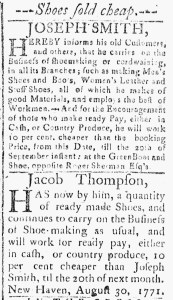
Shoes sold cheap.”

Joseph Smith and Jacob Thompson competed for customers.  Both placed advertisements in the September 6, 1771, edition of the Connecticut Journal to promote the shoes they made and sold in New Haven.  Smith’s notice appeared first, informing prospective customers that “he carries on the Business of shoemaking or cordwaining, in all its Branches” at his shop located at “the Green Boot and Shoe.”  He used “good Materials” and hired “the best of Workmen.”  In case that was not enough to attract the attention of local consumers, Smith also described a limited-time offer for those ready to pay (or barter for “Country Produce”) immediately rather than purchase their shoes and boots on credit.  Until September 20, he would “work 10 per cent. cheaper than the booking price.”  Customers could take advantage of this bargain, but only if they acted quickly.

Thompson’s advertisement ran immediately below Smith’s notice.  He declared that he “continues to carry on the Business of Shoe-making as usual” and already had “a quantity of ready made Shoes” in stock.  Rather than allow Smith to get the upper hand by setting lower prices, Thompson made an offer of his own.  For customers prepared to pay (or, again, barter) rather than buy on credit, he sold his shoes “10 per cent cheaper than Joseph Smith.”  This offer also concluded on September 20.  Only on rare occasions did advertisers mention competitors by name in eighteenth-century America, making Thompson’s notice exceptional.  Merchants, shopkeepers, and artisans frequently proclaimed that they had the lowest prices in town (or sometimes the entire colony).  Some offered to match the prices of their competitors, but they usually did not seek to undercut other purveyors of goods and services as blatantly as Thompson attempted to do with Smith.

The publication history of these advertisements added another layer to the competition.  Smith first inserted his notice in the Connecticut Journal on August 23, giving prospective customers four weeks to respond to his offer.  The following week, Thompson placed his advertisement as a response, but the two notices appeared on different pages.  On September 6, the printers decided to place the two advertisements together and added a headline that trumpeted, “Shoes sold cheap.” Neither Smith nor Thompson had previously included that headline in their advertisements.  A line separated it from Smith’s advertisement, making clear that the headline was an addition rather than part of either notice.  Why did the printers intervene?  Were they having some fun with the competition between two local shoemakers?  Whatever their intention, the new headline enhanced the advertisements, calling greater attention to them and benefitting consumers with cash (or country produce) on hand to respond to the limited-time offer.