April 23

Who was the subject of advertisements in colonial American newspapers 250 years ago today?

Connecticut Journal (April 23, 1773).

“TO BE SOLD … A likely Negro Man … Enquire of the Printers.”

“TO BE SOLD, A Negro Boy … Enquire of the Printers.”

Timothy Green ran a busy printing office in the early 1770s.  In addition to publishing the New-London Gazette, he sold books, some that he printed but most of them imported.  In the April 23, 1773, edition of his newspaper, Green advertised one of his own imprints, informing readers that “A Faithful HISTORY OF REMARKABLE OCCURRENCES, IN THE Captivity and Deliverances OF Mr. JOHN WILLIAMS, Minister of the Gospel in DEEERFIELD” was “Just Published, and to be Sold.”  Green also did job printing, including broadsides, handbills, and blanks (or forms).  Similarly, Thomas Green and Samuel Green oversaw a bustling printing office where they published the Connecticut Journal and New-Haven Post-Boy.  In the spring of 1773, they distributed subscription proposals for a new edition of “A Discourse on Justification by Faith alone. BY THE REVEREND JONATHAN EDWARDS.”  Those proposals also appeared in the April 23 edition of the New-London Gazette, part of a network of printers and others who cooperated in collecting the names of subscribers who reserved copies.

New-London Gazette (April 23, 1773).

Among their many other responsibilities, all three printers also served as slave brokers.  The same day that they promoted important historical and theological works, they also advised readers to “Enquire of the Printers” to learn more about enslaved people advertised for sale in their newspapers.  In the Connecticut Journal, a brief advertisement announced, “TO BE SOLD, (for no Fault, but for want of Employ,) A likely Negro Man, about 26 Years old, fit for Town or Country. Enquire of the Printers.”  An even shorter, but equally insidious, advertisement in the New-London Gazette stated, “TO BE SOLD, A Negro Boy, about 13 Years old, lately brought into the Country.  Enquire of the Printer.”  In both cases, the advertisers declined to identify themselves, instead instructing interested parties to contact the printers for more information.  In turn, the printers facilitated the sales of enslaved people twice over and generated revenue from the advertisements in the process.  First, they disseminated the notices, undertaking the labor required to print and distribute the advertisements and the rest of the newspapers.  Then, they actively participated in the sale of the “likely Negro Man” and the “Negro Boy, about 13 Years old,” responding to messages they received in the printing office and colonizers who visited to learn more.  As these advertisements demonstrate, printers in New England participated in perpetuating slavery during the era of the American Revolution, alongside their counterparts in Maryland, Virginia, South Carolina, and other colonies with greater numbers of enslaved people.  Such advertisements underwrote the production and dissemination of the news, while those that required readers to “Enquire of the Printers” further enmeshed printers in the slave trade as brokers for sales.

For an extended consideration of such advertisements, see Jordan E. Taylor, “Enquire of the Printer: Newspaper Advertising and the Moral Economy of the North American Slave Trade, 1704-1807,” Early American Studies 18, no. 3 (Summer 2020): 287-323, and the companion website.

April 2

What was advertised in a colonial American newspaper 250 years ago today?

Connecticut Journal (April 2, 1773).

“They shall be under the necessity of reducing it to its original size and price, unless the Subscribers for it, are more punctual in their payments.”

On April 17, 1772, Thomas Green and Samuel Green began printing the Connecticut Journal on larger sheets.  That allowed them to deliver more content to their subscribers, meeting the demand of “many of our Customers, and others, … desirous of having [the newspaper] enlarged.”  When they did so, they also noted that the previous edition “completed Four Years and an Half since the first Publication” of the newspaper, yet many of the subscribers “paid not a single Farthing” during that time and others were “indebted for Two or Three Year’s Papers.”  The printers called on anyone who owed for newspapers, advertisements, printed blanks, or anything else “to make speedy Payment.”

Almost a year later, the Greens made similar pleas.  On April 2, 1773, they declared, “The Printers are sorry, they can with truth inform the Public, That they have not for this year past, received from all the Customers for this Journal, so much money as they have expended for the blank paper, on which it has been printed.”  Colonial printers often lamented that subscribers and others did not pay their bills, but few did so in such stark terms.  The Greens noted that the “next week’s paper … completes one year since its enlargement,” a benefit to subscribers that accrued even greater expenses for the printers.  That benefit would not continue, the Greens warned, if subscribers did not settle accounts.  They proclaimed that “they shall be under the necessity of reducing it to its original size and price, unless the Subscribers for it, are more punctual in their payments.”  Other printers often threatened to take legal action against recalcitrant subscribers to force them to pay what they owed.  The Greens, on the other hand, threatened other consequences that would have an impact on all readers, not just those taken to court.

Whether it involved suing subscribers or publishing the names of those who refused to pay, printers usually did not follow through on their threats.  Whether or not the Greens’ notice prompted some subscribers to submit payment, the printers did not opt to revert to the original size of the newspaper.  Through experience, many readers likely believed that they could ignore such notices from the printers without suffering any consequences.  Printers wished to maintain robust circulations so they could sell advertising, a factor that played a role in their decisions about how to handle difficult subscribers.

March 23

What was advertised in a colonial American newspaper 250 years ago today?

Connecticut Courant (March 23, 1773).

“A motive to Gentlemen in Business to give orders for the Papers.”

As he prepared to launch a new newspaper, “RIVINGTON’s NEW-YORK GAZETTEER; OR THE CONNECTICUT, NEW-JERSEY, HUDSON’s-RIVER, AND QUEBEC WEEKLY ADVERTISER,” James Rivington continued to expand his advertising campaign in newspapers in New York, New England, and Pennsylvania.  He placed a notice in the Connecticut Courant on March 23, 1773, a full month after his first notices appeared in the Newport Mercury and the Pennsylvania Chronicle on February 22.  Except for the brief advertisement in the Newport Mercury, the much more extensive subscription proposals in the other newspapers all provided an overview about how Rivington envisioned that his newspaper would include content that distinguished it from others.  In many ways, he proposed a hybrid of a newspaper and a magazine, a publication that “will communicate the most important Events, Foreign and Domestic” as well as the “State of Learning” with the “best modern Essays,” a “Review of New Books,” and coverage of “new Inventions in Arts and Sciences, Mechanics and Manufactories.”

For readers of the Connecticut Journal and New-Haven Post-Boy, Rivington also attempted to incite interest through noting that “the Merchants and Traders of New-York, have universally patronized this Design, and their Advertisements will constantly appear in the Gazetteer.”  Given New Haven’s proximity to New York, Rivington apparently believed that consumers and retailers there would find such advertisements by merchants and shopkeepers in the bustling port as interesting and as useful as the rest of the content.  He made a similar pitch to residents of Hartford in his notice in the Connecticut Courant.  Following the paragraph describing the news and essays he planned to include in the newspaper, the printer expressed his hope that the “general support and promise of Mr. Rivington’s Friends, to Advertise in his Gazetteer … may be a motive to Gentlemen in Business to give orders for the Papers, which will be very regularly sent to the Subscribers.”  Rivington envisioned that advertising, in addition to coverage of “the Mercantile Interest in America, Departures and Prices Current, at Home and Abroad,” would facilitate commerce between New York and smaller towns in neighboring Connecticut.  He suggested to prospective subscribers in Hartford and New Haven that they consider advertisements placed by “Merchants and Traders” in New York as valuable sources of information, as newsworthy and practical in their own right as reports about current events.

February 26

What was advertised in a colonial American newspaper 250 years ago today?

Connecticut Journal (February 26, 1773).

“Their Advertisements will constantly appear in the Gazetteer.”

Four days after James Rivington first published advertisements promoting a new newspaper, Rivington’s New-York Gazetteer; or the Connecticut, New-Jersey, Hudson’s-River, and Quebec Weekly Advertiser, a new notice appeared in yet another newspaper.  The bookseller, printer, and stationer commenced advertising in the Newport Mercury and the Pennsylvania Chronicle on February 22, 1773.  Two days later, he inserted advertisements in the Pennsylvania Gazette and the Pennsylvania Journal.  His next notice ran in the Connecticut Journal and New-Haven Post-Boy on February 26.

That advertisement replicated, for the most part, the notices that ran in the Philadelphia newspapers.  Rivington included lengthy copy explaining how his newspaper differed “in its Plan from most others now extant,” describing how the “State of Learning shall be constantly reported” in addition to “the most important Events, Foreign and Domestic, the Mercantile Interest in Arrivals, Departures and Prices Current, at Home and Abroad.”  He also included a list of three local agents who accepted subscriptions in New Haven.  As he had in most other notices, Rivington stated that the “first Number shall make its Appearance when the Season will permit the several Post-Riders to perform their Stages regularly.”  The printer wanted subscribers to know when they could expect to receive the first issue.

Rivington added one short paragraph to his advertisement in the Connecticut Journal that did not appear in any of the other newspapers.  “The Gentlemen, the Merchants and Traders of New-York,” he asserted, “have universally patronized this Design, and their Advertisements will constantly appear in the Gazetteer.”  That reiterated what he said elsewhere in the advertisement about receiving “Encouragement from the first Personages in this Country” to publish the newspaper, but it also added a detail about the advertisements the newspaper would carry.  Rivington expected that readers in New Haven and nearby towns would be interested in advertisements for consumer goods as well as legal notices concerning New York, more interested than readers in Newport and Philadelphia.  That made sense since New Haven was much more within the commercial orbit of New York than the other two towns where he previously promoted his newspaper.  After all, Newport and Philadelphia were both thriving ports.  Residents of New Haven, on the other hand, had closer connections to New York, especially given the proximity.  Advertisements relevant to New York and nearby towns may not have been of much interest to most prospective subscribers in Newport and Philadelphia, but Rivington considered them a selling point when marketing his newspaper to readers in New Haven.

January 22

What was advertised in a colonial American newspaper 250 years ago today?

Connecticut Journal (January 22, 1773).

“By Reason of an ill State of Health, and other Misfortunes, he has been for some Time unable to attend his Business.”

Joseph Hopkins, a goldsmith and jeweler in Waterbury, took to the pages of the Connecticut Journal and New-Haven Post-Boy to raise interest in his business in January 1773. He pledged that he “will supply those who may want any Articles in either the Goldsmith or Jewelry Way, on the most reasonable Terms.”  Such appeals, however, were not the primary focus of his advertisement.

Instead, Hopkins sought to generate sympathy among prospective customers.  He reported that he reopened his shop after having been closed, stating that “by Reason of an ill State of Health, and other Misfortunes, he has been for some Time unable to attend his Business.”  The goldsmith did not go into detail about any of those “Misfortunes,” though some readers may have already been familiar with his situation.  He did declare that he “has of late, in some good Measure recovered his Health” and was ready to serve clients once again.

Hopkins offered other news to entice readers into his shop.  He announced that he “engaged an approved Workman,” presumably someone with training and experience as either a goldsmith or jeweler, to provide assistance.  He likely hoped that employing an associate would help alleviate any concerns about what kinds of service customers would experience now that his shop opened again.  Yet Hopkins did not want the public to have the mistaken impression that he merely entrusted orders to his new assistance.  He asserted that he gave “constant Attendance himself.”

In his efforts to attract customers to his shop, Hopkins balanced pleas for sympathy with assurances of competence.  He hoped that recovering from poor health and other unspecified “Misfortunes” would prompt prospective customers to give him their business, but he also realized that sympathy alone might not win them over.  Accordingly, he maintained that both he and his new assistant were qualified to produce “any Articles in either the Goldsmith or Jewelry Way” for customers who gave his shop a chance.

January 8

What was advertised in a colonial American newspaper 250 years ago today?

Connecticut Journal (January 8, 1773).

“Whose motive is to settle here if health permit[s], and the business answers.”

When Thomas Hilldrup arrived in Hartford in the fall of 1772, he commenced an advertising campaign to advise prospective customers that he repaired watches “in a perfect and durable manner, at an easy expence.”  Throughout late September and into October, November, and December, he consistently ran his advertisement in the Connecticut Courant, alerting readers that he planned “to settle here if health permit[s], and the business answers.”  That being the case, he invited the public “to make a trial of his abilities.”  In addition to repairing watches, Hilldrup also sold watches and accessories and provided ancillary services, including consultations with “those who are about to buy, sell or exchange.”

Hilldrup continued placing his advertisement in the Connecticut Courant in the new year.  He also decided to expand his advertising campaign to another newspaper, the Connecticut Journal and New-Haven Post-Boy.  Doing so extended the reach of his advertising and gave him access to a new market.  Why did the watchmaker decide to advertise in another publication?  Did he believe that the notice in the Connecticut Courant had been sufficiently successful to merit advertising in a newspaper in another town?  Among colonizers who perused multiple newspapers as they circulated far and wide in Connecticut and beyond, that certainly likely enhanced Hilldrup’s visibility and name recognition.  That he continued to invest in advertisements in the Connecticut Courant also suggests that he considered the outcomes so far worth the expense.

On the other hand, those advertisements may not have been as successful as Hilldrup hoped.  Perhaps placing the same notice in the Connecticut Journal and attempting to capture a portion of an adjacent market was an attempt to generate enough business to make remaining in Hartford a viable option.  Whatever his reasons for choosing to run his advertisement in an additional newspaper in January 1773, Hilldrup eventually determined that he cultivated a large enough clientele to remain in Hartford.  He continued advertising watches and repairs in newspapers published in that town for nearly two decades.  In the coming months, the Adverts 250 Project will examine some of his subsequent newspaper notices.

December 4

What was advertised in a colonial American newspaper 250 years ago today?

Connecticut Journal (December 4, 1772).

“Whoever shall take up the said Mare and return her … shall have One Dollar Reward.”

William Hickcok’s advertisement about a bay mare “STRAYED or Stolen” from a local stable must have arrived in the printing office of the Connecticut Journal just before the December 4, 1772, edition went to press.  That would explain its unusual placement on the third page of that issue.  The notice ran across the bottom of the page, divided into three columns of four lines each.  A line ran above Hickcok’s advertisement, making clear where other content ended and his notice began.

Thomas Green and Samuel Green, the printers of the Connecticut Journal, or a compositor who worked in their printing office made room for the advertisement rather than forcing Hickcok to wait an entire week for the next issue.  Like other colonial American newspapers, a standard issue of the Connecticut Journal consisted of four pages created by printing two pages on each side of a broadside and then folding it in half.  Printers typically produced the front and final pages first, reserving the second and third pages for the most current news and advertising.  That seems to have been the case for the December 4 edition.  Advertisements that previously ran in the newspaper, including one dated November 13 and another dated November 16, appeared on the front page, along with news from London that continued on the second page.  The third page featured recent news from Boston and New York and shipping news from the customs house as well as some advertisements from previous issues and two new advertisements dated December 4 (in addition to Hickcok’s advertisement with that date).  Hickcok’s advertisement ran in what otherwise would have been the margin at the bottom of the page.

A week later, Hickcok’s notice ran once again, this time in a single column on the first page.  Whoever set the type anticipated a means of saving time and labor.  By setting the type in columns, even though the advertisement initially ran across the bottom of the entire page, the compositor eliminated the necessity of breaking down the type and setting it again for the next issue.  In this way, the printing office managed to accommodate Hickcok’s desire to run his advertisement as soon as possible while minimizing the amount of additional time and labor required to do so.

November 13

What was advertised in a colonial American newspaper 250 years ago today?

Connecticut Journal (November 13, 1772).

“Will alter any Fault (if observed within Twelve Months) gratis.”

Like many other artisans who migrated across the Atlantic, Edward Hart, a “WIG-MAKER,” described himself as “Lately from London” when he introduced himself to prospective customers in a newspaper advertisement.  Realizing that readers were unfamiliar with him and his work, he sought to use his origins to suggest a certain level of skill and, especially, knowledge of current fashions in the cosmopolitan center of the empire to convince clients in Wallingford and nearby towns to give him a chance.  In an advertisement in the November 13, 1772, edition of the Connecticut Journal, he declared that he made “Lady’s Hair Rolls … in the best Manner.”  He also boasted that his customers would “be served with all Sorts of Wigs, made in the present Taste.”

Hart did not confine his marketing efforts to those appeals.  He also offered free repair services for a year, pledging that he would “alter any Fault (if observed within Twelve Months) gratis.”  Knowing that he could not yet depend on his reputation to sell his wigs, Hart likely hoped that providing that warranty would persuade prospective customers that they had nothing to lose when they purchased his wares.  If they discovered any defects, the wigmaker pledged to correct them without charge.  Customer service extended beyond the initial purchase, aiding Hart in cultivating a clientele in a new location.

At a glance, Hart’s advertisement may look like little more than a dense block of text to modern readers, but it was not a mere announcement that he made and sold wigs.  Instead, he advanced several appeals intended to entice consumers to acquire their wigs from him rather than other sources.  He promoted his origins in London, the quality of his work, and his knowledge of the latest trends.  In case that was not enough, he also provided a warranty to reassure customers still hesitant after his other marketing appeals.  Rather than inserting an announcement in the newspaper, Hart devised a strategy for attracting customers to his new shop.

June 5

What was advertised in a colonial American newspaper 250 years ago today?

Connecticut Journal (June 5, 1772).

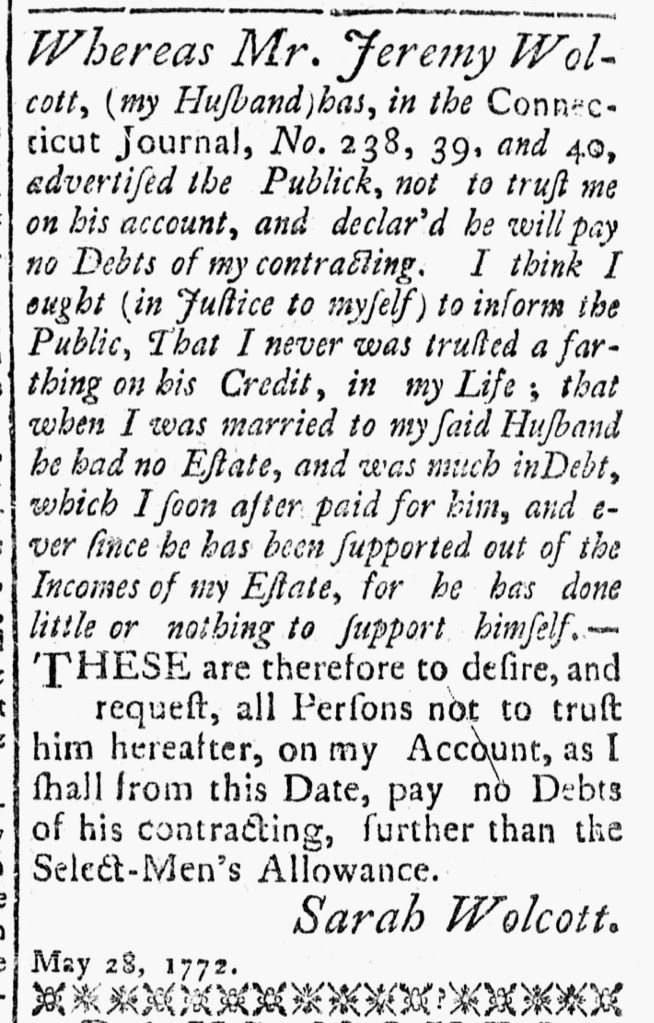
“I shall from this Date, pay no Debts of his contracting.”

Advertisements that ran in the Connecticut Journal and New-Haven Post-Boy in the spring of 1772 testified to marital discord in the Wolcott household.  In the May 8 edition, Jeremy Wolcott inserted a notice informing the public that “My wife SARAH, and MYSELF, being unhappy in the Marriage State !! which had subjected me to great anxiety; and for Reasons, I hereby forbid any Person trusting her on my Account, for I will not pay any Debts by her contracted, after this Date.”  It was one of dozens of similar advertisements placed by anxious patriarchs in newspapers published in New England that year.  Throughout the colonies, aggrieved husbands ran similar notices in their attempts to assert control over wives they claimed did not obey their commands.  Jeremy’s advertisement appeared in the next two issues as well.

When it concluded its run, something unusual happened.  Sarah inserted her own advertisement in response, a rare instance of a wife answering her husband’s charges in print.  Not surprisingly, Sarah told a very different story than the one rehearsed by Jeremy, one that likely humiliated him even more than placing his own advertisement that implicitly confessed his inability to exercise proper authority within his household.  In a notice that first appeared in the May 29 edition, Sarah referred to Jeremy’s notices “in the Connecticut Journal, No. 238, 39, and 40” that advised “the Publick, not to trust me on his account, and declar’d he will pay no Debts of my contracting.”  Given the actual state of affairs, according to Sarah, that advertisement misrepresented Jeremy’s record of providing for his wife.  “I think I ought (in Justice to myself),” she proclaimed, “inform the Public, That I never was trusted a farthing on his Credit, in my Life.” Furthermore, “when I was married to my said Husband, he had no Estate, and was much in Debt, which I soon after paid for him, and ever since he has been supported out of the Incomes of my Estate, for he has done little or nothing to support himself.”  In Sarah’s version, Jeremy had never fulfilled his responsibilities as husband and head of household.

She then turned the tables on him, issuing similar directions “not to trust him hereafter, on my Account, as I shall from this Date, pay no Debts of his contracting, further than the Select-Men’s Allowance.”  Sarah paid taxes legitimately levied by locally elected representatives, but she asserted that she did not want the resources she brought to the marriage used by Jeremy for any other purposes.  That must have resulted in further embarrassment for Jeremy, especially since the vast majority of women targeted in the sort of advertisement that he placed did not have the means to offer any sort of rebuttal in print.  Most of the time, husbands exercised exclusive access to the power of the press.  On occasions, however, women like Sarah Wolcott published forceful responses that may have caused their husbands to wish that they have never gotten the printing office involved at all.

April 17

What was advertised in a colonial American newspaper 250 years ago today?

Connecticut Journal (April 17, 1772).

“He continues to cut and dress Gentlemen and Ladies Hair in Taste, either antient or modern.”

Amos Morrisson described himself as a “Peruke-Maker and Dresser.”  He made wigs and styled hair for colonizers in and near New Haven in the early 1770s.  He placed an advertisement in the April 17, 1772, edition of the Connecticut Journal to inform current and prospective clients that he “lately removed from the Place where he formerly work’d, to a new Shop on the Church Land, next to Mr. Fairchild’s.”  That amounted to sufficient direction for patrons to find his new location.

Morrisson incorporated several marketing appeals into the remainder of his advertisement.  He addressed fashion and customer satisfaction simultaneously when he stated that he “continues to cut and dress Gentlemen and Ladies Hair in Taste, either antient or modern.”  In so doing, he hinted at debates about hairstyles that colonizers took seriously during the era of the American Revolution.  Men and women who adopted “modern” styles faced accusations that they indulged in luxury at the expense of good character.  Women wore high rolls, their hair and extensions elaborately arranged atop their heads.  Some men adopted a similar style, prompting critics to refer to them as “macaronis” as a critique of hairstyles, garments, and comportment associated with Italy.  Morrisson did not take a position in the debate.  Instead, he signaled that he was proficient in the “modern” style for those who wished to wear it, but he also served clients who preferred more conservative or “antient” styles.  Either way, his clients could depend on having their hair done “in Taste” at his shop.

In addition to styling hair, Morrisson “carried on Wigg-Making in all its Branches.”  He once again emphasized customer service, promising that “Gentlemen (both of Town and Country) … may depend upon being used in the best Manner.”  He constructed his wigs “of the best Materials” and set lower prices than prospective clients would find anywhere in the vicinity.  Morrisson declared that he sold his wigs “much cheaper … than has formerly been sold in Town.”  He also highlighted his experience and roots in the community, referencing clients “that have favoured him with their good Custom” in the past and inviting them to “continue the same.”

Morrisson’s advertisement was not particularly lengthy, but he managed to include a variety of appeals to incite demand for his services.  In so doing, he replicated aspects of advertisements placed by his counterparts in larger urban ports like New York and Philadelphia.  Fashion was not the province of the elite in those places.  Instead, purveyors of goods and services, including a “Peruke-Maker and Dresser” like Morrisson, served consumers throughout the colonies.