What was advertised in a revolutionary American newspaper 250 years ago today?
New-England Chronicle (May 25, 1775).
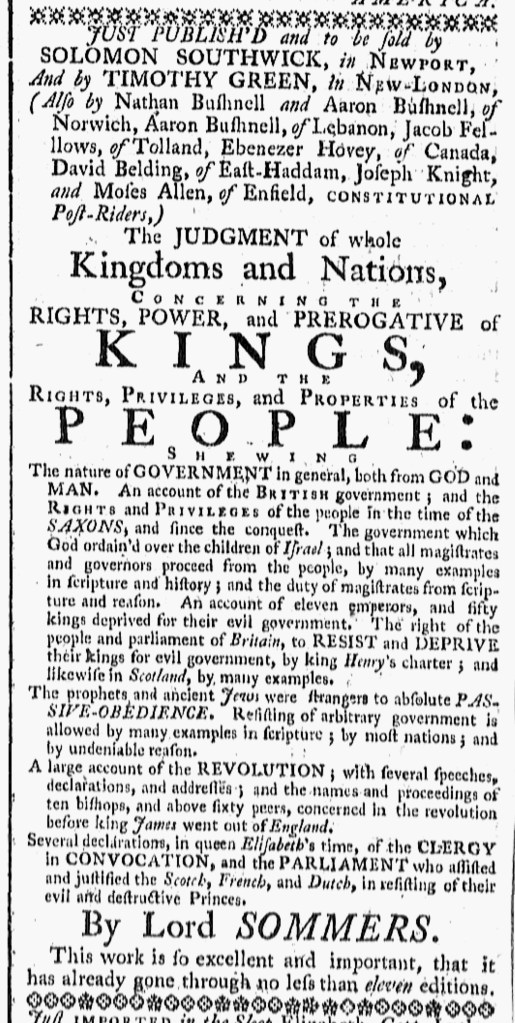
“CONSTITUTIONAL POST … to the CAMPS at ROXBURY and CAMBRIDGE.”
During the siege of Boston that followed the battles at Lexington and Concord in the spring of 1775, Nathan Bushnell, Jr., advertised his services as a post rider along a route that connected Boston and New London. He placed advertisements simultaneously in the New-England Chronicle, published in Cambridge, and the Connecticut Gazette, published in New London. With militia unites from throughout New England converging on Boston, the demand for his services significantly increased.
Bushnell asserted that he was affiliated with the Constitutional Post, a network operated independently of the British postal system. William Goddard, formerly the printer of the Maryland Journal and the Pennsylvania Chronicle, founded the Constitutional Post in 1774. As an alternative to the British postal system, it allowed colonizers to send letters and to disseminate newspapers without interference from British officials. The first route connected Philadelphia and Baltimore, but the Constitutional Post extended to New England by the time the Revolutionary War began. Bushnell mentioned several associates, each with established routes between towns in Connecticut, Massachusetts, and Rhode Island.
Although Bushnell accepted correspondence of all sorts, he emphasized letters sent to soldiers away from home now that the imperial crisis had taken a new turn. He rode to “the CAMPS at ROXBURY and CAMBRIDGE, and as often as practicable, to BOSTON.” On the return trip, he carried “Letters from the Camps.” In a nota bene, he advised that “when Letters are directed to private Soldiers, the Regiment they belong to may be mentioned” to aid in efficient delivery.
This was such an important service, especially considering the events unfolding in New England, that Bushnell did not expect those who sent letters to fund it by themselves. Instead, he placed subscription papers “in the Hands of Gentlemen in several Towns … to encourage this expensive Undertaking — and the smallest Favours will be acknowledged.” The post rider anticipated that subscribers would make pledges to fund the enterprise, recognizing its value and affirming their support of an alternative to the Parliamentary Post. As the Smithsonian Institution’s National Postal Museum notes, the Constitutional Post “proved quite popular as a way of rejecting British rule.”
American printers in three cities had recently produced American editions of The Judgment of Whole Kingdoms and Nations. In 1773, John Dunlap printed it in Philadelphia and Isaiah Thomas printed it for John Langdon, a bookseller, in Boston. The advertisement promoted a 1774 edition “JUST PUBLISH’D and to be sold by SOLOMON SOUTHWICH, in NEWPORT.” Timothy Green, the printer of the Connecticut Gazette, also sold the book in New London. In addition, readers could acquire it from “CONSTITUTIONAL Post-Riders” who operated out of Norwich, Lebanon, Tolland, East Haddam, and Enfield. The National Postal Museum explains that the Constitutional Post was “an alternative to the British run Parliamentary Post.” William Goddard originally established a “new constitutional Post … between [Philadelphia] and Baltimore” and quickly expanded it. According to the National Postal Museum, Goddard considered the Parliamentary Post “unacceptable because it was not private – postmasters were allowed to intercept and open letters – and because he saw it as another form of taxation without the colonists’ consent.” Many shared this view; the number of riders in Connecticut affiliated with the Constitutional Post just a few months after its founding demonstrates that was the case. In July 1775, the Second Continental Congress assumed responsibility for the Constitutional Post, appointing Benjamin Franklin as postmaster. Goddard desired the position, but he settled for Riding Surveyor of the Post. By then, the Constitutional Post had demonstrated its capacity for delivering letters, newspapers, and books. In the summer of 1774, for instance, the Constitutional Post served as a distribution network for The Judgment of Whole Kingdoms and Nations, consistent with Goddard’s vision for maintaining English rights and liberties in the colonies.
What was advertised in a colonial American newspaper 250 years ago today?
Pennsylvania Chronicle (February 8, 1774).
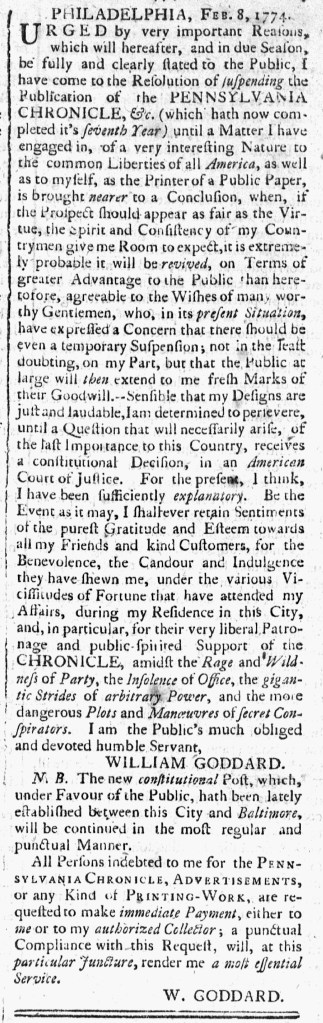
“I have come to the Resolution of suspending the Publication of the PENNSYLVANIA CHRONICLE.”
William Goddard published the final issue of the Pennsylvania Chronicle on February 8, 1774. That newspaper commenced publication seven years earlier, on January 26, 1767. The Adverts 250 Project tracked Goddard’s efforts to launch the Pennsylvania Chronicle, advertisements that ran in the first issues, and many more advertisements throughout its run. Aside from news items, the final issue featured only three paid notices along with a letter from Goddard.
The printer explained that “very important Reasons” led him to “the Resolution of suspending the Publication of the PENNSYLVANIA CHRONICLE.” He suggested that those reasons “will hereafter, and in due Season, be fully and clearly stated to the Public.” He further hinted that he planned to revive the newspaper when “a Matter I have been engaged in, of a very interesting Nature to the common Liberties of all America, as well as to myself, as the Printer of a Public Paper, is brought nearer to a Conclusion.” Goddard made other cryptic references, pronouncing that he had been “sufficiently explanatory.” Still, he could not resist thanking his patrons for their support “amidst the Rage and Wildness of Party, the Insolence of Office, the gigantic Strides of arbitrary Power, and the more dangerous Plots and Manoeuvres of secret Conspirators.”
Many readers, especially those who had resided in Philadelphia for any amount of time, may have remembered that Goddard initially published the Pennsylvania Chronicle in partnership with Joseph Galloway and Thomas Wharton. In his History of Printing in America (1810), Isaiah Thomas notes that the newspaper “was established under their influence and subject to their control, until 1770.” At that time, Galloway and Wharton sold their share to Benjamin Towne, but Goddard soon “separated from his partners.” After that, a “portion of [the newspaper] was … for a long time, devoted by Goddard to the management of a literary warfare which took place between him and his late partners.”[1] In 1770, Goddard had also published a pamphlet, The Partnership, that put the enmity between himself and his former partners on full view for the public. The lengthy subtitle testified to how much the relationship had deteriorated: “The history of the rise and progress of the Pennsylvania Chronicle, &c.: Wherein the conduct of Joseph Galloway, Esq; speaker of the Honourable House of Representatives of the province of Pennsylvania; Mr. Thomas Wharton, Sen. and their man Benjamin Towne, my late partners, with my own, is properly delineated, and their calumnies against me fully refuted.” In turn, Galloway and Wharton had Goddard imprisoned for debt for the following year.
As the Pennsylvania Chronicle declined, Goddard founded the Maryland Journal, the first newspaper published in Baltimore, in August 1773. Goddard relocated to Baltimore after “suspending” the Pennsylvania Chronicle. In a nota bene at the end of his letter in the final issue, he declared that the “new constitutional Post, which … hath been lately established between this City and Baltimore, will be continued in the most regular and punctual Manner.” That was the first route in what became a much more expansive network of post offices operated independently of the British postal system, allowing colonizers to send letters and disseminate newspapers without interference from British officials.
As a last matter of housekeeping, Goddard called on “All Persons indebted to me for the PENNSYLVANIA CHRONICLE, ADVERTISEMENTS, or any Kind of PRINTING-WORK … to make immediate Payment.” Printers and other entrepreneurs regularly placed notices with the intention of settling accounts. Goddard’s notice merits special attention because he indicates that some customers owed for advertisements. Many historians of the early American press assert that printers extended generous credit to subscribers while generating revenue by demanding that advertisers paid in advance. Some printers, however, periodically ran notices calling on advertisers to make payment. Goddard and some of his fellow printers apparently did not enforce a hard-and-fast policy when it came to paying for advertisement before publication.
Although the Pennsylvania Chronicle ceased publication in 1774, Goddard continued publishing the Maryland Journal and became involved in other projects, including the Constitutional Post, that became the subjects of news articles, editorials, and advertisements. Undoubtedly, William Goddard will make additional appearances as the Adverts 250 Project continues examining advertising, print culture, and politics during the era of the American Revolution.
**********
[1] Isaiah Thomas, The History of Printing in America: With a Biography of Printers and an Account of Newspapers (1810; New York: Weathervane Books, 1970), 438.