
What was advertised in a revolutionary American newspaper 250 years ago today?
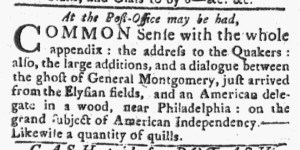
“At the Post-Office may be had, COMMON Sense … on the grand subject of American Independency.”
Thomas Paine’s Common Sense was advertised widely in Pennsylvania, New York, and New England in the winter and spring of 1776, especially as printers in many cities and towns produced local editions. As summer approached, the number and frequency of advertisements for the popular political pamphlet decreased. By that time the market had been saturated. Readers had many opportunities to purchase Common Sense as the arguments presented in the pamphlet helped to convince colonizers to declare independence rather than seek redress of grievances within the British imperial system. By the time the Continental Congress declared independence on July 2 and approved the Declaration of Independence on July 4, advertisements for Common Sense mostly disappeared. Only the Freeman’s Journal, published in Portsmouth, New Hampshire, carried advertisements for Common Sense in July 1776.
After several months, however, an advertisement for Common Sense suddenly appeared in the Independent Chronicle, published in Boston, on October 17. It was the first time that newspaper carried an advertisement for Paine’s pamphlet, though the Boston-Gazette (printed in nearby Watertown) and the New-England Chronicle previously featured advertisements for Common Sense. Local printers produced two editions to supplement those that came off presses in other towns in New England and beyond. The new advertisement in the Independent Chronicle did not indicate who sold Common Sense. It simply announced, “At the Post-Office may be had, COMMON Sense with the whole appendix,” and several other items that Robert Bell, the publisher of the first edition, added to subsequent unauthorized editions. Bell published, for instance, “a dialogue between the ghost of General Montgomery, just arrived from Elysian fields, and an American delegate in a wood, near Philadelphia,” separately and with Common Sense along with “large additions.” Other printers added some of those items to local editions of the pamphlet, though Richard Gimbel’s bibliography of Common Sense does not indicate that local editions printed outside Philadelphia included all the material listed in the advertisement in the Independent Chronicle.[1] Perhaps some copies of one of Bell’s Philadelphia editions made it to the post office in Boston in the fall of 1776. Even readers who had previously perused Common Sense could have been interested in reading additional content associated with the pamphlet, justifying a newspaper advertisement giving renewed attention to this pamphlet “on the grand subject of American Independency.”
**********
[1] Richard Gimbel, Thomas Paine: A Bibliographical Check List of Common Sense with an Account of Its Publication (New Haven: Yale University Press, 1956), 78-79, 88-91.