August 28

What was advertised in a colonial American newspaper 250 years ago today?

Providence Gazette (August 28, 1773).

“A large Quantity of Ordure, supposed to have been taken from some Privy-House Vault.”

Samuel Young and William Tyler were not happy.  Who could blame them?  Who, that is, except for “some evil-minded Person or Persons” who had befouled their well?  Upon making an unpleasant discovery, Tyler and Young took to the pages of the Providence Gazette with an advertisement describing how the perpetrators had, “in a most filthy Manner, bedaub[ed] the Stones, Curb and Bucket, of Tyler and Young’s Well, with a large Quantity of Ordure.”  The victims of such a disgusting act of vandalism suspected that the miscreants had taken the excrement “from some Privy-House Vault.”  What explained such an assault?  Tyler and Young attributed it to “the Instigation of the Devil.”

The aggrieved colonizers did not exclude any possible suspects, describing the “Party or Parties concerned” as “he, she, or they.”  Whoever was responsible for carrying out the devil’s work, Tyler and Young wanted them held accountable.  They had not published their advertisement to advise the public about what had happened to their well but rather to enlist the aid of anyone with information that would allow them to identify or “discover” the perpetrators that they “may be brought to Justice.”  Tyler and Young offered a reward, conditional on the conviction of the “Offender or Offenders.”

As was often the case, an advertisement supplied readers with a combination of local news and gossip … and perhaps even a bit of amusement, depending on their predilections for scatological humor or how they felt about Tyler and Young.  Other advertisements in the August 28, 1773, edition of the Providence Gazette also delivered news, gossip, or a combination of the two.  Uzal Green, for instance, advised others not to extend credit to his wife, Martha, because he would not pay any of her bills since she “hath eloped from me, and refuses to return to my Bed and Board.”  Another advertisement recounted how “the Shop of Robert Leonard, Taylor, was feloniously broke open … and robbed.”  That notice offered rewards for recovering the stolen goods and capturing the thief.  In an estate notice, the executors of Dr. Samuel Carew encouraged “all those who have unsettled Accounts” to “pay their respective Debts” or face legal action.  In yet another advertisement, Nehemiah Underwood promised a reward for the capture and return of his sixteen-year-old runaway apprentice, Daniel Sanders.  None of those advertisements may have been as remarkable as Tyler and Young’s effort to identify the villain or villains who defiled their well, but each of them did incorporate local news that did not appear elsewhere in the newspaper.
October 24

What was advertised in a colonial American newspaper 250 years ago today?

Oct 24 - 10:24:1768 Boston Evening-Post
Boston Evening-Post (October 24, 1768).

“IN seventeen hundred and sixty-eight, / Of a runaway servant I’ll relate.”

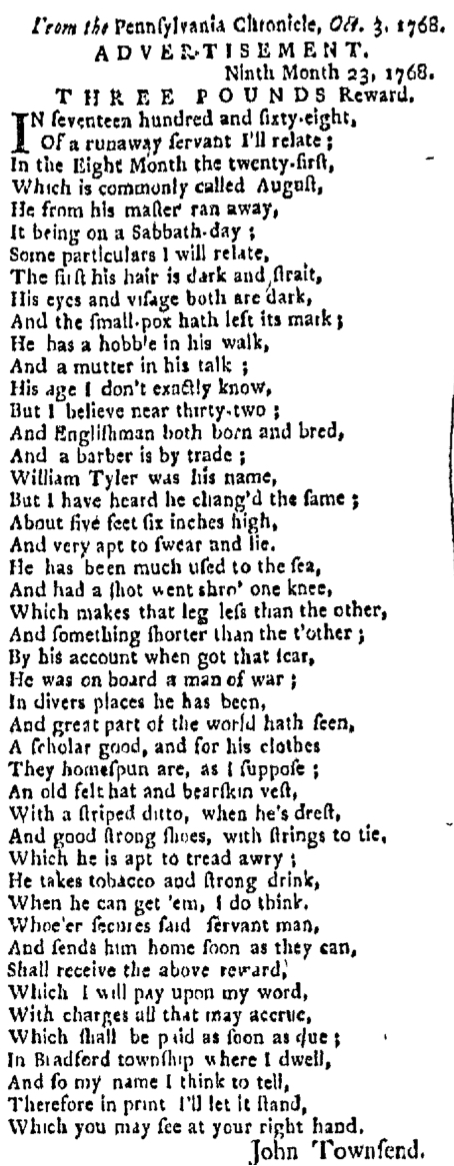
A curious advertisement appeared in the October 24, 1768, edition of the Boston Evening-Post. It offered “THREE POUNDS Reward” for the capture and return of William Tyler, an indentured servant who ran away from John Townsend. Yet Townsend had not paid to have this advertisement inserted in the Boston Evening-Post. Instead, the printers, Thomas Fleet and John Fleet, had made an editorial decision to reprint the advertisement as a novelty to entertain their subscribers and other readers. A brief note indicated that they reprinted it from the October 3 issue of the Pennsylvania Chronicle.

The subject of the advertisement was hardly unusual, but the method of delivering the content certainly deviated from that of most other advertisements in colonial newspapers. Rather than writing a brief narrative about the runaway servant, Townsend composed a poem. In nearly two dozen rhyming couplets, he delivered the usual information about Tyler’s age, appearance, occupation, clothing, personality, and other distinguishing characteristics. “He has a hobble in his walk, / And a mutter in his talk,” Townsend reported. Furthermore, the runaway “takes tobacco and strong drink, / When he can get ‘em, I do think.” Many of the rhymes were rather labored, but Townsend managed to insert all the pertinent information. The Fleets apparently considered his efforts worthy of sharing with a larger audience, though likely more for amusement than edification.

Colonial newspapers regularly included items reprinted from other newspapers, some published in the colonies and others in England and other parts of Europe. Modern concepts of plagiarism did not apply; networks of printers exchanged their publications and then borrowed extensively, usually word-for-word, from other newspapers when they compiled news and editorial content for inclusion in their own newspapers. However, they did not usually reprint advertisements. After all, advertisements meant revenues. In most instances printers expected others to pay to have their advertisements inserted in newspapers, but on occasion certain advertisements possessed such entertainment value that printers selected them without concern for collecting fees. In June 1768, for example, the printers of both the New-York Journal and the Providence Gazette inserted an advertisement for a show featuring “HORSEMANSHIP, performed on one, two, and three horses, by Mr. WOLTON.” That advertisement first ran in the London Gazetteer in March 31. Both newspapers acknowledged its origins. The New-York Journal explained that it “is inserted as a Curiosity.”

Advertisements had the capacity to entertain as well to inform or to shape consumer demand. That the Fleets reprinted Townsend’s advertisement that relayed the story of a runaway servant in a poem demonstrates that they perused more than just the news in other publications when identifying content to appropriate and share with their own readers.