May 21

What was advertised in a colonial American newspaper 250 years ago today?
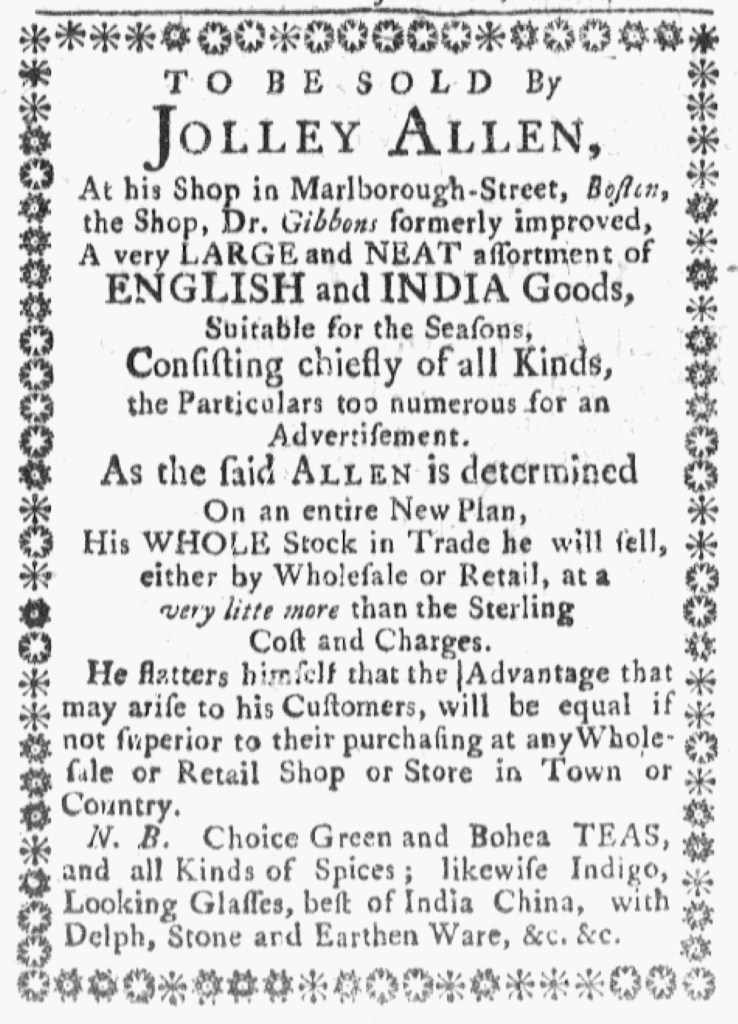
Massachusetts Gazette and Boston Weekly News-Letter (May 21, 1772).

“He will sell … at a very little more than the Sterling Cost.”

In an advertisement in the May 21, 1772, edition of the Massachusetts Gazette and Boston Weekly News-Letter, Jolley Allen announced that he adopted “an entire New Plan” for selling the “very LARGE and NEAT Assortment of English and India GOODS” at his shop on Marlborough Street.  He declared that he would sell “HIS WHOLE Stock in Trade…, either by Wholesale or Retail, at a very little more than the Sterling Cost and Charges.”  In other words, he did not mark up the prices significantly over what he paid to his suppliers.  Allen expressed his confidence that “the Advantages that may arise to his Customers, will be equal if not superior to their purchasing at any Wholesale or Retail Shop or Store in Town or Country.”  He was determined to beat his competitors.

The graphic design for Allen’s advertisement may have helped attract attention to his “new Plan” for selling imported goods.  A border comprised of ornamental type enclosed the notice, setting it apart from the news and other advertisements on the page.  That brought this advertisement in line with some that he previously published.  He did not always incorporate a distinctive design element, but he more regularly did so than most advertisers.  Sometimes ornamental type flanked his name in the headline of his advertisement.  On other occasions he opted for borders.  Both strategies appeared in more than one newspaper, suggesting that Allen gave specific instructions to the compositors rather than leaving the format to their discretion.

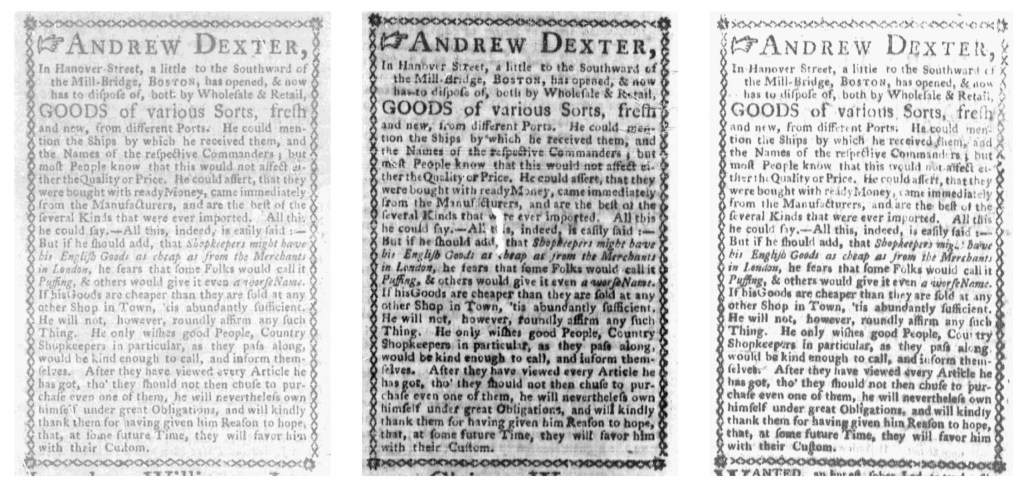
Curiously, Allen’s advertisement was not the only one in the May 21 edition of the Massachusetts Gazette and Boston Weekly News-Letter to feature a border.  Andrew Dexter’s advertisement had the same format, though a different printing ornament formed the border.  This was not a standard format in that newspaper or any other newspaper published in Boston at the time.  So how did two advertisements in the same issue happen to include borders?  Did one advertiser overhear the other giving directions to the compositor when dropping off copy to the printing office?  Or was it a coincidence?  Whatever the explanation, the borders made their advertisements distinctive enough compared to the rest that readers likely took note of both of them.

April 27

What was advertised in a colonial American newspaper 250 years ago today?

Boston Evening-Post (April 27, 1772).

“ENGLISH GOODS of all Sorts, At Francis Green’s Store, (Cheap).”

Purveyors of goods and services used a variety of design strategies in their efforts to get prospective customers to take note of their advertisements in the April 27, 1772, edition of the Boston Evening-Post.  Some emphasized consumer choice by publishing advertisements that took up significant space by listing the merchandise they sold.  Richard Jennys did so in a notice that was about as long as it was wide.  He listed a couple of dozen items in a dense paragraph of text.  Joseph Peirce also opted for a dense paragraph that enumerated his inventory, but his advertisement extended half a column.  John Frazier and Margaret Philips both inserted paragraphs of moderate length, occupying more space on the page than Jennys but less than Peirce.  The amount of text was part of the message.

Other merchants and shopkeepers who resorted to lists attempted to use graphic design to their benefit in a different way.  They divided their advertisements into columns, listing only one or two items per line in order to make them easier for prospective customers to navigate.  Since advertisers paid by the amount of space rather than the number of words, that meant they paid more to advertiser fewer items than their competitors who opted for paragraphs rather than columns, but they apparently considered it worth the investment.  John Cunningham, Ward Nicholas Boylston, and Herman and Andrew Brimmer all ran advertisements that included dozens of items arranged in advertisements divided into two columns.

Other advertisers emphasized the visual aspects of their notices to an even greater degree.  A woodcut depicting a mortar and pestle adorned Oliver Smith’s advertisement for “Drugs & Medicines” at his shop “At the GOLDEN MORTAR.”  Duncan Ingraham, Jr. relied on typography rather than images, arranging a short list of goods to form a diamond.  Joseph Barrell also created white space to draw attention by listing a few items on each line and centering them.  His lines of varying lengths did not look nearly as crowded as the paragraphs in other advertisements.  Francis Green limited his advertisement to ten words (“ENGLISH GOODS of all Sorts, At Francis Green’s Store, (Cheap)”), but deployed decorative type to form a border.  That made his notice particularly distinctive since no other advertiser adopted that strategy.  It also helped that his advertisement appeared in the middle of the page.  The border likely drew readers’ eyes away from the advertisements on the outer edges in favor of the middle, at least when first perusing the page.

Graphic design in early American newspapers may appear unsophisticated by modern standards, but that does not mean that colonizers did not attempt to leverage graphic design in marketing goods and services.  Within a single issue of the Boston Evening-Post, advertisers made a variety of choices about the visual aspects of their notices, some of them rather innovative for the period.

April 4

What was advertised in a colonial American newspaper 250 years ago today?

Apr 4 - 4:4:1770 South-Carolina Gazette Supplement
Supplement to the South-Carolina Gazette (April 4, 1770).

SHIP-CHANDLERY.”

William Price deployed typography to attract attention to his advertisement for “BEST Bridport CANVAS, and sundry other Articles” in the April 4, 1770, supplement to the South-Carolina Gazette.  A decorative border surrounded the headline for his advertisement, “SHIP-CHANDLERY,” making it one of only two advertisements in the supplement with that additional flourish.  The other announced “SALES by the Provost-Marshal,” an advertisement that was also a regular feature in the South-Carolina Gazette.  Its headline often appeared within a decorative border, which may have given Price the idea for enhancing his advertisement.  All of this suggests that Price made arrangements with the printer or compositor to spruce up his notice, though most advertisers merely supplied copy and left format to those who labored in the printing office.  Price may not have specified which printing ornaments should enclose his headline, but he most likely did offer some direction about the visual composition of his advertisement.

The border provided visual variation in a newspaper that consisted almost entirely of text.  Some advertisements included different fonts and font sizes to draw attention, as did Price’s notice, but consistencies among them suggest that compositors made such decisions, not advertisers.  Very few visual images appeared in eighteenth-century newspapers.  In the April 4 supplement, woodcuts accompanied only five of the thirty-five advertisements.  Three of those were real estate notices, two with woodcuts depicting a house and one with a woodcut showing a tree and a field.  An advertisement about a stray horse had a woodcut of a horse.  An advertisement describing an enslaved man who escaped featured a crude woodcut of a dark-skinned person that conflated characteristics associated with Africans and indigenous Americans.  All of those woodcuts belonged to the printer, as did woodcuts of ships at sea.  Price could have chosen one of those, but they were usually associated with vessels seeking freight and passengers, not ship chandlers looking to outfit ships before they departed from port.  He could have commissioned a woodcut depicting his merchandise, but he may not have considered that worth the expense, especially if he did not suspect that canvas or cordage would translate well via that medium.

The border that enclosed “SALES by the Provost-Marshal” and decorative type often used to separate “New Advertisements,” “Advertisements,” and, sometimes, news items from the content that appeared immediately above it suggested an alternative to prospective advertisers who wanted some sort of visual component in their notices.  As they perused the pages of the South-Carolina Gazette they encountered various means of creating a distinctive format for their advertisements even when they consisted almost entirely of text.  The pages of eighteenth-century newspapers may look fairly uniform to twenty-first-century eyes, but contemporary readers surely noticed the many variations in type, especially in the advertisements.