October 22

What was advertised in a colonial American newspaper 250 years ago today?

Massachusetts Gazette and Boston Weekly News-Letter (October 22, 1772).

“CHEAP GOODS.”

In the fall of 1772, David Sears joined other advertisers in Boston who used borders composed of decorative type to enclose either the headline or their entire newspaper notice.  Sears proclaimed that he sold “CHEAP GOODS,” that headline surrounded by printing ornaments that called attention to his advertisement and prompted subscribers of the Massachusetts Gazette and Boston Weekly News-Letter to read more about the “fresh Assortment of Gall and Winter Goods” he recently imported from London.  His advertisement in the October 26 edition of the Boston-Gazette included the same headline within a decorative border.  In with instances, the headline and its border directed prospective customers to his bold claim that he set “such Prices that is not possible to be conceived of without Trial.”  In other words, it would take some effort to even imagine such low prices.

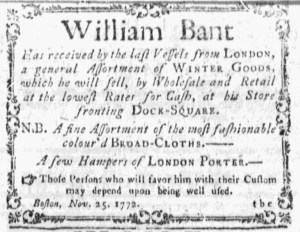
Sears certainly was not the first advertiser in Boston to incorporate a border into a newspaper advertisement.  As early as 1766, Jolley Allen made borders around his entire notices a signature element of his marketing.  Occasionally other advertisers deployed borders as well, but greater numbers did so simultaneously in the summer and fall of 1772.  Jolley Allen and Andrew Dexter both published advertisements with borders in May, though the Massachusetts Spy seemingly rejected any requests or instructions to include a border around Allen’s advertisement.  Martin Bicker ran an advertisement surrounded by a border in August.  Jonathan Williams, Jr., also did so in September.  Other merchants and shopkeepers opted for borders around just the headlines.  The week before Sears ran his advertisement on October 22, William Jackson introduced his notice with a border around the headline, “Variety Store.”  A few days later, Herman Brimmer and Andrew Brimmer had a border enclosing “Variety of Goods” at the top of their advertisement in Supplement to the Boston-Gazette.  The printers of that newspaper had recently used a decorative border for their own notice calling on subscribers with overdue accounts “to make immediate Payment.”

These examples may seem scattered, but considering how infrequently borders adorned advertisements in Boston’s newspapers (or newspapers printed elsewhere in the colonies) they suggest a trend among advertisers in 1772.  Sears may have observed that others included borders in their notices and determined that he desired the same for his advertisement, combining a pithy headline and graphic design to demand the attention of readers.

October 12

What was advertised in a colonial American newspaper 250 years ago today?

Boston-Gazette (October 12, 1772).

New Advertisements.”

Benjamin Edes and John Gill, printers of the Boston-Gazette, wanted to increase the chances that readers took notice of their call to settle accounts in the fall of 1772.  In the October 12 edition, they inserted an announcement that “ALL Persons indebted for this Paper, whose Accounts have been above 12 Months standing, are requested to make immediate Payment.”  The copy was standard for such notices, placed by printers throughout the colonies, but Edes and Gill deployed a format intended to increase the attention the notice received.  Decorative type enclosed the printers’ notice to delinquent subscribers within a border.  Edes and Gill did not however, devise that format for their own purposes.  Instead, they adopted a strategy already in use by some of their advertisers.  Herman Brimmer and Andrew Brimmer, for instance, enclosed “Variety of Goods,” the headline to their lengthy advertisement listing scores of items, within an ornate border.  Jonathan Williams, Jr., had a border around his entire advertisement.

Edes and Gill also selected an advantageous place on the page for their notice, inserting it at the top of the first column on the final page.  It appeared immediately below a headline for “New Advertisement,” another design element intended to direct attention to the printers’ call for subscribers to pay their bills.  That headline helped to distinguish advertisements on that page from others that ran on the second and third pages.  A brief note on the third page also aided Edes and Gill’s efforts to highlight their notice.  The advertisements on the third page commenced with instructions: “For New Advertisements, See last Page.”  The printers incorporated a variety of means of increasing the visibility of their notice. They exercised their prerogative in placing it first among the notices labeled “New Advertisements” and used notes elsewhere in the issue to direct readers to one of the only advertisements that featured a border composed of decorative type.  Edes and Gill used graphic design to demand attention for an otherwise mundane notice.

September 28

What was advertised in a colonial American newspaper 250 years ago today?

Massachusetts Gazette and Boston Post-Boy (September 28, 1772).

“FALL and WINTER / GOODS / OF ALL KINDS, / AND EXCELLENT / BROAD CLOTHS.”

In their efforts to capture as much of the market as they could, merchants and shopkeepers in cities with multiple newspapers often advertised in more than one publication.  They submitted identical copy to each printing office, but the compositors usually exercised discretion over the appearance of the advertisements in their newspapers.  This resulted in all sorts of variations in capitalization, italics, font sizes, line breaks, and white space.

Consider, for instance, an advertisement that Jonathan Williams, Jr., placed in the Boston-Gazette and the Massachusetts Gazette and Boston Post-Boy on September 28, 1772.  The two notices had identical copy, but what appeared as “Fall and Winter GOODS / of all Kinds,—and excellent / BROAD CLOTHS” on three lines in the Gazette ran as “FALL and WINTER / GOODS / OF ALL KINDS, / AND EXCELLENT / BROAD CLOTHS” over five lines in the Post-Boy.  Similar variations occurred throughout the remainder of the advertisements.  The version in the Post-Boy also occupied more space relative to other advertisements than the one in the Gazette.  Longer than it was wide, Williams’s advertisement in the Post-Boy filled nearly two “squares” of space.  In contrast, his advertisement in the Gazette was wider than it was long, filling a little less than one square.

Boston-Gazette (September 28, 1772).

Despite the differences in size and format, both advertisements featured borders made of decorative type that distinguished them from other notices.  It hardly seems likely that this happened by chance, that compositors working independently in two printing offices just happened to create borders for Williams’s notice.  This suggests that the advertiser played some role in designing those advertisements.  That may have involved brief conversations with the printers or compositors, but more likely resulted from submitting written instructions.

Williams certainly did not invent this strategy of making his advertisements distinctive compared to others that did not incorporate borders or other decorative type.  In July 1766, Jolley Allen placed the same advertisement in four newspapers published in Boston.  They had identical copy but different formats.  Borders enclosed all of them, though the compositors made different decisions about what kind of decorative type formed those borders.  Other advertisers occasionally adopted a similar strategy, hoping the borders would help draw attention to their advertisements across multiple newspapers.

September 26

What was advertised in a colonial American newspaper 250 years ago today?

Pennsylvania Chronicle (September 26, 1772).

Woollen-Drapery and Hosiery WAREHOUSE, At the sign of the GOLDEN FLEECE’S HEAD.”

In the fall of 12772, George Bartram advertised a “very large assortment of MERCHANDIZE” recently imported via “the last vessels from Britain and Ireland.”  To entice prospective customers, he provided a list that included “Dark & light drabs or cloth colours, suitable for women’s cloaks,” “Cinnamon, chocolate and snuff colours, with a variety of mixed elegant coloured cloths,” “Scotch plaid, suitable for littler boys short cloths, gentlemen’s morning gowns,” “A COMPLETE assortment of man’s wove and knit silk, silk and worsted, worsted, cotton and thread HOSE,” and “Men & women’s silk, thread and worsted gloves.”  The extensive list, however, did not exhaust Bartram’s inventory.  He proclaimed that he carried “a great variety of other articles in the woollen and linen drapery, and hardware branches.”

With such an array of goods, Bartram did not purport to run a mere shop.  Instead, he promoted his business as a “Woollen-Drapery and Hosiery WAREHOUSE, At the sign of the GOLDEN FLEECE’S HEAD” on Second Street in Philadelphia.  The header for his advertisement in the September 26, 1772, edition of the Pennsylvania Chronicle had the appearance of a sign, with Bartram’s name and address within a border of decorative type.  The merchant already had a record of using visual devices to draw attention to the name he associated with his store.  In the January 22, 1772, edition of the Pennsylvania Packet, for instance, the words “GEORGE BARTRAM’s WOOLLEN DRAPERY AND HOSIERY WAREHOUSE” flanked a woodcut depicting a “GOLDEN FLEECE’S HEAD.”  He previously kept shop “at the Sign of the Naked Boy.”  Newspaper advertisements Bartram placed between 1767 and 1770 featured a woodcut of a shop sign with a naked boy holding a length of cloth in a cartouche in the center, rolls of textiles on either side, and “GEORGE” and “BARTRAM” flanking the bottom of the cartouche.

Many merchants and shopkeepers published lists of their merchandise.  Bartram enhanced such marketing efforts by associating a distinctive device, first the Naked boy and then the Golden Fleece’s Head, with his business, giving his shop an elaborate and memorable name, and using visual images, both woodcuts and decorative type, to distinguish his advertisements from others.  He did not merely announce goods for sale.  Instead, he experimented with marketing strategies.

August 6

What was advertised in a colonial American newspaper 250 years ago today?

Massachusetts Gazette and Boston Weekly News-Letter (August 6, 1772).

“THE Subscriber takes this Method to inform his Friend and the Public in general …”

When Martin Bicker “prepared a compleat Room at his Dwelling House … for the Reception of Goods, to be Sold at public Sale,” he placed an advertisement in the Massachusetts Gazette and Boston Weekly News-Letter.  He advised prospective clients that “Such who are pleased to favor him with their Commands may, rest assured, that the greatest Punctuality and Honor will be strictly observed.”  He also asserted that since “the Situation is very suitable for said Business” that “the Result of his Undertaking will be attended with mutual Advantage to his Employers and self.”

To draw attention to his overtures “To the Public,” Bicker arranged to have his newspaper enclosed in a border composed of decorative type.  That distinguished the enclosure from the simple horizontal lines that separated other advertisements from one another.  No other advertisements in the August 6, 1772, edition of the Massachusetts Gazette and Boston Weekly News-Letter had a border, making Bicker’s notice all the more distinctive.  That was not the first time that Bicker sought to enliven a newspaper notice with some sort of unique visual element.  Earlier in the summer, he placed an advertisement for hats in the Massachusetts Spy, adorning it with a woodcut depicting a tricorne hat.  Advertisers sometimes availed themselves of stock images of ships, houses, horses, and enslaved people provided by printers, but fewer of them commissioned woodcuts that correlated to the goods they produced or the signs that marked their shops.

Bicker strove to make his advertisements visually interesting on newspaper pages that often consisted primarily of dense text.  Indeed, the first time he inserted the advertisement with the border, it appeared at the top of the final column on the first page.  The two columns to the left contained news from London, Bristol, and Philadelphia.  The border around Bicker’s advertisement clearly signaled that it was not part of those dense dispatches, inviting readers to have a closer look at what merited such special typographical treatment.  Bicker sought to use graphic design to his advantage when he launched his new enterprise.

July 24

What was advertised in a colonial American newspaper 250 years ago today?

New-Hampshire Gazette (July 24, 1772).

“Those Persons who are Indebted for this PAPER, are desired to settle within the Month.”

Throughout the colonies, printers regularly placed notices in their newspapers calling on subscribers and other customers to settler accounts.  Thomas Green and Samuel Green, printers of the Connecticut Journal and New-Haven Post-Boy, ran such a notice on July 24, 1772.  The use of italics set their notice apart from others in the same issue drawing attention to their declaration that “The Subscribers to this paper, who are one year or more in arrear, and those who are in any other manner indebted to the printers, are requested to discharge their accounts immediately.”  Newspaper subscribers notoriously neglected to make payments.  Printers often threatened legal action, but usually did not follow through on those threats, perhaps because maintaining robust circulation, even among subscribers who did not pay, helped attract advertisements.  Advertising represented a significant revenue stream for many colonial printers.

On the same day that the Greens ran their notice, Daniel Fowle and Robert Fowle, placed a similar announcement in the New-Hampshire Gazette.  They advised that “Those Persons who are Indebted for this PAPER, are desired to settle within the Month of August next,—and as many pay off as can.—They who cannot pay the whole, may give their Notes for the Remainder, as there is a Necessity for a Settlement as soon as possible.”  The Fowles did not elaborate on what constituted a “Necessity,” nor did they make any threats against those who ignored their notice.  On other occasions, they warned that they would sue recalcitrant subscribers or even publish their names to shame them in front of the rest of the community.  No list of delinquent subscribers appeared in the New-Hampshire Gazette.  Like the Greens who placed their notes in italics, the Fowles devised a means of calling attention to their notice.  They enclosed it in a border composed of printing ornaments, the only item in that issue to receive such treatment.

Printers and subscribers engaged in an ongoing battle of wills in colonial America.  Subscribers did not pay for their newspapers, prompting printers to suggest that they would sue their customers.  They sometimes implied that they could not continue publication if they did not receive payments, which may have been what the Fowles intended when they referred to the “Necessity” of subscribers settling accounts.  Printers cajoled subscribers in a variety ways, their notices frequently receiving privileged treatment in the newspapers they published.

June 16

What was advertised in a colonial American newspaper 250 years ago today?

Connecticut Courant (June 16, 1772).

“He Desires all Persons indebted to him, to make Immediate Payment.”

In a short advertisement in the June 16, 1772, edition of the Connecticut Courant, John Cable, a “BAKER from GERMANY,” informed the public “that he is (in a short Time) going to New York where he intends to Purchase a considerable Quantity of Flower for the Purpose of supplying his Customers as usual.”  He did not merely intend to incite demand for the bread he would bake upon his return; instead, he also aimed to raise the funds necessary to acquire the supplies he needed to continue operating his business.  Cable declared that since “his undertaking requires CASH, he Desires all Persons indebted to him, to make Immediate Payment.”  Unlike many others who published similar messages, he did not threaten legal action against those who did not heed his request.

Graphic design likely played a significant role in drawing attention to Cable’s advertisement.  A border comprised of decorative type, leafy flourishes, surrounded his notice.  No other advertisement in that issue or any recent issue of the Connecticut Courant had a border.  Only two images appeared in that edition, a crown and seal flanked by a lion and unicorn in the masthead and a much less elaborate woodcut depicting a horse in an advertisement about a strayed or stolen mare.  Compared to newspapers published in larger cities, the Connecticut Courant generally featured fewer images and fewer experiments with graphic design, though Caleb Bull’s advertisement for “New, New, New GOODS!” that ran once again demonstrated an interest in innovative marketing strategies.  Given Hartford’s proximity to Boston, Cable may have spotted Jolley Allen’s or Andrew Dexter’s advertisements with borders in one of the newspapers published there, prompting him to request similar treatment for his advertisement when he submitted the copy to the printing office. Alternately, he may have envisioned the format on his own, searching for a means of distinguishing his notice from others in hopes of increasing the chances that “Persons indebted to him” would see it and settle accounts before he ventured to New York.

June 11

What was advertised in a colonial American newspaper 250 years ago today?

Massachusetts Spy (June 11, 1772).

“The Particulars too numerous for an Advertisement.”

Thanks to a signature design element, a border comprised of decorative type, readers easily spotted Jolley Allen’s advertisements in several newspapers published in Boston in late spring in 1772.  The Massachusetts Gazette and Boston Weekly News-Letter, for instance, carried his advertisement with its distinctive border on June 11.  Three days earlier, the Boston-Gazette and the Massachusetts Gazette and Boston Post-Boy featured Allen’s advertisement, complete with the border.  On June 1, the Boston Evening-Post did so as well.

On the same day that the Massachusetts Gazette and Boston Weekly News-Letter carried Allen’s advertisement, it also ran in the Massachusetts Spy.  That completed Allen’s efforts to disseminate his notice as widely as possible by inserting it in all five newspapers printed in Boston at the time.  Yet the version in the Massachusetts Spy differed in format, though not in copy, from Allen’s advertisements in the other four newspapers.  No border enclosed the shopkeeper’s pronouncement that he “determined on an entire New Plan” for selling “His WHOLE Stock in Trade … at very little more than the Sterling cost and charges.”

Other design elements replicated Allen’s advertisements in the other newspapers.  For instance, the compositor centered the copy of the first portion, creating distinctive white space that helped draw attention to the notice, before resorting to a dense block of text that went to the left and right margins for the final portion.  Allen most likely requested a border when he submitted the copy to the printing office.  After all, he made an effort to make a consistent visual presentation throughout the other newspapers that carried his advertisement.  The compositor for the Massachusetts Spy allowed for some distinctiveness in the format of the notice, but apparently considered incorporating a border too much of a deviation.

The Massachusetts Spy already included borders comprised of thin lines around all advertisements, the only newspaper printed in Boston at the time to do so.  Perhaps the compositor exercised judgment in determining that a border within a border would appear too crowded, overruling instructions or preferences expressed by the advertiser.  This example hints at the conversations about graphic design that may have taken place between advertisers and those who worked in printing offices in early America.  How extensively did printers, compositors, and advertisers consult each other about the format of newspaper notices that customers paid to insert?

June 7

What was advertised in a colonial American newspaper 250 years ago this week?

New-Hampshires Gazette (June 5, 1772).

“This EVENING … will be Exhibited several serious and comic Pieces of Oratory.”

Newspaper advertisements testify to the entertainment and popular culture enjoyed in the colonies in the eighteenth century.  A notice in the June 5, 1772, edition of the New-Hampshire Gazette informed the public that they could attend “several serious and comic Pieces of Oratory, intersper’d with Music and Singing” at the “new Assembly-Room” in Portsmouth that evening.  The sponsors created a network for distributing tickets.  Those interested in the performance could purchase tickets in advance “at the Printing-Office, at Mr. Appleton’s Book-Store, and at Mr. Stavers’s Tavern.” The sponsors also included a nota bene to address potential concerns about the content of the performance: “the Public may be assured, that nothing will be delivered in the above Exhibition, but what is conducive to, and consistent with Politeness and Morality.”  Neither the “comic Pieces” nor the songs would be ribald or bawdy.

The design of the advertisement increased the chances that readers would take note of it, especially important for an “Exhibition” of oratory and music scheduled for the same day the newspaper that carried the advertisement was published.  The first line operated as a headline, announcing “This EVENING” in a font larger than any in the rest of the notice.  In addition, a decorative border, comprised of printing ornaments, encircled the advertisement, setting it apart from other content.  It was the only item in that issue, whether or news or advertising, that featured a border.  Furthermore, the printers rarely used borders in the New-Hampshire Gazette, making this advertisement even more noteworthy to regular readers.  Its placement on the page also encouraged attention.  It ran in the upper left column, the first item on the third page.  With limited time to sell tickets and attract an audience for the performance, the sponsors depended on both copy and innovative graphic design in their marketing efforts.

May 25

What was advertised in a colonial American newspaper 250 years ago today?

Massachusetts Gazette and Boston Post-Boy (May 25, 1772).

“ALLEN … will sell … at a very little more than the Sterling Cost.”

Jolley Allen made his advertisements in the Boston Evening-Post, the Boston Gazette, the Massachusetts Gazette and Boston Post-Boy, and the Massachusetts Gazette and Boston Weekly News-Letter easy to recognize in the spring of 1772.  Each of them featured a border comprised of ornamental type that separated Allen’s notices from other content.  Allen previously deployed this strategy in 1766 and then renewed it in the May 21, 1772, edition of the Massachusetts Gazette and Boston Weekly News-Letter.  Four days later, advertisements with identical copy and distinctive borders ran in three other newspapers printed in town.  Allen apparently gave instructions to the compositors at the Boston Evening-Post and the Massachusetts Gazette and Boston Post-Boy.  Those advertisements had copy identical to the notice in the Massachusetts Gazette and Boston Weekly News-Letter, but the compositors made different decisions about the format (seen most readily in the border of Allen’s advertisement in the Massachusetts Gazette and Boston Post-Boy).  Allen’s advertisement in the Boston-Gazette, however, had exactly the same copy and format as the one in the Massachusetts Gazette and Boston Weekly News-Letter.  For some of their advertisements, newspapers in Boston apparently shared type already set in other printing offices.

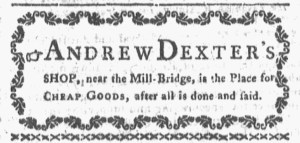
That seems to have been the case with Andrew Dexter’s advertisement.  He also included a border around his notice in the May 21 edition of the Massachusetts Gazette and Boston Weekly News-Letter.  The same advertisement ran in the Boston Evening-Post four days later.  It looks like this was another instance of transferring type already set from one printing office to another.  The compositor for the Boston Evening-Post may have very carefully replicated the format of Dexter’s advertisement that ran in the Massachusetts Gazette and Boston Weekly Mercury, but everything looks too similar for that to have been the case.  In particular, an irregularity in closing the bottom right corner of the border suggests that the printing offices shared the type once a compositor set it.  They might have also shared with the Boston-Gazette.  Dexter’s advertisement also ran in that newspaper on May 25.  It had the same line breaks and italics as Dexter’s notices in the other two newspapers.  The border looks very similar, but does not have the telltale irregularity in the lower right corner.  Did the compositor make minor adjustments?

It is important to note that these observations are based on examining digitized copies of the newspapers published in Boston in 1772.  Consulting the originals might yield additional details that help to clarify whether two or more printing offices shared type when publishing these advertisements.  At the very least, the variations in Allen’s advertisements make clear that he intentionally pursued a strategy of using borders to distinguish his advertisements in each newspaper that carried them.  The extent that Dexter meant to do the same or simply benefited from the printing offices sharing type remains to be seen after further investigation.

**********

Left to Right: Massachusetts Gazette and Boston Weekly Mercury (May 21, 1772); Boston-Gazette (May 25, 1772); Boston Evening-Post (May 25, 1772); Massachusetts Gazette and Boston Post-Boy (May 25, 1772).

**********

Left to Right: Massachusetts Gazette and Boston Weekly News-Letter (May 21, 1772); Boston Evening-Post (May 25, 1772); Boston-Gazette (May 25, 1772).