July 6

What was advertised in a revolutionary American newspaper 250 years ago today?
New-York Journal (July 6, 1775).

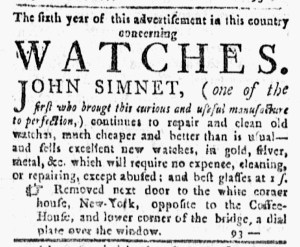
“Removed next door to the white corner house … a dial plate over the window.”

John Simnet, a cantankerous watchmaker who frequently advertised in New York’s newspapers in the early 1770s, once again took to the pages of the New-York Journal in the summer of 1775.  In this notice, he announced that he “continues to repair and clean old watches … and sells new watches.”  He took a neutral tone in that notice compared to the derogatory declarations he sometimes made about his competitors in other advertisements.  Simnet did state that he cleaned and repaired watches “much cheaper and better than is usual,” comparing the price and quality of his services to those offered by other watchmakers, but he did not denounce any competitors by name or launch into a diatribe about the general incompetence of those who followed an occupation he often claimed as solely his own.  He also described himself as “one of the first who brought this curious and useful manufacture to perfection,” but limited that comment to promoting his own work rather than denigrating other watchmakers.

Perhaps Simnet was more interested in drawing attention to his new location.  He moved from a shop “at the Dial, next Beekman’s Slip, in Queen Street” to a shop “next door to the white corner house, New-York, opposite to the Coffee-House, and lower corner of the bridge.”  Detailed directions were necessary.  Neither New York nor any other town had standardized street numbers in the 1770s, though some of the largest port cities would begin assigning them by the end of the century.  Sinnet resorted to landmarks to direct customers to his shop.  Like many other entrepreneurs, he also marked his location with a device that represented his business, “a dial plate over the window.”  It may have been the same “Dial” that had adorned his previous location.  If Simnet did transfer the “dial plate” from one shop to another, he maintained a consistent visual image for customers and others to associate with his business.  Other entrepreneurs who placed advertisements in the July 6, 1775, edition of the New-York Journal also used images to mark their locations, including James Wallace, a lacemaker and tailor “At the SIGN of the HOOD,” and William Pearson, a clock- and watchmaker “At the Dial, in HANOVER-SQUARE.”  That a competitor displayed a dial made Simnet’s elaborate directions imperative.  He did not want prospective customers stopping by another shop by mistake.

May 23

What was advertised in a colonial American newspaper 250 years ago today?

Dunlap’s Maryland Gazette (May 23, 1775).

Proper medicines in all stages of the Venereal disease put up with the most faithful attention to the symptoms.”

Patrick Kennedy, a surgeon and apothecary, advertised an “assortment of genuine Patent Medicines” available at his “Drug-Store” in Baltimore in the May 23, 1775, edition of Dunlap’s Maryland Gazette.  He carried many familiar items, including Bateman’s Drops and Stoughton’s Bitters, as well as “a few boxes of Patent dentifrice powder, for cleaning and beautifying the teeth.”  He also “compounded [prescriptions] with care and fidelity.”

Beyond those medicines and services, Kennedy devoted a significant portion of his advertisement to addressing readers who contracted syphilis and other venereal diseases.  “Proper medicines in all stages of the Venereal disease,” the apothecary advised, “put up with the most faithful attention to the symptoms.”  In other words, Kennedy devised prescriptions baes on the specific symptoms that patients reported to him.  When doing so, he observed “the most profound secrecy” to protect the privacy of his clients.  Prospective patients could trust Kennedy’s discretion concerning such delicate matters.  In addition to residents of Baltimore who visited his shop, he offered these services to “Persons afflicted with this disorder in the country.”  He instructed them to send “a line descriptive of their case” and then he would supply “remedies of the most approved kind, with ample directions.”  Providing written directions substituted for in-person consultations, allowing patients to use the medicines responsibly and effectively.  Although some may have been anxious about submitting their requests in writing, they may have found doing so less embarrassing than discussing their symptoms with the apothecary in his shop.  Ordering medicines from a distance made the patients nearly anonymous compared to face-to-face interactions at Kennedy’s shop.  His promise of “profound secrecy” also applied to those orders.

For those who had avoided misfortune and wished to keep it that way, the apothecary promoted the “Antivenereal preventive Wash.”  He explained that “repeated experiments” demonstrated its “assured efficacy in destroying the recent venereal infection; as it never fails to search after and cleanse away the acting cause of the malady.”  Kennedy hoped that readers would consider this preventative regimen worth the investment since it “preserv[ed] the constitution from the long course of medicines” that they would otherwise take after contracting venereal diseases.  As Benjamin Franklin had advised a few decades earlier, an ounce of prevention was worth a pound of cure!  Kennedy hoped that sentiment would resonate with prospective clients who sought to avoid venereal diseases.

March 15

What was advertised in a colonial American newspaper 250 years ago today?

Essex Journal (March 15, 1775).

The Sign of the GOLDEN EAGLE.”

In an era before standardized street numbers, colonizers used a variety of methods for giving directions and marking locations.  For instance, the colophon for the Essex Gazette noted that Ezra Lunt and Henry-Walter Tinges ran their printing office in “KING-STREET, opposite to the Rev. Mr. PARSONS’s Meeting-House” in Newburyport.  Some of the advertisements in the March 15, 1775, edition of their newspaper also gave directions in relation to other locations.  Robert Fowle, a stonecutter from Boston, advised prospective customers that he now had a workshop “next to Mr. Jonathan Titcomb’s store, near Somersby’s Landing,” places that he believed were familiar to local readers.  John Vinal ran a school “nearly opposite Mr. Davenport’s Tavern.”  Thomas Mewse gave even more elaborate directions to the site where he “CUTS Stamps and prepares a Liquid for Marking” textiles with the names of the owners, stating that he “may be spoke with at Mr. Jacksons, next door to Dr. Coffin’s, in Rogers’s-street, Newbury-Port.”

Another advertiser relied on a shop sign to mark the location where customers could purchase “English CHEESE,” “A good Assortment of English and Piece Goods, Iron-mongery, Cutlery and Braziery Ware,” and other merchandise: “the Sign of the GOLDEN EAGLE, Near the Court House.”  References to shop signs did not appear in advertisements in the Essex Journal as often as in advertisements inserted in newspapers published in Boston, New York, and Philadelphia, in part because that newspaper carried fewer paid notices than the others.  In addition, Newburyport was a smaller town with fewer businesses that relied on such devices to mark their locations.  Yet an advertisement that directed readers to “the Sign of the GOLDEN EAGLE” demonstrates that shop signs became part of the visual culture that colonizers encountered as they traversed the streets of smaller ports, not just major urban centers.  Few shop signs from the colonial era survive today.  Newspaper advertisements testify to the existence of this method that merchants, shopkeepers, and artisans used to establish commercial identities and mark their locations.

April 2

What was advertised in a colonial American newspaper 250 years ago today?

Providence Gazette (April 2, 1774).

“Genteel Boarding, FOR Gentlemen, Strangers and others.”

Thomas Russell provided “Genteel Boarding … at the House lately occupied by Mr. Benjamin Bagnall, deceased, near the State-House” in Boston.  He did not, however, place his advertisement in the Boston-Gazette or the Massachusetts Spyor any of the several other newspapers printed in that city.  Instead, he ran it in the Providence Gazette for six weeks in the spring of 1774.  For “Gentlemen, Strangers and others” who planned to visit Boston, Russell presented an option for accommodations and made planning their journey that much easier.

To convince prospective guests that his establishment was a good choice, he assured readers that the house was “a very noted Place for this Business” as well as “well known to be a large and commodious House.”  For anyone not familiar with its reputation, including those who lived any distance from Boston, they “have only to apply, to be convinced how agreeably they can be accommodated.”  Russell’s hospitality and the amenities he offered, he suggested, would become immediately apparent upon meeting.

Boston and other American towns had not yet adopted standardized street numbers, so Russell provided travelers with general directions to get them to the vicinity of the house and enough information to find it once they spoke with some locals.  Anyone who made their way to the “State-House” could then ask anyone they encountered about Russell’s boarding house, though they might more efficiently find it by invoking Benjamin Bagnall’s name since Russell apparently only recently acquired the property.  Describing the landmark according to local knowledge would get guests to Russell’s door.

In promoting his boarding house, Russell joined entrepreneurs who ran taverns and inns who advertised in newspapers published in other cities.  While they certainly welcomed local custom, they believed that marketing their establishments in publications in other towns would generate additional business.  Russell seemed certain enough of it that he invested in advertising in the Providence Gazette for six weeks rather than starting with the standard three-week run for his advertisement.  With the arrival of spring, he likely anticipated more travelers from Providence and its environs making their way to Boston.  Russell stood ready to provide them with lodgings.

September 28

What was advertised in a colonial American newspaper 250 years ago today?

Providence Gazette (September 28, 1771).

“He hath newly opened Shop near the North End of the Bridge.”

In an era before standardized street numbers, many advertisers included directions to their businesses in their newspaper advertisements.  Amos Throop, for instance, instructed prospective customers that he sold an assortment of medicines “At the Sign of the Pestle and Mortar, in King-street, Providence” in an advertisement in the September 28, 1771, edition of the Providence Gazette.  Elsewhere in that issue, Edward Thurber promoted a variety of goods “At his Store, the North End of Providence.”  In an advertisement for books and stationery, John Carter did not include directions to his printing office, but the colophon that appeared at the bottom of the page featured that information.  Each issue concluded with an invocation of Carter’s location, “at Shakespear’s Head, in King-Street, near the Court-House.”  Other advertisers, however, were so familiar to prospective customers in Providence and its environs that they did not need to list their locations, including John Brown and Joseph and William Russell.

Out of necessity, advertisers from beyond the city did include directions for finding their shops or directing correspondence.  Ebenezer Bridgham did so in his advertisement for imported goods available “At the Staffordshire and Liverpool Warehouse, in King-street, Boston.”  In a subscription notice that ran in newspapers throughout the colonies, John Dunlap gave his location as “the Newest Printing-Office, in Market-street, Philadelphia.”  Both Bridgham and Dunlap sought customers who would send away for the items in their advertisements.  Closer to Providence, Charles Rhodes of Pawtuxet aimed to attract customers to his “newly opened Shop near the North End of the Bridge.”  While he may have welcomed orders via letter, he also hoped that customers in and near his village would visit his shop to examine his “fresh and general Assortment of English, East and West India Goods … and many other Articles, too tedious to enumerate” for themselves.  Given the size of the village, it may have been sufficient to give his location as “CHARLES RHODES, In Pawtuxet.”  The shopkeeper instead elaborated further for the convenience the clientele he wished to cultivate, a down payment on the “good Treatment” he promised to “Those who shall please to favour him with their Custom.”  In the end, Rhodes expected good customer service, including directions to find his shop easily, would accrue benefits to his new enterprise.

December 13

What was advertised in a colonial American newspaper 250 years ago today?

Massachusetts Spy (December 13, 1770).

“At the store lately improved by Mr. Robert Gould, opposite the sign of the Crown and Sceptre in Back-street.”

Francis Shaw, Jr., stocked a “LARGE and neat Assortment of cream and other coloured WARE, of the newest fashion,” at his shop in Boston.  In an advertisement in the December 13, 1770, edition of the Massachusetts Spy, he gave his locations as “the store lately improved by Mr. Robert Gould, opposite the sign of the Crown and Sceptre in Back-street.”  American cities did not use standardized street numbers to organize urban spaces until the late 1780s and early 1790s.  Before then, residents relied on a variety of landmarks and other descriptions to give directions.  They often used them in combination, as Shaw did.  He gave his street, but he also indicated the previous occupant of his store to guide prospective customers familiar with Gould’s business on Back Street.  He also used a shop sign for reference, though the Sign of the Crown and Scepter did not mark his own location.  Instead, he mentioned it as a landmark, describing his location “opposite” or across the street from the sign.

Other advertisers deployed similar strategies in describing their locations.  On the same day that Shaw placed his advertisement, John Langdon placed a notice in the Massachusetts Gazette and Boston Weekly Mercury.  In it, he invited prospective customers to “his Store lately Improv’d by Messr’s Cox & Berry nearly opposite the Post-Office.”  Peter Roberts sold medicines and medical equipment at his shop “opposite the West-Door of the Town-House.”  John Crosby, a frequent advertiser who peddled citrus fruits and other grocery items, gave his location as “the Sign of the Basket of Lemmons at the South-End.”  Samuel Abbot declared that his store was located “on Greene’s Wharff, near the East of the Market.”  Collectively, these advertisements and others suggest some of the methods colonists used to make sense of the cityscape and navigate the streets of Boston.  These descriptions supplement eighteenth-century maps, engravings, paintings, drawings, and other visual images as well as travel narratives and letters that depicted the busy port.  They also reveal important relationships, such as previous occupants and nearby landmarks, that mattered to both advertisers and readers of early American newspapers.  Commercial notices provided their own portraits of cities like Boston, Charleston, New York, and Philadelphia.

April 13

What was advertised in a colonial American newspaper 250 years ago today?

Apr 13 - 4:13:1770 New-Hampshire Gazette
New-Hampshire Gazette (April 13, 1770).

At his Shop next to the Printing Office.”

Throughout the eighteenth century, most residences and businesses did not have standardized street addresses.  City directories as well as trade cards and billheads and other advertising ephemera reveal that some of the largest cities did adopt street numbers in the late 1780s and 1790s, but that practice did not arrive in other cities and towns until the nineteenth century.

Newspaper advertisements featured a variety of means of identifying locations of businesses in eighteenth-century America.  Some simply listed the street, as was the case in the advertisement for garden seeds that John Adams placed in the April 13, 1770, edition of the New-Hampshire Gazette.  Adams indicated that he sold his wares “In Queen Street, Portsmouth.”  The port town was small enough that Adams may not have needed to list an address of any sort for residents.  However, since the New-Hampshire Gazette was the only newspaper published in the colony and circulated far beyond Portsmouth, Adams may have included his street to aid prospective customers from the countryside who traveled to town or sent orders.

In the same issue, Gillam Butler advertised an assortment of textiles that he sold “At his Shop next to the Printing Office, in the Street that leads from the Parade to the Market and Ferry.”  He deployed two strategies for identifying his location.  Given that he did not frequently place advertisements, Butler may have thought it necessary to give as much information as possible to aid consumers who wished to visit his shop.  He named a landmark and described his location in relation to that landmark: “next to the Printing Office.”  He also provided more extensive information about the street.  In some cases, advertisers named intersecting streets to help readers get their bearings.  In this instance, Butler invoked other aspects of the street by describing other landmarks that it connected: “the Street that leads from the Parade to the Market and Ferry.”  He made it possible for prospective customers to imagine a map of his neighborhood to navigate to his shop.

To some extent, we have reverted to eighteenth-century means of thinking about where businesses are located as GPS systems become more advanced.  The algorithms that produce directions still rely on standardized street addresses, but users do not need to supply them or even be aware of them.  It is now possible to simply enter the name of a business and let the GPS take care of street numbers, landmarks, intersections, and a variety of other data.

April 25

What was advertised in a colonial American newspaper 250 years ago today?

Apr 25 - 4:25:1768 Newport Mercury
Newport Mercury (April 25, 1768).

“John Stevens, near Liberty-Tree.”

In the spring of 1768 Charles Dunbar, a gardener, placed an advertisement in the Newport Mercuryto announce that he sold “a Quantity of choice good Garden Seeds.”  Customers could purchase “Early Charlton Peas,” “fine Madeira Onion,” “double curled Parsley,” and a variety of other seeds directly from Dunbar or from “Gilbert Stewart, the North Corner of Banister’s Row” or “John Stevens, near Liberty-Tree,” and “Caleb Earle at the upper end of the Town.”

Dunbar’s advertisement testifies to colonial understandings of urban geography and how to navigate cities, especially smaller ones.  Residences and businesses did not have standardized street numbers in the 1760s. Some of the largest American cities would institute such a system in the final decade of the century, but on the eve of the Revolution colonists relied on a variety of other means for identifying locations.  Sometimes indicating just the street or an intersection gave sufficient direction, such as “North Corner of Banister’s Row.”  Sometimes the descriptions were even more vague, such as “upper end of the Town.” Especially in towns and smaller cities, neither residents nor visitors needed much more information to locate residences and businesses.  Colonists also noted the proximity of shop signs.  In another advertisement in the same issue of the Newport Mercury, Thomas Green listed his location as “the Sign of the Roe Buck in Banister’s Row.” Advertisements from other newspapers printed throughout the colonies in the 1760s suggest that residents of Newport likely used Green’s sign as a marker to identify other locations next door to his shop or across the street or three doors down.  Although associated with particular businesses, shop signs served a purpose other than merely branding the enterprises of their proprietors.

In that regard, shop signs operated as landmarks, another common method for indicating location … and some landmarks communicated more than just location.  Dunbar indicated that prospective customers could find his associate John Stevens “near Liberty-Tree,” a landmark that could not be separated from its political symbolism even as the advertiser used it to facilitate commerce.  As a result, politics infused Dunbar’s advertisement, prompting readers to consider more than just their gardens as they contemplated which seeds to purchase and plant.  Dunbar’s notice was not an isolated incident.  In the wake of both the Stamp Act and, later, the Townshend Act, colonists designated Liberty Trees and quickly incorporated the symbolism into their understanding of urban landscapes.  Advertisers in Boston most frequently invoked the city’s Liberty Tree as a landmark to aid prospective customers in finding their businesses, but Dunbar’s notice demonstrates that advertisers in other cities adopted the same strategy.  Some advertisers in Portsmouth, New Hampshire, took similar steps when they stated their location in relation to “Liberty-Bridge.” Even if advertisers did not actively endorse particular political positions, their use of these landmarks demonstrates how quickly residents of their cities integrated symbols of resistance into their points of reference for navigating urban centers.

May 10

What was advertised in a colonial American newspaper 250 years this week?

May 10 - 5:7:1767 Pennsylvania Gazette
Supplement to the Pennsylvania Gazette (May 7, 1767).

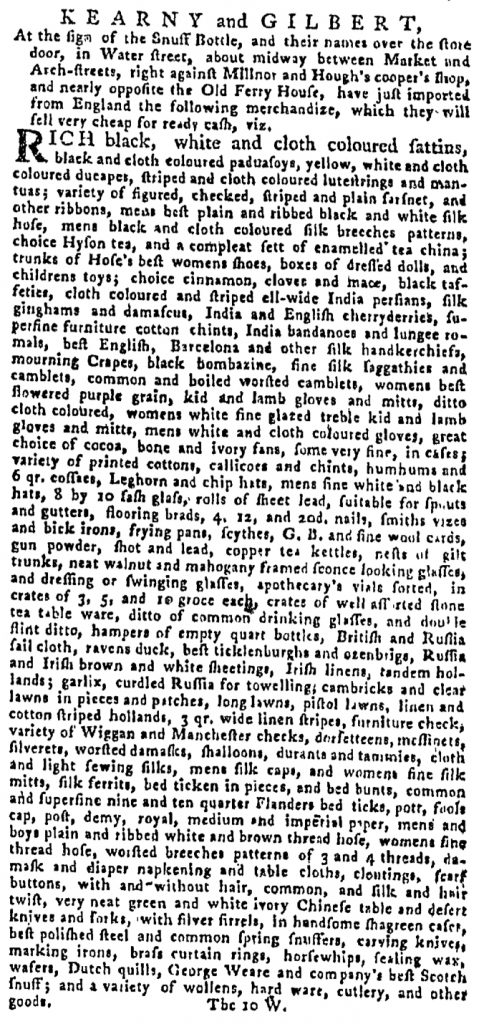
“KEARNY and GILBERT, At the sign of the Snuff Bottle, and their names over the store door.”

Newspaper advertisements from the period suggest visual elements of marketing erected in eighteenth-century cities and villages. Residents and visitors alike encountered an array of shop signs that retailers used to identify their businesses. Such was the case in the first issue of the Pennsylvania Gazette published in May 1767. Although their signs have been lost to time, several advertisers included descriptions of them alongside other directions intended to guide customers to their shops.

Nathaniel Tweedy, a druggist, announced that he could he sold medicines “At the Golden Eagle, in Market-street, near the Court-house.” Dyers Joseph Allardyce and Company practiced their trade “at the Sign of the Blue Hand, in Race-street, between Front and Second Streets.” Edward Penington, an attorney, advertised a real estate auction to be held “at the house of John Biddle, at the sign of the Indian King, in Market-street.” William Dawson, a cutler, not only stated that he made a various kinds of knives and other implements “At the sign of the Scythe and Sickle” but also included a woodcut depicting those instruments suspended from a signpost. Each of these, especially Dawson’s advertisement, hints at the rich visual cityscape of marketing in Philadelphia in the decade before the Revolution.

In many instances, such signs provided the sole means of identifying a shop or tavern, but other advertisers stated that they also labeled their places of business with their own names. Kearny and Gilbert, for instance, stocked an array of merchandise “At the sign of the Snuff Bottle … in Water Street.” To alleviate any potential confusion, customers could also look for “their names over the store door.” George Frederick Boyer, one of Dawson’s competitors in the cutlery business, displayed “a Sign in Front-street, and another in Water-street, with his Name thereon, and on which are painted Swords, Knives, Lancets, Razors, and Grinding Tools.”

How often did eighteenth-century shopkeepers, artisans, and other entrepreneurs label their locations with their own names or include them on their fanciful signs? Did most signs provide visual identification exclusively? Or did they also tend to incorporate at least a minimal amount of text, even if just the name of the proprietor? In the absence of devices like the Golden Eagle or the Blue Hand, did others at least post placards with their names so potential customers knew they had arrived at the correct destination? Or did they assume the extensive directions provided in advertisements sufficed?

I do not have satisfactory answers to these questions, but they remind me that the history of advertising in eighteenth-century America requires research along multiple trajectories, utilizing multiple sorts of sources. Newspaper notices and other printed ephemera (magazine wrappers, broadsides, trade cards, catalogs) tell much of the story, but material culture (such as shop signs or packaging materials, both more likely in museum collections rather than archives) reveals other important aspects of how marketing worked in early America.

March 16

GUEST CURATOR: Daniel McDermott

What was advertised in a colonial American newspaper 250 years ago today?

Mar 16 - 3:16:1767 Newport Mercury
Newport Mercury (March 16, 1767).

“Baizes, Duffels, Shalloons, Tammies, Calimancoes.”

William Cornell placed this advertisement for the array of textiles he sold. By today’s perspective the list seems foreign. However, in colonial America any person reading this advertisement would have known each material, including what style, how expensive, and common uses.

One textile on the list that may seem unfamiliar is baize. The Oxford English Dictionary describes baize as “A coarse woollen stuff, having a long nap, now used chiefly for linings, coverings, curtains, etc., in warmer countries for articles of clothing.” The OED also states it was used for shirts and petticoats. Abigail Adams wrote a letter to her husband, John Adams, and refered to a “Green Baize Gown,” making a recommendation to keep him warm during the cold nights: “I would recommend to you the Green Baize Gown, and if that will not answer, You recollect the Bear Skin.” This suggests baize could be heavy enough to be used for warmth during cold winter nights, just as warm as a “Bear Skin.” (Today, baize is most famously used to cover pool tables.)

Tammies were another textile Cornell sold that may seem unfamiliar. According to the Dictionary of Traded Goods and Commodities, 1550-1820, tammy is a lightweight fabric, but because of its simple weaving the material is also strong. Due to its durability but light weight it was utilized for linings, children’s garments, or curtains. Tammy was also often dyed yellow, a color that quickly faded when exposed to light. Yellow tammy may have been chosen for linings that would have been less exposed and thus less likely to fade.

**********

ADDITIONAL COMMENTARY: Carl Robert Keyes

When Daniel and I met to discuss William Cornell’s advertisement, we considered several aspects to examine in greater detail. Daniel ultimately opted to investigate some of the unfamiliar textiles, but during the research and writing process he also contemplated what this advertisement told us about colonists’ understanding of urban geography and how to navigate port cities.

In an era before standardized street numbers and addresses, colonists relied on a variety of landmarks to give directions. Advertisers frequently assumed that potential customers, especially in towns and smaller cities, were familiar with both local places and people. For instance, Cornell offered nothing by way of directions except noting that his shop was “Adjoining to Captain Robert Stoddard’s.” Apparently Stoddard was sufficiently known among residents of the port city that Cornell considered this sufficient for directing potential customers to his own business.

Some advertisers relied on their names alone, neglecting to offer any other sort of directions. Such was the case for Samuel Sanford (who advertised “A few Puncheons of Jamaica Rum”), Gideon Wanton, Jr. (who carried “Ticklenburgs [and] Osnaburgs,” textiles that did not appear in Cornell’s notice), and Joseph West (who sold “A Quantity of dry Cod Fish”).

Others provided a street name, a landmark, or a combination of the two to aid potential customers in locating them. John Hadwen, for instance, peddled his wares “At his Shop in Thames Street,” while Napthali Hart, Jr. sold a similar array of goods “At his Store on Mr. GEORGE GIBBS’s Wharf.” George Cornell maintained “Batchelor’s Hall,” presumably a boardinghouse, “IN Mill-Street, near the Ferry Wharf.”

Two other advertisers offered more complex directions. Christopher Smieller, a baker, announced that he “has removed from Mr. William Gyles’s Bakehouse, to that of Mr. Joseph Tillinghast.” Francis Skinner, a bookbinder, provided the most complicated – or perhaps the most exact – set of directions. Customers could find him “at his House the third below Trinity Church, on the East Side of the Street leading to the Neck.”

Regardless of how many or how few words any of these advertisers used, each expected readers and potential customers could make their way to their respective businesses based on the information they provided. Even the largest American cities were not yet so large in the 1760s to necessitate street numbers and standardized addresses to facilitate commerce. That changed by the end of the eighteenth century: advertisements increasingly included street numbers and a new kind of publication, the city directory, listed standardized addresses for residences and businesses alike. Both innovations transformed how early Americans, both locals and visitors, thought about navigating city streets.