What was advertised in a revolutionary American newspaper 250 years ago today?
New-York Journal (March 21, 1776).
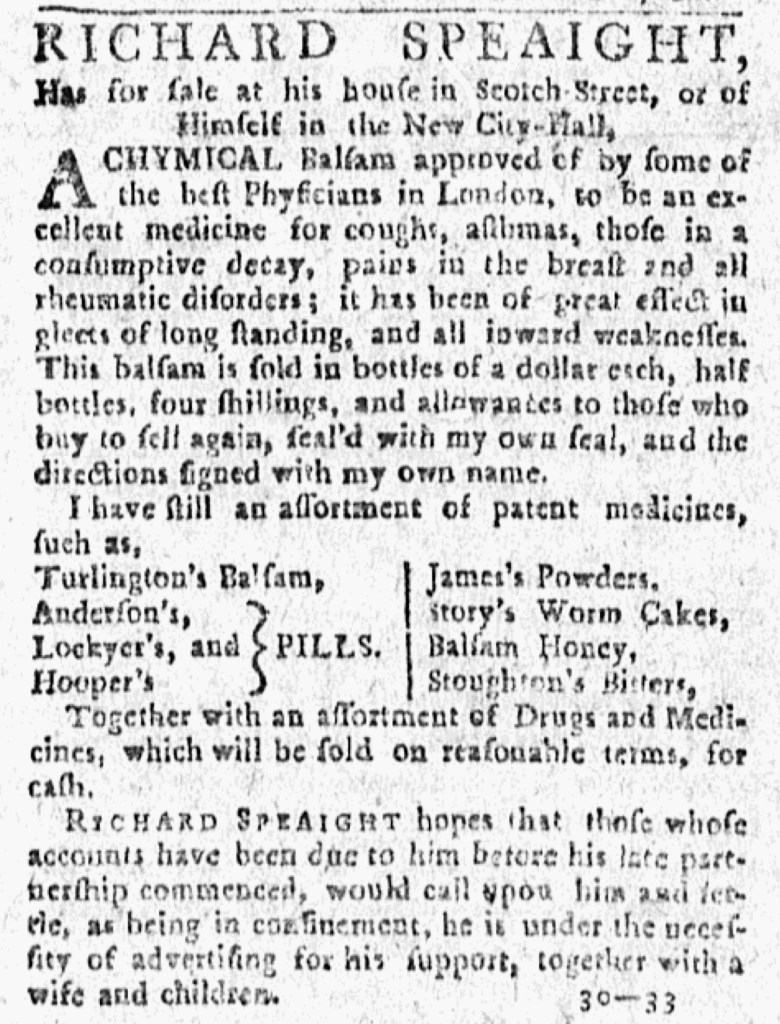
“This balsam is sold in bottles … seal’d with my own seal.”
Richard Speaight hawked a variety of patent medicines in an advertisement in the March 21, 1776, edition of the New-York Journal. He listed Turlington’s Balsam, Anderson’s Pills, Lockyer’s Pills, Hooper’s Pills, James’s Powders, Story’s Worm Cakes, and Stoughton’s Bitters. All these remedies were so familiar to consumers that Speaight did not consider it necessary to indicate which of them relieved which maladies. Prospective customers knew them as well as modern consumers know the over-the-counter medications available at local pharmacies. He sold all of them, along with “an assortment of [other] Drugs and Medicines,” for reasonable prices.
On the other hand, Speaight did devote a significant portion of his advertisement to describing a “CHYMICAL Balsam approved of by some of the best Physicians in London.” Those practitioners, he reported, considered the balsam “an excellent medicine for coughs, asthmas, those in a consumptive decay, pains in the breast and all rheumatic disorders.” It supposedly worked to “great effect,” a welcome promise to readers who had tried other treatments without success.
In addition to customers who purchased the balsam for their own use, Speaight also hoped to attract the attention of retails who would stock it in their own shops. He set the price at one dollar per bottle and four shillings for a half bottle while also making “allowances to those who buy to sell again.” In other words, he offered discounts for buying in volume. To avoid counterfeits, he informed the public that bottles of the balsam were “seal’d with my own seal.” Furthermore, he provided “directions signed with my own name.” Retailers and consumers alike could refer to those instructions when selling or using the balsam. For a medicine not nearly as familiar as Anderson’s Pills and Stoughton’s Bitters, a seal and printed directions likely enhanced confidence in the efficacy of the product.
What was advertised in a revolutionary American newspaper 250 years ago today?
Providence Gazette (February 17, 1776).
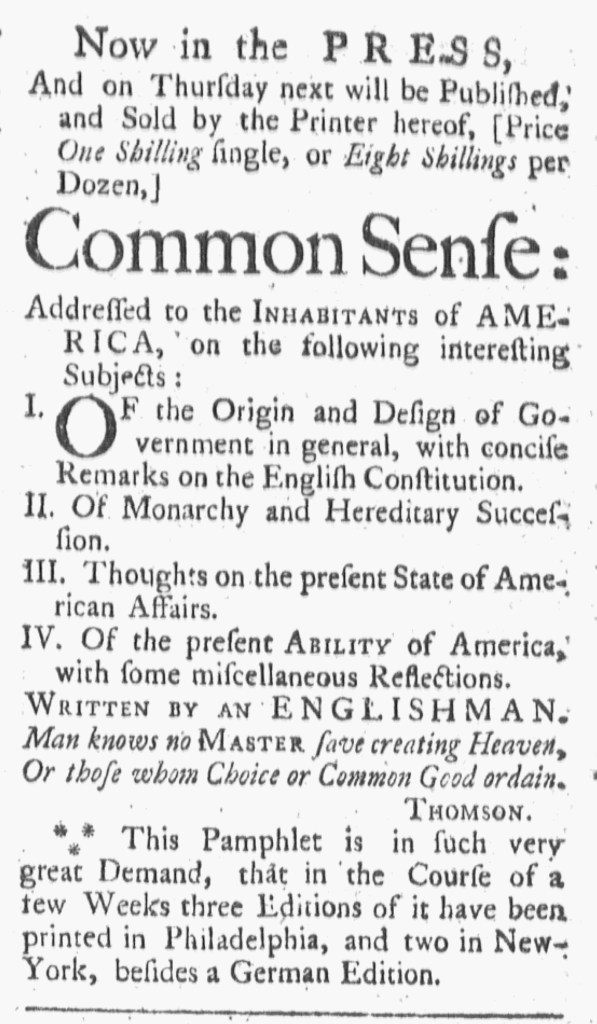
“This Pamphlet is in such very great Demand, that … three Editions of it have been printed in Philadelphia.”
On February 17, 1776, John Carter, the printer of the Providence Gazette, became the first printer in New England to announce plans to publish a local edition of Thomas Paine’s Common Sense. “Now in the PRESS,” he proclaimed, “And on Thursday next will be Published … Common Sense: Addressed to the INHABITANTS of AMERICA, on the following interesting Subjects.” Carter then listed the titles of the sections of the political pamphlet, replicating many of the advertisements that previously ran in newspapers published in Philadelphia and New York. He even included the epigraph from “Liberty,” a poem by James Thomson, that appeared on the first page of the first edition published by Robert Bell and in many of Bell’s advertisements for the pamphlet.
Carter disseminated this advertisement on a Saturday, but readers had to wait until the following Thursday for the pamphlet to go on sale. To stoke anticipation even more, he reported, “This Pamphlet is in such very great Demand, that in the Course of a few Weeks three Editions of it have been printed in Philadelphia, and two in New-York, besides a German Edition.” Indeed, Bell first advertised Common Sense on January 9 and soon after advertised an unauthorized second edition. Unhappy with Bell’s failure to earn a profit on the first edition, Paine turned to William Bradford and Thomas Bradford to publish a new edition with additional content. Before its publication on February 14, Bell and Paine engaged in bitter exchanges in advertisements in the Pennsylvania Evening Post and other newspapers. In their advertisement, the Bradfords also indicated that a “German edition is likewise in the press.” Meanwhile, John Anderson advertised his local edition, the first printed in New York, on February 7. Even if readers of the Providence Gazette had not previously heard much about Paine’s incendiary political pamphlet, Carter intended for its popularity in Philadelphia and New York to encourage sales of his local edition. He clearly intended for retailers to purchase it to sell again, offering a discount of “One Shilling single, or Eight Shillings per Dozen.” Perhaps he expected that supporters of the American cause would also purchase by the dozen and distribute them to friends and relations. Allowing such a steep discount likely helped the pamphlet achieve even greater circulation.
What was advertised in a revolutionary American newspaper 250 years ago today?
New-York Gazette and Weekly Mercury (January 15, 1776).
“Dr. Hill’s American Balsam; whose great efficacy is so well known.”
Nine months after his advertisements first appeared in newspapers in New York, shopkeeper Michael Hoffman continued receiving shipments of “DOCTOR HILL’s newly improved great STOMACHIC TINCTURE” and “Dr. Hill’s American Balsam” from an associate in Philadelphia. His advertisement in the January 15, 1776, edition of the New-York Gazette and Weekly Mercury echoed the one he previously placed in the May 4, 1775, edition of the New-York Journal, though it featured slightly different copy. Hoffman reminded prospective customers that the tincture was “a very excellent medicine for all weak stomach, as it procures a good healthy appetite, and a sound digestion.” In addition, it supposedly prevented all sorts of diseases since most, according to the advertisement, “have their origin contracted in a weak stomach.” The balsam, on the other hand, “is so well known to cure the most inveterate disorder in the breast, as shortness of breath, colds, coughs, and whooping coughs in children.” Yet that was not all! Through “a proper use and continuing the same a reasonable time,” the balsam “effectually cured … the most painful rhumatisms, cholic, gravel [kidney stones] and consumption.”
Yet Hoffman did not promote just the efficacy of these patent medicines. In his effort to attract customers, he assured them that “Doctor Hill’s own directions, printed in London, are wrapt about each bottle” to prevent confusion about the dosage once they took the medicines home. Those directions, however, included the price in “sterling money,” but Hoffman’s customers could ignore that. He had worked out a deal for bargain pricing for the benefit of “the poor and indigent” in New York. In that city, the medicines sold for four shilling and ten pence per bottle. Even better, those who bought a dozen bottles received a discount, only four shillings and four pence per bottle. Those customers saved ten percent, a good deal for those who intended to follow Hoffman’s directions to continue taking the medicine for “a reasonable time.” As had been the case all along, Hoffman had an exclusive appointment to sell Dr. Hill’s tincture and balsam in New York. He directed customers to his shop “in the Broad-Way, near the Oswego-Market” so they could avoid counterfeits peddled elsewhere.
What was advertised in a revolutionary American newspaper 250 years ago today?
Providence Gazette (December 30, 1775).
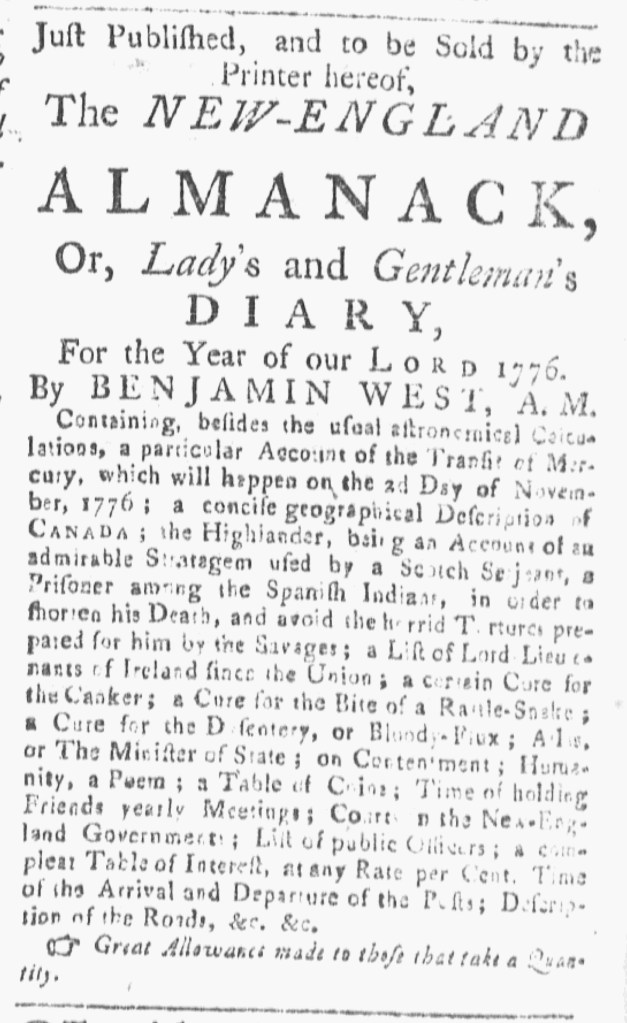
“Great Allowance made to those that take a Quantity.”
The collaboration between John Carter, the printer of the Providence Gazette, and Benjamin West, an astronomer and mathematician, continued for another year. An advertisement in the final issue of the Providence Gazette for 1775 alerted readers that the “NEW-ENGLAND ALMANACK, Or, Lady’s and Gentleman’s DIARY, For the Year of our LORD 1776” by Benjamin West was “Just Published, and to be Sold by the Printer hereof.” At the end of the advertisement, a manicule directed attention to a note that informed shopkeepers and others of a “Great Allowance made to those that take a Quantity.” In other words, Carter offered steep discounts to retailers who purchased a significant number of copies to sell to their own customers. That pricing scheme allowed them to turn a profit by setting prices that competed with customers acquiring the almanac at the printing office.
To entice customers of every sort, Carter provided an overview of the contents of the almanac. In addition to the “usual astronomical Calculations,” it included “a particular Account of the Transit of Mercury, which will happen on the 2d Day of November, 1776.” Carter stoked anticipation for that event, making it even more appealing by providing those who purchased the almanac detailed information to help them understand it. The almanac also contained useful reference material, including “a Table of Coins, Time of holding Friends yearly Meetings; Courts in the New-England Government; List of public Officers; a compleat Table of Interest, at any Rate per Cent. Time of the Arrival and Departure of the Posts; [and] Description of the Roads.” The almanac also served as a medical manual with several remedies, such as “a certain Cure for the Canker, a Cure for the Bite of a Rattle-Snake; [and] a Cure for the Dysentery, or Bloody-Flux.” In addition to all that, the almanac had items selected to entertain or to educate readers, including a short essay “on Contentment,” “Humanity, a Poem,” and “a concise geographical Description of CANADA.” That last item may have been of particular interest given the American invasion of Canada in hopes of winning support for the American cause. Despite capturing Montreal in November, the attack on Quebec City failed in late December. American forces withdrew. The “concise geographical Description of CANADA” would not serve the intended purpose once word arrived in New England, though readers could consult it to supplement reports they read in the Providence Gazette and heard from others. Overall, Carter aimed to convince prospective customers that this almanac has an array of features that merited selecting it for use throughout the new year.
What was advertised in a revolutionary American newspaper 250 years ago today?
Dunlap’s Maryland Gazette (October 31, 1775).
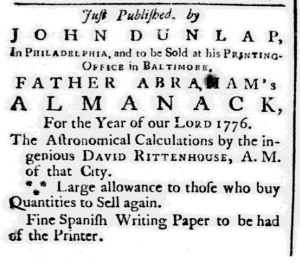
“Large allowance to those who buy Quantities to Sell again.”
When John Dunlap published “FATHER ABRAHAM’S ALMANACK, For the Year of our LORD 1776,” in the fall of 1775, he set about advertising the handy reference manual. He gave the advertisement a privileged place in the September 11, 1775, edition of Dunlap’s Pennsylvania Packet, the newspaper he printed in Philadelphia. It ran immediately below the lists of ships arriving and departing from the customs house, increasing the chances that readers interested more in news than advertisements would see it. Unlike other printers who hawked almanacs, Dunlap did not provide an extensive description of the contents to entice prospective customers, though he did indicate that “the ingenious DAVID RITTENHOUSE … of this city” prepared the “Astronomical Calculations.” The printer believed that the astronomer’s reputation would help sell copies of the almanac.
He also ran advertisements in Dunlap’s Maryland Gazette, the newspaper he printed in Baltimore. One of those notices appeared in the October 31 edition, again highlighting Rittenhouse’s role in making the “Astronomical Calculations.” This advertisement did not include additional information about the contents, but it did include an appeal to retails that did not appear in the first iteration of the advertisement in Dunlap’s Pennsylvania Packet on September 11 nor in the most recent insertion on October 30. Dunlap promised a “Large allowance to those who buy Quantities to Sell again.” In other words, he offered discounts for purchasing in volume to make the almanac attractive to booksellers, shopkeepers, and peddlers. Did Dunlap offer the same deal at his printing office in Philadelphia yet not advertise it in the public prints? Other printers advertised discounts for buying almanacs by the dozen or by the hundred frequently enough to suggest that it was a common practice. Given that Philadelphia had far more printers than Baltimore, many of them publishing one or more almanacs of their own, Dunlap may have carefully managed the discounts, offering one rate in one city and another rate in the other. That did not necessarily matter to retailers who saw his advertisement in Dunlap’s Maryland Gazette. His printing office in Baltimore, opened less than a year earlier, gave them easier access to almanacs than in the past. The “Large allowance” was a bonus to convince them to take advantage of the convenience rather than order almanacs from other printers in Philadelphia or Annapolis.
What was advertised in a revolutionary American newspaper 250 years ago today?
Pennsylvania Gazette (July 26, 1775).
“A SERMON, on the present Situation of American Affairs … to distribute … among the Military Associators.”
A few days ago, I examined an advertisement for “A sermon on the present Situation of American Affairs” by William Smith that ran in the July 21, 1775, edition of the South-Carolina and American General Gazette. I concluded that Wells likely sold copies of the pamphlet printed by James Humphreys, Jr., in Philadelphia and shipped to his “GREAT STATIONARY & BOOK STORE” in Charleston. An advertisement in the July 26, 1775, edition of the Pennsylvania Gazette suggests that was indeed the case.
That notice listed several printers who stocked the sermon. It gave top billing to James Humphreys, Jr., and noted that “the other Printers in Philadelphia” also sold the sermon. Radiating outward from the city, the list next named Matthias Slough and Francis Bailey in Lancaster and then Hugh Gaine, the printer of the New-York Gazette and Weekly Mercury, in New York. The list concluded with “Mr. ROBERT WELLS, in Charlestown, South-Carolina.” Humphreys apparently dispatched copies to associates both in his own city and in other towns and colonies.
Another aspect of that advertisement indicates that Wells most likely sold copies of the sermon printed by Humphreys in Philadelphia. Wells did not mention the price in his advertisement, but Humphreys gave prices for a single copy and multiple copies: nine pence for one copy, six shillings for a dozen, and six dollars for one hundred copies. That pricing structure concluded with a note that Humphreys intended the discount for purchasing in volume as a benefit “for such Persons as may desire to distribute them among the Military Associators.” He encouraged officers and other Patriots to disseminate the sermon widely by making a gift of it to those who volunteered to defend American liberties. Humphreys was not alone in envisioning that officers would give books and pamphlets about current affairs as gifts. George Washington had recently ordered eight copies of Thomas Hanson’s Prussian Evolutions in Actual Engagements to distribute among his subordinates.
The details in Humphreys’s advertisement strengthen the case that Wells did not publish his own edition of Smith’s sermon but instead advertised and sold copies that Humphreys printed in Philadelphia and distributed to printers and booksellers in several cities and towns. Doing so contributed to the creation of what Benedict Anderson terms an “imagined community” grounded in print. Newspapers played an important role as printers reprinted news and editorials from one to another, yet colonizers also had access to pamphlets, tracts, and sermons that circulated widely. They did not have to be present when Smith delivered his sermon to engage with the ideas and arguments that the minister offered for consideration.
What was advertised in a colonial American newspaper 250 years ago this week?
Massachusetts Spy (February 2, 1775).
“BUTTONS. MADE and sold … at the Manufactory-house, Boston.”
John Clarke’s advertisement for buttons that he “MADE and sold … at the Manufactory-house” in Boston was one of several in the February 2, 1775, edition of the Massachusetts Spy that hawked goods produced in the colonies. He advertised at a time that the harbor had been closed and blockaded for more than eight months because of the Boston Port Act, one of several measures that Parliament enacted in response to the Boston Tea Party. The other Coercive Acts included the Massachusetts Government Act, the Administration of Justice Act, and the Quartering Act. In turn, the colonies refused to import British goods, having previously pursued that strategy in response to the Stamp Act in 1765 and the duties imposed on certain goods in the Townshend Acts in the late 1760s. The Continental Association, devised by the First Continental Congress, went into effect on December 1, 1774. In addition to prohibiting imports, it called on colonizers to encourage “domestic manufactures” or goods produced in the colonies.
Clarke not only made buttons in Boston, he made “two sorts of new fashioned buttons.” One was a “plain flat Button, with a corded edge round it, either gilt or plated. The other bore an inscription, “UNION AND LIBERTY IN ALL AMERICA,” that made a statement. Consumers could express political sentiments and sartorial sensibilities simultaneously. (Similarly, the Adverts 250 Project previously examined another newspaper notice that included “glass buttons having the word liberty printed in them.”) Clarke’s “Liberty button,” well worth the investment, cost just a little more than the “plain flat Button,” at twenty shillings per dozen compared to eighteen shillings per dozen. Clarke also gave “good allowance to shopkeepers to sell again.” In other words, he offered discounts to retailers who purchased his buttons and presented them to their customers. After all, shopkeepers had their own part to play in promoting American products to consumers and supplying them with alternatives to goods imported from Britain. When it came to buttons, what better way to do that than with the inscribed “Liberty button” made in Boston?
What was advertised in a colonial American newspaper 250 years ago today?
New-York Gazette and Weekly Mercury (December 12, 1774).
“He will meet with due encouragement … by every real friend to American manufactures.”
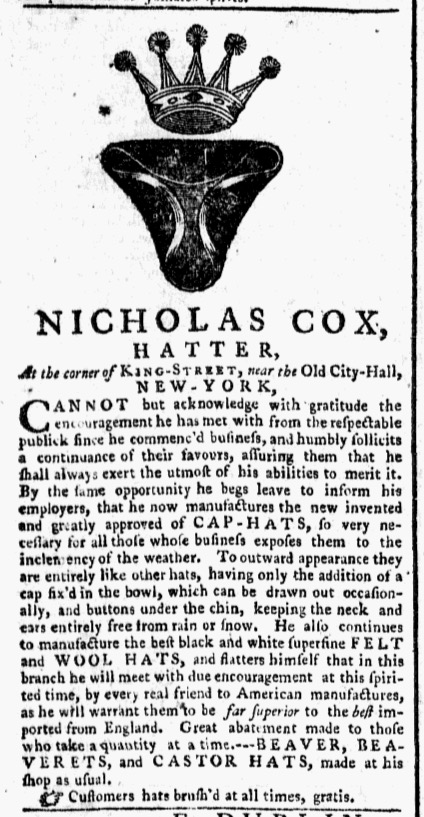
Nicholas Cox, a hatter, made several appeals to consumers in his advertisement in the December 12, 1774, edition of the New-York Gazette and Weekly Mercury. He commenced with a standard expression of gratitude for “the encouragement he had met with from the respectable publick since he commenc’d business.” Many purveyors of goods and services did so in their advertisements, signaling to readers that other consumers already considered them worthy of their business. It was a familiar means of bolstering an advertiser’s reputation.
The hatter also incorporated commentary specific to his trade, proclaiming that he “manufactures the new invented and greatly approved of CAP-HATS.” For those unaware of this innovation, eh explained that by “outward appearance they are entirely like other hats, having only the addition of a cap fix’d in the bowl, which can be drawn out occasionally.” In such instances, it “buttons under the chin, keeping the neck and ears entirely free from rain or snow.” Cox marketed this new style, a very practical element, as “so very necessary for all those whose business exposes them to the inclemency of the weather.” According to Kate Haulman, colonizers debated whether they should carry umbrellas, “stylistic spoils of empire hailing from India,” in the 1760s and 1770s. “Some regarded umbrellas as ridiculous and frivolous,” she notes, “serving no purpose that a good hat could not supply.”[1] Cox produced and sold such hats for men of business who sought to eschew the effeminacy and luxury associated with umbrellas.
His next appeal made an even more explicitly political argument to prospective customers. He made “the best black and white superfine FELT and WOOL HATS,” like the tricorne hat depicted in the woodcut that adorned his advertisement. Cox asserted that patriotic consumers had a duty to support his business when they made choices about where to acquire their hats. He expressed confidence that he “will meet with due encouragement at this spirited time, by every real friend to American manufactures.” The Continental Association, a boycott of British goods adopted in response to the Coercive Acts, had recently gone into effect. Cox offered an alternative to colonizers who desired to acquire hats yet wished to remain patriotically correct, either according to their own principles or at least to avoid the ire of others who observed the purchases they made. Furthermore, his customers did not have sacrifice quality for principles. The hatter pledged that “he will warrant [his hats] to be far superior to the best imported from England.” That being the case, the crown that appeared above the tricorne hat at the top of his advertisement may have testified to the superior quality of his hats, a general sense of pride in being part of the British Empire, or reverence for the monarch whom many colonizers still hoped would intervene on their behalf in their altercation with Parliament.
In addition to those appeals, Cox included two more common marketing strategies. He promised a “[g]reat abatement … to those who take a quantity at a time.” In other words, he gave discounts for buying multiple hats, both for consumers and for retailers who intended to sell them in their own shops. He also provided a free ancillary service: “Customers hats brush’d at all times, gratis.” Cox saw to the care and maintenance of the hats he made and sold long after the time of purchase. He cultivated relationships with customers by encouraging them to return to his shop for assistance in keeping their hats in good order. Overall, Cox resorted to a variety of familiar and specific appeals when advertising his hats, distinguishing him from competitors who did not put as much effort into marketing their wares.
**********
[1] Kate Haulman, “Fashion and the Culture Wars of Revolutionary Philadelphia,” William and Mary Quarterly, 3rd ser., 62, no 4 (October 2005): 632.
What was advertised in a colonial American newspaper 250 years ago today?
South-Carolina Gazette and Country Journal (November 22, 1774).
“They will sell off very low … their valuable STOCK of GOODS.”
It was a going out of business sale. That was not the language that Hawkins, Petrie, and Company used in their advertisement in the November 22, 1774, edition of the South-Carolina Gazette and Country Journal, yet that was what they described to readers. They first noted that their “co-partnership” would “expire” at the end of the year and, “by mutual consent,” they did not plan to renew it. Indeed, neither of them intended to continue in business, so they called on customers and associates to settle accounts.
They also sought to liquidate their inventory, announcing that they “will sell off very low … their valuable STOCK of GOODS, which consists of a large assortment.” Prospective customers could anticipate good deals because Hawkins, Petrie, and Company acquired their wares “on the very best terms.” They expected cash payments (or “ready money”), but also made allowances to “sell for credit to good customers” who had made timely payments in the past. To further entice sales, the partners offered discounts to customers “purchasing to a considerable amount,” whether merchants and shopkeepers seeking to expand their own inventories or consumers stocking up on items they frequently used. “[T]he larger the purchase,” they proclaimed, “the lower the goods will be sold.” In other words, Hawkins, Petrie, and Company were so eager to move their merchandise that they determined discounts on a sliding scale. The more that a customer purchased the larger they discount they would receive.
Hawkins, Petrie, and Company did not undertake the sort of flashy going out of business sale familiar in modern marketing, but they did underscore the opportunities and advantages they made available to both consumers and other businesses in the final weeks that their business remained open. Moving their merchandise was their priority, so they started with low prices and promised to slash them even more for customers who bought in volume.
What was advertised in a colonial American newspaper 250 years ago today?
Massachusetts Spy (November 17, 1774).
“To the whole is added, The ASSOCIATION of the Grand AMERICAN CONGRESS.”
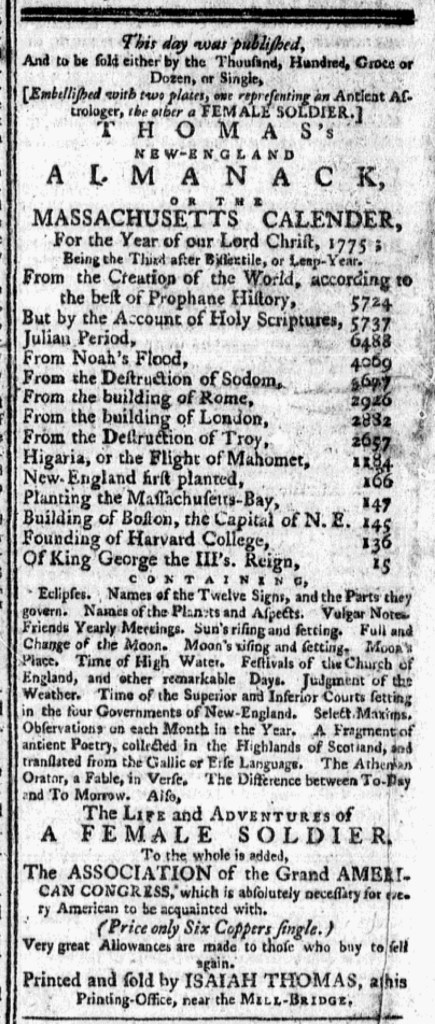
Like many colonial printers, Isaiah Thomas generated significant revenue from publishing almanacs. From the most affluent to the most humble households in port cities and in the countryside, each year colonizers acquired these handy reference manuals that included all kinds of information. Thomas’s “NEW-ENGLAND ALMANACK, OR THE MASSACHUSETTS CALENDER, For the Year of our Lord Christ, 1775,” for instance, had everything from the tides or “Time of High Water” to a schedule of “the Superior and Inferior Courts setting in the four Governments of New-England” to poetry. Thomas “Embellished” the almanac with two images, “one representing an Antient Astrologer, the other a FEMALE SOLDIER.” The latter corresponded to the “LIFE and ADVENTURES of A FEMALE SOLDIER” that the printer promoted among the content of his almanac. Practically every almanac included the tides and many listed the dates for important meetings in Connecticut, Massachusetts, New Hampshire, and Rhode Island, so Thomas and other printers sought ways to distinguish their almanacs from others, including images and novel stories.
Thomas anticipated doing brisk business with the contents that he selected for his almanac. He announced that he sold it “by the Thousand, Hundred, Groce or Dozen, or Single,” offering peddlers, booksellers, and shopkeepers the opportunity to purchase in volume for resale. A single copy cost “Six Coppers,” yet Thomas promised that “Very great Allowances are made to those who buy to sell again.” In addition to turning a profit on his almanac, this patriot printer also wanted it disseminated widely because of a particular item that he inserted among the contents. His almanac included “The ASSOCIATION of the Grand AMERICAN CONGRESS.” He referred to the Continental Association, a nonimportation agreement recently adopted by the First Continental Congress when it met in Philadelphia in September and October 1774. The inclusion of the Continental Association distinguished Thomas’s almanac from others advertised in the same issue of the Massachusetts Spy, including “BICKERSTAFF’S BOSTON ALMANACK” published by Nathaniel Mills and John Hicks and “LOW’S ALMANACK” published by John Kneeland. That newspaper also featured advertisements for two different editions of “EXTRACTS from the Votes and Proceedings of the American Continental CONGRESS,” which included the Continental Association. Whether or not readers happened to purchase that political pamphlet, Thomas provided easy access to what they needed to know about the nonimportation agreement in an almanac that they would consult for a variety of purposes throughout the coming year. He asserted that the Continental Association “is absolutely necessary for every American to be acquainted with” … and since so many colonizers already planned to purchase an almanac for 1775 they might as well become acquainted with the Continental Association by purchasing Thomas’s almanac, the one that he sought to distribute “by the Thousand, Hundred, Groce or Dozen” to get into as many households as possible.