January 31

What was advertised in a revolutionary American newspaper 250 years ago today?
Constitutional Gazette (January 31, 1776).

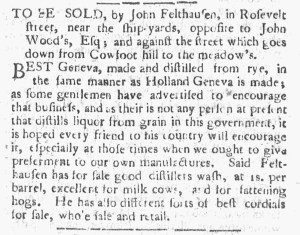
“BEST Geneva, made and distilled from rye.”

Advertisements for consumer goods and services crowded the pages of early American newspaper.  Did they work?  Unfortunately, that question is difficult to answer.  The advertisements reveal what kinds of marketing appeals merchants, shopkeepers, artisans, and other entrepreneurs thought would resonate with consumers and influence them to make purchases, but they rarely indicated how readers responded.

That so many entrepreneurs advertised and that they invested in advertising regularly suggests that they believed that they received a sufficient return on their investment to make the expense worth it.  Consider John Felthausen and his advertisement for “BEST Geneva [or Jenever, a type of gin], made and distilled from rye,” in the January 31, 1776, edition of the Constitutional Gazette.  That was not the first time that Felthausen placed that advertisement.  Three months earlier, he ran an advertisement with nearly identical copy in the New-York Gazette and Weekly Mercury.  If Felthausen believed that previous advertisement had not yielded results, would he have run it again in another newspaper a few months later?

That new advertisement had nearly identical copy, though the compositor for the Constitutional Gazette made very different decisions about the format than the compositor for the New-York Gazette and Weekly Mercury.  Felthausen may have even clipped the advertisement from one newspaper and delivered it to the printing office for the other, making marks on it to indicate copy he wished to update.  Those revisions amounted to adding a sentence at the end: “He has also different sorts of best cordials for sale, wholesale and retail.”  He retained his appeal to “every friend to this country” to “encourage” or support his business, “especially at those times when we ought to give preferment to our own manufactures.”  The distiller apparently believed that his previous advertisement met with sufficient success to merit repeating it to hawk both his “BEST Geneva” and additional products not previously included.

April 16

What was advertised in a colonial American newspaper 250 years ago this week?

Rivington’s New-York Gazetteer (April 13, 1775).

“Being fully determined not to be undersold by any person whatever.”

A “NEW ADVERTISEMENT BY RICHARD DEANE, Distiller,” ran in the April 13, 1775, edition of Rivington’s New-York Gazetteer.  Even though it had a dateline from two months earlier, “Feb. 10, 1775,” and had been running for several weeks, it still merited being called a “NEW ADVERTISEMENT” because it displaced another advertisement that Deane regularly placed in New York’s newspapers for many months.

The distiller took to the pages of the newspaper with some fanfare to inform “the public, my friends and customers” that he would not be undersold by any of his competitors who marketed their own “brandy, Geneva, and cordials.”  He believed that he had lost some customers to other distillers, prompting him to proclaim that he “can afford to sell said liquors on as cheap terms as any others can theirs, of an equal quality.”  Moreover, he deserved special consideration because “it cannot be denied, that I was the first distiller that ever made brandy and geneva, for sale in this province, … introducing a business, whereby the country saves annually large sums of money, that must otherwise have gone to foreign parts.”  Consumers should purchase his liquor, he asserted, to support local industry and, especially, the entrepreneur who took the risk of establishing the trade in the colony.  In turn, they could depend on what they spent supporting the local economy.

At the same time, Deane made appeals to quality.  He declared that even though he lowered his prices considerably, he still made “brandy and geneva of a full quality, and a high proof, as usual.”  He also pledged that he would not “diminish the goodness of my cordials, in any respect whatever.”  Furthermore, the “great demand for my liquors in most parts of North-America … is sufficient proof of their excellence.”  Consumers should trust existing customers, the distiller reasoned.  To encourage them to do so, he offered a price match guarantee.  He listed the prices the prices per gallon of brandy, gin, and several cordials, but also declared “that if any other person sells liquors of an equal quality with mine, cheaper than the rates underneath, I will immediately sell at the same price, being fully determined not to be undersold by any person whatever.”  Deane recognized that he lost customers because other set lower prices, but he aimed to win them back and gain new ones in the process.

April 6

What was advertised in a colonial American newspaper 250 years ago today?

Essex Journal (April 6, 1774).

“The business will be carried on as usual by his sons.”

In the spring of 1774, Patrick Tracy of Newburyport, Massachusetts, ran an advertisement in the Essex Journal to request those he owed money to call on him to settle accounts because he had “quitted the business he has been in of late years.”  Only after that did the conscientious entrepreneur also instruct “all who are indebted to him … to make speedy payment, more especially those whose debts have been long standing.”  Tracy made what he owed his priority, signaling how he did business and suggesting to current and prospective customers that they could expect similar treatment from his sons who carried on the business.  Tracy considered that business well enough known that he did not indicate his occupation.

His sons, however, revealed that they “have taken the business lately carried on by their honoured father” and “carry on the distillery as usual” in an advertisement that conveniently appeared immediately below Tracy’s notice in the April 6 edition of the Essex Journal.  Their father deployed more subtle means in attempting to pass along his clientele to his sons, while they instead emphasized their desire for “the continuance of his good customers and the custom of all others.”  The elder Tracy established a reputation during his many years in business.  His sons hoped to benefit from the customer loyalty their father had cultivated, asserting a “mutual advantage” for all involved.

To that end, they also made clear that they put the interests of their customers and associates first.  In addition to operating the distillery “as usual,” they also stocked “an assortment of English Goods, which they will sell by wholesale upon reasonable terms, and so as to afford a profit to the purchaser.”  Though they intended to make money on those transactions, the distillers associated “profit” with their customers who purchased imported goods from them, reversing the usual relationship between sellers and buyers.  Shopkeepers and others who purchased those items to sell retail would acquire them at low enough prices that Jackson, Tracy, and Tracy practically guaranteed that they could in turn offer such bargains that retail customers would purchase their wares.

In their newspaper advertisements, Tracy and his sons carefully choreographed his departure from the family business and their role in continuing its operations.  They sought to maintain and even expand the existing clientele by emphasizing certain principles, including paying what they owed to associates and selling merchandise at such “reasonable terms” that everyone involved benefited from the transactions.

April 4

What was advertised in a colonial American newspaper 250 years ago today?

New-York Gazette and Weekly Mercury (April 4, 1774).

“West-India and New-York rum.”

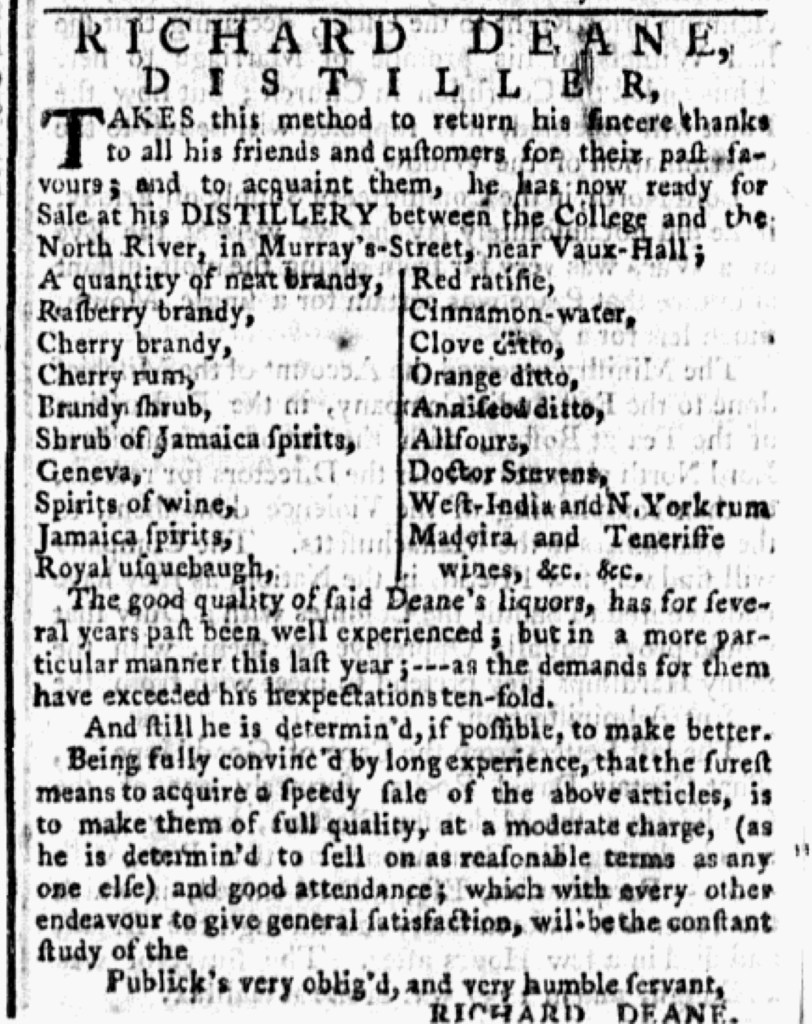
Delia Lee, a student in my Revolutionary America class, selected advertisements placed by local distillers in the April 4, 1774, edition of the New-York Gazette and Weekly Mercury to feature today.  Richard Deane frequently placed advertisements in the public prints.  The Adverts 250 Project previously examined one of his advertisements that he ran in the New-York Journal in 1772.  Philip Kissick, “DISTILLER and VINTNER,” on the other hand, is making his first appearance among on the Adverts 250 Project.

New-York Gazette and Weekly Mercury (April 4, 1774).

Delia, who was enrolled in business courses at the same time she was studying Revolutionary America, was interested in the production, distribution, and consumption of alcohol in early America.  When she set about her research, she consulted W.J. Rorabaugh’s overview of “Alcohol in America” in the OAH Magazine of History.[1]  According to Rorabaugh, “By 1770 Americans consumed alcohol, mostly in the form of rum and cider, routinely with every meal.”  Deane and Kissick stood ready to meet that demand.  Both included “West-India and New-York rum” among the lists of spirits that they sold.  Rorabaugh also notes that each colonizer “consumed about three and a half gallons of alcohol per year.”  Deane asserted that demand for his “Rasberry brandy,” “Cherry rum,” “Shrub of Jamaica spirits,” and other products “exceeded his expectations ten-fold,” suggesting a brisk market, especially for his wares.

Over the next couple of decades, the American Revolution and its aftermath “drastically changed drinking habits.  When the British blockaded the seacoast and thereby cut off molasses and rum imports, Americans looked for a substitute.”  Whiskey, distilled by Scot-Irish immigrants on the western frontier, replaced rum at the end of the eighteenth century “since the British refused to supply it and the new federal government began to tax it in the 1790s.”  Neither Deane nor Kissick included whiskey among the many spirits they advertised on the eve of the American Revolution.  Their advertisements provide a snapshot of the alcohol industry in the colonies at that time, an industry that politics and war would soon alter in significant ways.

**********

[1] W.J. Rorabaugh, “Alcohol in America,” OAH Magazine of History 6, no. 2 (Fall 1991): 17-19.

October 4

What was advertised in a colonial American newspaper 250 years ago this week?

New-York Journal (October 1, 1772).

“The surest Means to acquire a speedy Sale … is to make them of full Quality, at a moderate Charge, and good Attendance.”

Richard Deane, “DISTILLER, from “LONG-ISLAND,” considered experience one of the best markers of quality for the spirits that he sold in New York.  He stocked “a Quantity of neat Brandy, Geneva, Spirits of Wine, and Cordials of different Sorts” as well as “the very best Quality” shrub and New York rum.  In an advertisement in the October 1, 1772, edition of the New-York Journal, he attempted to leverage a precursor to name recognition or brand recognition, stating that the “good Quality of said DEANE’s Brandy, Geneva, and Cordials, has for several Years past been well experienced” by satisfied customers.  In turn, he redoubled his efforts “to excel in that particular Branch of Business” to further enhance his distillery’s reputation.

Deane elaborated on his business philosophy in a note that concluded his advertisement, confiding that he was “fully convinced by long Experience, that the surest Means to acquire a speedy Sale of the above Articles, is to make them of full Quality, at a moderate Charge, and good Attendance, which, with every other Endeavour to give Satisfaction, will be the constant Study, of the Public’s very obliged humble Servant.”  A manicule drew attention to the distiller’s promise to combine high quality, reasonable prices, and excellent customer service.  In many ways, Deane’s marketing strategy anticipated those deployed by breweries and distilleries today.  Many modern companies link their beers and spirits to traditions that date back to previous centuries, invoking a heritage their founders passed down through generations.  They invoke “long Experience” to encourage consumers to feel as though they participate in customs of significance when they imbibe beverages from their breweries or distilleries.  That “long Experience” also testifies to quality.  After all, breweries and distilleries would not remain in business so long if generations of customers did not appreciate their beers and spirits.  The philosophy that Dean expounded at the conclusion of his advertisement in the New-York Journal is the type of historical record that modern advertising executives would love to exploit in connection to the products they market.

July 16

What was advertised in a colonial American newspaper 250 years ago this week?

Jul 16 - 7:13:1769 Massachusetts Gazette Draper
Massachusetts Gazette [Draper] (July 13, 1769).
Confectioner and Distiller from London.”

In the summer of 1769 Peter Lorent, a confectioner and distiller, provided a variety of sweet treats to the residents of Boston. In addition to “Cakes of all kind,” he made and sold macaroons, sugar plums, candied fruits, syrups, and cordials.

As part of his marketing efforts, Lorent underscored the quality of his confections. He introduced himself to prospective customers as a “Confectioner and Distiller from London,” hoping readers would associate him with his counterparts in the most cosmopolitan city in the empire. Advertisers from many occupations, especially artisans and doctors, frequently deployed this strategy, implying that their origins testified to skills and expertise gained from training or employment on the other side of the Atlantic. They also prompted consumers to imbue their goods or services with the cachet of having been acquired from a purveyor “from London.” Advertisers like Lorent invoked their origins as a means of asserting status; they suggested that customers could demonstrate and enhance their own status by making purchases from the right providers of goods and services.

Lorent helped consumers reach the intended conclusions about the cakes, candies, and cordials they could acquire from a confectioner “from London.” He trumpeted that he made all of his treats “in as great Perfection as in Europe” and underscored that he had the requisite exposure to make that claim since he previously “worked in England, France, and Italy.” Lorent aimed to impress prospective customers with his experience that ranged beyond England to other countries often associated with taste and fashion. He also attempted to ease their anxieties about residing far from the center of the empire. Residents of Boston did not need to worry that they lived in a provincial backwater, not when they could consumer confections as fine as those enjoyed by the genteel ladies and gentlemen of London.

March 25

GUEST CURATOR: Ceara Morse

What was advertised in a colonial American newspaper 250 years ago today?

Mar 25 - 3:25:1767 Georgia Gazette
Georgia Gazette (March 25, 1767).

“HENRY SNOW, Distiller from London, MAKES and SELLS … FINE Georgia Geneva.”

Henry Snow distilled many different spirits, including “Georgia Geneva,” “Orange Shrub,” and “Mulberry Brandy.” Many of the spirits he distilled could probably be found in local taverns.

Taverns were very important gathering places in colonial and Revolutionary America. An article about the Queen’s Head Tavern (now more commonly known as Fraunces Tavern) in New York City states, “Taverns were centers of community in the 18th century.” They were where people came to stay as well as just come in for a drink and learn of what was going on in the area. Imported spirits sometimes did not come fast enough to keep up with their popularity in taverns and households, thus American produced spirits were needed to help provide taverns and other consumers with the alcoholic beverages they desired. That’s where American products, like Henry Snow’s spirits, came into play. Because it was expensive to even import these goods, the domestic products were that much better.

 **********

ADDITIONAL COMMENTARY: Carl Robert Keyes

Henry Snow walked a fine line in his advertisement for a variety of spirits “Distilled and sold at his shop” in Savannah. As Ceara notes, he produced an array of cordials, brandies, and other liquor to compete with imports at affordable prices. Yet he wanted to assure potential customers of the quality of the spirits he distilled. To do so, he adopted a strategy deployed by many artisans who placed advertisements in eighteenth-century newspapers: he indicated his place of origin along with his occupation.

In this case, Snow was not merely a distiller but instead a “Distiller from London.” This imbued him and his products with greater cachet by suggesting connections to the cosmopolitan center of the empire and perhaps even specialized training compared to his local competitors. It also served as a recommendation for the dozen or so different types of spirits he distilled, suggesting that they were among the most popular among consumers in the metropole. Just as tailors implied their familiarity with the latest fashions by stating they were “from London,” Snow hinted that he distilled spirits currently in vogue rather than backwater alternatives to the beverages enjoyed by “gentlemen” on the other side of the Atlantic.

Doing so also meant making assurances about the quality of his locally produced liquors, describing some of them as “fine” or “superfine.” (The layout of the advertisement suggests that the distiller may have intended for “FINE” to describe all of the spirits in the first column and all or most in the second.) As far as Snow’s brandy was concerned, “Any gentlemen who may be pleased to favour him with their orders” could depend on it being “equal to French” brandy. His usquebaugh, however, was an exception. It was merely “little inferior to Irish.” It appears that Henry Snow knew better than to suggest that his whiskey was equal or superior to any produced and imported from Ireland. “Little inferior to Irish” was exceptionally high praise indeed!