May 23

What was advertised in a colonial American newspaper 250 years ago today?
Dunlap’s Maryland Gazette (May 23, 1775).

Proper medicines in all stages of the Venereal disease put up with the most faithful attention to the symptoms.”

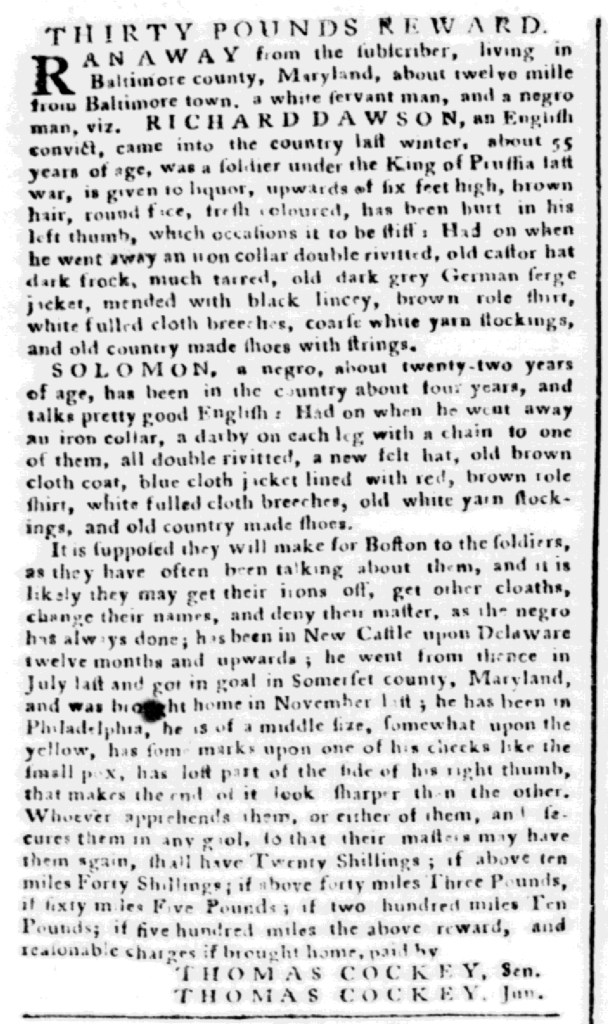
Patrick Kennedy, a surgeon and apothecary, advertised an “assortment of genuine Patent Medicines” available at his “Drug-Store” in Baltimore in the May 23, 1775, edition of Dunlap’s Maryland Gazette.  He carried many familiar items, including Bateman’s Drops and Stoughton’s Bitters, as well as “a few boxes of Patent dentifrice powder, for cleaning and beautifying the teeth.”  He also “compounded [prescriptions] with care and fidelity.”

Beyond those medicines and services, Kennedy devoted a significant portion of his advertisement to addressing readers who contracted syphilis and other venereal diseases.  “Proper medicines in all stages of the Venereal disease,” the apothecary advised, “put up with the most faithful attention to the symptoms.”  In other words, Kennedy devised prescriptions baes on the specific symptoms that patients reported to him.  When doing so, he observed “the most profound secrecy” to protect the privacy of his clients.  Prospective patients could trust Kennedy’s discretion concerning such delicate matters.  In addition to residents of Baltimore who visited his shop, he offered these services to “Persons afflicted with this disorder in the country.”  He instructed them to send “a line descriptive of their case” and then he would supply “remedies of the most approved kind, with ample directions.”  Providing written directions substituted for in-person consultations, allowing patients to use the medicines responsibly and effectively.  Although some may have been anxious about submitting their requests in writing, they may have found doing so less embarrassing than discussing their symptoms with the apothecary in his shop.  Ordering medicines from a distance made the patients nearly anonymous compared to face-to-face interactions at Kennedy’s shop.  His promise of “profound secrecy” also applied to those orders.

For those who had avoided misfortune and wished to keep it that way, the apothecary promoted the “Antivenereal preventive Wash.”  He explained that “repeated experiments” demonstrated its “assured efficacy in destroying the recent venereal infection; as it never fails to search after and cleanse away the acting cause of the malady.”  Kennedy hoped that readers would consider this preventative regimen worth the investment since it “preserv[ed] the constitution from the long course of medicines” that they would otherwise take after contracting venereal diseases.  As Benjamin Franklin had advised a few decades earlier, an ounce of prevention was worth a pound of cure!  Kennedy hoped that sentiment would resonate with prospective clients who sought to avoid venereal diseases.

May 16

What was advertised in a revolutionary American newspaper 250 years ago today?

Dunlap’s Maryland Gazette (May 16, 1775).

“He will sell at smaller profits than usual … agreeable to the resolve of the Continental Congress.”

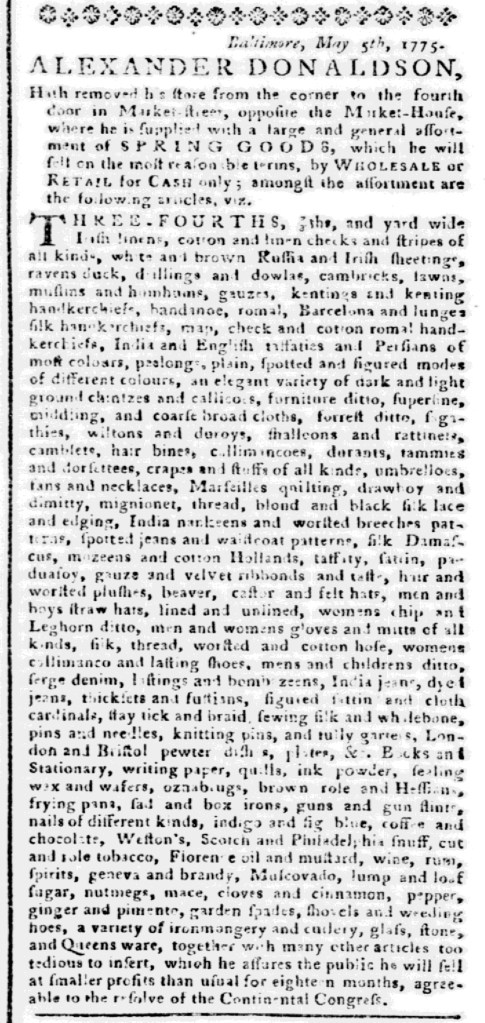
Alexander Donaldson advertised a “large and general assortment of SPRING GOODS” available at his store in Baltimore in Dunlap’s Maryland Gazette in the spring of 1775.  To entice prospective customers, he provided an extensive list of textiles, accessories, housewares, and other items.  His inventory included, for instance, “India and English taffaties and Persians of most colours,” “an elegant variety of dark and light ground chintzes and callicoes,” “umbrelloes, fans and necklaces,” “taffaty, sattin, paduasoy, gauze and velvet ribbonds,” “men and womens gloves and mitts of all kinds,” “London and Bristol pewter,” “a variety of ironmongery and cutlery,” and “writing paper, quills, ink powder, [and] sealing wax and wafers.”  Donaldson also stocked “many other articles too tedious to insert,” though his concern may have been the additional cost to catalog even more of his merchandise in an already-lengthy newspaper notice.

The merchant ended with a note that he “will sell at smaller profits than usual for eighteen months, agreeable to the resolve of the Continental Congress.”  In doing so, he invoked the ninth article of the Continental Association, a nonimportation, nonconsumption, and nonexportation agreement devised by the First Continental Congress in response to the Coercive Acts.  That article specified, “That such as are Venders of Goods or Merchandise will not take Advantage of the Scarcity of Goods thar may be occasioned by this Association, but will sell the same at the Rates we have been respectively accustomed to do for twelve Months last past.”  In other words, merchants and shopkeepers would not gouge customers by jacking up prices once the Continental Association went into effect on December 1, 1774.  The ninth article also spelled out the consequences: “if any Venders of Goods or Merchandise shall sell any Goods on higher Terms, or shall in any Manner, or by any Device whatsoever, violate or depart from this Agreement, no Person ought, nor will any of us deal with any such Person, or his or her Factor or Agent, at any Time thereafter, for any Commodity whatever.”

Considering such penalties, Donaldson very carefully explained that he set fair prices.  Even better, he offered bargains to his customers.  The Continental Association called for selling at the “Rates” or prices established during the year before it went into effect, yet Donaldson declared that he “will sell at smaller profits than usual.”  He did not indicate when his good arrived in the colonies, leaving it to readers to assume that since he abides by the price controls that he also observed the deadline for receiving imported goods.  The favorable “Rates” for his wares may have also distracted colonizers from asking too many questions about when Donaldson’s inventory had been ordered and shipped or when it arrived in an American port.  In addition, the merchant did not list tea, forbidden by the third article, alongside other popular beverages, coffee and chocolate, another indication that he adhered to the Continental Association.  Donaldson signaled to customers that they could shop at his store while still supporting the American cause.

April 2

What was advertised in a colonial American newspaper 250 years ago this week?

Virginia Gazette [Dixon and Hunter] (April 2, 1775).

“Advertisements … will be ranged, without partiality as they come to Hand.”

Baltimore did not have its own newspaper until William Goddard commenced publication of the Maryland Journal on August 20, 1773.  Less than two years later, John Dunlap, the printer of Dunlap’s Pennsylvania Packet, proposed publishing a second newspaper in that growing port on the Chesapeake Bay.  He followed a model designed by Goddard, who had been publishing the Pennsylvania Chronicle in Philadelphia when he set about opening a second printing office and establishing another newspaper in a neighboring colony.

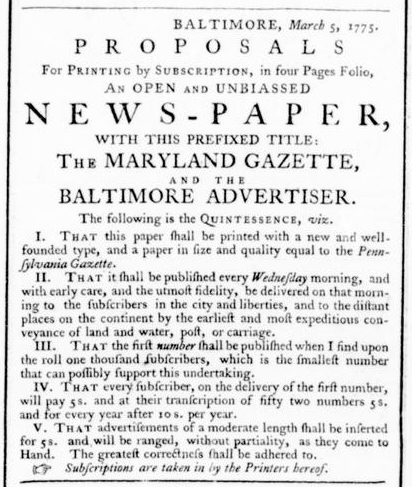
Dunlap disseminated subscription proposals widely, including inserting them in John Dixon and William Hunter’s Virginia Gazette.  He announced a plan for an “OPEN AND UNBIASED NEWS-PAPER,” a claim made by many printers during the era of the American Revolution even though they often took an editorial stance that favored either Patriots or Loyalists.  He planned to call it the “MARYLAND GAZETTE, AND THE BALTIMORE ADVERTISER,” distinguishing it from the Maryland Gazette published in Annapolis since 1745, but he would not take it to press until he attracted “one thousand subscribers, which is the smallest number that can possibly support this undertaking.”  The proposed newspaper apparently drew that many subscribers (or at least enough that Dunlap considered it a viable enterprise) because he issued the “first number” of Dunlap’s Maryland Gazette; or the Baltimore General Advertiser on May 2, just two months after the date on the proposals.  Perhaps subscribers grew eager for an additional source of news as the imperial crisis intensified, or perhaps news of the skirmishes at Lexington and Concord in April convinced Dunlap that the time was right to launch his newspaper, even if he did not yet have one thousand subscribers, because current events would guarantee its success.

His subscription proposal covered some of the usual nuts and bolts, what many printers called “conditions,” yet Dunlap referred to as “the QUINTESSENCE.”  He indicated that the newspaper “shall be printed with a new and well-founded type, and a paper in size and quality to the Pennsylvania Gazette,” curiously drawing comparison to another newspaper published in Philadelphia rather than his own.  He planned to publish a new issue “every Wednesday morning,” the same day that Goddard distributed copies of the Maryland Journal.  He promised delivery “on that morning to the subscribers in the city and liberties.”  Those in “the distant places on the continent,” such as readers of Dixon and Hunter’s Virginia Gazette, could expect “the earliest and most expeditious conveyance of land and water, post, or carriage.”  Subscriptions cost five shillings, due at the time of delivery of the first issues, and then another five shillings upon receiving fifty-two issues.  They continued at ten shillings each year.

While many subscription proposals for newspapers solicited advertisements, few specified how much they cost; instead, they declared that they charged the same fees as their competitors.  In the proposals for the Pennsylvania Ledger that also circulated in the first months of 1775, for instance, Jame Humphreys, Jr., stated, “Advertisements to be inserted on the same Terms as is usual with other Papers in this City.”  Similarly, Isaiah Thomas pronounced that advertisements in the Worcester Gazette would be “inserted in a neat and conspicuous [manner], at the same rates as they are in Boston.”  Dunlap, in contrast, gave a price: “advertisements of a moderate length shall be inserted for 5s.”  He did not, however, indicate how many times notices ran for that rate nor whether advertisers received discounts for subsequent insertions.  He did assert that they “will be ranged, without partiality, as they come to Hand.  The greatest correctness shall be adhered to.”  In other words, he would print notices in the order they arrived in the printing office; no advertisements would receive a privileged place based on their content, the printer’s relationship with the advertiser, or other factors.  All advertisers could depend on their notices appearing accurately in the Maryland Gazette.  The inaugural issue featured one advertisement.  The Adverts 250 Project will turn its attention to that advertisement and others in the coming months.