September 12

What was advertised in a revolutionary American newspaper 250 years ago today?
Dunlap’s Maryland Gazette (September 12, 1775).

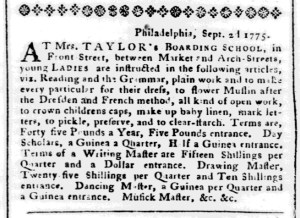
“Mrs. TAYLOR’s BOARDING SCHOOL … [for] young LADIES.”

The first advertisement in the September 12, 1775, edition of Dunlap’s Maryland Gazette, published in Baltimore, promoted “Mrs. TAYLOR’s BOARDING SCHOOL” for “young LADIES” on Philadelphia, apparently an elite institution based on the tuition.  The headmistress charged forty-five pounds per year along with an initial entrance fee of five pounds.  Taylor advised the parents and guardians of prospective pupils that they would be taught “Reading and the Grammar, plain work and to make every particular for their dress, to flower Muslin after the Dresden and French method, all kind of open work, to crown childrens caps, make up baby linen, mark letters, to pickle, preserve, and to clear-starch.”  The standard curriculum combined practical skills that prepared young women to run a household with some leisure activities that testified to their status.

Yet that was not the extent of the instruction that took place at Taylor’s boarding school.  For additional fees, her charges could opt for additional lessons taught by tutors that Taylor hired.  Students learned to form their letters from a “Writing Master” for fifteen shillings each quarter.  They learned their steps from a “Dancing Master” for a guinea (or twenty-one shillings) each quarter.  Although Taylor did not say so, those students presumably learned to dance with grace rather than focusing exclusively on the mechanics of minuets and other popular dances.  Lessons from a “Drawing Master” cost twenty-five shillings per quarter.  Taylor also listed a “Musick Mater &c. &c.” but did not note their rates.  Repeating the common abbreviation for et cetera twice suggested that other tutors taught painting, French, and other genteel pursuits in addition to singing and playing instruments.  Taylor operated her boarding school in the largest and most cosmopolitan city in the colonies.  For pupils aspiring to gentility, she could arrange for access to all sorts of instructors, allowing her students and their families to choose which kinds of lessons they needed or desired in addition to the standard curriculum.  For the gentry in Baltimore, a port growing in size and importance on the eve of the American Revolution, Taylor’s boarding school for young ladies may have looked very attractive indeed.

August 29

What was advertised in a revolutionary American newspaper 250 years ago today?

Dunlap’s Maryland Gazette (August 29, 1775).

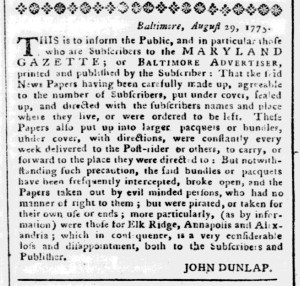
“The Papers taken out by evil minded persons, who had no manner of right to them.”

Something went wrong.  John Dunlap, the printer of Dunlap’s Maryland Gazette, had a system for delivering his newspaper to subscribers who lived outside of Baltimore, but “evil minded persons” interfered with it.  In particular, disruptions occurred in Annapolis and Elk Ridge, both in Maryland, and Alexandria, Virginia.  That prompted Dunlap to run a notice in the August 29, 1775, edition, placing it immediately after local news and first among the advertisements to increase the likelihood that readers would see it.

The exasperated printer went into great detail about his delivery infrastructure, hoping to convince “the Public, and in particular those who are Subscribers” that he made every effort to follow through on his obligation to deliver the newspaper.  The correct number of copies had been “carefully made up, agreeable to the number of Subscribers, put under covers, sealed up, and directed with the subscribers names and place where they live, or were ordered to be left.”  Then, those newspapers were “also put up into larger pacquets or bundles, under cover, with directions” and “constantly every week delivered to the Post-rider or other, to carry, or forward to the place they were directed to.”  Despite such careful attention and “notwithstanding such precaution, the said bundles or pacquets have been frequently intercepted, broke open, and the Papers taken out by evil minded persons, who had no manner of right to them.”  Dunlap called this “a very considerable loss and disappointment, both to the Subscribers and Publisher.”  Advertisers may have also been frustrated upon learning that the notices they paid to insert in Dunlap’s Maryland Gazette did not circulate as widely as they expected.  The printer likely realized that could have an impact on revenue as well.

Dunlap declared that the missing newspapers “were pirated, or taken for their own use or ends” by the thieves.  Despite the consequences for subscribers, advertisers, and the printer, the motivation for taking the newspapers may not have been completely nefarious.  In the wake of recent events – the battles at Lexington and Concord, the Battle of Bunker Hill, the Second Continental Congress meeting in Philadelphia, colonial assemblies holding their own meetings, George Washington assuming command of the Continental Army as it besieged Boston – colonizers were eager for news.  Some may have resorted to unsavory means of getting the latest updates, taking newspapers that did not belong to them.  That did not justify what they did, but it does testify to the role of the early American press in disseminating information about the imperial crisis and the Revolutionary War.  Some colonizers became better informed because of the theft, while subscribers to Dunlap’s Maryland Gazette had to seek out other newspapers or rely on conversations and correspondence to learn the latest updates.

August 22

What was advertised in a revolutionary American newspaper 250 years ago today?

Dunlap’s Maryland Gazette (August 22, 1775).

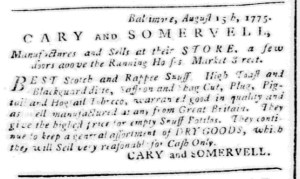
BEST Scotch and Rappee Snuff … warranted good in quality and as well manufactured as any from Great Britain.”

The partnership of Cary and Somervell stocked and sold “a general Assortment of DRY GOODS” at their store in Baltimore in the summer of 1775, but that was not their primary reason for running an advertisement in the August 22 edition of Dunlap’s Maryland Gazette.  Instead, they wished to advise the public that their firm “Manufactures and Sells … BEST Scotch and Rappee Snuff, High Toast and Blackguard [snuff], Saffron and Shag Cut, Plug, Pigtail and Hogtail Tobacco.”  Cary and Somervell offered tobacco users an array of choices of familiar products.  They also paid “the highest price for empty Snuff Bottles,” encouraging prospective customers to offset the cost of their purchases by trading in bottles that they no longer needed.

In promoting the tobacco products that they made in Baltimore, Cary and Somervell published promises about their wares: “warranted good in quality and as well manufactured as any from Great Britain.”  That was a familiar aspect of “Buy American” advertisements prior to the American Revolution, yet it had greater resonance once the Continental Association went into effect on December 1, 1774, and, especially, following the battles at Lexington and Concord on April 19, 1775.  The Continental Association, a nonimportation agreement devised by the First Continental Congress in response to the Coercive Acts, called for “encourag[ing] Frugality, Economy, and Industry; and promot[ing] Agriculture, Arts, and the Manufactures of this Country” as alternatives to imported goods.  Thus, the nonimportation agreement also outlined the responsibilities of both producers and consumers in the colonies.  Such civic duties gained even greater urgency in the wake of battles fought in Massachusetts.

Even without taking current events into consideration, Cary and Somervell issued a familiar challenge when they asserted that their tobacco products were as “good in quality and as well manufactured as any from Great Britain.”  How would consumers know unless they tested Cary and Somervell’s snuff and tobacco for themselves?  The partners used a bold assertion to entice prospective customers to sample their products and become the final arbiters of whether they, the consumers, agreed with the claims made in the newspaper advertisement.

August 8

What was advertised in a revolutionary American newspaper 250 years ago today?

Dunlap’s Maryland Gazette (August 8, 1775).

“A SERMON, PREACHED … the DAY recommended by the Honorable CONTINENTAL CONGRESS for A GENERAL FAST.”

On July 20, 1775, the “DAY recommended by the Honorable CONTINENTAL CONGRESS for A GENERAL FAST Throughout the TWELVE UNITED COLONIES of NORTH-AMERICA,” Thomas Coombe delivered a sermon to “the Congregations of CHIRST CHURCH and ST. PETER’s” in Philadelphia.[1]  Less than three weeks later, John Dunlap advertised a local edition of the sermon “PUBLISHED BY REQUEST” and sold in Baltimore in Dunlap’s Maryland Gazette.  He also printed a Philadelphia edition of the sermon, which apparently sold well enough to convince him to publish a second edition.  Solomon Southwick, printer of the Newport Mercury, produced yet another edition, as did James Magee in Belfast, Ireland.

According to researchers at the William Reese Company, a prominent antiquarian rare book dealer specializing in American, Coombe “was an Anglican minister and Loyalist in Philadelphia, and formerly the Chaplain for the Marquis of Rockingham.”  Both the advertisement and the title page noted the latter credential.  The sermon “calls for restraint amongst the citizenry of Philadelphia in the wake of the opening battles of the American Revolution.”  After the colonies declared independence, Coombe was imprisoned for his political stance, but “allowed to return to England in 1779.”  Publishing and disseminating this sermon, like various other sermons advertised during the summer of 1775, allowed the public greater access to discussions about how to respond to the imperial crisis after hostilities commenced in Massachusetts.  Colonizers read newspapers that carried reports about current events and editorials, examined pamphlets that outlined perspectives drawn from political philosophy ancient and modern, and participated in town meetings and everyday conversations about the deteriorating relationship between the colonies and Britain.  Sermons that circulated in print gave them even greater access to public discourse.  Just as they read news about events they had not witnessed when they perused newspapers, they became members of a congregation or audience when then read sermons printed and sold by early American printers.

Dunlap did something savvy in marketing the Baltimore edition of Coombe’s sermon.  He devoted the entire first page of the August 8, 1775, edition of Dunlap’s Maryland Gazette to the first portion of the sermon.  It spilled over onto the second page, along with a note: “To be Concluded in our next.)”  The printer gave readers a taste of the sermon.  Those who could not wait a week for the next issue or who wanted a copy in a single pamphlet could purchase the sermon at Dunlap’s printing office.  Those who did wait for the August 15 edition of the newspaper were disappointed.  The first page featured a portion of “The SPEECH of EDMUND BURKE, Esq; on moving his Resolutions for Conciliation with the Colonies, March 22, 1775,” along with a familiar note, “[To be Continued.]”  The remainder of Coombe’s sermon did not appear in that issue, nor in the Postscript, additional pages, that supplemented it.  Dunlap did continue Burke’s speech in the August 22 edition, but he neglected to provide the remainder of Coombe’s sermon.  The advertisement for the sermon, however, did appear on August 15 and August 22, enticing readers who wanted to finish what they had started.

**********

[1] Why twelve “UNITED COLONIES” instead of thirteen?  Georgia had not yet sent delegates to the Second Continental Congress.

July 11

What was advertised in a revolutionary American newspaper 250 years ago today?

Dunlap’s Maryland Gazette (July 11, 1774).

“It is hoped that all who wish to see the Manufactures of Great-Britain established in America will encourage this work.”

Robert Moore, a “Cabinet maker in Baltimore Town,” advertised paper hangings (or wallpaper) and “MOCK INDIA PICTURES” to decorate domestic interiors in a notice in Dunlap’s Maryland Gazette in July 1775.  He did not claim that he produced the paper hangings and pictures, only that he sold them.  The cabinetmaker likely aimed to diversity the revenue streams for his workshop.

Yet earning his livelihood was not Moore’s only purpose in hawking those items or promoting them in the public prints.  He also aimed to advance the American cause, doing his part in the commercial realm as readers in Maryland continued to receive news about military encounters, especially the battles at Lexington and Concord, the siege of Boston, and the Battle of Bunker Hill, and the Second Continental Congress and provincial congresses throughout the colonies coordinated responses as the imperial crisis became a war.  Both entrepreneurs and consumers had been using commerce as a means of resistance before the fighting commenced; Moore intended to continue following that strategy.  The Continental Association that the First Continental Congress devised in response to the Coercive Acts, called for boycotting imported goods and encouraging the production and consumption of alternatives made in the colonies.

Moore echoed that ideology in his advertisement.  He proclaimed that he paper hangings and pictures were “all entire the Manufacture of this Country.”  Perhaps he stocked paper hangings produced by Ryves and Fletcher at their “NEW AMERICAN MANUFACTORY” in Philadelphia and advertised in Dunlap’s Pennsylvania Packet.  Whatever the source, Moore emphasized that their quality (“great Perfection”) and price (“lower rates”) rivaled those imported from England.  Consumers did not have to make sacrifices to when they chose to put their political principles into action in the marketplace.  Furthermore, Moore asserted that consumers had a civic responsibility to purchase goods produced in the colonies: “It is hoped that all who wish to see the Manufactures of Great-Britain established in America will encourage this work.”  Even after the fighting commenced in New England, colonizers attempted to continue exerting pressure on Parliament through the choices they made as retailers and consumers.

July 4

Who was the subject of an advertisement in a revolutionary American newspaper 250 years ago today?

Dunlap’s Maryland Gazette (July 4, 1775). NB: The compositor mistakenly updated the masthead to “TUESDAY, JULY 3, 1775,” instead of “TUESDAY, JULY 4, 1775.”

“SOLOMON, a negro, … will make for Boston to the soldiers.”

They made their escape together.  Solomon, an enslaved man, and Richard Dawson, a “white servant man” and “an English convict,” ran away from Thomas Cockey, Sr., and Thomas Cockey, Jr., in Baltimore County in the spring of 1775.  Their advertisement describing Solomon and Dawson first appeared in the May 16, 1775, edition of Dunlap’s Maryland Gazette.  The two men apparently eluded capture because the notice ran regularly for the next several months, including in the July 4 edition.

When they departed, both Solomon and Dawson had an “iron collar double rivetted.”  Solomon had also been outfitted with “a darby” or fetters “on each leg with a chain to one of them,” probably because the Cockeys correctly considered him likely to attempt to liberate himself.  He did, after all, have a history of making a break for freedom.  According to the Cockeys, Solomon previously made it to New Castle in Delaware, remaining there for “twelve months and upwards,” but then in July 1774 went to Somerset County, Maryland.  There he was captured, jailed, and “brought home in November.”  Within months, he became a fugitive seeking freedom once again.  The Cockeys believed that Solomon “has been in Philadelphia.”

Solomon was a young man, “about twenty-two years of age,” who had been in the colonies “about four years.”  Dawson, in contrast, was older, “about 55 years of age.”  He had served as a soldier “under the King of Prussia [during the] last war.”  The Cockeys did not indicate which crimes Dawson committed to merit punishment as a convict servant transported to America.  They did speculate that Solomon and Dawson “will make for Boston to the soldiers, as they have often been talking about them,” though they did not reveal the particulars of what the enslaved man and the former soldier had to say about the British troops or when their conversations first occurred.  Had they taken place after learning of the battles at Lexington and Concord?  Did Dawson think that British soldiers might feel some sympathy for a former comrade?  Did Solomon believe that regulars would shelter him from the colonizers who put him in bondage?  Even if they did not hope for aid, Solomon and Dawson might have considered the upheaval in New England the best opportunity to avoid detection and capture.  The Cockeys anticipated that both men would “get their irons off, get other cloaths [to disguise themselves], change their names, and deny their master.”  Since Solomon “talks pretty good English” and evaded capture for so long during his previous attempt to liberate himself, he had likely learned to tell plausible stories.

Some advertisements about enslaved men and women who liberated themselves by running away from their enslavers during the era of the American Revolution suggested that they received assistance from enslaved relatives and friends.  On occasion, other advertisements recorded enslaved people and unfree colonizers (indentured servants, convict servants, apprentices) working together.  The role that the battles at Lexington and Concord and the siege of Boston played in Solomon’s decision to make common cause with Dawson cannot be determined from the narrative the Cockeys presented in their advertisement.  What is clear, however, is that Solomon repeatedly made his own declarations of independence.

For other stories of enslaved people liberating themselves originally published on July 4 during the era of the American Revolution, see:

May 23

What was advertised in a colonial American newspaper 250 years ago today?

Dunlap’s Maryland Gazette (May 23, 1775).

Proper medicines in all stages of the Venereal disease put up with the most faithful attention to the symptoms.”

Patrick Kennedy, a surgeon and apothecary, advertised an “assortment of genuine Patent Medicines” available at his “Drug-Store” in Baltimore in the May 23, 1775, edition of Dunlap’s Maryland Gazette.  He carried many familiar items, including Bateman’s Drops and Stoughton’s Bitters, as well as “a few boxes of Patent dentifrice powder, for cleaning and beautifying the teeth.”  He also “compounded [prescriptions] with care and fidelity.”

Beyond those medicines and services, Kennedy devoted a significant portion of his advertisement to addressing readers who contracted syphilis and other venereal diseases.  “Proper medicines in all stages of the Venereal disease,” the apothecary advised, “put up with the most faithful attention to the symptoms.”  In other words, Kennedy devised prescriptions baes on the specific symptoms that patients reported to him.  When doing so, he observed “the most profound secrecy” to protect the privacy of his clients.  Prospective patients could trust Kennedy’s discretion concerning such delicate matters.  In addition to residents of Baltimore who visited his shop, he offered these services to “Persons afflicted with this disorder in the country.”  He instructed them to send “a line descriptive of their case” and then he would supply “remedies of the most approved kind, with ample directions.”  Providing written directions substituted for in-person consultations, allowing patients to use the medicines responsibly and effectively.  Although some may have been anxious about submitting their requests in writing, they may have found doing so less embarrassing than discussing their symptoms with the apothecary in his shop.  Ordering medicines from a distance made the patients nearly anonymous compared to face-to-face interactions at Kennedy’s shop.  His promise of “profound secrecy” also applied to those orders.

For those who had avoided misfortune and wished to keep it that way, the apothecary promoted the “Antivenereal preventive Wash.”  He explained that “repeated experiments” demonstrated its “assured efficacy in destroying the recent venereal infection; as it never fails to search after and cleanse away the acting cause of the malady.”  Kennedy hoped that readers would consider this preventative regimen worth the investment since it “preserv[ed] the constitution from the long course of medicines” that they would otherwise take after contracting venereal diseases.  As Benjamin Franklin had advised a few decades earlier, an ounce of prevention was worth a pound of cure!  Kennedy hoped that sentiment would resonate with prospective clients who sought to avoid venereal diseases.

May 16

What was advertised in a revolutionary American newspaper 250 years ago today?

Dunlap’s Maryland Gazette (May 16, 1775).

“He will sell at smaller profits than usual … agreeable to the resolve of the Continental Congress.”

Alexander Donaldson advertised a “large and general assortment of SPRING GOODS” available at his store in Baltimore in Dunlap’s Maryland Gazette in the spring of 1775.  To entice prospective customers, he provided an extensive list of textiles, accessories, housewares, and other items.  His inventory included, for instance, “India and English taffaties and Persians of most colours,” “an elegant variety of dark and light ground chintzes and callicoes,” “umbrelloes, fans and necklaces,” “taffaty, sattin, paduasoy, gauze and velvet ribbonds,” “men and womens gloves and mitts of all kinds,” “London and Bristol pewter,” “a variety of ironmongery and cutlery,” and “writing paper, quills, ink powder, [and] sealing wax and wafers.”  Donaldson also stocked “many other articles too tedious to insert,” though his concern may have been the additional cost to catalog even more of his merchandise in an already-lengthy newspaper notice.

The merchant ended with a note that he “will sell at smaller profits than usual for eighteen months, agreeable to the resolve of the Continental Congress.”  In doing so, he invoked the ninth article of the Continental Association, a nonimportation, nonconsumption, and nonexportation agreement devised by the First Continental Congress in response to the Coercive Acts.  That article specified, “That such as are Venders of Goods or Merchandise will not take Advantage of the Scarcity of Goods thar may be occasioned by this Association, but will sell the same at the Rates we have been respectively accustomed to do for twelve Months last past.”  In other words, merchants and shopkeepers would not gouge customers by jacking up prices once the Continental Association went into effect on December 1, 1774.  The ninth article also spelled out the consequences: “if any Venders of Goods or Merchandise shall sell any Goods on higher Terms, or shall in any Manner, or by any Device whatsoever, violate or depart from this Agreement, no Person ought, nor will any of us deal with any such Person, or his or her Factor or Agent, at any Time thereafter, for any Commodity whatever.”

Considering such penalties, Donaldson very carefully explained that he set fair prices.  Even better, he offered bargains to his customers.  The Continental Association called for selling at the “Rates” or prices established during the year before it went into effect, yet Donaldson declared that he “will sell at smaller profits than usual.”  He did not indicate when his good arrived in the colonies, leaving it to readers to assume that since he abides by the price controls that he also observed the deadline for receiving imported goods.  The favorable “Rates” for his wares may have also distracted colonizers from asking too many questions about when Donaldson’s inventory had been ordered and shipped or when it arrived in an American port.  In addition, the merchant did not list tea, forbidden by the third article, alongside other popular beverages, coffee and chocolate, another indication that he adhered to the Continental Association.  Donaldson signaled to customers that they could shop at his store while still supporting the American cause.

April 2

What was advertised in a colonial American newspaper 250 years ago this week?

Virginia Gazette [Dixon and Hunter] (April 2, 1775).

“Advertisements … will be ranged, without partiality as they come to Hand.”

Baltimore did not have its own newspaper until William Goddard commenced publication of the Maryland Journal on August 20, 1773.  Less than two years later, John Dunlap, the printer of Dunlap’s Pennsylvania Packet, proposed publishing a second newspaper in that growing port on the Chesapeake Bay.  He followed a model designed by Goddard, who had been publishing the Pennsylvania Chronicle in Philadelphia when he set about opening a second printing office and establishing another newspaper in a neighboring colony.

Dunlap disseminated subscription proposals widely, including inserting them in John Dixon and William Hunter’s Virginia Gazette.  He announced a plan for an “OPEN AND UNBIASED NEWS-PAPER,” a claim made by many printers during the era of the American Revolution even though they often took an editorial stance that favored either Patriots or Loyalists.  He planned to call it the “MARYLAND GAZETTE, AND THE BALTIMORE ADVERTISER,” distinguishing it from the Maryland Gazette published in Annapolis since 1745, but he would not take it to press until he attracted “one thousand subscribers, which is the smallest number that can possibly support this undertaking.”  The proposed newspaper apparently drew that many subscribers (or at least enough that Dunlap considered it a viable enterprise) because he issued the “first number” of Dunlap’s Maryland Gazette; or the Baltimore General Advertiser on May 2, just two months after the date on the proposals.  Perhaps subscribers grew eager for an additional source of news as the imperial crisis intensified, or perhaps news of the skirmishes at Lexington and Concord in April convinced Dunlap that the time was right to launch his newspaper, even if he did not yet have one thousand subscribers, because current events would guarantee its success.

His subscription proposal covered some of the usual nuts and bolts, what many printers called “conditions,” yet Dunlap referred to as “the QUINTESSENCE.”  He indicated that the newspaper “shall be printed with a new and well-founded type, and a paper in size and quality to the Pennsylvania Gazette,” curiously drawing comparison to another newspaper published in Philadelphia rather than his own.  He planned to publish a new issue “every Wednesday morning,” the same day that Goddard distributed copies of the Maryland Journal.  He promised delivery “on that morning to the subscribers in the city and liberties.”  Those in “the distant places on the continent,” such as readers of Dixon and Hunter’s Virginia Gazette, could expect “the earliest and most expeditious conveyance of land and water, post, or carriage.”  Subscriptions cost five shillings, due at the time of delivery of the first issues, and then another five shillings upon receiving fifty-two issues.  They continued at ten shillings each year.

While many subscription proposals for newspapers solicited advertisements, few specified how much they cost; instead, they declared that they charged the same fees as their competitors.  In the proposals for the Pennsylvania Ledger that also circulated in the first months of 1775, for instance, Jame Humphreys, Jr., stated, “Advertisements to be inserted on the same Terms as is usual with other Papers in this City.”  Similarly, Isaiah Thomas pronounced that advertisements in the Worcester Gazette would be “inserted in a neat and conspicuous [manner], at the same rates as they are in Boston.”  Dunlap, in contrast, gave a price: “advertisements of a moderate length shall be inserted for 5s.”  He did not, however, indicate how many times notices ran for that rate nor whether advertisers received discounts for subsequent insertions.  He did assert that they “will be ranged, without partiality, as they come to Hand.  The greatest correctness shall be adhered to.”  In other words, he would print notices in the order they arrived in the printing office; no advertisements would receive a privileged place based on their content, the printer’s relationship with the advertiser, or other factors.  All advertisers could depend on their notices appearing accurately in the Maryland Gazette.  The inaugural issue featured one advertisement.  The Adverts 250 Project will turn its attention to that advertisement and others in the coming months.