March 26

What was advertised in a colonial American newspaper 250 years ago today?

Massachusetts Gazette and Boston Weekly News-Letter (March 26, 1772).

“An ORATION … to commemorate the BLOODY TRAGEDY.”

Encouragement to participate in the commemoration of the second anniversary of the Boston Massacre by purchasing a copy of the oration delivered by Joseph Warren to mark the occasion continued in the March 26, 1772, edition of the Massachusetts Gazette and Boston Weekly News-Letter.  Three days earlier, Benjamin Edes and John Gill announced in their own newspaper, the Boston-Gazette, that they had just published “AN ORATION DELIVERED MARCH 5TH, 1772 … TO COMMEMORATE THE BLOODY TRAGEDY.”  The following day, a notice in the Essex Gazette, published in Salem, alerted readers that “Yesterday was published in Boston, and now to be sold by Samuel Hall … An ORATION … to commemorate the BLOODY TRAGEDY.”  That advertisement was much shorter than the one in the Boston-Gazette.  Edes and Gill included a lengthy excerpt from Warren’s address in their notice as a means of inciting greater interest and enticing prospective customers.

As proprietors of the Boston-Gazette, Edes and Gill had access to as much space in that newspaper for promoting the goods and services available at their printing office as they wished.  On the other hand, they presumably had to pay to insert an advertisement in another newspaper, though they could have worked out some other arrangement with fellow printer Richard Draper when they advertised Warren’s oration in the Massachusetts Gazette and Boston Weekly News-Letter.  The advertisement in that newspaper was much shorter, consisting of only six lines without any of the excerpt about “the ruinous Consequences of standing Armies to free Communities.”  There may have been limits to what Draper was willing to publish, either paid or gratis.  After all, the excerpt from the oration amounted to an editorial even though it appeared among advertisements.  Draper’s newspaper tended to take a more supportive stance toward the British government, especially compared to the strident critiques that regularly ran in the Boston-Gazette.  Among the printers in Boston, Edes and Gill were some of the most ardent in supporting and promoting the Patriot cause.  For them to advertise “An ORATION … to commemorate the BLOODY TRAGEDY” in the Massachusetts Gazette and Boston Weekly News-Letter at all had political significance likely not lost on readers.

March 4

What was advertised in a colonial American newspaper 250 years ago this week?

Boston-Gazette (March 2, 1772).

“THE FRUGAL HOUSEWIFE … By SUSANNAH CARTER.”

In 1772, Benjamin Edes and John Gill, printers of the Boston-Gazette, published an American edition of The Frugal Housewife, or Complete Woman Cook by Susannah Carter of London.  The book included “Five Hundred approved Receipts” for everything from roasting and frying to sauces and soups to tarts and puddings to jellies and custards as well as instructions for preserving, pickling, and candying various foods.  In addition, Carter provided “Various BILLS of FARE, For DINNERS and SUPPERS in every Month of the Year” to guide readers in consulting the many recipes and choosing which items to prepare together.  The book also featured “a copious Index of the whole” to help readers find the recipes.  Edes and Gill promised that “Any Person, by attending to the Instructions given in this Book, may soon attain to a compleat Knowledge in the Art of Cookery.”

The printers marketed The Frugal Housewife in their own newspaper, but they also turned to other publications in their effort to create a larger market for what they believed had the potential to be a popular American edition of a cookbook first published in London in the 1760s.  On March 2, 1772, they ran advertisements in both the Boston Evening-Post and the Boston-Gazette.  Three days later, they placed an advertisement in the Massachusetts Spy.  The notices in the other newspapers were not as elaborate as the one that appeared in their own.  The version in the Boston-Evening Post, for instance, did not include the price nor the nota bene assuring prospective customers that they would acquire “a complete Knowledge” of cooking.  The version in the Massachusetts Spy, on the other hand, included both of those items as well as a note that the book “contains more in Quantity than most other Books of a much higher Price.”  It did not, however, feature the distinctive typography with only two items on each line that made the notices in the other newspapers occupy significantly more space.  Instead, a dense list of the contents comprised most of the content of the advertisement in the Massachusetts Spy.

Edes and Gill sought to expand their marketing and sales by placing advertisements in multiple newspapers.  Though they exercised control over the copy, they did not exert as much influence when it came to the format.  Compositors who labored in other printing offices made decisions about the appearance of Edes and Gill’s advertisements for The Frugal Housewife.

December 26

What was advertised in a colonial American newspaper 250 years ago today?

Massachusetts Spy (December 26, 1771).

“AMES’s ALMANACK, for 1772.  Sold by EDES & GILL, and T. & J. FLEET.”

Ebenezer Russell correctly anticipated that some of his competitors would produce and sell a pirated edition of “AMES’s ALMANACK, for 1772.”  He warned consumers, running advertisements that proclaimed that he published “THE original Copy” of the popular almanac yet suspected that other printers planned to market their own editions.  On December 26, 1771, the Massachusetts Spy carried advertisements for both.  In a fairly lengthy advertisement, Russell described the contents to entice consumers.  He also listed nearly twenty booksellers in Boston, Salem, Newburyport, and Portsmouth who sold his edition.  A shorter advertisement simply announced, “This day published, AMES’s ALMANACK, for 1772.  Sold by EDES & GILL, and T. & J. FLEET.”

Isaiah Thomas, the printer of the Massachusetts Spy, appeared on Russell’s list of booksellers.  That did not prevent him from running an advertisement for the pirated edition.  He also inserted his own advertisement advising readers of “AMES’s, Low’s, Bicker[st]aff’s, Massachusetts and Sheet ALMANACKS, to be sold by I. THOMAS, near the Mill Bridge.”  Conveniently, that notice was the only advertisement on the second page, making it the first that readers encountered as they perused the December 26 edition.  Almanacs had the potential to generate significant revenues for printers in the early American marketplace.

It was not the first time that Benjamin Edes and John Gill, printers of the Boston-Gazette, and Thomas Fleet and John Fleet, printers of the Boston Evening-Post, pirated Ame’s Almanack.  In 1768, a cabal of printers issued a pirated copy of William Alpine’s legitimate edition of Nathaniel Ames’s Astronomical Diary, or, Almanack for the Year of Our Lord Christ 1769.  The conspirators included Edes and Gill and the Fleets as well as Ricard Draper, the printer of the Massachusetts Gazette and Boston Weekly News-Letter.  This time around, however, Draper did not join his fellow printers in that endeavor.  Instead, Russell included him among the authorized sellers of “THE original Copy” in his advertisements.

As the new year approached, consumers still in the market for purchasing almanacs had a variety of choices.  In addition to choosing from among a variety of popular and familiar titles, those who followed the dispute between Russell and his competitors that unfolded in newspaper advertisements faced decisions about whether they wished to acquire an “original Copy” or reward the printers and booksellers who sold a pirated edition.

June 17

Who was the subject of an advertisement in a colonial American newspaper 250 years ago today?

Supplement to the Boston-Gazette (June 17, 1771).

“For further Particulars, enquire of Edes & Gill.”

Two short advertisements about enslaved people appeared in the June 17, 1771, edition of the Boston Evening-Post.  One announced, “TO BE SOLD, A likely Negro Fellow about 15 Years of Age.”  The other declared, “A Negro Child of a good Breed, to be given away.”  The same day, two other advertisements ran in the Boston-Gazette.  “To be Sold for Want of Employ,” stated one, “A likely Negro Woman, about 33 Years old, remarkable for Honesty and a good Temper.”  The other described “a Negro Man named Dick or Richard” who liberated himself.  The clever fugitive for freedom possessed a forged pass.

Each of those advertisements testified to the presence of slavery in northern colonies in the era of the American Revolution.  As colonists debated their rights and objected to abuses perpetrated by Parliament, many continued to enslave Africans and African Americans.  They turned to the same newspapers that kept them informed about politics and current events to facilitate the buying and selling … and even giving away … of enslaved men, women, and children.  In offering a reward for the capture and return of Dick, David Edgar encouraged all readers, whether enslavers or not, to engage in surveillance of Black people to detect the fugitive seeking freedom.  Newspapers, especially advertisements, helped perpetuate slavery in early America.

Most of those advertisements in the Boston Evening-Post and the Boston-Gazette on June 17 had another similarity:  the extent that the printer participated in the transaction.  Edgar was the only advertiser who signed his notice.  Both advertisements in the Boston Evening-Post concluded with “Enquire of the Printers.”  The one offering a “likely Negro Woman” for sale in the Boston-Gazette advised, “For further Particulars, enquire of Edes & Gill.”  In addition to being well known as printers of that newspaper, their names appeared in the colophon at the bottom of the column that featured that advertisement.  The printers of both newspapers not only generated revenues by publishing advertisements about enslaved people but also actively took part in the buying, selling, and giving away of enslaved men, women, and children.  They played the role of information brokers beyond the printed page, providing additional services to enslavers who placed and responded to advertisements.

May 6

What was advertised in a colonial American newspaper 250 years ago today?

Boston-Gazette (May 6, 1771).

“AN ORATION … to COMMEMORATE the BLOODY TRAGEDY.”

In the spring of 1771, colonists had several opportunities to purchase memorabilia that marked the first anniversary of the Boston Massacre.  For the fourth consecutive week, Benjamin Edes and John Gill advertised James Lovell’s “ORATION … to COMMEMORATE the BLOODY TRAGEDY” in the May 6 edition of the Boston-Gazette.  Edes and Gill, printers of that newspaper, also printed the oration “by Order of the Town of BOSTON,” according to the imprint on the title page.

Lovell delivered the first oration commemorating the Boston Massacre sanctioned by the town of Boston on April 2, 1771, though Thomas Young also gave an address on the same theme a few weeks earlier and closer to the first anniversary of British soldiers firing into a crowd and killing several colonists.  No copy of Young’s address survives, but Edes and Gill took Lovell’s oration to press less than two weeks after he spoke to the residents of Boston.  Starting on April 15, they promoted the oration in the Boston-Gazette, informing readers that they could acquire copies of this commemorative item.  A week later, Samuel Hall, printer of the Essex Gazette, advised residents of Salem and its environs that he also carried Lovell’s oration.

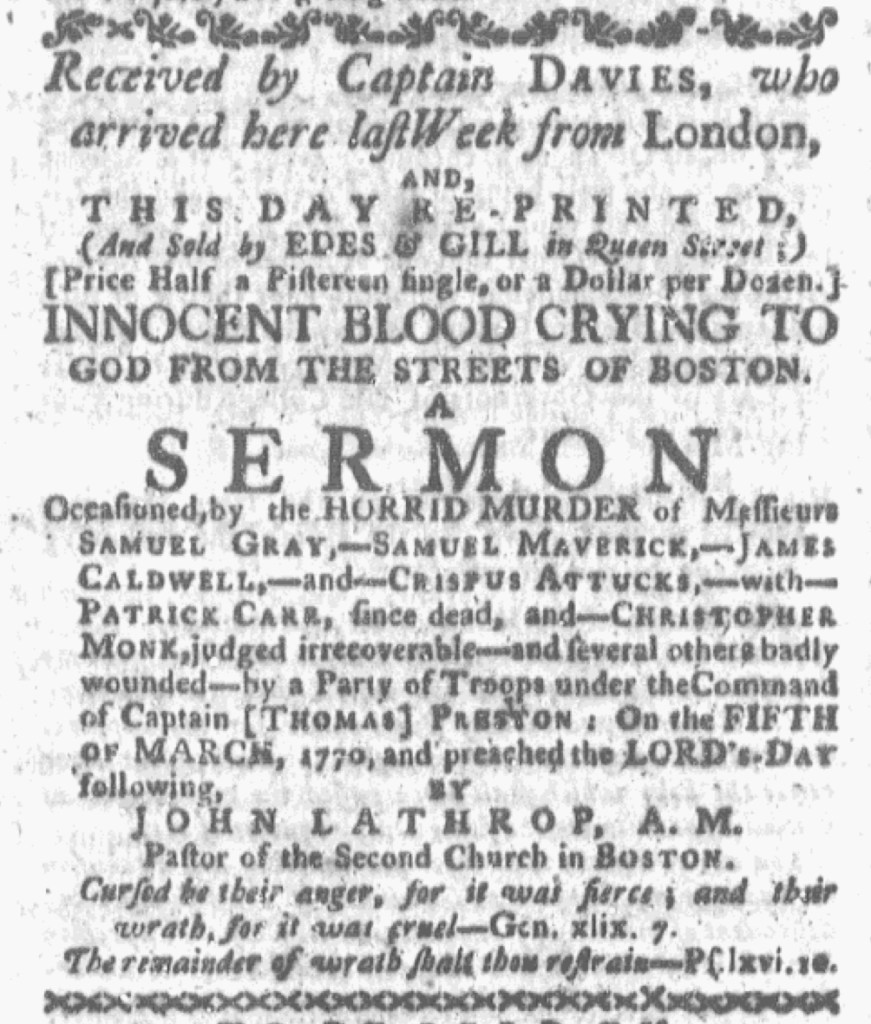
Edes and Gill simultaneously marketedINNOCENT BLOOD CRYING TO GOD FROM THE STREETS OF BOSTON,” a sermon that John Lathrop, “Pastor of the Second Church in BOSTON,” delivered just days after the Boston Massacre.  Edes and Gill reprinted a London edition delivered to them by a ship captain who carried both news and consumer goods across the Atlantic.  In the case of the sermon, news and merchandise came packaged in a single pamphlet, ready for reprinting and dissemination throughout the busy port and into the countryside.  According to their advertisement, Edes and Gill sold the sermon single and by the dozen, an invitation to retailers to purchase and sell it in their shops.

Civic leaders in Boston encouraged a culture of commemoration around the Bloody Massacre, just as colonists in many towns marked the anniversary of the repeal of the Stamp Act.  Printers like Edes and Gill eagerly participated in that process, inspired by both their political principles and their desire to generate revenues.  Printing and marketing orations and sermons about the Boston Massacre helped to keep the event fresh in popular memory by making those addresses readily accessible long after the speakers delivered them.

April 29

What was advertised in a colonial American newspaper 250 years ago today?

Boston-Gazette (April 29, 1771).

“INNOCENT BLOOD CRYING TO GOD FROM THE STREETS OF BOSTON.”

When ships from England arrived in American ports in the spring of 1771, they delivered news of reactions to George Whitefield’s death from the other side of the Atlantic.  The prominent minister died in Newburyport, Massachusetts, on September 30, 1770.  It took several weeks for news to reach England and even longer, given the difficulty and dangers of crossing the North Atlantic in winter, before colonists learned how that news was received.  In addition to newspaper accounts, colonists also received commemorative items produced in England, including sermons dedicated to the memory of the minister.  Yet that was not the only memorabilia associated with major news events that vessels from England carried to the colonies on the spring of 1771.  They also delivered items that commemorated the Boston Massacre.

Benjamin Edes and John Gill, printers of the Boston-Gazette, received a London edition of “INNOCENT BLOOD CRYING TO GOD FROM THE STREETS OF BOSTON,” a sermon “Occasioned by the HORRID MURDER” of several colonists “by a Party of Troops under the Command of Captain [THOMAS] PRESTON” on March 5, 1770.  John Lathrop, “Pastor of the Second Church in BOSTON,” gave the sermon on the Sunday following the Boston Massacre.  Lathrop or an associate apparently sent a manuscript copy to London.  Printers there took the sermon to press.  The sermon then crossed the Atlantic in the other direction.  When Edes and Gill received it, they published an American edition of a sermon originally delivered in their own city, further disseminating it to consumers in Boston and beyond.  In so doing, they expanded the simultaneous commemoration and commodification of the Boston Massacre already underway in the colonies.

Edes and Gill intended to place copies of Lathrop’s sermon in the hands of as many readers as possible.  They offered discounts to buyers who purchased a dozen or more copies for retail sales, though they also sold single copies.  As entrepreneurs, they wished to generate revenues, but that did not comprise their sole motivation.  Edes and Gill were perhaps the most vocal of Boston’s printers when it came to supporting the patriot cause.  Their newspaper provided extensive coverage of current events, both news accounts and editorials with a patriot slant, during the imperial crisis that culminated in the American Revolution.  Both profits and their principles likely guided their decision to print and distribute Lathrop’s sermon on “INNOCENT BLOOD CRYING TO GOD FROM THE STREETS OF BOSTON.”  In so doing, they helped cultivate a culture of remembrance of significant events.  For several years, colonists had been marking the anniversary of the repeal of the Stamp Act.  In 1771, residents of Boston commenced a new tradition of commemorating the Massacre on or near its anniversary.  Edes and Gill participated, printing both James Lovell’s oration occasioned by the first anniversary and Lathrop’s sermon delivered just days after the Boston Massacre.

March 11

What was advertised in a colonial American newspaper 250 years ago today?

Boston-Gazette (March 11, 1771).

“The Feast of ST. PATRICK is to be celebrated, together with the Repeal of the STAMP-ACT.”

According to advertisements in the New-York Journal in February and March 1771, colonists began planning an event to commemorate the fifth anniversary of the repeal of the Stamp Act several weeks in advance of March 18.  The organizers invited “all the Friends of LIBERTY” to Hampden Hall to mark the occasion “with proper Festivity.”  In early March, advertisements about a similar gathering appeared in the Boston-Gazette.  In that case, however, the organizers combined commemorations of the repeal of the Stamp Act with celebrating the “Feast of ST. PATRICK” at the Green Dragon tavern.

The advertisement ran twice in the Boston-Gazette, first on March 4 and a week later in the last issue prior to the important anniversary.  In neither issue was it the only act of commemoration of events that ultimately led to the American Revolution.  Several years before declaring independence, colonists marked anniversaries of significant events.  In the March 4 edition, Benjamin Edes and John Gill, printers of the Boston-Gazette, inserted an editorial about the Boston Massacre.  “To-morrow will be the anniversary of the fatal fifth of March 1770,” they proclaimed, “when Mess. Gray, Maverick, Caldwell, Car and Attucks, were slain by the Hands of Eight Soldiers, of the 29th Regiment, then posted in this Town.”  Edes and Gill acknowledged that not all colonists agreed about why the soldiers were quartered in Boston, though they made their position clear.  “[S]ome ridiculously alledge” the soldiers were present “to preserve the Peace, but others say to inforce the Revenue Acts, and the arbitrary unconstitutional Measures of a corrupt and wicked Administration.”  The editorial further lamented the outcome of a trial during which “it was adjudg’d to be excuseable Homicide in six of the Soldiers, and in two of them Manslaughter!”  Despite the verdict, Edes and Gill declared that “By far the greater Part” of the residents of Boston “still think it was a barbarous Murder.”

When the advertisement for the gathering at the Green Dragon ran a second time a week later, Edes and Gill devoted the entire front page of the Boston-Gazette to reprinting the “solemn and perpetual MEMORIAL” about “Preston’s Massacre–in King-Street” that originally ran in the Essex Gazette on the day of the first anniversary of the Boston Massacre.  Thick black borders, a symbol of mourning in the wake of a significant loss, enclosed the entire memorial.  Before they encountered the invitation to the event commemorating the repeal of the Stamp Act at the Green Dragon tavern among the advertisements, readers already contemplated other abuses perpetrated by the British.

Dual commemorations thus appeared in the Boston-Gazette, spanning the sections devoted to news and advertising, in the first weeks of March 1771.  Edes and Gill marked the first anniversary of the Boston Massacre with editorials, one original and the other reprinted from another newspaper, while organizers of an event on the fifth anniversary of the repeal of the Stamp Act published advertisements inviting colonists to the Green Dragon tavern to celebrate.  Advertising contributed to a culture of invoking memories of important events as part of the political culture of the period.

August 29

What was advertised in a colonial American newspaper 250 years ago this week?

Aug 29 - 8:27:1770 Boston-Gazette
Boston-Gazette (August 27, 1770).

They have Removed their PRINTING-OFFICE two Doors lower down Queen-Street.”

Colonial printers adopted various strategies when it came to inserting advertisements in their newspapers.  Some reserved advertisements for the final pages, appearing only after news items, editorials, lists of prices current, shipping news from the custom house, poems for amusement or edification, and other content selected by the editor rather than paid for inclusion by advertisers.  Others placed advertisements on the first and fourth pages, with other content on the second and third pages.  Doing so reflected practical aspects of producing newspapers.  Most consisted of four pages created by printing two pages on each side of a broadsheet and then folding it in half.  That meant the first and fourth pages were printed with one pull of the press and the second and third pages with another.  Advertisements, often repeated from week to week, could be printed first on the first and last pages, allowing for any breaking news to be set in type as late as possible before the second and third pages went to press.  Both of those methods kept advertisements clustered together, either at the end of an issue or bookending it.  Another method more evenly distributed advertising throughout the newspaper, placing advertisement on every page, often, but not always, at the bottom or in the final column.

For the August 27, 1770, edition of the Boston-Gazette, printers Benjamin Edes and John Gill included advertising on each of its four pages.  Advertisements constituted the first of three columns on the first page, but only a few short advertisements appeared at the bottom of the third column on the second page.  Advertisements accounted for half of the third page, but, like the second page, they ran after news content, sequestered at the bottom of the second column and in the third.  The fourth page consisted entirely of advertising, with the exception of the colophon at the bottom of the final column.  No matter which page they perused, readers encountered advertising in this edition of the Boston-Gazette.  In the midst of all those paid notices, Edes and Gill reserved a privileged place for an advertisement concerning their own business.  In the first item in the first column on the first page, “THE PUBLISHERS of this Paper” placed an advertisement to “hereby inform their Customers and others, That they have Removed their PRINTING-OFFICE two Doors lower down Queen-Street, to the House formerly improv’d by Messieurs Kneeland & Green, directly opposite the new Court-House.”  Edes and Gill exercised their power as printers of the Boston-Gazette and their access to the press to increase the chances that readers would see and take note of their advertisement.  Other advertisers paid for access to the press, but they usually had little control over where their advertisements appeared in the newspaper.  When it came to the placement of advertisements within newspapers, printers had an advantage that “their Customers and others” did not.

April 2

What was advertised in a colonial American newspaper 250 years ago today?

Apr 2 - 4:2:1770 Boston-Gazette
Boston-Gazette (April 2, 1770).

“An Original Print, representing the late horrid Massacre in King Street.”

Although Paul Revere’s engraving is more famous, Henry Pelham also produced a print depicting the Boston Massacre shortly after the event took place.  He marketed his engraving, The Fruits of Arbitrary Power, in the April 2, 1770, editions of the Boston Evening-Post and the Boston-Gazette, a week after Revere promoted his Bloody Massacre in those same newspapers.  The Boston Massacre occurred on March 5, so both men moved quickly to make a visual representation of the event available for public consumption.  Revere offered his print for sale just three weeks after soldiers from the 29th Regiment shot into a crowd, wounding several colonists.  Some died of their wounds on the spot; others died soon after.  By the time Revere and Pelham marketed their prints, five colonists had died.

Many consumers may have thought that Pelham’s Fruits of Arbitrary Power closely resembled Revere’s Bloody Massacre, but the opposite was actually the case.  Pelham shared his drawing with Revere, then expressed dismay that his fellow engraver moved forward with his own print based on the drawing and beat Pelham to market by a week.  Their advertisements also resembled each other, neither of them particularly flashy considering the products they presented to consumers.  Pelham’s advertisement simply stated, “To be Sold by EDES and GILL and T. and J. FLEET, (Price Eight Pence) The Fruits of Arbitrary Power, an Original Print, representing the late horrid Massacre in King Street, taken from the Spot.”  (The version in the Boston Evening-Post switched the order of the printers who sold the print.  Each partnership gave itself top billing.). In stating that Fruits of Arbitrary Power was “an Original Print,” Pelham took a swipe at Revere and attempted to set the record straight.

Perhaps neither Revere nor Pelham considered it necessary to devise flashy advertisements for their competing prints.  After all, the Boston Massacre occurred only weeks earlier.  It received extensive newspaper coverage, including descriptions of the funeral procession honoring the victims.  Coverage continued as Boston prepared for a trial of Captain Thomas Preston and soldiers from the 29th Regiment.  Beyond the several newspapers printed in the busy port, the Boston Massacre was surely the talk of the town.  Neither the engravers who produced the prints nor the printers who sold them needed to explain their significance beyond noting that they depicted the “horrid Massacre” and offering brief commentary.  The title of Pelham’s engraving, The Fruits of Arbitrary Power, summed up the political calculus of the event.  He apparently considered that sufficient to convince consumers that they needed to acquire his memento of the Boston Massacre.  Consumption played a vital role in commemoration.

March 8

What was advertised in a colonial American newspaper 250 years ago today?

Mar 8 - 3:8:1770 Massachusetts Gazette and Boston Weekly News-Letter
MassachusettsGazette and Boston Weekly News-Letter (March 8, 1770).

“The Landing of – Troops in the Year 1768.”

At the time of the Boston Massacre, more newspapers were published in that city than any other in the colonies.  The Boston Chronicle, the Boston Evening-Post, the Boston-Gazette, and the Massachusetts Gazette and Boston Post-Boy all came out on Mondays.  Later in the week, the Massachusetts Gazette and Boston Weekly News-Letter and another edition of the Boston Chronicle both came out on Thursdays.  The Boston Massacre occurred on a Monday evening, by which time the newspapers usually published on that day had already been distributed to subscribers.  That meant that the News-Letter and the Chronicle were the first newspapers to appear after the “BLOODY MASSACRE perpetrated in King-Street, BOSTON on March 5th 1770 by a party of the 29th REG[IMEN]T” (as Paul Revere described the event).

Both carried limited coverage of the Boston Massacre.  The Chronicle, notorious for its pro-British sympathies, stated, “We decline at present, giving a particular account of this unhappy affair, as we hear the trial of the unfortunate prisoners [Captain Thomas Preston and eight soldiers] is to come on next week.”  The News-Letter issued a Postscript supplement that acknowledged the event but provided only a brief overview.  Its publisher, Richard Draper, also tended to support the British perspective, though usually not as vociferously as the publishers of the Chronicle.  Draper indicated that “A Number of Gentlemen are collecting Evidences of the whole Transactions, as soon as these are done, an Account will be drawn up and Published in the Papers.”  Four days later, Benjamin Edes and John Gill, vocal patriots, published an account of the Boston Massacre and the funeral procession for its victims in the Boston-Gazette, complete with a woodcut depicting the coffins and heavy black borders to denote mourning.

In the aftermath of the Boston Massacre, Edes and Gill ran an advertisement for their “North-American ALMANACK, AND Massachusetts REGISTER” in the March 8, 1770, edition of the News-Letter.  The list of contents made it clear that the publishers placed far more emphasis on the patriotic propaganda in the register than the astronomical calculations in the almanack, especially more than two months into the new year.  Edes and Gill had previously placed the same advertisement for their almanac and register in the News-Letter, but it did not run in the issue of that newspaper that came out immediately before the Boston Massacre.  It did reappear in the first edition published after the “tragical Affair,” as Draper described it.  Edes and Gill led the list of contents with a description of an illustration of “a Prospective View of the Town of Boston … and the Landing of – Troops in the Year 1768.”  Those troops eventually fired on the residents of Boston, killing and wounding many of them in the “Bloody Massacre.”  Although coverage of the “Proceedings of that Evening” was tentative and abbreviated in the first issue of the News-Letter after the Boston Massacre, the patriotic tenor of the advertisements for Edes and Gill’s almanack and register took on new urgency in the wake of recent events on King Street.