June 25

What was advertised in a colonial American newspaper 250 years ago today?
Providence Gazette (June 25, 1774).

“There has been Cause of many Complaints on the Part of his Customers.”

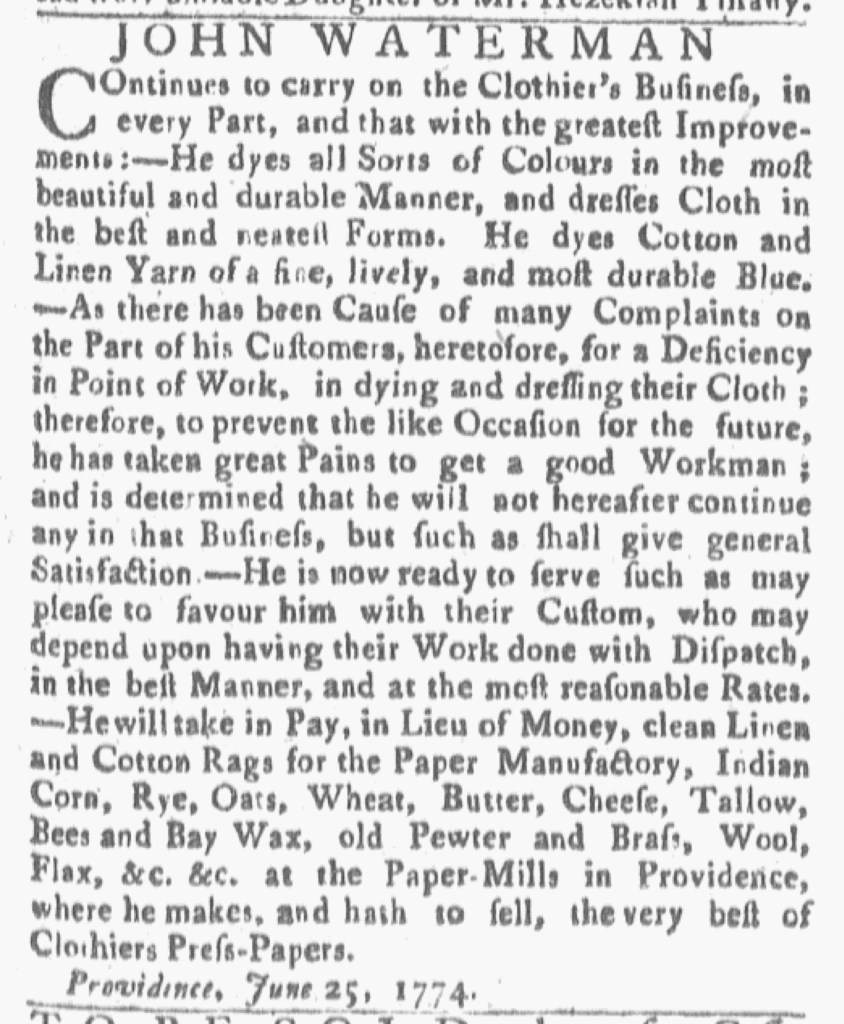
In the summer of 1774, John Waterman ran an advertisement in the Providence Gazette to inform the public that he “Continues to carry on the Clothier’s Business, in every Part, … with the greatest Improvements.”  Among the services he provided, he “dyes all Sorts of Colours in the most beautiful and durable Manner, and dresses Cloth in the best and neatest Forms.”  In particular, he “dyes Cotton and Linen Yarn of a fine, lively, and most durable Blue.”  Waterman did not go into detail about the “Improvements” he made to his business, but some of them likely involved hiring new employees.  At the start of the year, he had placed an advertisement seeking a clothier “well experienced in all Parts of the Business” to work at the “new and most compleat Works in the Colony.”

In this new advertisement, Waterman confessed that “there has been Cause of many Complaints on the Part of his Customers, heretofore, for a Deficiency … in dying and dressing their Cloth.”  Apparently, launching his new enterprise had not gone as smoothly as Waterman hoped.  To remedy the situation, he assured the public that he “has taken great Pains to get a good Workman.”  Furthermore, he asserted that he “is determined that he will not hereafter continue any in that Business, but such as shall give general Satisfaction.”  In other words, he would no longer employee workers who produced shoddy work, deferring to the judgment of his customers when it came to deciding what was unacceptable.  In an effort to redeem his reputation, Waterman acknowledged legitimate concerns voiced by previous customers and pledged that he had taken appropriate action to address them.

That being the case, the clothier proclaimed that he “is now ready to serve such as may please to favour him with their Custom.”  Waterman promised that they “may depend upon having their Work done with Dispatch, in the best Manner, and at the most reasonable Rates,” combining appeals to efficiency, quality, and price.  He asked former and prospective customers to forgive any misstarts that previously occurred and trust that his business now provided exemplary service.
April 29

What was advertised in a colonial American newspaper 250 years ago today?

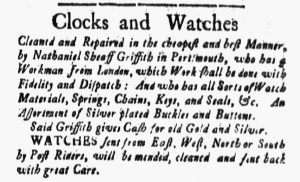
New-Hampshire Gazette (April 29, 1774).

WATCHES sent … by Post Riders, will be mended, cleaned and sent back with great Care.”

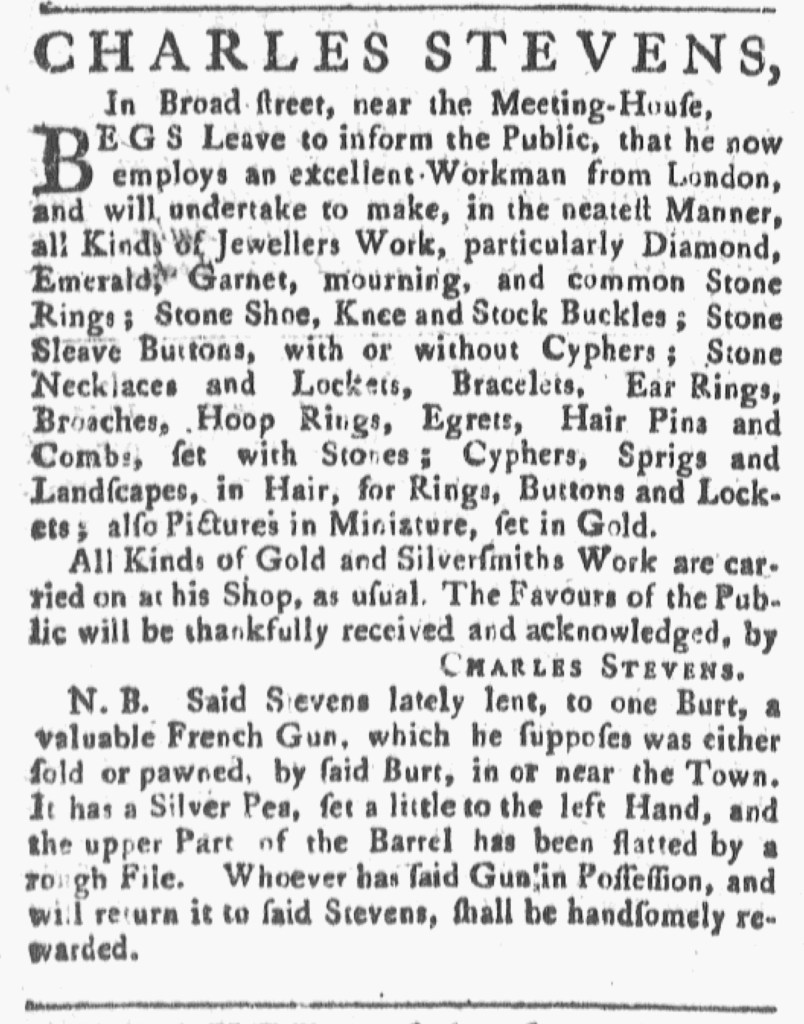
In the spring of 1774, Nathaniel Sheaff Griffith once again advertised that he “Cleaned and Repaired” clocks and watches “in the cheapest and best Manner,” making appeals to both price and skill.  He regularly ran notices in the New-Hampshire Gazette, but this one included an update about an employee who worked in his shop in Portsmouth.  Griffith advised prospective customers that he “has a Workman from London, which Work shall be done with Fidelity and Dispatch.”  In other words, Griffith vouched for his employee.  Other artisans in New England sometimes promoted the work undertaken by their employees.  For instance, Charles Stevens, a goldsmith and silversmith in Providence, informed the public that he “employs an excellent Workman from London” who did “all Kinds of Jewellers Work.”  Similarly, Enos Doolittle advised readers of the Connecticut Courant that he “employed a journeyman who has serv’d a regular Apprenticeship to the Watchmaking business in London.”  Griffith, Stevens, and Doolittle all signaled that they could effectively serve an even more extensive clientele thanks to the workmen from London who labored in their shops.

That may have been a factor in another marketing strategy that Griffith deployed for the first time.  He concluded his advertisement with a note that “WATCHES sent from East, West, North or South by Post Riders, will be mended, cleaned and sent back with great Care.”  While he may have done business that way in the past, he had not previously mentioned this option in his newspaper advertisements.  Perhaps now that he had an assistant Griffith felt more secure in advertising this service widely.  Once again, other artisans in New England also marketed similar arrangements.  Thomas Hilldrup, a watchmaker from London who settled in New London, declared that clients could “forward their Watches to me … by applying to Mr. JOSEPH KNIGHT, Post-Rider.”  He promised the same sort of “Dispatch” or quick service that Griffith did, stating that any watches he received would be “returned regularly the next Week.”  Post riders provided an infrastructure for watchmakers like Griffith and Hilldrup to serve clients who lived at a distance, expanding their business to rural towns rather than working solely for local customers in port cities.

February 19

What was advertised in a colonial American newspaper 250 years ago today?

Providence Gazette (February 19, 1774).

“He has procured an European Dyer.”

Stephen Potter, a clothier in Coventry, Rhode Island, gave the public advance notice about a service he would soon offer.  In an advertisement that first appeared in the February 12, 1774, edition of the Providence Gazette and then continued on February 19 and 26, he advised “his old Customers, and all others” that he “begins colouring the first of March next.”

That expanded the range of services that the fuller provided when he processed woolen cloth “at his Clothier’s Works,” but Potter did not do so on his own.  Instead, he hired an employee (or perhaps acquired an indentured servant) who possessed skills that he did not.  As he explained to prospective customers, Potter “procured an European Dyer” who could “dye any Colour in Cloth or Yarn.”  The clothier highlighted the fact that his new dyer produced “a compleat Green.”

Entrepreneurs did not usually credit others who worked in their shops when they ran advertisements in colonial newspapers, but a few did so when they believed that acknowledging those who labored beside them or on their behalf helped in marketing the goods and services they sold.  In this instance, Potter’s “old Customers,” in particular, “and all others,” in general, likely knew that dying woolen goods was not a skill that he possessed.  As he sought to expand his business, Potter deemed it necessary to credit the “European Dyer” who recently joined “his Clothier’s Works.”

That did not prevent Potter from promoting his own contributions to the business, declaring that he “engages to dress his Work in the neatest Manner.”  Customers could expect the highest quality of both the fulling and the dying of cloth entrusted to Potter.  That Potter offered dying as an ancillary service distinguished his operation from other clothiers in the area.  That included John Waterman, a competitor who simultaneously ran advertisements in the Providence Gazette.

January 18

What was advertised in a colonial American newspaper 250 years ago today?

Connecticut Courant (January 18, 1774).

“He employs Workmen who manufacture the Leather in the best Manner.”

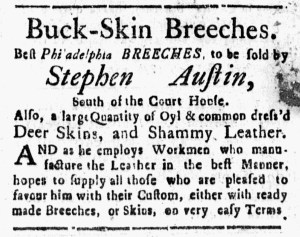
Stephen Austin sold “Buck-Skin Breeches” as well as “dress’d Deer Skins, and Shammy Leather” at his shop “South of the Court House” in Hartford.  In an advertisement that he placed in the January 18, 1774, edition of the Connecticut Courant, he not only highlighted the quality of his products but also the skill of those who labored in his shop.  Austin informed prospective customers that he “employs Workmen who manufacture the Leather in the best Manner.”  Among his competitors, Cotton Murray, a tailor, also ran an advertisement in the Connecticut Courant.  The tailor focused primarily on the services that he performed, but also added a nota bene about an employee who dressed leather.  Murray declared that he “carries on Leather Breeches making in all its branches, has a quantity of Leather of the best kind, and has employed a Workman in that business who serv’d his time in Europe.”

Both Austin and Murray promoted contributions that employees made to their businesses.  Artisans often relied on various assistants, whether employees, apprentices, or family members, but such workers did not regularly appear in newspaper advertisements.  Instead, the proprietors personified their shops, especially in an era that most businesses did not have names.  Austin’s shop, for instance, did not have a name.  Instead, his own name and one of the products he sold appeared as headlines.  For Murray, it was his name and occupation in the headlines.  Even artisans who ran shops identified by signs, like Daniel King, a brass founder “At the Sign of the Bell and Brand” in Philadelphia, deployed their own names rather than the sign that doubled as a shop’s name in the headlines of their advertisements.  Such methods emphasized work undertaken by the proprietor while obscuring the labor of others in a shop.  Artisans often considered such name recognition the best strategy for building their own reputations and the reputations of their businesses, but occasionally some of them saw benefits in marketing the skills of their employees.  Austin and Murray both hoped that doing so would help convince customers to select them over their competitors.

July 17

What was advertised in a colonial American newspaper 250 years ago today?

Providence Gazette (July 17, 1773).

“He now employs an excellent Workman from London.”

Charles Stevens, a goldsmith and jeweler, occasionally advertised in the Providence Gazette in the late 1760s and early 1770s.  A new development in his workshop prompted each of his advertisements.  On September 24, 1768, for instance, Stevens advised the public, “particularly those who have hitherto kindly favoured him with their Custom,” that he moved to a new location “in the main Street of Providence, where he continues to carry on his Business, in all its various Branches, and engages to execute his Work in the best and most elegant Manner.”  The goldsmith and jeweler made the same appeals as other artisans, yet they appeared in the public prints only when Stevens wanted to make sure that former clients knew about his new location.  Similarly, when he “removed to BROAD-STREET” in the summer of 1771, Stevens placed an advertisement to inform the public, “particularly his old Customers,” that he “carries on his Business in all its Branches, as usual.”

The goldsmith and jeweler had other news to share two years later.  In July 1773, he placed an advertisement to announce that “he now employs an excellent Workman from London, and will undertake to make, in the neatest Manner, all Kinds of Jewellers Work.”  Artisans who placed newspaper advertisements rarely gave credit to employees and relations who labored in their workshops.  Those who did so usually emphasized one or more of three specific reasons.  Sometimes an employee or associate possessed expertise that the proprietor did not, expanding the offerings available at the shop.  Sometimes their connections to London or other cities suggested greater familiarity with current fashions and tastes as well as superior training in their craft.  Sometimes an additional employee testified to the popularity of a workshop, suggesting that the artisan who ran it required assistance to keep up with orders.  All three reasons may have applied to the “excellent Workman from London” who produced “all Kinds of Jewellers Work” in Stevens’s shop.  The proprietor noted, “All Kinds of Gold and Silversmith’s Work are carried on at his Shop, as usual.”  Stevens may have shifted his focus to that work, leaving jewelry orders to his new employee.  He had already established his reputation in Providence, accepting jobs “as usual,” yet the addition of an employee with specialized skills merited an advertisement to keep existing customers and the public aware of new developments that benefited his patrons.

November 29

What was advertised in a colonial American newspaper 250 years ago today?

New-London Gazette (November 29, 1771).

“He has lately employed a Workman from England.”

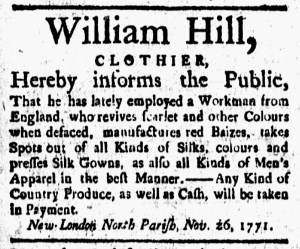
As winter approached in 1771, William Hill, a clothier who operated a fulling mill, took to the pages of the New-London Gazette to promote new services available at his shop.  Hill informed readers that he recently hired “a Workman from England” who provided assistance maintaining garments of various sorts.  According to the clothier, his employee “revives scarlets and other Colours when defaced,” restoring textiles after they experienced fading or other damage.  The workman also “takes Spots out of all Kinds of Silks” to make them presentable once again.  In addition, he “colours and presses Silk Gowns, as also all Kinds of Men’s Apparel in the best Manner.”  Hill was not content solely with treating fabrics in advance of making them into clothing; he also sought to generate revenues by offering them options for caring for their garments.  He did not possess the skills to deliver those ancillary services on his own, so he hired someone to work in his shop.

Whether artisans or shopkeepers, most advertisers did not mention those who labored in their shops, though wives, sons, daughters, apprentices, assistants, employees, and enslaved men and women made many and various contributions in all sorts of workplaces in eighteenth-century America.  Advertisements depicted bustling sites of production and commerce, but only testified to a fraction of the workers who interacted with customers or labored behind the scenes.  In most cases, newspaper notices mentioned only the proprietor, often in a larger font that served as a headline.  Such was the case for Joseph Gale, whose advertisement listed an assortment of textiles, housewares, and hardware in stock at his shop in Norwich, but did not mention any family members, employees, or others who served customers.  Those advertisers who did acknowledge others who worked in their shops usually sought to enhance their reputations by calling attention to supplementary services as they expanded their businesses.  Hill made sure that the public knew about the various skills his new employee possessed, but did not mention the contributions of anyone else who might have worked in his clothier’s shop.

November 9

What was advertised in a colonial American newspaper 250 years ago today?

Providence Gazette (November 9, 1771).

“Atwell hath hired an English Workman, of exquisite Sill.”

In the fall of 1771, Amos Atwell took to the page of the Providence Gazette to let “the Town and Country” know that he “hath set up the CUTLERY BUSINESS, in all its Branches, at his Smith’s Shop.”  Residents of Providence and nearby towns knew Atwell as a blacksmith, so the “CUTLERY BUSINESS” was a new endeavor for him.  That being the case, he provided an overview of his goods and services to instill confidence that he was indeed prepared to expand his business.  Atwell carried “Case Knives and Forks, Carving Knives and Forks, Pocket and Pen Knives of various Kinds, Razors, Surgeons Instruments, &c. &c.”  Repeating “&c.” (the abbreviation for et cetera most commonly used in the eighteenth century) underscored the range of cutlery available at his shop.  In addition, customers could have “all Kinds of Cutlery Ware cleaned, ground, and put in the best Order.”

The blacksmith did not undertake these tasks himself.  Instead, this enterprise depended on acquiring qualified help, “for which Purpose said Atwell hath hired an English Workman.”  Atwell proclaimed that he “carries on the Blacksmith’s Business as usual,” so his new employee attended to the “CUTLERY BUSINESS, in all its Branches.”  Atwell declared that the cutler possessed “exquisite Skill” and promised that he “gives constant Attendance on the Business, and is always ready to receive and execute the Commands” of customers.  New to the town, the unnamed cutler had not yet established his own reputation among prospective clients.  That made his arrangement with Atwell mutually beneficial.  The blacksmith aimed to attract more customers now that he offered more services at his shop, while the cutler received an endorsement from an artisan well known in the community.  In their newspaper advertisements, blacksmiths and other artisans rarely mentioned the workers, free or enslaved, who labored in their shops.  These circumstances, however, demanded that Atwell acknowledge that even though he “hath set up the CUTLERY BUSINESS” that another artisan actually oversaw those services at his shop.

August 28

What was advertised in a colonial American newspaper 250 years ago this week?

New-York Gazette and Weekly Mercury (August 26, 1771).

“Some of the best workmen … that could be had in any part of England.”

In the summer of 1771, Bennett and Dixon introduced themselves to residents of New York as “Jewellers, Gold-smiths, and Lapidaries, from London” and invited prospective customers to their shop near the post office.  The partners recently imported “a great variety of jewellery,” including “necklaces, ear rings, egrets, sprigs and pins for ladies hair, rings, lockets, and broaches of all sorts, ladies tortoise-shell combs plain and sett,” and many sorts of buckles.  They promised low prices for both wholesale and retail prices.

Yet Bennett and Dixon were not merely purveyors of imported jewelry, accessories, and adornments.  They also accepted commissions and fabricated items at their shop.  In promoting that aspect of their business, they underscored the level of skill represented among their employees.  “[F]or the better carrying on the jewellery, goldsmith and lapidary business,” Bennett and Dixon proclaimed, they “engaged some of the best workmen in those branches, that could be had in any part of England.”  The partners imported not only merchandise and materials but also artisans with exceptional skills.  Prospective customers did not need to feel anxious that items they ordered from Bennett and Dixon would be of inferior quality or easily distinguished from imported jewelry.  Even though New York was far away from London, the cosmopolitan center of the empire, consumers could still acquire custom-made jewelry that rivaled anything produced on the other side of the Atlantic.  Bennett and Dixon also declared that their customers did not have to pay a premium for jewelry as “good as in the City of London.”  Their artisans worked “as cheap” as their counterparts there, keeping prices reasonable for customers who placed special orders.

Colonial consumers often worried that they only had access to second best when compared to goods and services available in English cities, especially London.  Advertisers like Bennett and Dixon frequently reassured prospective customers that they had choices that rivaled anything available to consumers in the metropolitan center of the empire.

June 9

What was advertised in a colonial American newspaper 250 years ago today?

Jun 9 - 6:9:1770 Providence Gazette
Providence Gazette (June 9, 1770).

“Having engaged two Workmen … he proposes shortly to manufacture all Kinds of Stone Ware.”

When Joseph Wilson, a potter, moved to a new location late in the spring of 1770, he placed an advertisement “to inform the Public, particularly his old Customers,” where they could find him.  He also reminded readers of the Providence Gazette that “he continues to sell all Kinds of Earthen Ware,” inviting both new and returning customers to visit his shop.

At the conclusion of his advertisement, Wilson included a nota bene to request that prospective customers take note of the employees he recently hired.  “Having engaged two Workmen from New-York and Philadelphia,” Wilson declared, “he proposes shortly to manufacture all Kinds of Stone Ware, in the neatest and best Manner.”  Although artisans occasionally mentioned others who worked in their shops, they did so relatively rarely in their newspaper advertisements.  They usually assumed sole responsibility and took sole credit for the items they produced and sold.

Wilson likely expected to derive certain benefits from mentioning the “two Workmen” that he now employed.  Doing so suggested that his business was expanding, indicative of his own skill and careful management as well as demand for his wares.  Noting that his new employees came from New York and Philadelphia, two of the largest cities in the colonies, also implied that he cast his net widely to enlist the most skilled assistants who would indeed produce pottery “in the neatest and best manner.”

Most advertisements for consumer goods and services concealed the contributions of the various people who worked in colonial shops and workshops, whether wives and other family members who waited on customers or assistants, apprentices, and enslaved artisans who performed much of the labor.  “JOSEPH WILSON, POTTER,” offered a rare acknowledgment that he did not operate the business alone, that others supplied their own skill and expertise in producing the merchandise that he offered for sale.

February 22

What was advertised in a colonial American newspaper 250 years ago today?

Feb 22 - 2:22:1770 Maryland Gazette
Maryland Gazette (February 22, 1770).

“He has engaged Two exceeding good Workmen.”

While eighteenth-century artisans frequently promoted their own training and other credentials, relatively few devoted space in their newspaper advertisements to acknowledging the skill and experience of subordinates who worked in their shops.  William Faris, a clock- and watchmaker in Annapolis, however, incorporated several employees into the advertisement he placed in the February 22, 1770, edition of the Maryland Gazette.  Indeed, he said little about his own contributions to the business in favor of convincing prospective customers that he hired skilled artisans capable of executing their orders.

Faris opened his advertisement by announcing that “he has engaged Two exceeding good Workmen.”  He noted that one “has been a Finisher several Years to the celebrated Mr. Allen,” expecting that name to resonate with consumers familiar with clock- and watchmakers.  Faris leveraged the reputation of another artisan, perhaps even a competitor, to enhance the standing of his own business.  Having competent workmen in the shop allowed Faris to branch out.  He informed prospective customers that he also “executes any Orders he may be favoured with for Chair Work,” an endeavor made possible by hiring “a good Workman” who has produced “several Dozens of very neat black Walnut Chairs.”

In the midst of acquainting the public with his skilled staff, Faris also noted, though briefly, that “he still carries on” activities closely aligned with making clocks and watches.  He pursued the “Gold, Silversmiths and Jewellers Businesses,” doing that work “in the neatest and Best Manner.”  His own skill and experience made him qualified to assess the abilities of the workmen he employed.  By listing the several tradesmen who worked alongside him, Faris conjured images of a busy and bustling shop, one where customers could depend on the proprietor having sufficient assistance to see to their orders “faithfully” and “with the utmost Dispatch.”  At the same time, Faris assured them that they did not have to worry about inferior work undertaken by those he employed.  He vouched for their skill and experience.  Many colonial artisans disguised labor done by others in their shops when they advertised, but Faris sought to mobilize his workmen to his advantage when wooing prospective customers.