October 25

What was advertised in a colonial American newspaper 250 years ago today?

Essex Gazette (October 25, 1774).

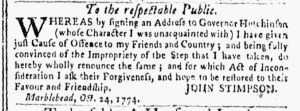
“By Signing an Address to Governor Hutchinson … I have given just Cause of Offence.”

It was another plea for forgiveness for exercising poor judgment, at best, or expressing unsavory political views by signing an address to Thomas Hutchinson that thanked him for his service as governor of Massachusetts.  At the end of October 1774, John Stimpson of Marblehead took to the pages of the Essex Gazette to a acknowledge to “the respectable Public” that he had “given just Cause of Offence to my Friends and Country” when he had done so.  He explained that he “was unacquainted” with Hutchinson’s character the previous spring, but in the time that elapsed since then he became “fully convinced of the Impropriety of the Step that I have taken.”  That being the case, he placed an advertisement to “wholly renounce the same” as well as seek forgiveness for that “Act of Inconsideration.”  Ultimately, Stimpson “hope[d] to be restored to their Favour and Friendship.”

He was not the first to insert an open letter in the Essex Gazette or other newspapers for that purpose.  Thomas Kidder published a similar apology in the Boston-Gazette in July 1774.  Samuel Flagg and Joseph Lee each did so in the Essex Gazette three weeks before Stimpson did.  Flagg’s extensive message to his “Fellow Citizens and Countrymen” incorporated an editorial on the “unjust and oppressive” legislation imposed by Parliament.  Others published similar missives explaining their error, assuring the public that they were not admirers of Hutchinson (and, by extension, the Tory perspective on current events), and asking for forgiveness so they could restore their standing within their communities.

Stimpson’s version of what was becoming a familiar feature in the newspapers did not appear among the news and editorials.  Samuel Hall and Ebenezer Hall, the patriot printers of the Essex Gazette, did not treat it as a letter to the editor to include alongside local news.  Instead, it ran between an advertisement offering a reward for the capture and return of an enslaved man, Caesar, who liberated himself from his enslaver, and a real estate notice announcing the sale of a house and land in Long Wharf Lane in Salem.  Stimpson’s message to “the respectable public” was an advertisement, a paid notice.  The Halls did not extend the opportunity to seek absolution for free.  They may have experienced a bit of satisfaction in generating revenue from someone who made such a poor decision in initially offering support to the royal governor so unpopular among Patriots.

October 18

What was advertised in a colonial American newspaper 250 years ago today?

Essex Gazette (October 18, 1774).

“In Consequence of the Boston Port-Bill … he has opened a Store in Salem.”

In October 1774, Nathan Frazier did what he could to continue selling “an Assortment of Goods, suitable for the Season,” when the Boston Port Act closed the harbor in retaliation for colonizers destroying shipments of tea the previous December.  He opted to open a second location, renting a shop in Salem.  In the October 18 edition of the Essex Gazette, published in that town, he informed readers that “in Consequence of the Boston Port-Bill, and with a View of accommodating those of his Customers to whom it may be most convenient to have their Supplies conveyed by Water,” he now did business in Salem as well as in Boston.  The circumstances had not caused him to close his original store; he “still continues his Business at his Store in Boston as usual.”  Accordingly, his customers “may be supplied at either of said Stores,” though Frazier, “for the present, give[s] his personal Attendance at his Salem Store.”

In addition to inserting this notice in the Essex Gazette, the merchant also placed it in the Boston Evening-Post and the Boston-Gazette on October 17, increasing the chances that readers in Boston, Salem, and other towns would see it.  In the Boston Evening-Post, Frazier’s advertisement happened to appear immediately below William Blair Townsend’s notice that he sold goods “imported before the oppressive Acts on this Town and Province were laid” and, accordingly, could be bought and sold “without any Breach on the solemn League and Covenant” that called for ceasing trade with Britain until Parliament repealed the Coercive Acts.  In the Essex Gazette, Samuel Flagg asserted that “he is determined not to import any more Goods at present,” alluding to current events without naming them as plainly as Frazier and Townsend.  All three advertisements testified to the challenges that merchants and shopkeepers faced as well as their efforts to meet them.  As much as Frazier wished to encourage consumers to visit either of his shops, it was not business “as usual” in Boston and other towns in Massachusetts.  Advertisements, as well as news articles and editorials, made that clear.

October 11

What was advertised in a colonial American newspaper 250 years ago today?

Essex Gazette (October 11, 1774).

“LOST at the Fire on Wednesday Night last … the following Pieces of Merchandise.”

The October 11, 1774, edition of the Essex Gazette included coverage of a fire in Salem on October 6.  The conflagration destroyed the homes of several families as well as the shops and stores of more than a dozen merchants and shopkeepers.  In addition, the fire consumed a meeting house and the customs house.  Samuel Hall and Ebenezer Hall, the printers of the Essex Gazette, lost their printing office.  Just below the article about the fire, they inserted a notice alerting the public that they had relocated.  The Halls also reported that “Great Quantities of Goods, House Furniture and Papers of Value were lost, stole and destroyed in the Confusion and Destruction occasioned by the Fire; but it is impossible to obtain Accounts from the several Sufferers, sufficiently accurate to publish at this Time.”

That did not prevent others from publishing more information about the fire, either as letters to editors or by taking out advertisements that supplemented the coverage provided by the Halls.  One letter, for instance, noted that “the Sufferers in the late Fire in this Town, and others whose Goods were removed, still miss great Quantities of their Furniture and Goods.”  Such items clearly had not been misplaced and would soon be recovered as the confusion subsided and the town recovered; instead, the anonymous author asserted that goods and personal property “were stolen by the hardened Villains who ever stand ready to make their Harvest at such Times of Danger and Distress.”  Furthermore, those “Miscreants, in the Form of Pedlars, will doubtless be hawking these Goods about the Country,” capitalizing on the misfortune of others.  The letter concluded with a call for “well disposed People” to identify and imprison the thieves and encouraging justices of the peace to invoke existing laws to regulate peddlers to make sure they did not sell stolen goods when they “stroll[ed] about the Country.”

Nathaniel Sparhawk was among those with missing goods following the fire.  In an advertisement, he listed and described “Pieces of Merchandise” he “LOST at the Fire.”  He offered a reward to “Whoever will bring the above Articles or any of them” to him.  In a nota bene, he added, “No Questions will be asked.”  In other words, he only sought to recover goods apparently looted during the fire, choosing to give the benefit of the doubt that they had been removed to save them.  In exchange for that polite fiction, he would not prosecute anyone whose conscience (or the reward) prompted them to return the items.  He hoped that a reward given without questions or the possibility of prosecution would seem more attractive than whatever thieves might earn if they risked selling or fencing the stolen items.

Other advertisements also provided additional information about the fire.  One offered “300 Dollars Reward” to anyone who “will give Information” that the fire “was kindled with Design.”  Many residents believed the fire had been set intentionally.  Anyone who could prove that was the case would receive the reward “on Conviction of the Perpetrator or Perpetrators.”  Henry Putnam, who lost his shop in the fire, feared that he was a suspect.  In his own advertisement, he reported that “some ill-minded Person or Persons” spread “false Reports … intimating that there was reason to suspect that I had been guilty of the horrid Crime of being the Occasion of the late terrible Fire.”  Doing what he could to combat such gossip, he harnessed the power of the press to inform the public, especially “People at a Distance” who might hear such rumors, that “the People of this Place are fully convinced that the Reports are false and groundless.” Putnam defended his reputation in print, hoping to reach people who heard tales that spread by word of mouth.

Readers of the Essex Gazette pieced together a more complete account of the fire and its aftermath when they consulted the coverage written by the printers, the letter to the editors, and the advertisements.  As was often the case in colonial newspapers, advertisements delivered news that supplemented information that appeared elsewhere.  In this instance, the advertisements appeared in the next column, immediately to the right of the news, helping readers to make connections among the different kinds of reporting.

October 4

What was advertised in a colonial American newspaper 250 years ago today?

Essex Gazette (October 4, 1774).

“Forgive my Error [and] restore me to their Favour and Friendship.”

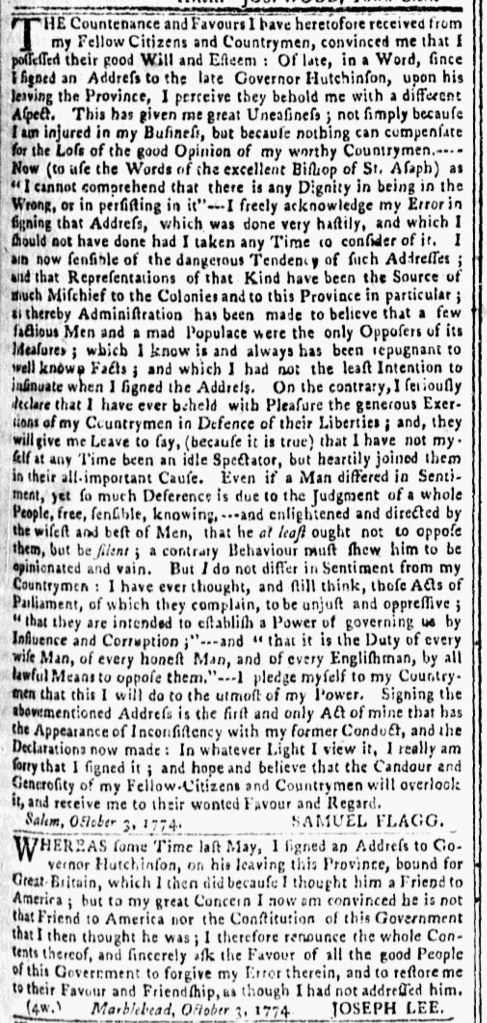
Samuel Flagg of Salem and Joseph Lee of Marblehead needed to do damage control and rehabilitate their reputations after signing “an Address to Governor Hutchinson, on his leaving this Province” in May 1774.  Like Thomas Kidder had done in July, they took to the public prints to confess their error and beg for the forgiveness of their friends and neighbors who believed they did not support the American cause.  The reaction they experienced became so overwhelming that they recanted a position that they claimed they never firmly held.  Lee, for instance, stated that he signed the address because at the time he “thought [Hutchinson] a Friend to America,” yet he had since reconsidered.  He expressed “great Concern” while confessing that “I am now convinced he is not that Friend to America nor the Constitution of this Government that I then thought he was.”  To that end, Lee renounced the entire address and “sincerely ask[ed] the Favour of all the good People of this Government to forgive my Error therein, and to restore me to their Favour and Friendship.”  His plea, dated October 3, first appeared in the October 4 edition of the Essex Gazette, with a notation that it would run for four weeks.  Rather than submitting a letter to the printer that might get printed once, Lee paid to run an advertisement that would present his story and his apology to readers multiple times.

Lee’s notice was brief compared to the one that Flagg inserted on the same day.  He had formerly been in good standing in the community, having the “good Will and Esteem” of his “Fellow Citizens and Countrymen,” but perceived “they behold me with a different aspect” after he signed an address in honor of the Governor Hutchinson upon his return to England.  Flagg confessed that this “has given me great Uneasiness; not simply because I am injured in my Business, but because nothing can compensate for the Loss of the good Opinion of my worthy Countrymen.”  Flagg acknowledged that his livelihood had suffered; apparently customers refused to shop at his store in Salem.  Yet participating in the marketplace was not the only or even the primary reason that Flagg wished to correct the record.  He desired the “Favour and Regard” that he had once enjoyed in relationships with other colonizers, plus he wanted to assure the public that he indeed supported the patriot cause.  He admitted his error while disavowing the address as “the Source of much Mischief to the Colonies and to this Province in particular,” but did not end there.  “I seriously declare,” he wrote, “that I have ever beheld with Pleasure the generous Exertions of my Countrymen in Defence of their Liberties.”  Furthermore, Flagg claimed that “I have note myself at any Time been an idle Spectator, but heartily joined them in their all-important Cause.”  In his advertisement for an “Assortment of ENGLISH and INDIA GOODS” on the next page, he indicated that he “is determined not to import any more Goods at Present,” signaling his support for nonimportation agreements as a means of protesting the Coercive Acts.

Beyond his confession and apology, Flagg incorporated an editorial into his advertisement seeking forgiveness from his “Fellow Citizens and Countrymen.”  He asserted, “I do not differ in Sentiment from my Countrymen; I have ever thought, and still think, those Acts of Parliament, of which they complain, to be unjust and oppressive.”  To demonstrate that point, he inserted quotations that made familiar arguments: “‘that they are intended to establish a Power of governing us by Influence and Corruption’” and “‘that it is the Duty of every wise Man, of every honest Man, and of every Englishman, by all lawful Means to oppose them.’”  Flagg thus had a duty to fulfill, prompting him to “pledge myself to my Countrymen that this I will do to the utmost of my Power.”  He reiterated that he regretted signing the “abovementioned Address,” insisting that it was “the first and only Act of mine that has the Appearance of Inconsistency with my former Conduct, and the Declarations now made.”  He apologized once again, requesting the “Candour and Generosity” of others in overlooking the entire incident.

Signing the address to Governor Hutchinson had been a lapse in judgment; at least that was how some of those who signed it depicted their actions when they repeatedly encountered hostile reactions.  Both Flagg and Lee sought to remedy the damage done to their reputations by placing advertisements in which they confessed their error.  Flagg did even more: he spilled a lot of ink in support of the American cause, hoping that doing so would convince the public of his sincerity and return him to their good graces.  News and editorials could not contain the politics of the period. Instead, advertisements became sites for participating in debates and controversies as the imperial crisis intensified in 1774.

September 13

What was advertised in a colonial American newspaper 250 years ago today?

Essex Gazette (September 13, 1774).

“This GAZETTE may be had for 6s. 8d. per Annum, exclusive of Postage.”

The printers of the Essex Gazette incorporated the colophon into the masthead of that newspaper.  Within that masthead, they declared that the publication “Contain[ed] the freshest Advices, both foreign and domestic” and gave the date and volume and issue numbers.  Next came the publication information that more often appeared at the bottom of the final page in other newspapers: “SALEM: Printed by Samuel and Ebenezer Hall, at their Printing-Office in King-Street.”  That made it easy for prospective subscriber and advertisers as well as others with business for the printers to contact or visit them.

Even with that choice about where to place the colophon, the Halls still recognized the bottom of the final page as valuable space for promoting their newspaper, publishing a perpetual advertisement that ran across all three columns in each issue.  A single line advised, “This GAZETTE may be had for 6s. 8d. per Annum, exclusive of Postage – 3s. 4d. (or 4s. 6d. if sent by the Eastern Post) to be paid at Entrance.”  Throughout the colonies, printers generously extended credit to subscribers, recognizing that if they increased their circulation then they could attract more advertisers.  In turn, printers often published notices calling on subscribers to pay for subscriptions going back months and even years.

For their part, the Halls refused to assume the risk of allowing readers to subscribe completely on credit.  They required payment of three shilling and four pence, half of the annual price of six shillings and eight pence, at the time that subscriptions commenced.  Even if they had difficulty collecting the balance from subscribers, those initial payments covered some of the expenses and limited their losses.  In addition, subscribers who ordered their newspapers delivered by a post rider were expected to pay an additional shilling at the start, though the notice did not indicate if that covered the entire year or, like the entrance fee, was only half of what subscribers were expected to pay.  Either way, the Halls intended that service would further expand their circulation.

No matter what kinds of news or paid notices the printers placed on the final page of the Essex Gazette from week to week, readers always encountered an advertisement for the newspaper as the final item.  Colonial newspapers often passed from hand to hand, reaching readers beyond the original subscribers.  This strategy encouraged those additional readers to consider purchasing their own subscriptions for consistent access to the news rather than rely on the possibility that others would share their newspapers.

July 26

What was advertised in a colonial American newspaper 250 years ago today?

Essex Gazette (July 26, 1774).

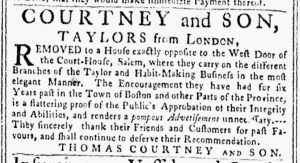
“Public approbation … renders a pompous advertisement unnecessary.”

When Thomas Courtney and Son relocated from Boston to Salem, they ran in advertisement in the Essex Gazette to inform readers that they “carry on the different Branches of the Taylor and Habit-Making Business” at a shop near the courthouse.  They described themselves as “from LONDON,” hoping that their origins gave them some cachet among prospective clients, yet also reported that they had followed their trade “for six Years past in the Town of Boston.”

Their experience there served as even more of a recommendation and evidence that prospective customers should give them a chance.  The “Encouragement” they received for so many years, the tailors argued, “is a flattering proof of the Public’s Approbation of their Integrity and Abilities.”  No tailoring shop could have lasted for so long without the “Encouragement” of satisfied customers who gave them return business or offered positive reviews to friends.  Courtney and Son earned such a reputation that “renders a pompous Advertisement unnecessary.”  With that critique of the elaborate appeals made by some of their competitors and other purveyors of goods and services, the tailors expressed gratitude to former customers and declared that they “shall continue to deserve their Recommendation.”

It was not the first time that Courtney and Son deployed that marketing strategy.  Nine months earlier, they moved to a new location in Boston.  On that occasion, they ran an advertisement in the Massachusetts Spy.  Its copy was so similar, nearly identical, to their notice in the Essex Gazette that the tailors may have clipped it from the Massachusetts Spy and later from it.  The two advertisements featured variations in capitalization, not uncommon when advertisers ran notices in more than one newspaper.  In both, the phrase “pompous advertisement” appeared in italics.  While this does not reveal the effectiveness of the advertisement, it does suggest that Courtney and Son believed that it met with a positive reception that merited republishing it rather than devising other sorts of appeals to prospective customers in their new town.

June 21

What was advertised in a colonial American newspaper 250 years ago today?

Essex Gazette (June 21, 1774).

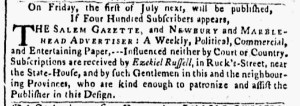
“Will be published … A Weekly, Political, Commercial, and Entertaining Paper.”

On June 21, 1774, the Essex Gazette carried an advertisement for a new newspaper that would become a competitor.  At that time, Samuel Hall and Ebenezer Hall printed the first and only newspaper in Salem.  Ezekiel Russell, however, wished to test the market to see if it would support the “SALEM GAZETTE, AND NEWBURY and MARKBLEHEAD ADVERTISER: A Weekly, Political, Commercial, and Entertaining Paper.”  He proposed that the Salem Gazette would commence publication on “the first of July next … If Four Hundred Subscribers appears.”  The enterprising printer hoped that a notice in the Essex Gazette would help generate subscribers, though that was not his only means of inciting interest.  He distributed an unnumbered prospectus issue on June 24, hoping that the content and appearance would convince the public to subscribe (and advertisers to place to notices).  Similarly, Isaiah Thomas and Henry-Walter Tynges gave out free copies of the first issue of the Essex Journal, the first newspaper printed in Newburyport, seven months earlier.

Whether or not Russell managed to attract four hundred subscribers by the appointed date, he did indeed publish the Salem Gazette on July 1.  Isaiah Thomas provided a brief overview in his History of Printing in America (1810), describing it as “the second paper published in the town, … published weekly on Friday.”  The Halls distributed the Essex Gazette on Tuesdays, so newspapers now circulated twice a week in Salem (in addition to those printed in other towns that made their way there).  As Thomas further explained, “This Gazette was of short continuance; its circulation was confined to a few customers in Salem and the neighboring towns, which were inadequate to its support.”[1]  The last known issue bears the date April 21, 1775, just two days after the skirmishes at Lexington and Concord.  It was not the only newspaper printed in Massachusetts that experienced disruptions or folded when the Revolutionary War began.  The Boston Evening-Post ceased publication on April 24, 1775, whole the last known issue of the Massachusetts Gazette and Boston Post-Boy appeared on April 17, 1775.  In his advertisement, Russell stated that the Salem Gazette would be “Influenced neither by Court or Country,” indicating that it would not take a political stance in favor of patriots or loyalists as the imperial crisis intensified.  Some prospective subscribers may have remembered that Russell previously published The Censor in Boston from November 1771 through May 1772.  As Thomas recounted, that “paper was supported, during the short period of its existence by those who were in the interest of the British government.”[2]  Perhaps Russell intended for the prospectus issue to demonstrate that this newspaper would not privilege one perspective over another.

Unfortunately, advertisements from the Salem Gazette will not be featured in the Adverts 250 Project.  According to Clarence Brigham’s History and Bibliography of American Newspapers, 1690-1820, the British Museum has a complete run (with the exception of the prospectus) and various research libraries in Massachusetts have scattered issues, but the Salem Gazette has not yet been digitized for greater access.  Although colonizers in Salem had access to yet another source of news and advertising for several months in 1774 and 1775, the availability of digitized primary sources largely determines the scope of the Adverts 250 Project.

**********

[1] Isaiah Thomas, The History of Printing in America: With a Biography of Printers and an Account of Newspapers (1810; New York: Weathervane Books, 1970), 275.

[2] Thomas, History of Printing, 153.

June 7

What was advertised in a colonial American newspaper 250 years ago today?

Essex Gazette (June 7, 1774).

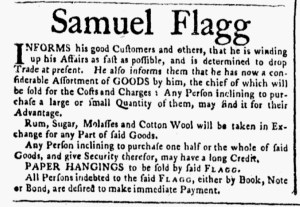
“He is winding up his Affairs as fast as possible, and is determined to drop Trade.”

It was a going out of business sale by another name.  As summer approached in 1774, Samuel Flagg took to the pages of the Essex Gazette to inform residents of Salem and nearby towns that “he is winding up his Affairs as fast as possible, and is determined to drop Trade at present.”  That meant that he needed to get rid of his existing inventory, “a considerable Assortment of GOODS.”  For bargain hunters or any consumers looking for good deals, this was quite an opportunity since Flagg pledged to sell his wares “for the Costs and Charges” without significant retail markup.  He attempted to entice customers with promises that they “may find it for their Advantage” to purchase “a large or small Quantity” of his remaining goods.  Flagg also presented his decision to “drop Trade” as favorable to other retailers, suggesting that they might be interested in acquiring “one half or the whole of said Goods.”  Provided that they “give Security,” Flagg was willing to allow “a long Credit” for payment.

Flagg had a history of publishing colorful advertisements in the Essex Gazette, commenting on the marketing strategies deployed by some of his competitors, and it was not the first time that he announced plans to liquidate his merchandise.  A year earlier, he asserted “his present Determination is to go home to London in the Fall; he is therefore determined to sell off the whole of his Goods.”  The entrepreneur made bold claims that he would part with his goods “as low as they can be bought at any Store on the Continent, without any Exception.”  His “Determination” did not result in returning to London in the fall of 1773, but it may have resulted in some good deals for consumers who took advantage of his intentions.  Those who benefited from that sale might have been especially eager to examine Flagg’s goods this time, though others who did not consider the savings all that significant likely would have been wary of renewed promises.  Today, consumers become skeptical of retailers who repeatedly hold going out of business sales yet do not close their doors, realizing that liquidation prices are just their everyday prices.  Flagg risked the same response if he resorted to this marketing strategy too many times.

May 31

Who was the subject of an advertisement in a colonial American newspaper 250 years ago today?

Essex Gazette (May 31, 1774).

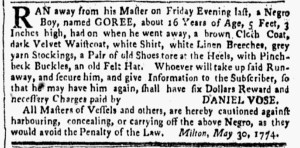
“RAN away … a Negro Boy, named GOREE.”

As the summer of 1774 approached, an enslaved youth named Goree saw his opportunity to liberate himself by running away from Daniel Vose of Milton, Massachusetts.  Vose, for his part, joined the ranks of enslavers who placed newspaper advertisement that offered rewards for the capture and return of enslaved men and women who made similar declarations of independence during the era of the American Revolution.  He provided a description of the Goree, encouraging readers to engage in surveillance of all Black people, especially young Black men, with the intention that such scrutiny would aid in identifying him.  Vose also warned “All Masters of Vessels and others … against harbouring, concealing, or carrying off” Goree or else face “the Penalty of the Law” for aiding him.

Massachusetts Gazette and Boston Post-Boy (May 30, 1774).

Vose made quite an investment in locating and securing Goree.  In addition to offering “six Dollars Reward and necessary Charges” for securing him in jail and sending word to Milford, he also ran advertisements in several newspapers.  On May 30, his notice appeared in the Boston Evening-Post, the Boston-Gazette, and the Massachusetts Gazette and Boston Post-Boy, all three newspapers published in Boston on Mondays.  His advertisement in the Massachusetts Gazette and Boston Post-Boy even included a crude woodcut depicting an enslaved man on the run as a means of drawing attention to it.  Apart from the masthead, that was the only image in that issue of the newspaper.  The following day, Vose ran the same advertisement in the Essex Gazette, published in Salem.  He did not place his advertisement in the Massachusetts Gazette and Boston Weekly News-Letter or the Massachusetts Spy, both published in Boston on Thursdays, perhaps believing that four newspapers printed in two towns provided sufficient dissemination of Goree’s description and the reward for capturing him.

South-Carolina Gazette and Country Journal (May 31, 1774).

Vose was not alone in placing such advertisements in multiple newspapers.  At the same time that he sought to enlist the aid of other colonizers in securing an enslaved youth who liberated himself, Charles Ogilvie ran advertisement about “a Negro Man named MINOS” in the South-Carolina and American General Gazette on May 27, the South-Carolina Gazette on May 30, and the South-Carolina Gazette and Country Journal on May 31.  That accounted for every newspaper published in Charleston and the rest of the colony at the time.  Ogilvie had recently purchased Minos “at Mr. Benjamin Wigfall’s Sale,” but Minos had other ideas.  The enslaver suspected that Minos had assistance from “his Wife at Mr. Elias Wigfall’s” or his “many Relations” in the “Parishes of St. James, Santee, and Christ Church,” believing that they “harboured” or hid him.  Although not his purpose in placing the advertisement, Ogilvie revealed one of Minos’s likely motivations for liberating himself.

In both New England and South Carolina, enslavers like Vose and Ogilvie went to great expense in running advertisements about enslaved people who liberated themselves.  Such notices were not a feature solely of the newspapers published in southern colonies during the era of the American Revolution.  Instead, they appeared in newspapers throughout the colonies, part of the everyday culture of slavery from New England to Georgia.

May 17

What was advertised in a colonial American newspaper 250 years ago today?

Essex Gazette (May 17, 1774).

William Vans’s CHeap Shop.”

Readers encountered several invitations to purchase cheap goods when they perused the May 17, 1774, edition of the Essex Gazette.  Stephen Higginson’s advertisement listing dozens of items available “At his Store opposite the King’s Arms in SALEM” featured a headline that proclaimed, “Very Cheap.”  That framed how he wished prospective customers to think about his merchandise before they engaged with the rest of his notice.  Nathaniel Sparhawk stocked a “large and beautiful Assortment of English, India and European GOODS … at his CHEAP STORE in King-Street, SALEM.”  He pledged to sell “at the lowest Advance” or lowest markup “for Cash.”  Similarly, William Vans described his establishment as a “CHeap Shop,” though he did not offer further commentary on his prices.

These merchants and shopkeepers deployed the word “cheap” in a different manner than retailers and consumers use it today.  For colonizers, “cheap” did not have connotations of inferior quality. Vans certainly did not want prospective customers to think of the “beautiful blue and white China Cups and Saucers” he stocked at his “CHeap Shop” as deficient in any way, nor did Higginson intend for the public to have the impression that he prioritized price over quality for his “Very Cheap” textiles, “Men’s, Women’s and Children’s colour’d and white lamb and kid Gloves,” “Looking-Glasses,” and other wares.  Instead, “cheap” merely meant inexpensive.  Shoppers could expect to find bargain prices when they went to Vans’s “CHeap Shop” or Sparkawk’s “CHEAP STORE.”  The Oxford English Dictionary makes a distinction between “cheap” (meaning “bought at small cost; bearing a relatively low price; inexpensive”) and “cheap and nasty” (meaning “of low price and bad quality; inexpensive but with the disadvantage of being unsuitable to one’s purposes”).  The earliest examples for “cheap and nasty” given by the Oxford English Dictionary” come from the 1820s, a half century after Higginson, Sparhawk, Vans, and other advertisers used “cheap” to promote their goods.  At the time that colonial entrepreneurs used the word, neither they nor their prospective customers associated “cheap” with poor quality.  That sense of the word evolved over time, making it less positive and less powerful in modern marketing campaigns.  Today, consumers are wary of cheap goods, but that was not the case in eighteenth-century America.