July 1

What was advertised in a revolutionary American newspaper 250 years ago today?
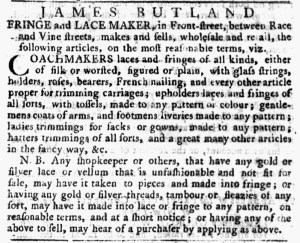
Pennsylvania Evening Post (July 1, 1775).

“Unfashionable [lace] … taken to pieces and made into fringe.”

In the summer of 1775, James Butland, a “FRINGE and LACE MAKER, in Front-street” in Philadelphia, placed a new advertisement in some of the city’s newspapers.  A few months earlier, he assured “the public, that no advantage shall be taken on account of the troubles between Britain and America” and “he retails his goods cheaper than ever they were in this country before.”  In other words, he did not raise his prices for the fringe and lace he made in Philadelphia once the Continental Association, a nonimportation agreement adopted in protest of the Coercive Acts, went into effect.  In his new advertisement, he reminded readers that he “makes and sells … COACHMAKERS laces and fringes of all kinds … and every other article proper for trimming carriages; upholders [upholsterer’s] laces and fringes of all sorts, with tossels, made to any pattern or colour; … hatters trimmings of all sorts, and a great many other articles in the fancy way.”

In a nota bene that constituted a significant portion of this advertisement, Butland sought other business by proposing an eighteenth-century version of upcycling, the transformation of unwanted or undesirable items into fashionable new ones. “Any shopkeeper or others, that have any gold or silver lace or vellum that is unfashionable and not fit for sale,” he suggested,” may have it taken to pieces and made into fringe.”  Furthermore, anyone “having gold or silver threads, tambour or sleazies of any sort, may have it made into lace or fringe to any pattern.”  Tambour, according to the Oxford English Dictionary, could have referred to either a kind of fine gold or silver thread or a kind of embroidery that Butland deconstructed for the materials.  Sleazies, a corruption of Silesia, referred to a kind of thin woven cloth originally from Silesia and used for making clothing in Britain and the colonies in the eighteenth century.  Butland did this work “on reasonable terms, and at a short notice,” promoting both price and efficiency.  Even if readers were not interested in incorporating upcycled fringe into their own wardrobes or décor, Butland still wanted any castoffs that they wished to sell to him.  With the Continental Association still in place and the uncertainty about when trade with Britain might resume following the outbreak of hostilities in Massachusetts in April, Butland may have needed materials to continue his business.
September 23

What was advertised in a colonial American newspaper 250 years ago today?

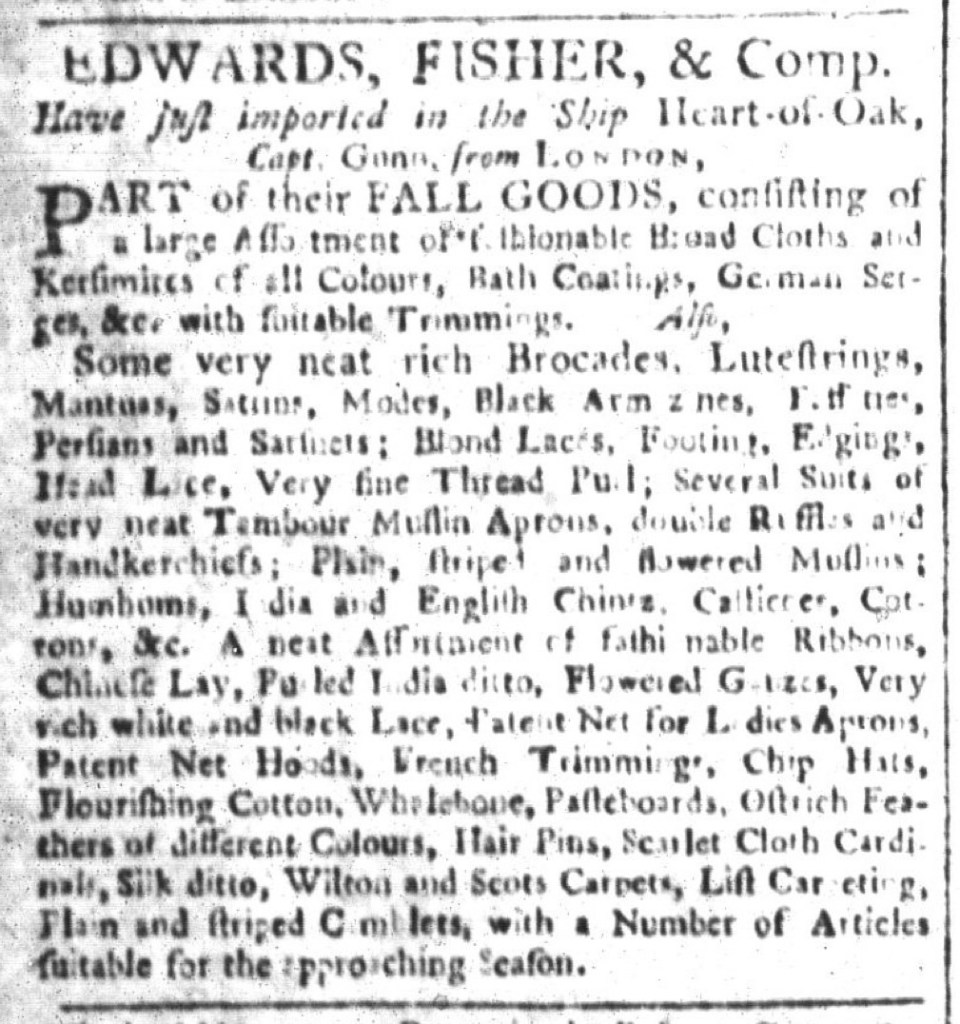
South-Carolina and American General Gazette (September 23, 1774).

“Just imported … from LONDON, PART of their FALL GOODS.”

Like many other merchants and shopkeepers, Edwards, Fisher, and Company in Charleston updated their merchandise with the changing of the seasons.  With the arrival of fall in 1774, they ran advertisements in the South-Carolina and American General Gazette, the South-Carolina Gazette, and the South-Carolina Gazette and Country Journal to announce that they had “just imported” a “large Assortment” of textiles and other items.  This new inventory accounted for “PART of their FALL GOODS,” suggesting that they would continue to supplement their wares as ships arrived from London.

Edwards, Fisher, and Company may have believed that they had a narrow window of opportunity to import and sell these goods.  Earlier in the month, a competitor acknowledged that “a Non-importation Agreement will undoubtedly soon take Place here,” encouraging consumers (“Ladies” in particular) to shop while they had the chance.  The First Continental Congress had recently convened in Philadelphia to discuss coordinated measures in response to the Coercive Acts.  Their deliberations would result in the Continental Association, a nonimportation, nonconsumption, and nonexportation agreement set to go into effect on December 1.  In late September, merchants, shopkeepers, and consumers in Charleston and other American cities and towns did not yet know exactly which measures the First Continental Congress would adopt, but they reasonably anticipated that importing and purchasing goods would be constrained in the coming months.

That gave Edwards, Fisher, and Company an opportunity to sell the “Number of Articles suitable for the approaching Season” that had already arrived as “PART of their FALL GOODS.”  They probably kept their fingers crossed that other shipments would arrive from London before news of a nonimportation agreement arrived from Philadelphia.  They sought to entice prospective customers with an extensive list of their wares, describing them as “fashionable” more than once.  What consumers would consider fashionable, however, evolved when nonimportation agreements went into effect.  Homespun textiles produced in the colonies rather than “very neat rich Brocades” and other imported fabrics became fashionable because of the political principles they communicated.  Edwards, Fisher, and Company would have to content with that another day; for the moment, they could continue following familiar strategies for marketing imported textiles and other goods.

August 31

What was advertised in a colonial American newspaper 250 years ago today?

South-Carolina Gazette and Country Journal (August 31, 1773).

“The most minute and trifling article, INDISPUTABLY CHEAPER than they could possibly do in London.”

Working on behalf of the beneficiary of George Thomson’s estate at the end of August 1773, Benjamin Villepontoux attempted to liquidate the remaining inventory in the store “lately occupied” by Thomson on Tradd Street in Charleston.  The merchandise included a “Large and valuable assortment of DRY GOODS,” most of them imported by Thomson “in the month of October last.”  Although nearly a year had passed, Villepontoux insisted that the goods were still in style, reiterating the word “fashionable” in the list of goods in the advertisement: “SUPERFINE fashionable broad cloths, with trimming,” Fashionable beaver hats, with gold and silver bands,” “fashionable cloaks,” and “the most fashionable ribbons.”  Similarly, he promoted a “variety of genteel articles in the millinary branch” and “very elegant embroidered brocade for waistcoats.”

Villepontoux hoped that such descriptions would attract both consumers and, especially, retailers.  To encourage prospective buyers to take a significant portion of the inventory, he allowed credit until January 1774 to anyone who made a purchase “of 50l. sterling, at one time.”  Otherwise, “immediate payment will be expected” for smaller sales.  This was an opportunity for “planters, shopkeepers, and others” to acquire even “the most minute and trifling article, INDISPUTABLY CHEAPER than they could possibly do in London.”  How could Villepontoux make such a promise about these fashionable wares?  How could the prices in Charleston beat the prices in London?  He asserted that the goods “were purchased, in large parcels, of the original manufacturers, with the utmost care and pains.”  He rehearsed a narrative often delivered by merchants who sought to convince shopkeepers and consumers that they offered the best deals.  Rather than dealing with English merchants, middlemen responsible for inflating prices, Thomson contracted with the producers directly.  That lowered his costs, as did purchasing in volume.  That meant that Thomson (and now Villepontoux) could give bargains to colonizers in South Carolina by passing along the discounts.

In his effort to clear out the merchandise at Thomson’s store, Villepontoux combined a variety of popular marketing appeals.  He invoked choice, fashion, price, and connections to the most cosmopolitan city in the empire.  To persuade prospective buyers that they did not want to pass on the deals now available, he presented an explanation about how he managed to set low prices.  Those circumstances suggested the possibility of negotiating favorable transactions with an already motivated seller.

August 22

What was advertised in a colonial American newspaper 250 years ago this week?

Maryland Journal (August 20, 1773).

“He will be always ready to convey to his partner any new fashions.”

Just a few days before William Goddard distributed the inaugural issue of the Maryland Journal, the first newspaper published in Baltimore, Grant and Garritson, “TAYLORS from PHILADELPHIA,” submitted an advertisement to the printing office on Market Street.  Their advertisement was one of twenty that ran in the first issue of the newspaper.  About half of the notices promoted consumer goods and services.  Others included legal notices, real estate opportunities, an account of a lost bundle of papers, and a description of an indentured servant who ran away from his master.  Two advertisements concerned enslaved people, one seeking a young girl to purchase and the other offering a reward for the capture and return of Prince, an enslaved man who liberated himself and managed to elude his enslaver.  All in all, the advertisements in the Maryland Journal resembled those that ran in other newspapers throughout the colonies.

Grant and Garrison’s advertisement also looked similar to notices by tailors in other newspapers.  They stated that they “will be greatly obliged to all Gentlemen who will be pleased to favour them with their commands” and they pledged that their customers “may depend on having their work done in the neatest and most fashionable manner, with care and dispatch.”  With an economy of prose, Grant and Garritson made appeals to quality, fashion, customer service, and their own skill.  As many artisans did in their notices, the tailors also emphasized their previous experience working in another location, one known for its cosmopolitanism.  Tailors and others often described themselves as “from London” or “from Paris.”  In this instance, Grant and Garritson purposefully presented themselves as “TAYLORS from PHILADELPHIA,” the largest and most cosmopolitan city in the colonies.  Yet they did not merely possess a prior connection to that major urban port.  The tailors explained in a note at the end of their advertisement that Grant “resides and carries on the business in Philadelphia.”  That being the case, “he will be always ready to convey to his partner any new fashions, either in making or trimmings.”  Tailors, seamstresses, milliners, and others in the garment trades in Philadelphia and other port cities eagerly awaited news about new fashions from Europe.  Grant and Garritson provided a direct pipeline for disseminating that information to their clients in Baltimore, making sure that they kept pace with all the latest developments and perhaps even ahead of the curve compared to others colonizers who did not have tailors with such beneficial networks.  As Baltimore gained in prominence as a port and a center of commerce, Grant and Garrison offered their services in keeping their clients advised of the latest fashions so they could demonstrate their own influence.

June 27

What was advertised in a colonial American newspaper 250 years ago this week?

New-York Journal (June 24, 1773).

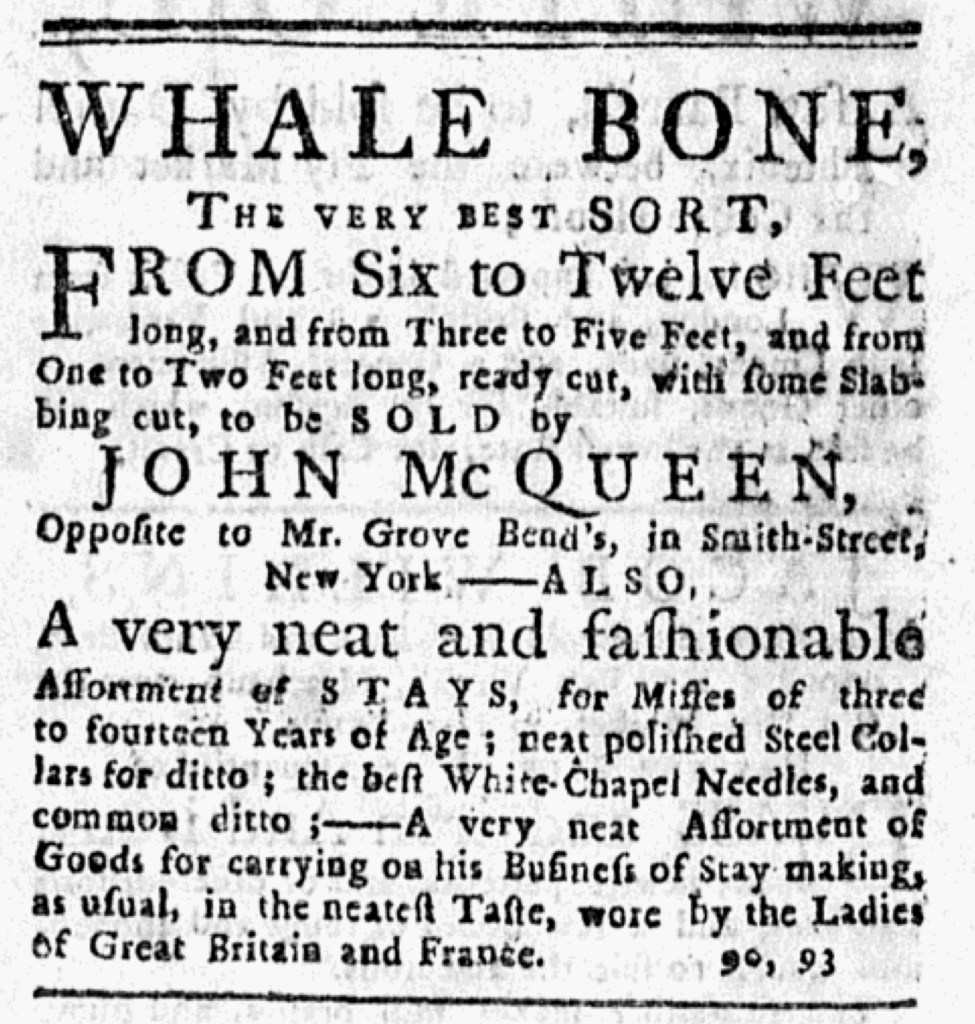
“Carrying on his Business of Stay-making … in the neatest Taste, wore by the Ladies of Great Britain and France.”

John McQueen continued making and selling stays in New York in 1773.  He had been living, working, and advertising in the city for many years.  Similar to a corset, a pair of stays, according to the Oxford English Dictionary, consisted of a “laced underbodice, stiffened by the insertion of whale-bone (sometimes of metal or wood) worn by women (sometimes by men) to give shape and support to the figure.”  Furthermore, the “use of the plural is due to the fact that stays were originally (as they still are usually) made in two pieces laced together.”  John White included a woodcut depicting a pair of stays and lacing in his advertisement in the September 19, 1772, edition of the Pennsylvania Chronicle.

When he advertised in the New-York Journal in June 1773, McQueen emphasized his role as a supplier of “WHALE BONE” of “THE VERY BEST SORT” to other staymakers.  In addition, he stocked a “very neat and fashionable Assortment of STAYS, for Misses of three to fourteen Years of Age.”  Apparently, both staymakers and consumers did not believe that girls were ever too young to deploy these devices to shape their figures.”  Richard Norris, another staymaker in New York, regularly placed newspaper advertisements addressed to “young Ladies and growing Misses” as well as “Any Ladies uneasy in their shapes.”  Cultivating and preying on such anxieties was not invented by the modern beauty and fashion industries.

McQueen also resorted to another familiar refrain, declaring that he had on hand a “very neat Assortment of Goods for carrying on his Business of Stay-making, as usual, in the neatest Taste, wore by the Ladies of Great Britain and France.”  He often made such transatlantic connections, suggesting to prospective customers that he could assist them in demonstrating the sort of sophistication associated with cosmopolitan cities in Europe.  In 1766, he declared that he made stays “in the newest Fashion that is wore by the Ladies of Great-Britain or France.”  In another advertisement from 1767, he confided that he made “all sorts of Stays for Ladies, in the newest Fashions that is wore in London.”  Encouraging anxiety about the female form and making comparisons to fashionable elites became standard marketing strategies for McQueen and other staymakers in the eighteenth century.

February 13

What was advertised in a colonial American newspaper 250 years ago today?

Providence Gazette (February 13, 1773).

“Gibbs makes plated Buckles in the newest Fashions, warranted tough and good.”

John Carter, printer of the Providence Gazette, limited the number of advertisements in the February 6, 1773, edition in order to make room for political news from Massachusetts.  A week later, the final page of his newspaper once again consisted entirely of advertising.  Other advertisements appeared on the first and third pages as well.  Collectively, paid notices accounted for nearly half the space in the February 13 edition.

Those advertisements included one from John Gibbs.  The notice ran for the first time, perhaps delayed by a week when Carter made the editorial decision to focus on the politics of the imperial crisis in the previous issue.  Whatever the particulars of the timing, Gibbs, wished to inform prospective customers that he opened a new shop “where he carries on the Goldsmith’s and Jeweller’s Business, in all their various Branches.”  In other words, he possessed the skill to undertake any sort of order he received.

In addition to promoting his abilities, Gibbs made other appeals commonly deployed by artisans in their newspaper advertisements.  He promised exemplary public service, stating that “Ladies and Gentlemen that please to favour him with their Custom, may depend on being served with Fidelity and Dispatch.”  He also promised low prices, declaring that he charged “as low Rates as any can work for in this Colony, or elsewhere.”  According to Gibbs, those were not just reasonable prices but the lowest prices that consumers would find in Rhode Island or anywhere else.  He also emphasized current trends and quality.  In a nota bene, he exclaimed that he “makes plated Buckles in the newest Fashions, warranted tough and good.”

Gibbs purchased a square of advertising, yet in that small amount of space in the Providence Gazette he incorporated multiple appeals intended to entice prospective customers to visit his shop and give him their business.  He demonstrated his familiarity with advertising culture by including so many appeals commonly used in notices published by goldsmiths, jewelers, and other artisans during the era of the American Revolution.  Given the prevalence of newspaper advertising in the second half of the eighteenth century, both Gibbs and readers recognized the standard elements of such advertisements.

January 24

What was advertised in a colonial American newspaper 250 years ago this week?

Virginia Gazette [Purdie and Dixon] (January 21, 1773).
“He likewise makes Head Dresses for Ladies, so natural as not to be distinguished by the most curious Eye.”

George Lafong described himself as a “Hair Cutter and Dresser” in an advertisement he placed in the January 21, 1773, edition of the Virginia Gazette.  He aimed to generate business by suggesting that he already served a satisfied clientele, extending his “humble Thanks to such Ladies and Gentlemen as have been pleased to honour him with their Commands.”  In addition, he invited new clients to engage his services.

Lafong deployed several appeals in his efforts to convince residents of Williamsburg and nearby towns to hire him.  For instance, he did not require that clients visit his shop.  Instead, they could schedule appointments in advance “by giving timely Notice” and the hairdresser traveled to their homes and “waited upon [them] at any Distance from Town.”  He did not charge exorbitant prices, but instead set “very reasonable Terms” for such excursions.

In addition, Lafong promoted an associate that he recently hired, reporting that he “has engaged a Man from London who dresses in the newest and most elegant Taste.”  That gave Lafong an advantage over other hairdressers who relied on correspondence to learn about the latest trends in the cosmopolitan center of the empire.  His associate had firsthand knowledge and experience with the latest styles in London.  That advantage transferred to clients; not only did their appearance testify to making good choices in selecting a hairdresser but they could also boast about that hairdresser to friends and acquaintances.

In case that was not enough to convince prospective clients, Lafong also indicated that someone in his shop, either his new associate or Lafong himself, “makes Head Dresses for Ladies, so natural as not to be distinguished by the most curious eye.”  In other words, he created wigs and extensions, such as the popular high roll, that withstood close scrutiny.  Observers would not be able to tell which portions, if any, of his client’s hairstyle was not her actual hair.  Such authenticity helped in projecting grace, elegance, and other genteel attributes.

Fashion found its way to places far removed from London as colonizers participated in a transatlantic consumer revolution in the eighteenth century.  Hairdressers offered their services in major urban ports, like Charleston, New York, and Philadelphia, while also seeking to generate demand among prospective clients in the countryside “any Distance from Town.”  Fashion, both as a practice and as a motivation, was not confined to early American cities.

December 12

What was advertised in a colonial American newspaper 250 years ago today?

Pennsylvania Chronicle (December 12, 1772).

“He has had the Pleasure of pleasing some of the most respectable Gentlemen in London.”

John Marie, a tailor, wanted the better sort to know that he was well qualified to serve them at the shop he ran out of his house in Gray’s Alley in Philadelphia.  In an advertisement in the December 12, 1772, edition of the Pennsylvania Chronicle, he introduced himself as a “TAYLOR, from PARIS.”  He intended that his connection to one of the most cosmopolitan cities in Europe, a city where the fashionable often set tastes adopted in London, the most cosmopolitan city in the British Empire, would recommend him to genteel consumers in the largest and one of the most cosmopolitan cities in the colonies.  He made clear that he sought a particular kind of client by addressing “the Gentry and Public.”  Consumers and tailor would mutually benefit from their association as Marie enhanced the appearances of his clients and those clients gained the cachet of being dressed by a French tailor.

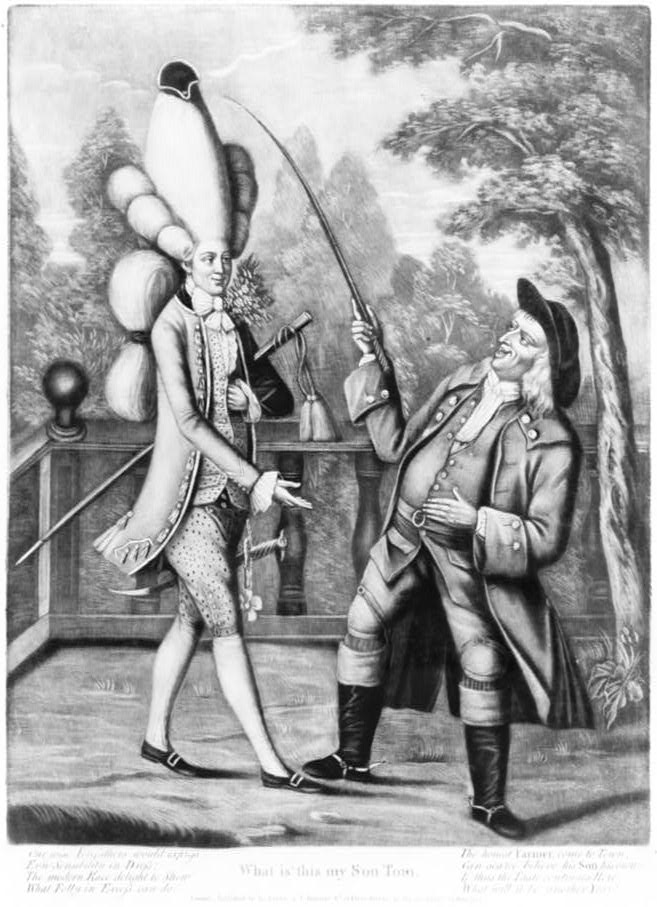
To demonstrate that he was prepared to work with the local gentry, Marie heralded his previous experience.  The tailor proclaimed that he “has had the Pleasure of pleasing some of the most respectable Gentlemen in London,” though he was too discreet to mention names.  That he served “respectable Gentlemen” suggested that he kept them outfitted according to the latest styles but did not resort to anything too frivolous or outrageous.  Prospective clients could depend on him dressing them well without transforming them into the macaronis who were the target of so much derision in both London and Philadelphia in the 1770s.  In “Fashion and the Culture Wars of Revolutionary Philadelphia,” Kate Haulman explains that the term macaroni “applied to elaborately powdered, ruffled, and corseted men of fashion” whose “suits were opulent and closely cut, with incredibly slim silhouettes.”[1]  A series of prints published in London depicted all sorts of men, “from farmers to barristers,” as macaronis.  Thus, Haulman argues, “macaroni could apply to any man who followed fashion to ape high status.”[2]  Marie suggested that he did not seek to serve such pretenders.  The gentry in Philadelphia could depend on him to dress them as “respectable Gentlemen,” just as he had done for his clients in London.

Print depicting a macaroni and his perplexed father. “What is this my Son Tom” (London: R. Sayer and J. Bennett, 1774). Courtesy Library of Congress.

[1] Kate Haulman, “Fashion and the Culture Wars of Revolutionary Philadelphia,” William and Mary Quarterly, 3rd ser., 62, no. 4 (October 2005): 635

[2] Haulman, “Fashion and the Culture Wars,” 636.

April 20

GUEST CURATOR: Victoria Ostrowski

What was advertised in a colonial American newspaper 250 years ago today?

Boston Evening-Post (April 20, 1772).

Ladies SILKS of the newest Fashion.”

In this advertisement, Thomas Lee sold a variety of goods imported from England. The ones that stood out the most to me were the “Ladies SILKS of the newest Fashion.” I was interested in finding more about silks because I wanted to know more about women’s fashion in the colonial era. I discovered that the materials used to make women’s clothing changed during the eighteenth century. According to the “Fashion History Timeline” from the Fashion Institute of Technology, “The heavy, brocaded, lushly floral silks of the mid-century were superseded by silks that were both lighter in weight and simpler in design, heralding ‘the advent of Neo-Classicism.’ In the first half of the 1770s, motifs shrank significantly and ‘the vertical element of the of the late 1760s proliferated in the early 1770s into clusters of broad and narrow stripes.’ By the middle of the decade, ‘the clustered stripes had all but disappeared and, instead … [they were absolutely regular in width.” Fashions for women seemed to enter a new age of design every couple of years! Thomas Lee advertised “a most elegant Assortment” of “Ladies SILKS,” allowing for colonial women to dress in “the newest Fashions.”

**********

ADDITIONAL COMMENTARY: Carl Robert Keyes

Along with price and quality, eighteenth-century advertisers frequently made appeals to fashion as they attempted to incite demand for the goods they sold.  Merchants and shopkeepers, tailors and milliners all tried to convince prospective customers that they could outfit them in current styles.  As Tori notes, Thomas Lee promoted his “Supply of Ladies SILKS of the newest Fashions” in an advertisement that ran in the April 20, 1772, edition of Boston Evening-Post.  Elsewhere in the same issue, Cyrus Baldwin advertised a “large and neat Assortment of English and India Goods” that included “LADIES newest-fashioned bonnets” and other items.  The proprietors of the Irish Linen Warehouse on King Street informed readers that they stocked a “Variety of the most elegant Copper-Plate printed Muslins for Ladies Summer Wear, much esteemed at present among the most fashionable People in England.”  John Barrett and Sons published an extensive catalog of goods available at their shop, underscoring fashion in the first two entries: “New fashion brown, purple, green & blue English Damasks” and “Very fashionable & genteel brocaded & striped, changeable cloth color’d, white, grey and black Mantuas & Lutestrings.”

As these examples make clear, purveyors of textiles, garments, and all sorts of accessories knew that prospective customers did not measure fashion solely in terms of the styles they saw others wearing in the colonies.  Instead, consumers looked across the Atlantic for cues, seeking to demonstrate that they shared the sophisticated tastes of genteel men and women who shopped in London and pursued cosmopolitan lifestyles in town and country.  Those tastes evolved quickly, as Tori discovered in her research.  How quickly they evolved was one of the defining features of the consumer revolution of the eighteenth century.  On both sides of the Atlantic, consumers updated their wardrobes much more frequently than they did a century earlier, fueled by a preoccupation with fashion and a desire to display their own status and good taste.  That gave Lee and other advertisers greater leverage in their interactions with prospective customers, enticing them with “the newest Fashions” to get consumers into their shops.

April 17

What was advertised in a colonial American newspaper 250 years ago today?

Connecticut Journal (April 17, 1772).

“He continues to cut and dress Gentlemen and Ladies Hair in Taste, either antient or modern.”

Amos Morrisson described himself as a “Peruke-Maker and Dresser.”  He made wigs and styled hair for colonizers in and near New Haven in the early 1770s.  He placed an advertisement in the April 17, 1772, edition of the Connecticut Journal to inform current and prospective clients that he “lately removed from the Place where he formerly work’d, to a new Shop on the Church Land, next to Mr. Fairchild’s.”  That amounted to sufficient direction for patrons to find his new location.

Morrisson incorporated several marketing appeals into the remainder of his advertisement.  He addressed fashion and customer satisfaction simultaneously when he stated that he “continues to cut and dress Gentlemen and Ladies Hair in Taste, either antient or modern.”  In so doing, he hinted at debates about hairstyles that colonizers took seriously during the era of the American Revolution.  Men and women who adopted “modern” styles faced accusations that they indulged in luxury at the expense of good character.  Women wore high rolls, their hair and extensions elaborately arranged atop their heads.  Some men adopted a similar style, prompting critics to refer to them as “macaronis” as a critique of hairstyles, garments, and comportment associated with Italy.  Morrisson did not take a position in the debate.  Instead, he signaled that he was proficient in the “modern” style for those who wished to wear it, but he also served clients who preferred more conservative or “antient” styles.  Either way, his clients could depend on having their hair done “in Taste” at his shop.

In addition to styling hair, Morrisson “carried on Wigg-Making in all its Branches.”  He once again emphasized customer service, promising that “Gentlemen (both of Town and Country) … may depend upon being used in the best Manner.”  He constructed his wigs “of the best Materials” and set lower prices than prospective clients would find anywhere in the vicinity.  Morrisson declared that he sold his wigs “much cheaper … than has formerly been sold in Town.”  He also highlighted his experience and roots in the community, referencing clients “that have favoured him with their good Custom” in the past and inviting them to “continue the same.”

Morrisson’s advertisement was not particularly lengthy, but he managed to include a variety of appeals to incite demand for his services.  In so doing, he replicated aspects of advertisements placed by his counterparts in larger urban ports like New York and Philadelphia.  Fashion was not the province of the elite in those places.  Instead, purveyors of goods and services, including a “Peruke-Maker and Dresser” like Morrisson, served consumers throughout the colonies.