October 15

What was advertised in a revolutionary American newspaper 250 years ago this week?
Virginia Gazette [Dixon and Hunter] (October 14, 1775).

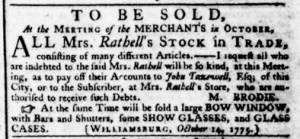
“Will be sold a large BOW WINDOW, with Bars and Shutters, some SHOW GLASSES, and GLASS CASES.”

In the spring of 1775, Catherine Rathell, a milliner in Williamsburg, advertised her intention to “dispose of my Goods” and go to England “till Liberty of Importation is allowed.”  The Continental Association, a nonimportation agreement devised by the First Continental Congress in protest of the Coercive Acts, disrupted trade for merchants, shopkeepers, and others who sold imported goods.  When she first placed her advertisement, Rathell and the rest of the residents of Williamsburg had not yet received word of the battles at Lexington and Concord.  The outbreak of hostilities may have prompted her to adjust her plans because she did not wait until she sold all her merchandise to depart.  Instead, she left her wares in the hands of Margaret Brodie, a mantuamaker who had worked with Rathell since 1771, to sell “At theMEETING of the MERCHANTS in OCTOBER.”  The milliner did not return to Williamsburg.  Unfortunately, she died when the ship taking her to England got caught in a hurricane and sank.

Brodie’s advertisement in the October 14, 1775, edition of John Dixon and William Hunter’s Virginia Gazette concerned more than just selling Rathell’s remaining merchandise.  It also called on those indebted to Rathell to settle accounts with Brodie.  A short note at the end of the notice, marked with a manicule to draw attention, noted that “a large BOW WINDOW, with Bars and Shutters, some SHOW GLASSES, and GLASS CASES” would be sold at the same time as “Mrs. Rathell’s STOCK in TRADE.”  That provides a glimpse of Rathell’s merchandising strategies.  By the early eighteenth century, bow windows became popular features of shops in London, so common that some critics complained about the way that they jutted into the street and made it more difficult for pedestrians to pass.  Yet that was one of the intended purposes, causing prospective customers to slow down and view the merchandise on display.  In addition, bow windows offered more space for displaying goods than windows flush with exterior walls.  Some American retailers, including Rathell, adopted this strategy for marketing their wares.  Rathell also invested in glass cases to showcase some of her merchandise for visitors to her shop.  She could protect valuable items from shoplifters while still making them visible to entice customers.  Similarly, the bars on shutters on the bow window protected goods from burglars when the shop was closed.  Without contemporary visual images of American shops, Rathell’s advertisement helps reconstruct their interiors and the experience of shopping in eighteenth-century America.

August 31

What was advertised in a revolutionary American newspaper 250 years ago today?

Virginia Gazette [Pinkney] (August 31, 1775).

“She intends to open a DANCING SCHOOL … for young ladies.”

The new term had commenced, yet Sarah Hallam continued advertising her “DANCING SCHOOL” in Williamsburg in the August 31, 1775, edition of John Pinkney’s Virginia Gazette.  She first promoted the school in the public prints on August 17, announcing that she “intends to open a DANCING SCHOOL, on Friday the 25th instant, for young ladies.  That gave prospective pupils and their parents just over a week to enroll.  Hallam advertised a second time on the eve of opening her school and again a week later to give stragglers a chance to join.  She apparently considered advertising worth the investment.  The advertisement continued in four more issues, through the end of September.  According to the rates in the newspaper’s masthead, Pinkney charged three shillings for the first insertion (to cover setting type and space in the newspaper) and two shilling for each additional insertion (for the space once the type was set).  That meant that Hallam spent fifteen shillings on advertisements in Pinkney’s Virginia Gazette.  She charged twenty shillings as an entrance fee and then four pounds per year for each student.  That meant that the entrance fee for just one student covered her advertising expenses.

Hallam certainly made choices about her marketing campaign, choices not limited to how long it lasted.  Williamsburg had three newspapers at the time.  John Dixon and William Hunter published their own Virginia Gazette, as did Alexander Purdie.  Yet Hallam opted not to place notices in either of the other newspapers even though the printers charged the same rates.  She had a limit to how much she would spend on recruiting new students.  She apparently decided that a longer campaign in a single newspaper would be more effective than a shorter campaign in several newspapers.  She may have reasoned that each Virginia Gazette circulated so widely in Williamsburg that inserting an advertisement in Dixon and Hunter’s Virginia Gazette or Purdie’s Virginia Gazette would be superfluous after running it in Pinkney’s Virginia Gazette.  Why choose Pinkney’s newspaper over the others?  Perhaps she appreciated that Pinkney had printed the Virginia Gazette “FOR THE BENEFIT OF CLEMENTINA RIND’s CHILDREN” after the former printer’s death in September 1774.  For six months, the masthead made that proclamation immediately above the advertising rates.  As a female entrepreneur, Hallam may have found meaning in choosing the newspaper formerly printed by a woman and then printed to support her children following her death.

August 20

What was advertised in a revolutionary American newspaper 250 years ago this week?

South-Carolina and American General Gazette (August 18, 1775).

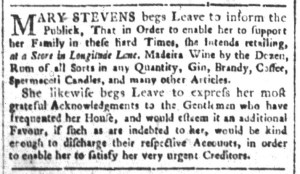
“In Order to enable her to support her Family in these hard Time, she intends retailing … Gin, Brandy, Coffee.”

Women regularly advertised goods and services in early American newspapers.  Mrs. Miller, a milliner, for instance, ran an advertisement in the August 18, 1775, edition of the South-Carolina and American General Gazette.  Like many advertisements placed by female entrepreneurs, it did not differ from others placed by their male counterparts.  Mary Stevens also placed an advertisement in the same issue of that newspaper, though she deployed a marketing strategy more often used by women than by men.  She announced that she planned to open a store to retail wine, rum, gin, brandy, coffee, candles, and “many other Article.”  She did so, she declared, “in Order to enable her to support her Family in these hard Times.”  Rather than promote the quality or variety of her wares or promise exemplary customer service, some of the most common marketing strategies of the era, Stevens made her ability to support her family the primary reason that prospective customers should visit her store.  Many readers would have known more details than Stevens revealed in her advertisement, details that would have made her even more sympathetic.

Whatever her circumstances, Stevens had apparently conducted another sort of business for some time.  She devoted the second half of her advertisement to expressing “her most grateful Acknowledgments to the Gentlemen who have frequented her House.”  Again, many readers would have known whether Stevens took in boarders or prepared meals or served coffee in the parlor while her patrons discussed business and current events.  She served those “Gentlemen” on credit, but “these hard Times” made it necessary to ask them to “discharge their respective Accounts, in order to enable her to satisfy her very urgent Creditors.”  Men very often placed newspaper notices that called on associates to settle accounts, but rarely did they invoke the urgency that Stevens conveyed in her advertisement.  Even more rarely did they refer to supporting their families.  As a woman in business, Stevens may have been able to exercise a small amount of privilege in framing her advertisement in this manner, though the necessity that led her to do so did not suggest that she benefited from many advantages when it came to participating in the marketplace.

August 6

What was advertised in a revolutionary American newspaper 250 years ago this week?

New-York Journal (August 3, 1775).

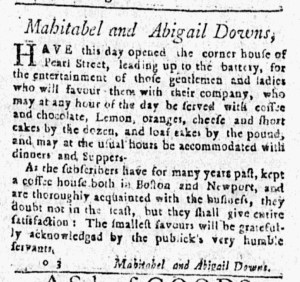
“The subscribers have for many years past, kept a coffeehouse both in Boston and Newport.”

In the summer of 1775, Mahitabel Downs and Abigail Downs published an advertisement that advised residents of New York that they had opened a “house … for the entertainment for those gentlemen and ladies who will favour them with their company.”  They offered hospitality to their guests “at any hour of the day,” serving “coffee and chocolate, Lemon, oranges, cheese and short cakes by the dozen, and loaf cakes by the pound.”  Among the beverages listed in their advertisement, the Downses notably did not include tea.  Although a favorite of many colonizers, tea was at the center of political controversies during the imperial crisis.  In not serving tea to their patrons, the Downses indicated that they supported the American cause or at least abided by the boycott currently in effect.  Guests could gather at their house of entertainment with confidence that they upheld the Continental Association’s prohibition on drinking “East India Tea.”

Apparently the Downses were newcomers in New York.  Accordingly, they believed that they needed to do more to entice guests to dine and socialize at their house of entertainment on Pearl Street than merely list the refreshments that they could enjoy there.  Although new to the city, they were not new to the business, as they explained in their advertisement.  The hostesses shared that they “have for many years past, kept a coffee house both in Boston and Newport, and are thoroughly acquainted with the business.”  As a result, “they doubt not in the least, but they shall give entire satisfaction” to their guests.  Even though readers did not know them by reputation, the Downses hoped that their prior experience operating similar establishments in bustling port cities in New England would convince prospective patrons of the quality of the experience – the food, the beverages, the furnishings, the atmosphere – they could expect at this new house of entertainment.  If the Downses succeeded in persuading guests to visit them once then they anticipated that the food, drink, and service would serve as sufficient recommendation to return.

July 15

What was advertised in a colonial American newspaper 250 years ago today?

Massachusetts Spy (July 15, 1774).

“She has removed from Fore-street, to a little above the Hay-Market.”

Susanna Renken achieved her greatest visibility in the public prints with the advertisements for garden seeds she inserted in several newspapers printed in Boston in the winter and spring.  In several years, she was the first entrepreneur to advertise garden seeds, quickly joined by a sorority of seed sellers who sought their share of the market.  Most of those female entrepreneurs did not place advertisements throughout the rest of the year, even those, like Renken, who mentioned that they also stocked “English and India Goods all which may be had cheap for Cash.”

In the summer of 1774, however, circumstances prompted Renken to advertise that “she has removed from Fore-street,” where she had been for many years, “to a little above the Hay-Market.”  She reminded both current customers and the public that she “has for Sale, a variety of English and India GOODS, Groceries of all sorts, West-India and New-England Rum.”  Renken did not go into as much detail about her wares as many other merchants and shopkeepers, confining her notice to announcing her new location so she could maintain (and perhaps expand) her clientele.

She also did not advertise as widely as she usually did when she promoted garden seeds.  She usually placed notices in several newspapers printed in Boston and sometimes even in the Essex Gazette published in Salem.  Of the five newspapers that served Boston in 1774, Renken opted to advertise in only two, the Boston-Gazette, printed by Benjamin Edes and John Gill, and the Massachusetts Spy, printed by Isaiah Thomas.  Those printers and their publications were well known for their support of the Sons of Liberty and their critiques of a British government that encroached on the liberties of colonizers.  Thomas had recently updated the masthead of the Massachusetts Spy to include an image of a snake, representing the colonies, defending itself against a dragon, representing Britain, with the declaration “JOIN OR DIE.”  With the harbor closed to trade due to the Boston Port Act, perhaps Renken expressed her own political views in choosing which newspapers to carry her advertisement.

June 17

What was advertised in a colonial American newspaper 250 years ago today?

South-Carolina and American General Gazette (June 17, 1774).

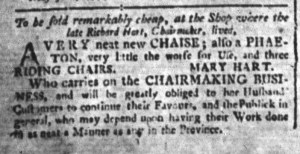
“MARY HART … will be greatly obliged to her Husband’s Customers to continue their Favours.”

When she took to the pages of the South-Carolina and American General Gazette in the summer of 1774, Mary Hart advertised several wheeled vehicles for sale “remarkably cheap, at the Shop where the late Richard Hart, Chairmaker, lived” in Charleston.  Her inventory included a “VERY neat new CHAISE,” described by the Oxford English Dictionaryas a “light open carriage for one or two persons, often having a top,” and a “PHAETON, very little the worse for Use,” described as a “light four-wheeled open carriage, usually drawn by a pair of horse, and having one or two seats facing forward.”  Like the modern automobile industry, Hart marketed both new and used vehicles.  She also had three “RIDING CHAIRS,” which public historians at George Washington’s Mount Vernon describe as a “wooden chair on a cart with two wheels … pulled by single horse.”  They explain that riding chairs “could travel country lanes and back roads more easily than bulkier four-wheeled chariots and coaches.”  Hart offered different kinds of wheeled vehicles to suit the needs, tastes, and budgets of her customers.

The widow did not merely seek to sell carriages previously produced by her late husband.  Instead, she announced that she “carries on the CHAIRMAKING BUSINESS.”  Eighteenth-century readers understood that she referred to making wheeled vehicles, not household furniture.  Her husband had cultivated a clientele for the family business, one that Hart wished to maintain and even expand.  She declared that she “will be greatly obliged to her Husband’s Customers to continue their Favours, and the Publick in general, who may depend upon having their Work done in as neat a Manner as any in the Province.”  Did Hart construct carriages herself?  Perhaps, though if that was the case it demonstrated what was possible rather than what was probable.  In a dissertation on “Women Shopkeepers, Tavernkeepers, and Artisans in Colonial Philadelphia,” Frances May Manges demonstrated that female entrepreneurs worked in a variety of trades.[1]  Hart may have worked alongside her husband before his death and then continued.  Rather than building carriages, she may have supervised employees in the workshop, running other aspects of the business both before and after her husband’s passing.  Either way, she confidently asserted that a workshop headed by a woman produced carriages equal in quality to any others made in the colony.  Out of necessity, Hart joined the ranks of widows who continued operating family businesses in colonial America.

**********

[1] Frances May Manges, “Women Shopkeepers, Tavernkeepers, and Artisans in Colonia Philadelphia” (Ph.D. diss., University of Pennsylvania, 1958).

January 26

What was advertised in a colonial American newspaper 250 years ago today?

Pennsylvania Journal (January 26, 1774).

“THOMAS & MARY GRIFFITH, Are removed from Christian-street, to … Sixth-street.”

When Thomas Griffith and Mary Griffith took the pages of the Pennsylvania Gazette at the end of January 1774, they incorporated the same headline they used in their advertisement the previous August.  They promoted their services “TO THE LADIES” of Philadelphia and nearby towns, Thomas his “FAN-MAKING business” and Mary cleaning various kinds of laces “to look like new.  The Griffiths had recently “removed from Christian-street” and now operated their businesses on Sixth Street, occasioning the new advertisement.

Despite deploying the same headline, this notice was shorter than the other one.  Perhaps the Griffiths felt that they had established their reputations in Philadelphia and did not need to provide as much information for a clientele that they wished to follow them to their new location as they had when they introduced themselves upon arriving in a new city.  Thomas had described himself as a “Fan-Maker from London, but last from Charlestown,” but did not do so in the new advertisement, nor did he go into any detail except to say that he “intends to continue the FAN-MAKING business in general.”  Similarly, Mary provided only a brief overview, but did not mention her “new method” for cleaning laces to entice prospective customers.  The Griffiths did “return thanks to the Ladies for the encouragement they received,” another suggestion that they had cultivated a clientele over the last six months.

The secondary headline for their new advertisement included both their names, “THOMAS & MARY GRIFFITH,” whereas Thomas’s name alone ran as the secondary headline in their other advertisement.  This time, Mary’s contribution to the household economy received the same visibility as Thomas’s “FAN-MAKING business,” though his enterprise still received top billing.  It may have been that publishing a shorter advertisement prompted this change, though the Griffiths may have also realized that Mary’s enterprise brought as many or more of “THE LADIES” to the shop in their house as the fans that Thomas made and sold.  Whatever convinced them to take a new approach, they apparently considered their previous newspaper advertisements effective enough to merit investing in a new advertisement when they moved to a new location.

January 19

What was advertised in a colonial American newspaper 250 years ago today?

Pennsylvania Journal (January 19, 1774).

JEDIDIAH SNOWDEN … carries on his business of Cabinet and Windsor Chair-Making … The MILLINARY BUSINESS is carried on as usual, by ANN SNOWDEN.”

Jedidiah Snowden and Ann Snowden pursued different lines of business, but they placed a joint advertisement in the January 19, 1774, edition of the Pennsylvania Journal.  Jedidiah informed the public that he moved from Market Street to Front Street, “where he carries on his business of Cabinet and Windsor Chair-Making, and sells them at the most reasonable rates.”  For her part, Ann declared that the “MILLARY BUSINESS is carried on as usual” and she “has imported a large and general assortment of MILLINARY.”  She then listed dozens of items among her inventory, including “a genteel assortment of figured and plain ribbands,” “mens, womens, boys and girls white and coloured gloves,” “pearl, French and English white wax necklaces,” and “India, ivory, bone, and black fans.”

The Snowdens did not specify their relationship to each other in their advertisement.  Most likely they were husband and wife, though they could have been father and daughter, mother and son, brother and sister, cousins, or some other relations.  Whatever the case, Jedidiah was the head of household, so his name and information about his business came first.  Although Ann’s name ran in the same size font as Jedidiah’s name, “Cabinet and Windsor Chair-Making” appeared as a secondary headline, also in a larger font than the rest of the advertisement, while “MILLINARY BUSINESS” merely appeared in capital letters integrated into the regular copy rather than treated as another headline.  Still, Ann’s portion of the advertisement occupied the most space on the page, approximately four times as much as Jedidiah’s portion.  The Snowdens made a much larger investment in promoting Ann’s “MILLINARY BUSINESS” than Jedidiah’s “Cabinet and Windsor Chair-Making.”  Perhaps Jedidiah believed that he had established such a reputation for his work that he did not need to provide more details beyond telling readers that he had moved and sold the furniture he made “at the most reasonable rates.”  Ann, on the other hand, competed with merchants, shopkeepers, and milliners who constantly imported new wares and updated their advertisements in the several newspapers published in Philadelphia.  Demonstrating that she offered the same selection of merchandise as her competitors may have been imperative to the milliner.  Advertisements jointly placed by husbands and wives or other male and female relations rarely listed the female entrepreneur first, but no matter their format they did reveal that both advertisers contributed to the household economy through their participation in the marketplace.

January 17

GUEST CURATOR:  David Alexander

What was advertised in a colonial American newspaper 250 years ago today?

Boston Evening-Post (January 17, 1774).

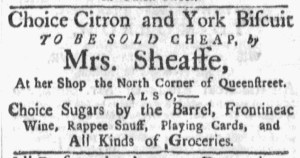
TO BE SOLD CHEAP, by Mrs. Sheaffe.”

Mrs. Sheaffe placed this advertisement in the Boston Evening-Post.  She ran a shop where she sold a variety of items, including choice citron (referring to citrus fruits), sugar, wine, and “All Kinds of Groceries.” Mrs. Sheaffe ambitiously invested to integrate herself into life as a businessowner as her advertisements appear twice in Massachusetts newspapers during the week of January 14-20, 1774, appearing in both the Boston Evening-Post and the Boston-Gazette. According to Gloria Main in “Gender, Work, and Wages in Colonial New England,” most women in retailing were widows who had taken over a deceased husband’s shop.”[1]  As this woman went by “Mrs. Sheaffe” it is likely that she was a widow and opened her shop to support herself and her family. Mrs. Sheaffe’s investments in advertising her shop in multiple newspapers demonstrates her industriousness and desire to establish herself as a businessowner of Boston. During the Revolutionary Era, the role of women in business extended far beyond just buying goods, many of them acting as retailers themselves.

**********

ADDITIONAL COMMENTARY:  Carl Robert Keyes

David convincingly suggests that Mrs. Sheaffe may have been a widow responsible for supporting herself and perhaps others in her household.  When other female entrepreneurs placed advertisements in newspapers published in Boston, they tended to use their full names, just as their male counterparts did.  Mrs. Sheaffe’s decision to go by “Mrs. Sheaffe” may have been intended to remind those who knew her of her circumstances as a widow.  She may have also meant for that to justify her role in the marketplace as a shopkeeper rather than as a consumer.  Although some women ran businesses, as their advertisements attest, doing so was often depicted as a masculine endeavor, one better suited to men than women.

Mrs. Sheaffe attained a certain level of visibility in Boston, thanks in part to her frequent advertisements.  Other women certainly assisted in running family businesses, even when they were not considered proprietors or mentioned in advertisements.  When Herman Brimmer and Andrew Brimmer advertised “An Assortment of Mens, Womens & Childrens Hose” and other garments in the same edition of the Boston Evening-Post that Mrs. Sheaffe promoted her wares, they sought female customers, recognizing the role that women played as consumers.  Their advertisement, like so many others, may have hidden the role that wives, daughters, and other female relations played in helping to run their shop “next Door to the Sign of the Lamb.”

Other female entrepreneurs did not achieve the same visibility in the marketplace as Mrs. Sheaffe because women were less likely to place newspaper advertisements compared to men who ran businesses.  That same issue of the Boston Evening-Post included a notice calling on “All Persons indebted to the Estate of the late Mrs. Ruth Sinclair, Shopkeeper,” to settle accounts.  According to a list of recent deaths in the December 27, 1773, edition of the Boston Evening-Post, she was the “Widow of the late Capt. Sinclair.”  He died thirteen years earlier, a notice about settling his estate in the August 25, 1760, edition of the Boston-Gazette listing his widow as “sole Executrix.”  Although she was apparently known to residents of Boston as a shopkeeper, Ruth Sinclair did not publish any advertisements.  Instead, she may have relied on foot traffic and recommendations from loyal customers.

Mrs. Sheaffe was not alone as a proprietor of her own business during the era of the American Revolution.  Other women ran businesses and an even greater number participated in the marketplace as more than consumers, assisting in shops run by husbands, fathers, brothers, and others.  Yet Mrs. Sheaffe did make her role as a female entrepreneur much more visible in the public prints than most other women.  Her advertisements testify to what was possible for women, though not usual.

**********

[1] Gloria L. Main, “Gender, Work, and Wages in Colonial New England,” William and Mary Quarterly, 3rd ser., 51, no. 1 (January 1994): 58.

December 9

What was advertised in a colonial American newspaper 250 years ago today?

Massachusetts Gazette and Boston Weekly News-Letter (December 9, 1773).

“She will engage to sell as Cheap as can be bought in Town.”

Mrs. Sheaffe sold “GROCERIES of all Kinds, and of the best Qualities,” at her shop in Boston in 1773.  In an advertisement in the December 9 edition of the Massachusetts Gazette and Boston Weekly News-Letter, she listed many of the items she stocked, including “Superfine and common Philadelphia Flour by the Barrel or less,” “Fresh Jar and Cask Raisins,” “Choice Hyson, Souchong and Bohea Tea,” “Spanish and French Olives,” “single, middling and double refin’d Loaf-Sugar,” anchovies, oatmeal, coffee, “split Peas,” and “Fresh Spices.”  In addition, she sold corks, “Choice Frontineac WINE,” “crown & hard Soap,” “Playing-Cards,” and two different kinds of snuff.

An enterprising entrepreneur, Sheaffe stated that she would not be undersold by any of the merchants in Boston.  Her name served as the primary headline, preceded by a note declaring, “TO BE SOLD CHEAP.”  That sentiment framed Sheaffe’s entire advertisement, setting up expectations for prospective customers before they encountered the list of groceries available at her shop.  She concluded her notice with a nota bene, promising that she “will engage to sell as Cheap as can be bought in Town.”  Sheaffe faced competition on that front.  Immediately below her advertisement, Penuel Brown’s notice listed several of the items that Sheaffe enumerated, including “Choice New FLOUR per Barrel,” “RAISINS per Cask nearly equal to Jarr,” “SPICES fresh and good, by all Quantities,” and “all other GROCERIES.”  Bowen also pledged to sell his wares “As Cheap as any in Boston.”  As prospective customers did their comparison shopping to find the best deals, Sheaffe and Bowen both wanted to increase the chances that they would consult with them about their prices.

Unlike Bowen, Sheaffe also made clear that she sold her groceries “by WHOLESALE AND RETAIL.”  She welcomed customers seeking to buy in large or small quantities, whether shopkeepers looking to replenish their own inventory or consumers acquiring essentials for their households.  Matching the best bargains in town did not require purchasing in large volumes.  Sheaffe intended to win her share of the market by making appeals concerning low prices that demonstrated to prospective customers that they should choose to shop with her rather than any of her competitors.