April 23

GUEST CURATOR: Samantha Surowiec

Who was the subject of an advertisement in a colonial American newspaper 250 years ago this week?

Georgia Gazette (April 26, 1769).

“Brought to the Work House, a TALL STOUT ABLE NEGROE FELLOW … says his name is Michael.”

This advertisement for an enslaved African named Michael who attempted to escape and had been captured and “Brought to the Work House.” In other similar advertisements, as well as runaway slave advertisements, only the first names of the slaves were usually listed. Although there have been claims made that slaves did not have last names until after they were emancipated following the Civil War, research done on the naming of Thomas Jefferson’s slaves suggests that many did, in fact, have last names (“Naming Patterns in Enslaved Families”).[1] In analyzing records of slaves beginning in the late eighteenth century, historians and other scholars found that these surnames allowed slaves to maintain family connections. Even if they were separated, which was more usual than not, slaves had a way to preserve family ties. One of the most prominent families on Jefferson’s plantation, the Hemings, can be connected to Monticello for over five generations because of their shared last name. It was also common for enslaved people to name children after themselves or relatives. Their offspring then chose to continue to preserve this attachment to their families left behind after being sold by sharing a last name or giving their own children the names of their siblings, parents, or other relatives. Enslaved people placed emphasis on family values and found ways to stay connected, no matter when they were separated.

**********

ADDITIONAL COMMENTARY: Carl Robert Keyes

In a recent entry I discussed the challenges of working with remediated sources rather than the original documents. While all historians face these sorts of challenges, they offer particularly valuable lessons in problem solving to the undergraduates who serve as guest curators for the Adverts 250 Project and the Slavery Adverts 250 Project. Those students “do” history in ways that are new to them when they consult multiple versions of the same primary sources, discovering that all remediation is not equal.

Compare this black-and-white image to the greyscale image of the same advertisement above. Georgia Gazette (April 26, 1769).

Consider two images of today’s advertisement concerning Michael, “A TALL STOUT ABLE NEGROE FELLOW” who had been captured and “Brought to the Work-house” in Savannah after attempting to make his escape from his enslavers. Both images come from Readex’s America’s Historical Newspapers, a database that guest curators become very adept at navigating. The processes used to download the images, one originally as a gif file and the other originally as a pdf file (and both converted to jpg files to post here), resulted in one image easier to read than the other. The shades of grey in the gif file distinguished which text had been printed on the page and what had bled through from the other side, unlike the black and white image from the pdf file.

The interface for America’s Historical Newspapers has been designed such that it is much more efficient to download pdf files. Acquiring gif files would be much more time consuming, both for me as a scholar who works on this project every day and for undergraduates who make contributions as guest curators over shorter durations. Once students have acquired digital copies of the newspapers for their week as guest curator, we print copies that they may use however they wish, such as marking them up and clipping items. These black-and-white images printed on 8.5×11 office paper can be quite difficult to read, depending on the remediation process. Poorly preserved primary sources, poor photography, and conversion from one kind of digital file to another all contribute to making some digital surrogates less legible than the originals. Although students often find it most convenient and efficient to work with the hard copies we have generated, I encourage them to work back and forth between digital copies and hard copies when they encounter text that is not clearly legible. I do the same, often discovering that the digital copy becomes more legible as I manipulate it, sometimes zooming in and sometimes consulting the greyscale gif image.

This process underscores to students that when they examine a hard copy of a digitized image of a newspaper from the eighteenth century that they are working with a particular manifestation of that source, one that has been altered through repeated remediation over the years. Doing the work of an historian requires not only consulting primary sources but also learning and developing strategies for working with those sources effectively.

**********

[1] Editor’s note: “Naming Patterns in Enslaved Families” has been widely cited online. It has also appeared in the citations for at least one scholarly monograph, Sharon Block’s Colonial Complexions: Race and Bodies in Eighteenth-Century America. At the time of publication for this entry, however, the article is not available on Monticello’s website. The link currently takes visitors to Monticello’s home page. Hopefully “Naming Patterns in Enslaved Families” will be restored soon.

April 19

GUEST CURATOR: Matthew Ringstaff

Who was the subject of an advertisement in a colonial American newspaper 250 years ago today?

Georgia Gazette (April 19, 1769).

“ABOUT TWENTY-ONE VALUABLE PLANTATION SLAVES.”

On April 19, 1769, Benjamin Fox put an advertisement in the Georgia Gazette to sell a plantation. The advertisement boldly stated “ABOUT TWENTY ONE VALUABLE PLANTATION SLAVES.” I was curious about the lives of plantation slaves and learned more from the Understanding Slavery Institute sponsored by several museums in Great Britain. According to the Understanding Slavery Institute, “plantations depended on skilled slaves – masons, joiners, coopers, metalworkers – to keep factories, fields, equipment and transport prepared and functioning. The needs of the wider slave community were served by other vital workers: cooks, nurses, and seamstresses.” However, other slaves were very skilled in agriculture. Those slaves were responsible for more important decisions on the plantation. They were sometimes responsible for determining when sugar cane was ready for harvest or when tobacco leaves were ideal for picking or “how best to pack, load, and transport the commodities grown on the plantation.” Slaves had occupations and could be traded and sold from plantation to plantation as their services were required.

**********

ADDITIONAL COMMENTARY: Carl Robert Keyes

Although this particular advertisement did not, other advertisements concerning enslaved men and women often listed their skills or occupations. As Matt indicates, enslaved artisans contributed far more than labor to colonial commerce. Their involuntary contributions also included their skill and expertise.

Consider the advertisements that ran in the South-Carolina and American General Gazette earlier in the same week as this advertisement from the Georgia Gazette. One offered to sell a “Valuable NEGRO MAN” … who was “well qualified for a gentleman’s servant, or as a waiter in a tavern.” Another advertisement described an enslaved man who was “a very good GARDINER.” In both instances, they skillfully accomplished tasks beyond agricultural labor in the fields on plantations.

In the course of describing a plantation for sale, yet another advertisement also listed “about thirty likely NEGROES,” many best suited for working in the fields but some possessing other valuable skills. They included “a very good bricklayer, a driver, and two sawyers” along with seventeen considered “fit for the field or boat-work.” In addition, John Matthews once again ran an advertisement that had appeared for months. He sought to sell both a plot of land and an enslaved laundress. He also mentioned that he “hath not yet sold his negro Shoe-makers” and could thus supply customers with boots and shoes “as usual.” Matthews had previously attempted to sell those shoemakers, placing advertisements in Charleston’s newspapers for months. He proclaimed that “they have done all my business for nine Years past, and are at least equal to any Negroes of the Trade in this Province.” Matthews stated that he intended to “decline Shoemaking,” but his advertisement suggests that he supervised skilled enslaved artisans rather than making any shoes himself.

Considering advertisements about enslaved men, women, and children collectively, along with other sources, reveals the broad range of skills they possessed and occupations they followed in eighteenth-century America. While many did indeed labor in the fields on plantations, a significant number worked in diverse settings at various occupations that required specialized skills.

April 5

GUEST CURATOR: Aidan Griffin

Who was the subject of an advertisement in a colonial American newspaper 250 years ago today?

Georgia Gazette (April 5, 1769).

“A PRIME CARGO OF NEW NEGROES.”

Advertisements about enslaved men, women, and children were common in most newspapers in most colonies in 1769. In the northern colonies, the amount of such advertisements was usually less than in southern colonies. This advertisement was in the Georgia Gazette, where slave advertisements were almost everywhere. These slaves in this advertisement came from Africa, specifically from Gambia. The transatlantic slave trade was brutal as Africans were packed in slave ships with little room left unfilled. This was just the beginning of the awfulness as the unhygienic conditions on the ships allows pathogens to thrive, causing regular outbreaks of various diseases that would easily spread to the slaves as they were transported together. Once a ship arrived at a colony, the suffering continued with the Africans being sold off, usually not with their family.

This advertisement is ironic because at this time the colonists were beginning to think of becoming independent from Britain in light of all the acts by Parliament, such as the Declaratory Act. At the same time, colonists imported slaves from Africa. As the colonists thought of getting their liberty and freedom, they were taking away the freedom of the enslaved men, women, and children, like the “NEW NEGROES” in this advertisement.

**********

ADDITIONAL COMMENTARY: Carl Robert Keyes

As Aidan notes, this advertisement reveals important details about the transatlantic slave trade and one voyage in particular. It includes enough information to locate this delivery of “NEW NEGROES” in the Slave Voyages database, where it is recorded as Voyage ID 77969. Considered together, the advertisement and the data compiled in Slave Voyages tell a more complete story of the captives and crew who crossed the Atlantic on the Britannia.

The voyage began in London on September 8, 1768. Stephen Deane commanded the vessel with a crew of twenty-two. The Britannia had four guns mounted to fend off any sort of attack. Deane sailed to Gambia, the principal place for purchasing Africans on this voyage. There, approximately 175 Africans boarded the Britannia before it sailed to Georgia, arriving in late March. (Slave Voyages lists April 5 as the arrival date, likely deriving the date from when the Georgia Gazette was published. The advertisement itself, however, lists March 31 as the date it was written. The Britannia likely arrived sometime in the previous week.) According to the advertisement in the Georgia Gazette, only “about one hundred and fifty” of the Africans arrived at the colony. One in seven did not survive the voyage. Many of them likely perished due to smallpox. The advertisement reported “one hundred and twenty … had the smallpox on board said vessel before they arrived here.” Although this “PRIME CARGO” was scheduled for sale in Savannah on April 11, the captives were first “performing a quarantine at Tybee” while they recovered enough to safely put them on display for colonial buyers. From the time the Britannia departed London until it arrived in Georgia, a little more than two hundred days passed. The records, however, do not provide enough information to determine the length of the Middle Passage that the survivors, “chiefly men,” endured.

According to Slave Voyages, the Britannia was one of three vessels that delivered human cargo to Georgia directly from Africa in 1769. In total, twenty-eight vessels made such voyages between Africa and mainland North America that year. The vast majority disembarked enslaved men, women, and children in Charleston, but others also arrived in New York and Virginia. This continuing trade did indeed stand in stark contrast to colonists decrying their own loss of liberty at the hands of Parliament in the late 1760s.

March 29

GUEST CURATOR: Sean Duda

Who was the subject of an advertisement in a colonial American newspaper 250 years ago today?

Georgia Gazette (March 29, 1769).

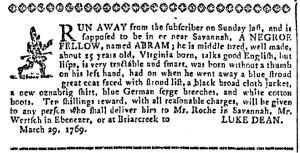
“RUN AWAY … A NEGRO FELLOW, named ABRAM.”

This advertisement contains the description of a runaway slave named Abram, including what he was wearing and distinguishing marks, and a reward for returning him. In running away, Abram participated in an his own act of resistance during a time of growing tensions between the British and the colonists. Unsurprisingly, many slaves were always looking for ways to become free. Noticing this sentiment, the governor of Virginia issued Lord Dunmore’s Proclamation on November 7, 1775. This proclamation offered freedom to slaves that belonged to people that were supporting or taking part in the war against the British, so long as they took up arms with the British against their masters. Many slaves took up this offer; according to Maya Jasanoff in Liberty’s Exiles: American Loyalists in the Revolutionary World, approximately 20,000 slaves joined up with the British. As for the Americans, many people who owned slaves had reservations against arming those that they had held in bondage. Jasanoff says only around 5,000 slaves fought for the colonists.[1] According to Ray Raphael, “Some who fought for the patriots were sent back into slavery at war’s end. … Patriot leaders in the South offered enslaved people as bounties to entice white recruits.”[2] It is not hard to see that slaves may have thought that their best shot at freedom would have been with the British instead of the colonists, who were not above using them as currency to entice more people to join their cause.

**********

ADDITIONAL COMMENTARY: Carl Robert Keyes

At a glance, the pages of the Georgia Gazette may appear rather static to modern eyes. Like most other colonial printers, James Johnston filled his newspaper with dense text and very few visual images. Yet careful attention to the issues published in early 1769 reveals variations in organization and typography that suggest Johnston and others who worked in his printing office experimented with how they presented the news and other content in the Georgia Gazette.

The March 29, 1769, edition, for instance, included another advertisement with the advertiser’s name in large gothic font, replicating an innovative visual element adopted by other advertisers in recent weeks. This time, John Johnston called on prospective customers to purchase bread.

Johnston also distributed advertisements throughout the entire issue, an organizational strategy repeated from other recent issues. Paid notices, along with the usual colophon, filled both columns of the last page. Every other page featured at least one advertisement. Two appeared at the bottom of the second column on the first page. Another, Johnston’s advertisement, ran at the top of the second column on the second page. Perhaps those on the first page served, in part, as filler to complete the column. Even so, Johnston made a choice not to continue with news coverage. The first item on the next page, news from Corsica, would have fit in the remaining space on the first page if Johnston had wished to continue with news rather than switch to advertising. Similarly, it would be difficult to argue that Johnston’s advertisement on the second page appeared there solely to neatly complete a column. Its position at the top of the column forced Johnston to continue the last item on the page, a moral tale, on the following page.

The advertisement about Abram making his escape ran in the first column on the third page, immediately following the conclusion of the moral tale. News from Savannah, including the usual lists from the customs house, appeared below it. Advertisements completed the column and the rest of the page. On the third page, Johnston switched between paid notices and other content multiple times rather than grouping all of the advertisements together. Readers holding open the newspaper to peruse the second and third pages encountered a hodgepodge of content, with advertisements in three of the four columns.

Some colonial printers chose to reserve advertising for the final pages of their newspapers, inserting paid notices only after all other content appeared. That was often Johnston’s strategy when he had only enough advertising to fill the last page. On occasions that he had more than would fit on the final page, however, he experimented with interspersing advertisements among news and other content throughout the rest of the issue. This strategy likely increased the chances readers noticed some of those advertisements since they were not consigned to space reserved solely for paid notices. Anyone seeking just the news had to make more effort to distinguish among the various types of content in the Georgia Gazette when Johnston spread out the advertisements.

**********

[1] Maya Jasanoff, Liberty’s Exiles: American Loyalists in the Revolutionary World (New York: Penguin, 2011), 361.

[2] Ray Raphael, Founding Myths: Stories that Hide Our Patriotic Past, rev. ed. (New York: New Press, 2014), 216.

March 22

GUEST CURATOR: Zachary Dubreuil

Who was the subject of an advertisement in a colonial American newspaper 250 years ago today?

Georgia Gazette (March 22, 1769).

TO BE SOLD … ONE NEGROE GIRL.”

This advertisement from the Georgia Gazette talked about selling an enslaved person, “ONE NEGROE GIRL.” Newspapers from the southern colonies constantly had advertisements for selling enslaved people in the 1760s. So did many newspapers from northern colonies, but they did not have as many advertisements about enslaved people as the southern newspapers. This advertisement shows that Matthew Roche, the provost marshal, offered to sell a girl that was “seized” from James Lambert because he could not pay his bills, which meant anything that he owned, including human “property,” could be taken away. The girl that was seized had her whole life changed, especially if she had any family or friends who were not sold with her. This advertisement does not give a description of what the girl was like or anything about her features or her skills. It shows that Roche did not give her any identity and only cared that she was property.

**********

ADDITIONAL COMMENTARY: Carl Robert Keyes

Zach comments on the number of advertisements concerning enslaved people that ran in newspapers in the southern colonies in the 1760s. Indeed, this advertisement for “ONE NEGRO GIRL” was not the only one concerning enslaved men, women, and children in the March 22, 1769, edition of the Georgia Gazette. A total of ten such advertisements, spread over three of the four pages, appeared in that issue.

Six of those advertisements offered enslaved people for sale. Similar to the advertisement placed by the provost marshal, one advertisement for a “PUBLICK VENDUE” or auction promoted “ONE NEGROE GIRL” for sale. It listed her, however, among a variety of commodities put up for bids to settle the estate of Captain David Cutler Braddock, including “A PARCEL RAW DEER SKINS” and “some BEES-WAX.” Other advertisements sought to sell several enslaved people at once, though that would not have been any less disruptive to their lives and their relationships since there was no guarantee of being sold together. One brief advertisement offered “ FEW NEGROES belonging to the Estate of Martin Fenton.” Another estate notice included “ABOUT TWENTY-ONE VALUABLE PLANTATION SLAVES” along with “A STOCK OF CATTLE.” Henry Yonge also announced an auction, leading with “ABOUT FIFTEEN VALUABLE PLANTATION AND HOUSE SLAVES” before listing furniture, livestock, corn, and other provisions. Due to his own declining health, another advertiser aimed to sell his plantation, including “About THIRTY LIKELY NEGROES.” To make them more attractive to prospective buyers, he noted that “amongst them is a very good Bricklayer, a Driver, and two Sawyers.” Many of them were “fit for field or boat work.” The rest were “fine thriving children.” Like the “NEGRO GIRL” to be sold by the provost marshal, all of those children and the other enslaved people offered for sale in these advertisements faced fates largely determined by those who held them in bondage.

Acts of resistance, however, were possible. Two of the advertisements about enslaved people reported on those who had escaped. Two men, Perth and Ned, had run away “some time ago.” Thomas Morgan suspected that they “went to Halifax in St. George’s parish, where they are well known.” Shand and Henderson once again ran an advertisement about Cuffy and Bersheba, who had been gone for more than a month, having made their escape on February 9. Two other advertisements, on the other hand, described runaways who had been captured. A couple, Sampson and Molly, had been “TAKEN UP … on the Indian Country Path, about 20 miles from Augusta.” They had an infant “about two months old” with them. The arrival of the child may have provided the motivation to abscond. The final advertisement described Michael, “A TALL STOUT ABLE NEGROE FELLOW.” He had been imprisoned in the workhouse in Savannah for several months following his capture.

As Zach notes, advertisements about enslaved people were indeed a “constant” feature in many newspapers in the 1760s, especially newspapers published in the southern colonies. In the same era that colonists decried their figurative enslavement by Parliament in the pages of those same newspapers they also placed and read advertisements that contributed to the perpetuation of the enslavement of Africans and African Americans.

March 15

GUEST CURATOR: Luke DiCicco

What was advertised in a colonial American newspaper 250 years ago today?

Georgia Gazette (March 15, 1769).

“STRAYED … AN OLD SORREL HORSE.”

In this advertisement “the subscriber,” John McLean, mentions that he had lost a few of his horses. He proceeded to describe what the horses looked like in an attempt to give people an idea how to identify them. I knew that horses played an important part in colonial society because they were often the fastest form of transportation or were the best way to transport goods from place to place. According to the International Museum of the Horse, “Both people and goods moved by horseback, as carriages and wagons could not negotiate primitive paths” in colonial America. Horses played an important role in transporting heavy goods in times of peace and war. Colonists relied on teams of horses to carry supplies for them. With horses so important, the owner put a reward out for the return of the horses, hoping to encourage honesty if someone found his horses. The advertisement also mentions how the horses were branded so this would increase the chances of the horses being returned.

**********

ADDITIONAL COMMENTARY: Carl Robert Keyes

Whether marketing consumers goods and services for sale, alerting readers about enslaved men and women who had escaped from those who held them in bondage, calling on creditors and debtors to settle accounts, or asking for assistance capturing stray horses, all of the advertisements in colonial newspapers generated revenues for the newspapers that printed them. James Johnston, the publisher of the Georgia Gazette, depended on these revenues to supplement those he received from selling subscriptions. Indeed, colonial printers often earned more from fees from advertisers than they did from subscribers.

The amount of advertising in the Georgia Gazette fluctuated from week to week. Johnston sometimes only had enough advertising to fill the final page, but he had far more than that for the March 15, 1769, edition. Although the first page consisted entirely of news items, advertisements appeared on all of the remaining pages. Paid notices accounted for nearly half of the content on the second page and more than half on the third page as well the entire final page. Each and every advertisement subsidized the delivery of the news that comprised the rest of the newspaper.

Johnston was so eager to bring in addition revenues from advertising (as well as subscriptions) that he inserted a note in the colophon of every issue of the Georgia Gazette. Rather than merely inform readers that the newspaper was “Printed by JAMES JOHNSTON, at the Printing-Office in Broughton-Street” in Savannah, he stated that he received “Advertisements, Letters of Intelligence, and Subscriptions for this Paper.” Notably, he listed advertisements first, suggesting their importance in the continued operation of the newspaper. John McLean’s advertisement concerning stray horses on the final page helped to make possible the dissemination of news from London on the first page and news from South Carolina on the third page. Many forms of media, especially those that deliver the news, rely on selling advertisements today. Although the mechanisms have changed over the course of a quarter millennium, the business model has not.

March 12

GUEST CURATOR: Luke DiCicco

What was advertised in a colonial American newspaper 250 years ago this week?

Georgia Gazette (March 8, 1769).

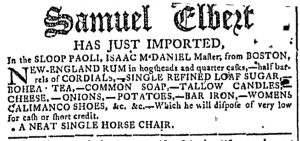
“Samuel Elbert HAS JUST IMPORTED … NEW-ENGLAND RUM.”

This advertisement features a series of items that recently had been imported into Georgia by a trader named Samuel Elbert. Some of the items included soap, “CALIMANCO SHOES,” and New England rum.

Who was Samuel Elbert? Originally I was not expecting to uncover much about this advertiser, but I learned that he was an American merchant, politician, and officer during the Revolution. According to the Georgia Historical Society, Elbert started as a merchant and served in the colonial legislature as well as being a captain of a grenadier company. However, once fighting started, he decided that he wanted to serve in the war. He received a commission as an officer because of his wealth and social status. He rose up the ranks and was promoted to brigadier general in 1783 after years of service. He was later elected governor of Georgia. It is important to know about the many different people who participated in the American Revolution. Elbert may not be as famous as other officers, but he played a major role in the southern campaigns. Like other officers and soldiers from diverse backgrounds and occupations, he helped with defeating the British.

**********

ADDITIONAL COMMENTARY: Carl Robert Keyes

Luke has chosen an advertisement that may look familiar to regular readers of the Adverts 250 Project. Samuel Elbert’s notice was the featured advertisement on February 22. While the methodology for this project usually requires selecting an advertisement only once, I sometimes make exceptions when I wish to explore a particular aspect of an advertisement in more detail.

Elbert’s advertisement first appeared in the February 22, 1769, edition of the Georgia Gazette, notable because it was one of only two that incorporated a large gothic font for its headline. Such typography distinguished both advertisements from the others on the same page and throughout the issue. The other advertisement, an announcement that the former members of the “Ugly Club” would meet on the 25th was discontinued the following week, but Elbert’s advertisement ran once again on March 1. In that issue, Lewis Johnson, an apothecary, and William Sime, a goldsmith and jeweler, both inserted advertisements that displayed their names in the same large gothic font. Elbert, Johnson, and Sime all ran their advertisements once again in the March 8 edition, the one examined by Luke, though yet another notice deployed the same visual style, this time featuring the name of Michael Hamer, a shopkeeper.

Who was responsible for the sudden infusion of such bold typography? Was it all at the discretion of a compositor who wished to experiment with some of the types not often used in the pages of the Georgia Gazette? Or did Johnson, Sime, and Hamer notice how the unique type drew attention to Elbert’s advertisement and then request that their own notices receive the same treatment? The answers cannot be found in the pages of the Georgia Gazette. Instructions may have been submitted with the copy for those advertisements, though advertisers may have simply made verbal requests when visiting James Johnston’s printing office on Broughton Street in Savannah. In his examination of the typography of the Georgia Gazette, Ray Dilley remarks that the “large size (Great Primer, or 36 point), appears at least once as a fascinating announcement for a meeting of ‘The Ugly Club,’” but does not mention its use in Elbert’s advertisement or any that appeared in subsequent issues.[1] Nor does Lawrence speculate on why Johnston or a compositor happened to resort to that type. The advertisements themselves testify to a willingness to experiment with graphic design, but the identity of the innovator remains unknown.

**********

[1] Lawrence A. Alexander, James Johnston, Georgia’s First Printer: With Decorations and Remarks on Johnston’s Work by Ray Dilley (Savannah: Pigeonhole Press, 1956), 42.

March 8

GUEST CURATOR: Olivia Burke

Who was the subject of an advertisement in a colonial American newspaper 250 years ago today?

Georgia Gazette (March 8, 1769).

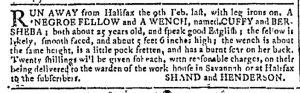
“RUN AWAY … CUFFY and BERSHEBA.”

Slavery advertisements were common in eighteenth-century newspapers, especially in the Georgia Gazette and other newspapers in southern colonies,. In the advertisement, Shand and Henderson offered a monetary reward for two of their slaves who ran away: Cuffy and Bersheba. They offered twenty shillings for each of them. This was one of six advertisements concerning slavery in this issue. In the Georgia Gazette, advertisements for slaves were just as common as advertisements for tea, household goods, and property for sale.

In a chapter on “Runaway Advertisements in Colonial Newspapers,” Victoria Bissell Brown and Timothy J. Shannon discuss how colonists saw slaves as material goods, not as human beings. “One of the great advantages to reading these advertisements in their original context is to comprehend how casually colonial Americans bought and sold human laborers.”[1] Based on the look inside colonial society that newspapers give us, we are able to see how colonists in the eighteenth century did not think twice about seeing an advertisement for a runaway slave next to one for a stray horse. As revolution drew closer to becoming a reality, slavery began to decline in the north but it remained strong in the south, where advertisements like this one were very common.

**********

ADDITIONAL COMMENTARY: Carl Robert Keyes

Olivia notes that in addition to Shand and Henderson’s notice about Cuffy and Bersheba making their escape, five other advertisements concerning enslaved men, women, and children appeared in the March 8, 1769, edition of the Georgia Gazette. Two of them reported on runaways that had been captured. Two offered enslaved people for sale, wile the final one offered an enslaved woman “To be hired out” as a domestic servant. When it came to such advertisements in the Georgia Gazette, this was actually relatively few compared to most issues. That newspaper often featured a dozen or more advertisements related to enslavement. They constituted an important source of revenue for James Johnston, the printer.

Olivia challenges us to consider how unremarkable white colonists found these advertisements that appeared week after week throughout the colonial period. This certainly reveals something significant about the attitudes of most colonists, but these advertisements also tell important stories about the experiences of enslaved people. Consider not only Cuffy and Bersheba but also their counterparts in the advertisements reporting Africans and African Americans who had been “TAKEN UP” or “”Brought to the Work-house.” Cuffy and Bersheba were both approximately twenty-five years old. Both spoke “good English,” indicating that they were either born in the colonies or had been transported there quite some time ago. When they made their escape, Cuffy had “leg irons on” (and Bersheba may have as well, though the wording of the advertisement does not make it clear). Shand and Henderson made every effort to keep them around, but Cuffy and Bersehba were determined to free themselves. Sampson, Molly, and an unnamed infant were discovered “on the Indian Country Path,” making their escape from a “master [who] lives near the salt water.” Sampson “speaks such bad English as scarcely to be understood,” suggesting that he may not have been enslaved his entire life. Michael, a “TALL STOUT ABLE NEGROE FELLOW” who had been confined to the workhouse in Savannah definitely had not been born into slavery in Georgia. He spoke little English. The advertisement reported that he was “of the Coromantee country” and had “his country marks thus ||| on each side of his face,” referring to ritual scarification.

Each of these advertisements provides a miniature and incomplete biography of enslaved people who attempted to seize their own liberty in the era of the American Revolution. White colonists placed them for one reason, recovering their human property, but these advertisements ultimately served an unintended purpose. They testified to the agency and resistance of enslaved men and women. Although not in their own words, these advertisements tell the stories of people who had few opportunities to create documents that recorded their own experiences.

**********

[1] Victoria Bissell Brown and Timothy J. Shannon, Going to the Source: The Bedford Reader in American History (Boston: Bedford/St. Martin’s, 2004), 48.

March 1

GUEST CURATOR: Chloe Amour

Who was the subject of an advertisement in a colonial American newspaper 250 years ago today?

Georgia Gazette (March 1, 1769).

“He is branded on the breast IW in small letters.”

In this particular advertisement for a runaway slave, the vivid description suggests the desperation to find him. Including a reward made the search that much more enticing. A key detail in the advertisement states the slave, named Bristol, was “Angola born.” He was brought to the West Indies, then eventually to Georgia. This implies the slave has been sold multiple times. Coming from the West Indies with a brand also became a telltale sign he had previous masters. In addition, Bristol speaks “pretty good English,” which implies he had been enslaved long enough to learn the language. With the demand for slave labor and the revenue it produced, masters circulated their slaves for profit. The amount of information and detail provided in the advertisement allows for readers to reconstruct the story of Bristol.

The brand on Bristol’s breast, “IW in small letters,” helped to identify him. Betty Wood examines the practice of branding enslaved people: “If they had not been branded before leaving Africa, then there was a good chance that it would happen to them upon their arrival in America.”[1] Branding, using a “red-hot iron,” was a common technique to leave an imprint upon the bodies of slaves. Typically, the brand was stamped on the chest, shoulder, or cheek. The act of branding by slave owners made a bold statement; it displayed complete ownership and possession of the slave. The visual image of a brand made a statement, to deny the humanity of people of African origin. To put branding in perspective, this type of treatment was used on animals, such as cattle and horses, to keep track of them if they became lost. Similar to the runaway slave Bristol, the origins of other enslaved people could be traced through the symbol branded upon their body.

**********

ADDITIONAL COMMENTARY: Carl Robert Keyes

By the time George McIntosh’s advertisement concerning Bristol ran in the March 1, 1769, edition of the Georgia Gazette, the runaway had been absent for nearly seven weeks. McIntosh reported that Bristol “WENT AWAY” on January 13. Also by early March the advertisement would have been familiar to colonists who regularly read the Georgia Gazette. Dated “17th January, 1769,” it appeared in its sixth consecutive issue. McIntosh apparently submitted it to the printing office too late for inclusion in the January 18 edition, but starting on January 25 the advertisement appeared every week. By then, Bristol had been “AWAY” from McIntosh’s plantation for nearly two weeks. In the several weeks since, he continued to make good on his escape. Perhaps he had learned from a previous failed attempt and crafted a better plan. McIntosh stated that Bristol had been “taken up once before” in the area of Sunbury and Midway.

The longevity of McIntosh’s advertisement describing a man who had escaped from bondage was hardly unique, at least not compared to other advertisements that described runaways and offered rewards for their capture and return. Some ran for as long as six months before being discontinued. When such advertisements disappeared from the pages of the Georgia Gazette after so long, it most likely indicated that slaveholders decided not to make further investments in alerting the public about the runaways. After seeing the same advertisements for months, readers were probably well aware of the descriptions of the runaways and the circumstances of their escapes.

In contrast to the constant republishing of runaway advertisements, other sorts of paid notices usually ran for a much more limited time. Advertisements for consumer goods and services, for example, typically ran for three or four weeks. Merchants and shopkeepers did not make the same investment in notifying the public about their wares as slaveholders made in their attempts to reclaim their human property. Advertisements for runaway slaves were an important revenue stream for the Georgia Gazette not only because colonists placed so many of them but also because those advertisements ran for so much longer than any others.

**********

[1] Betty Wood, Slavery in Colonial America, 1619-1776 (New York: Rowman and Littlefield, 2005), 28.

February 22

What was advertised in a colonial American newspaper 250 years ago today?

Georgia Gazette (February 22, 1769).

“Samuel Elbert HAS JUST IMPORTED … NEW-ENGLAND RUM in hogsheads and quarter casks.”

James Johnston rarely experimented with typography in the pages of the Georgia Gazette. Both news items and advertisements generally adhered to a uniform format that did little to distinguish one news item from another or one advertisement from another. Like other colonial printers, Johnston printed some words in italics or all capitals, presumably for emphasis, but those examples usually represented the extent of his playfulness with the type that appeared in his newspaper in the late 1760s. One exception regularly distinguished an advertisement that listed captured runaway slaves who were being held until slaveholders claimed them. The headline “Brought to the Work-house” appeared in a gothic font of the same size as the rest of the advertisement. Although Johnston possessed that font, he rarely deployed it elsewhere in the pages of the Georgia Gazette.

The February 22, 1769, edition, however, included several advertisements that incorporated the gothic font for the headline. One presented an enslaved woman “To be hired out.” While rare, that advertisement was not unique. The phrase “To be hired out” did not appear nearly as often as ever constant “Brought to the Work-house,” but Johnston was just as likely to set it with gothic type when inserting such an advertisement. This advertisement introduced some variation onto the page, but not anything that caught the eye nearly so well as two other advertisements with headlines in gothic font. One informed prospective customers that Samuel Elbert had just imported a variety of goods from Boston. Like many other advertisements for consumer goods, the merchant’s name served as the headline. Unlike others in the Georgia Gazette, his name was in gothic font much larger than the remainder of the advertising copy. The same was true of “Ugly Club” in a notice that advised members of an upcoming gathering.

While either Elbert or the officers of the club may have negotiated with the printer for a distinctive headline, it seems unlikely that both did so simultaneously. More likely Johnston decided to experiment with the tools available to him. After all in the previous issue he upended the usual layout of the Georgia Gazette by distributing the advertisements throughout rather than grouping them all on the final pages after the news items. He did so again in the February 22 issue, with advertisements appearing on every page. In setting type for Elbert’s advertisement, Johnston demonstrated what was possible when it came to the paid notices in his newspaper, even if not what was probable. The spark of innovation apparent in that advertisement eventually became a much more common element of advertisements published in the nineteenth century.