December 6

What was advertised in a colonial American newspaper 250 years ago today?
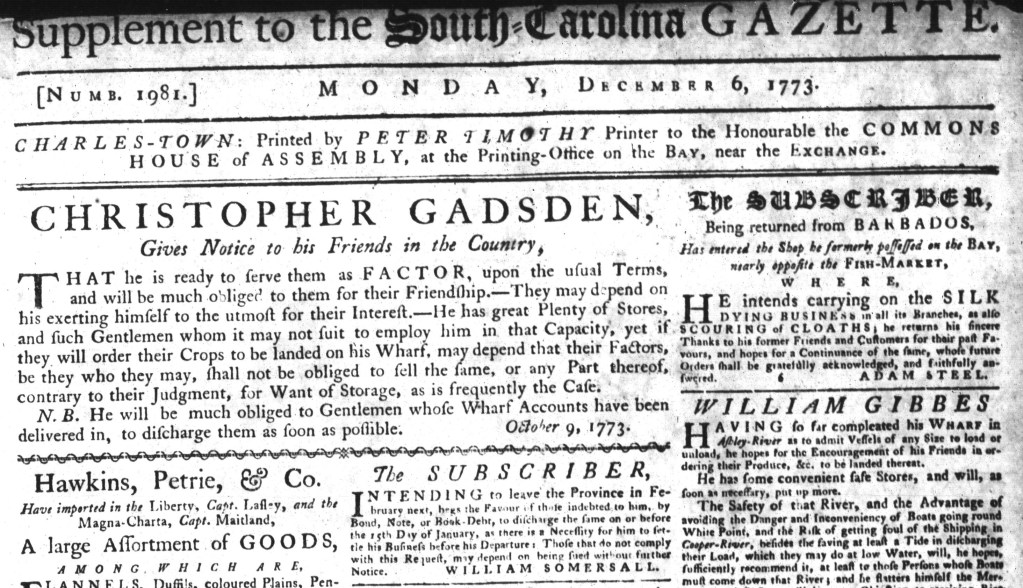
Supplement to the South-Carolina Gazette (December 6, 1773).

“CHRISTOPHER GADSDEN, Gives Notice to his Friends … THAT he is ready to serve them as FACTOR.”

In the fall of 1773, Christopher Gadsden took to the pages of newspapers published in Charleston to offer his services “as FACTOR, upon the usual Terms,” to plantation owners who raised rice, indigo, and other crops “in the Country.”  For those who did not wish to employ him as an agent buying and selling commodities on their behalf, he also rented space in a “great Plenty of Stores” or warehouses “on his Wharf.”

The copy in Gadsden’s advertisement read much the same as the notices placed by his competitors.  The format, however, distinguished his advertisement from the dozens of others placed for many different purposes.  At least that was the case in the South-Carolina Gazette.  In that newspaper, Gadsden’s advertisement extended across two columns.  His name served as a headline, the size of the font rivaling the title of the newspaper in the masthead.  The rest of the copy appeared in larger font than other notices, also demanding the attention of readers.

South-Carolina Gazette and Country Journal (December 7, 1773).

That differed from Gadsden’s advertisement in the South-Carolina Gazette and Country Journal.  Featuring identical copy, it had a much different format.  His name once again served as a headline, but in a font the same size used for headlines of other advertisements.  Most significantly, the compositor confined that advertisement to a single column, one more notice among the many that ran in that newspaper.

Compositors usually made decisions about the format of advertisements after advertisers submitted copy to printing offices.  In this instance, however, the extraordinary format for Gadsden’s advertisement in the South-Carolina Gazettesuggests that he successfully negotiated for some sort of design to set his notice apart from others.  Did he envision an advertisement spanning two columns?  Or did the compositor make that decision after learning that Gadsden wanted something different?  Did Gadsden make a similar request for his advertisement in the South-Carolina Gazette and Country Journal, only to have it rejected?  Some printers and compositors seemed more amenable to instructions from advertisers than others.  In Boston, for instance, decorative borders enclosed Jolley Allen’s notices in every newspaper except the Massachusetts Spy.  Isaiah Thomas, the printer, presumably rejected Allen’s trademark format.  Similarly, Gadsden may have had more luck working with Peter Timothy and the South-Carolina Gazette than with Charles Crouch and the South-Carolina Gazette and Country Journal.

November 4

What was advertised in a colonial American newspaper 250 years ago today?

Rivington’s New-York Gazetteer (November 4, 1773).

“A large assortment of goods.”

In its first six months of publication, Rivington’s New-York Gazetteer developed a signature style for many of its advertisements.  They featured the same copy that appeared in other newspapers published in the city, yet surrounded by borders made of decorative type.  James Rivington and the compositors who worked in his printing office certainly were not the first to devise borders for newspaper notices.  After all, borders enclosed Jolley Allen’s advertisements in several Boston newspapers going back years and the shopkeeper continued to incorporate that design element into his advertisements in the early 1770s (in every newspaper except the Massachusetts Spy, which seemed hesitant to accommodate that request).  Borders occasionally surrounded advertisements in other newspapers as well, but in no newspaper did they appear as frequently as in Rivington’s New-York Gazetteer.

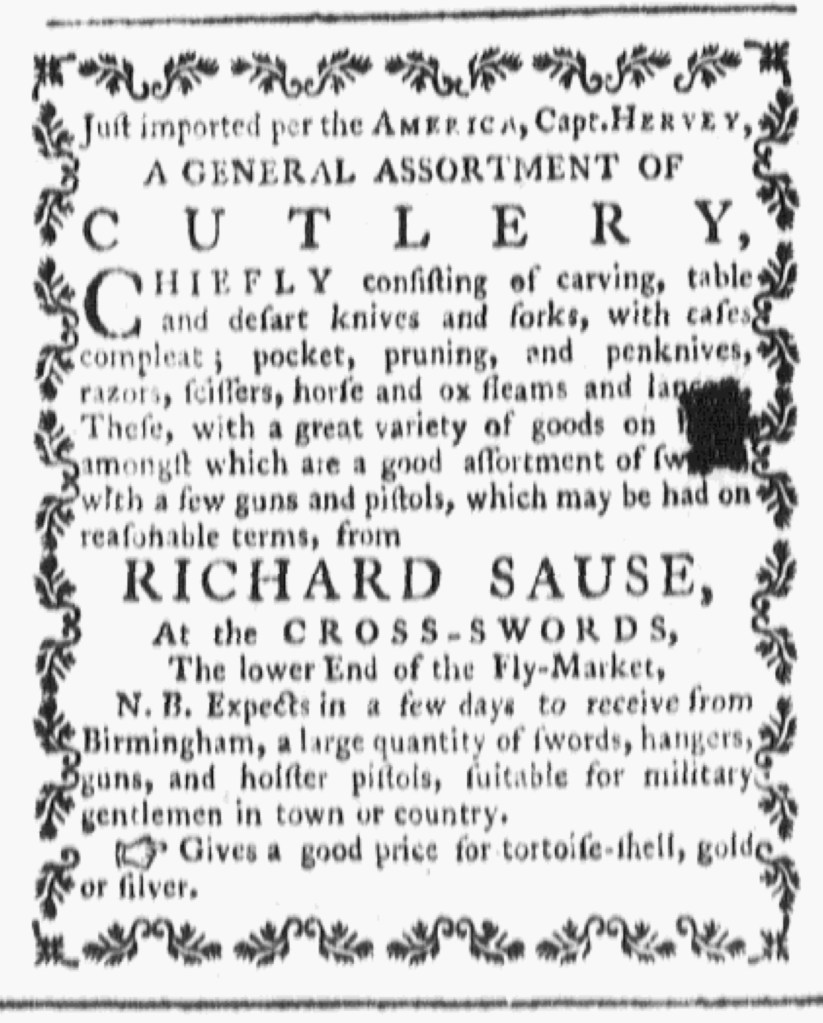
In the fall of 1773, Richard Sause, a cutler “At the CROSS SWORDS,” joined the ranks of advertisers with borders around their advertisements.  Several notices in the November 4 edition had borders, including those places buy John Arthur, a shopkeeper, John Laboyteaux, a tailor, John J. Roosevelt, a merchant, and John Siemon, a furrier.  Borders also enclosed advertisements for “SHIP BREAD” sold by Crommelin and Horsfield and Rivington’s own notice for “Dr. KEYSER’s PILLS.”  The compositor selected different printing ornaments for each advertisement, making them distinctive even though they shared a common feature.

The copy for Sause’s advertisement matched his notice on the front page of the November 1 edition of the New-York Gazette and Weekly Mercury.  An extensive list of merchandise, divided into two columns with one or two items per line, appeared below a headline and brief introduction that promised a “large assortment of goods, which he will sell cheap for cash or short credit.”  Sause’s advertisement filled three-quarters of a column in Rivington’s New-York Gazetteer, making it the longest advertisement with a border in that issue.  Yet Sause did not need to experiment with a border as a means of drawing attention to his advertisement.  Like Siemon, he previously ran advertisements with a woodcut depicting some aspect of his business.  For the furrier, it was a muff.  For Sause, it was a sign that showed many of the items that he made and sold, including a table knife with “SAUSE” at the base of the blade and a sword with “SAUSE” in the same position.”  The sign depicted on the woodcut even included his name and occupation, “RD. SAUSE CUTLER,” making it one of the few woodcuts personalized in such a manner.  That image appeared in Sause’s advertisement in Rivington’s New-York Gazetteer on April 29, only the second issue of that newspaper.  Six months later, however, Rivington opted for the decorative border rather than the woodcut.  The increasingly popular style apparently made an impact on the advertiser, convincing him to give it a try in his own marketing in hopes that it would have a similar effect on prospective customers.

October 3

What was advertised in as colonial American newspaper 250 years ago this week?

Rivington’s New-York Gazetteer (September 30, 1773).

“A GENERAL ASSORTMENT OF CUTLERY.”

Richard Sause joined other entrepreneurs who experimented with decorative borders enclosing their advertisements when he promoted a “GENERAL ASSORTMENT OF CUTLERY” in Rivington’s New-York Gazetteer.  The cutler had previous experience incorporating visual images into his advertisements in both the New-York Gazette and Weekly Mercury and Rivington’s New-York Gazetteer.  By the fall of 1773, many advertisements in New York’s newest newspaper featured borders, a popular means of enhancing notices.  Similar borders sometimes adorned advertisements in other newspapers, but not in the numbers and frequency that they appeared in Rivington’s New-York Gazetteer.

The September 30, 1773, edition of that newspaper, for instance, included eight advertisements with ornate borders.  Most of those notices were relatively short, a single square of text.  Among them, Dennis McReady, a tobacconist, hawked his wares and Aspinwall and Smith announced that they sold “CHOICE OLD JAMAICA SPIRIT.”  Another of these shorter announcements advised that “the Delaware Lottery for the Sale of Lands, belonging to the Earl of Stirling, will commence on Monday the first Day of November next.”  James Rivington, the printer, also enclosed his advertisement for Keyser’s Pills within a decorative border.  George Webster, “At the THREE SUGAR LOAVES,” listed a couple of items “just received from LONDON” and promised “many other Articles which will be inserted next week.”  That advertisement, however, never materialized.  Given that advertisers paid by the amount of space their notices occupied rather than the number of words, borders made advertisements more expensive.  Rivington may have also charged additional fees for the borders, making them especially attractive to entrepreneurs running shorter advertisements.

Still, some advertisers enclosed longer notices within borders.  Thomas Hazard, one of Sause’s competitors, did so with an advertisement for “Ironmongery and Cutlery,” as did Francis Lewis and Sons in their advertisement that listed dozens of items for sale at their store on Queen Street.  Among these three longer advertisements, Sause’s notice was the shortest.  He apparently appreciated the visual appeal of the border and considered it worth the investment.  Four weeks later he placed a much more extensive advertisement that extended approximately three-quarters of a column.  A decorative border enclosed the lengthy list of merchandise that Sause “JUST IMPORTED.”  Along with several other advertisers, the cutler sought to generate interest in his newspaper notices by making them more visually appealing than text alone.  The printing office seems to have encouraged this innovation.

August 16

What was advertised in a colonial American newspaper 250 years ago today?

New-York Gazette and Weekly Mercury (August 16, 1773).

“IRISH / LINENS, / Sheetings, cotton and / Linen checks; calicoes.”

The format of an advertisement for upcoming sales at Templeton and Stewart’s Auction Room in the August 16, 1773, edition of the New-York Gazette and Weekly Mercury almost certainly caught the eye of readers.  Rather than appear in a blocky paragraph of text or side-by-side columns with one or two items per line, as was the case in other advertisements for consumer goods in that issue, the list of items for sale formed a diamond.  The entries at the top and bottom of the diamond, “IRISH LINENS” and “PLAYING CARDS,” had one word per line, all in capital letters spaced appropriately to create a pleasing and attractive form.  The compositor realized that lowercase letters at the top and bottom of the diamond would have had a jarring and unpleasant visual effect.  Likewise, too many uppercase letters would have crowded the rest of the diamond, so other items appeared in lowercase letters as the list progressively widened and then progressively narrowed.

Using type to form geometric shapes, especially diamonds, was rare but not unknown in newspaper advertisements of the period.    On September 30, 1771, all of the copy in Gilbert Deblois’s advertisement in the Supplement to the Boston-Gazette appeared within a diamond, though the compositor did not manage to create lines nearly as straight as those in Templeton and Stewart’s advertisement.  Such was also the case for Deblois’s advertisement in the Massachusetts Gazette and Boston Weekly News-Letter later that week.  The compositor for the Essex Gazette achieved better results in an advertisement placed by John Cabot and Andrew Cabot in the December 3, 1771, edition of the Essex Gazette.  All of the copy ran at a forty-five-degree angle, filling an entire square.  Two weeks later, the compositor and the Cabots experimented with the same copy, devising a shape that resembled a bulb as much as a diamond.  Still, the unique format set it apart from other advertisements.  With a shorter list of goods, Duncan Ingraham, Jr., concluded his advertisement in the April 20, 1772, edition of the Massachusetts Gazette and Boston Post-Boy with a diamond that featured straight edges.

Each of these advertisements demonstrates one manner for experimenting with graphic design elements of newspaper notices.  The advertisers likely made special requests or sent instructions.  They may have even submitted copy arranged the way they wished for it to appear in print, though compositors exercised final discretion in making innovative designs work.  While some of these advertisements evidenced greater skill than others, each presented a novelty to readers and prospective customers.  Such innovative graphic design demanded attention on pages largely devoid of visual images, the format encouraging readers to peruse the content.

March 15

What was advertised in a colonial American newspaper 250 years ago today?

Pennsylvania Chronicle (March 15, 1773).

“A great variety of calicoes, whole and half chintzes, and printed cottons.”

It was not a full-page advertisement, but it came close.  Daniel Benezet’s advertisement in the March 15, 1773, edition of the Pennsylvania Chronicle filled the first column on the front page, extended throughout the second column, and overflowed into the final column.  Eight much shorter advertisements filled the remainder of the page.  As was often the case in eighteenth-century newspapers, news articles, letters, and editorials began on the second page.

Benezet announced that he recently imported a variety of goods from London, Bristol, and Holland.  To demonstrate the choices that he made available to consumers, he published an extensive catalog of his merchandise.  Benezet’s inventory included “Blue, green, scarlet, claret, brown, cinnamon, drab, copper and mixt coloured, middling and low priced broadcloths,” a “large assortment of men’s women’s and children’s Bath, white metal, steel, block tin, and pinchbeck shoe buckles,” “Best English hammered brass kettles,” and “Newest fashion’d snuff-boxes.”  He concluded with “&c. &c. &c.”  Repeating an abbreviation for et cetera suggested even more wonders available at his store on Arch Street in Philadelphia, too many to appear in the already lengthy newspaper advertisement.  In the first advertisement that followed Benezet’s notice, Peter Wikoff and Isaac Wikoff stated that they “joined both their stocks in trade together … and now have a very large and compleat assortment of dry goods on hand.”  The Wikoffs invited prospective customers to imagine their wares; in contrast, Benezet encouraged consumers to browse through his inventory in the pages of the public prints.  He likely believed that if readers spotted items they wanted or needed in his catalog of goods that they would be more likely to shop at his store.

To aid prospective customers in navigating the advertisement and discovering items that interested them, the compositor divided each column into two columns, ran a dividing line down the center, and listed only one item or category of items on each line.  In most instances, those descriptions required more than one line, with second and subsequent lines indented.  That created additional white space that made Benezet’s advertisement easier to read than notices that clustered merchandise together in paragraphs of dense text.  Benezet and the compositor leveraged graphic design in their efforts to engage readers of the Pennsylvania Chronicle and entice them to become customers.  The compositor apparently did not consider it sufficient to publish a lengthy advertisement, but instead believed that good design made it more effective.

Pennsylvania Chronicle (March 15, 1773).

November 3

What was advertised in a colonial American newspaper 250 years ago today?

South-Carolina Gazette and Country Journal (November 3, 1772).

“A compleat ASSORTMENT of fashionable GOODS.”

Below the masthead, the entire front page of the November 3, 1772, edition of the South-Carolina Gazette and Country Journal consisted entirely of advertisements.  The one placed by William Stukes dominated the page, due in large part to its size and unusual format.  That newspaper ran three columns per page.  Stukes’s advertisement extended across two columns.  This was not a case of a lengthy advertisement that overflowed from one column into another.  Instead, it had been designed to take up space in more than one column.  The notice ran at the top of the first two columns, making it the first item in that issue.  That enhanced its visibility, though readers could hardly have missed an advertisement that occupied about half the space on the page.

The notice opened with a standard headline and introduction, similar to those in other advertisements for consumer goods.  The advertiser’s name in capital letters, “WILLIAM STUKES,” served as the headline.  The introduction stated that he “ACQUAINTS hid Customers and Friends, that he has removed into Broad-Street … and is now opening a complete ASSORTMENT of fashionable GOODS, imported in the last Ships from LONDON.”  In addition, Stukes declared that he would sell his wares “on the most reasonable Terms, at the usual CREDIT, and extraordinary cheap for CASH.”  He used formulaic language even as the format differentiated his advertisement from others on the same page and throughout the rest of the issue.

While the headline and introduction ran across two columns, Stukes’s extensive list of merchandise ran in three narrow columns.  Other advertisers grouped goods together in dense paragraphs.  Stukes made it easier for prospective customers to skim his advertisement and spot items of interest by giving each item its own line.  That resulted in significantly more white space within his advertisement than in the news and other paid notices.  For instance, “Silk gauze handkerchiefs” appeared on their own line without other items crowding them.  That even allowed space for readers to make notations, if they wished.

Stukes deployed popular marketing strategies and incorporated formulaic language into his advertisement, depending on its size and unique format to draw attention to the low prices and range of choices he offered to consumers.  Even though this newspaper notice consisted entirely of text, Stukes effectively used graphic design to distinguish it from advertisements placed by his competitors.

October 22

What was advertised in a colonial American newspaper 250 years ago today?

Massachusetts Gazette and Boston Weekly News-Letter (October 22, 1772).

“CHEAP GOODS.”

In the fall of 1772, David Sears joined other advertisers in Boston who used borders composed of decorative type to enclose either the headline or their entire newspaper notice.  Sears proclaimed that he sold “CHEAP GOODS,” that headline surrounded by printing ornaments that called attention to his advertisement and prompted subscribers of the Massachusetts Gazette and Boston Weekly News-Letter to read more about the “fresh Assortment of Gall and Winter Goods” he recently imported from London.  His advertisement in the October 26 edition of the Boston-Gazette included the same headline within a decorative border.  In with instances, the headline and its border directed prospective customers to his bold claim that he set “such Prices that is not possible to be conceived of without Trial.”  In other words, it would take some effort to even imagine such low prices.

Sears certainly was not the first advertiser in Boston to incorporate a border into a newspaper advertisement.  As early as 1766, Jolley Allen made borders around his entire notices a signature element of his marketing.  Occasionally other advertisers deployed borders as well, but greater numbers did so simultaneously in the summer and fall of 1772.  Jolley Allen and Andrew Dexter both published advertisements with borders in May, though the Massachusetts Spy seemingly rejected any requests or instructions to include a border around Allen’s advertisement.  Martin Bicker ran an advertisement surrounded by a border in August.  Jonathan Williams, Jr., also did so in September.  Other merchants and shopkeepers opted for borders around just the headlines.  The week before Sears ran his advertisement on October 22, William Jackson introduced his notice with a border around the headline, “Variety Store.”  A few days later, Herman Brimmer and Andrew Brimmer had a border enclosing “Variety of Goods” at the top of their advertisement in Supplement to the Boston-Gazette.  The printers of that newspaper had recently used a decorative border for their own notice calling on subscribers with overdue accounts “to make immediate Payment.”

These examples may seem scattered, but considering how infrequently borders adorned advertisements in Boston’s newspapers (or newspapers printed elsewhere in the colonies) they suggest a trend among advertisers in 1772.  Sears may have observed that others included borders in their notices and determined that he desired the same for his advertisement, combining a pithy headline and graphic design to demand the attention of readers.

October 12

What was advertised in a colonial American newspaper 250 years ago today?

Boston-Gazette (October 12, 1772).

New Advertisements.”

Benjamin Edes and John Gill, printers of the Boston-Gazette, wanted to increase the chances that readers took notice of their call to settle accounts in the fall of 1772.  In the October 12 edition, they inserted an announcement that “ALL Persons indebted for this Paper, whose Accounts have been above 12 Months standing, are requested to make immediate Payment.”  The copy was standard for such notices, placed by printers throughout the colonies, but Edes and Gill deployed a format intended to increase the attention the notice received.  Decorative type enclosed the printers’ notice to delinquent subscribers within a border.  Edes and Gill did not however, devise that format for their own purposes.  Instead, they adopted a strategy already in use by some of their advertisers.  Herman Brimmer and Andrew Brimmer, for instance, enclosed “Variety of Goods,” the headline to their lengthy advertisement listing scores of items, within an ornate border.  Jonathan Williams, Jr., had a border around his entire advertisement.

Edes and Gill also selected an advantageous place on the page for their notice, inserting it at the top of the first column on the final page.  It appeared immediately below a headline for “New Advertisement,” another design element intended to direct attention to the printers’ call for subscribers to pay their bills.  That headline helped to distinguish advertisements on that page from others that ran on the second and third pages.  A brief note on the third page also aided Edes and Gill’s efforts to highlight their notice.  The advertisements on the third page commenced with instructions: “For New Advertisements, See last Page.”  The printers incorporated a variety of means of increasing the visibility of their notice. They exercised their prerogative in placing it first among the notices labeled “New Advertisements” and used notes elsewhere in the issue to direct readers to one of the only advertisements that featured a border composed of decorative type.  Edes and Gill used graphic design to demand attention for an otherwise mundane notice.

August 6

What was advertised in a colonial American newspaper 250 years ago today?

Massachusetts Gazette and Boston Weekly News-Letter (August 6, 1772).

“THE Subscriber takes this Method to inform his Friend and the Public in general …”

When Martin Bicker “prepared a compleat Room at his Dwelling House … for the Reception of Goods, to be Sold at public Sale,” he placed an advertisement in the Massachusetts Gazette and Boston Weekly News-Letter.  He advised prospective clients that “Such who are pleased to favor him with their Commands may, rest assured, that the greatest Punctuality and Honor will be strictly observed.”  He also asserted that since “the Situation is very suitable for said Business” that “the Result of his Undertaking will be attended with mutual Advantage to his Employers and self.”

To draw attention to his overtures “To the Public,” Bicker arranged to have his newspaper enclosed in a border composed of decorative type.  That distinguished the enclosure from the simple horizontal lines that separated other advertisements from one another.  No other advertisements in the August 6, 1772, edition of the Massachusetts Gazette and Boston Weekly News-Letter had a border, making Bicker’s notice all the more distinctive.  That was not the first time that Bicker sought to enliven a newspaper notice with some sort of unique visual element.  Earlier in the summer, he placed an advertisement for hats in the Massachusetts Spy, adorning it with a woodcut depicting a tricorne hat.  Advertisers sometimes availed themselves of stock images of ships, houses, horses, and enslaved people provided by printers, but fewer of them commissioned woodcuts that correlated to the goods they produced or the signs that marked their shops.

Bicker strove to make his advertisements visually interesting on newspaper pages that often consisted primarily of dense text.  Indeed, the first time he inserted the advertisement with the border, it appeared at the top of the final column on the first page.  The two columns to the left contained news from London, Bristol, and Philadelphia.  The border around Bicker’s advertisement clearly signaled that it was not part of those dense dispatches, inviting readers to have a closer look at what merited such special typographical treatment.  Bicker sought to use graphic design to his advantage when he launched his new enterprise.

July 21

What was advertised in a colonial American newspaper 250 years ago today?

Connecticut Courant (July 21, 1772).

“☞ once more! ☜”

Many former customers of the “late Company of Gardiner & Jepson” did not respond to William Jepson’s notices in the Connecticut Courant calling on those “indebted by Judgment, Execution, Note, Book Debt, or otherwise” to settle accounts.  That exasperated him.  It also influenced the format of an advertisement that first ran in the July 21, 1772, edition of the newspaper.  He wished to call attention to his efforts to notify debtors of their obligations, proclaiming that he “☞ once more! ☜” addressed them, setting apart that phrase not only in italics but also with a manicule (a typographic mark depicting a hand with its index finger extended in a pointing gesture) on either side to draw even more attention.  He deployed that format a second time when threatening legal action against those who continued to ignore his advertisements, warning that “they must expect Trouble ☞ without Exception or further notice! ☜”  A set of manicules once again enclosed the words in italics, making Jepson’s frustration palpable.

Other colonizers who placed advertisements in the Connecticut Courant included manicules, bit not nearly as extensively or creatively.  Manicules most often appeared at the conclusion of advertisements, where “N.B.” might otherwise appear for a nota bene advising readers to take notice.  For instance, Caleb Bull concluded an advertisement for “Choice Linseed Oyl” with a brief note stating that “☞ Cash will be given by said Bull for Post-ash.”  A manicule that preceded that note directed attention to it.  In another advertisement, enslavers John Northrop and John Sanfard offered a reward for the capture and return of “two Negro Men” who liberated themselves by running away at the end of May.  Northrop and Sanfard provided descriptions of the unnamed fugitives seeking freedom in the body of the advertisement.  In a note at the end, marked by a manicule, they warned that “☞ ‘Tis supposed they have each of them a forged pass.”

Manicules sometimes appeared in advertisements in the Connecticut Courant in the early 1770s.  Most advertisers included them according to a standard fashion, but occasionally some advertisers, like Jepson, deployed manicules in innovative ways when they sought to underscore the message in their notices.  They experimented with the graphic design possibilities available to them.