December 17

What was advertised in a revolutionary American newspaper 250 years ago this week?
Providence Gazette (December 16, 1775).

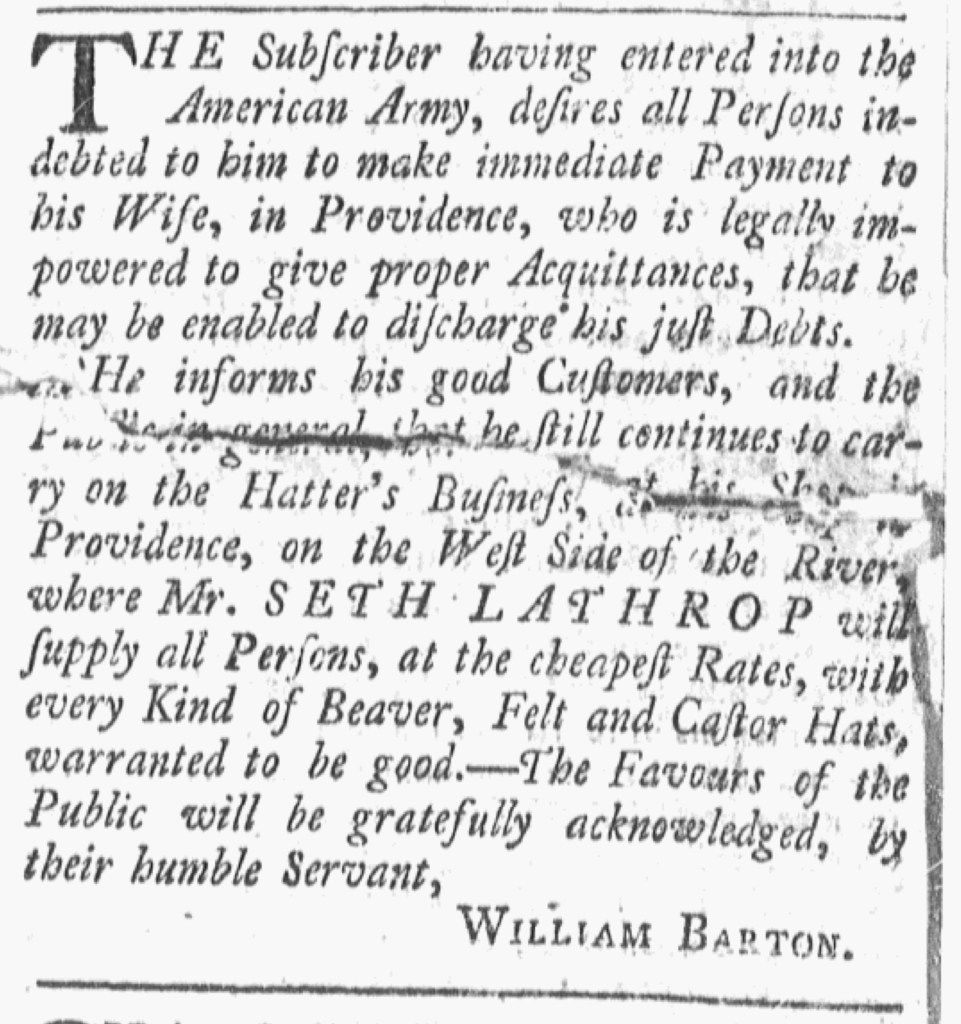
“THE Subscriber having entered into the American Army, desires all Persons indebted to him to make immediate Payment to his Wife.”

When William Barton, a hatter in Providence, “entered into the American Army” in 1775, he ran a newspaper advertisement that delegated responsibilities to his wife and a business associate.  He requested that “all Persons to indebted to him … make immediate Payment to his Wife, … who is legally impowered to give proper Acquittances, that he may be enabled to discharge his just Debts.”  It may not have been the first time that his unnamed wife oversaw accounts for the Barton household and her husband’s shop.  Like many other wives of shopkeepers and artisans, she could have had experience assisting her husband by tending to customers while he was busy or away from the shop.  She did not, however, assume responsibility for making sales during her husband’s extended absence while he served in the Continental Army, at least not initially.

Instead, Barton “inform[ed] his good Customers, and the Public in general, that he still continues to carry on the Hatter’s Business, at his Shop … where Mr. SETH LATHROP will supply all Person … with every Kind of Beaver, Felt and Castor Hats.”  Barton did not indicate whether Lathrop previously played a role in the business.  Had Lathrop been an employee or an apprentice who now ran the shop while Barton was away?  Did he take new orders and make new hats according to the tastes of Barton’s “good Customers” and new clients who responded to the advertisement?  Or did he merely sell hats already in stock when Barton enlisted in the army?  Barton’s notice did promise low prices, “the cheapest Rates,” and made assurances about the quality of the hats available at the shop, proclaiming that they were “warranted to be good.”

Barton also declared, “The Favours of the Public will be gratefully acknowledged, by their humble Servant.”  Although he deployed language that often appeared in newspaper advertisement to conclude his notice, he may have intended that his introduction would entice both his existing “good Customers” as well as new customers to support his business and, in doing so, his wife and their household.  Barton likely hoped to leverage his service in the “American Army” as a selling point for his hats.  After all, he chose to disclose that information first, making sure that it framed the overview of his shop that remained open during his absence.  Some advertisers espoused support for the American cause in their newspaper advertisements.  More significantly, Barton demonstrated his commitment to his political principles through his enlistment.  That merited special consideration for his “Hatter’s Business, at his Shop” that remained open in Providence.
December 12

What was advertised in a colonial American newspaper 250 years ago today?

New-York Gazette and Weekly Mercury (December 12, 1774).

“He will meet with due encouragement … by every real friend to American manufactures.”

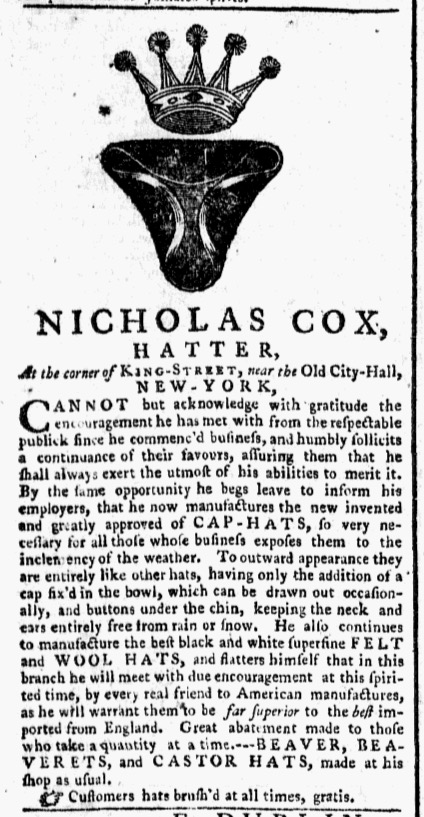
Nicholas Cox, a hatter, made several appeals to consumers in his advertisement in the December 12, 1774, edition of the New-York Gazette and Weekly Mercury.  He commenced with a standard expression of gratitude for “the encouragement he had met with from the respectable publick since he commenc’d business.”  Many purveyors of goods and services did so in their advertisements, signaling to readers that other consumers already considered them worthy of their business.  It was a familiar means of bolstering an advertiser’s reputation.

The hatter also incorporated commentary specific to his trade, proclaiming that he “manufactures the new invented and greatly approved of CAP-HATS.”  For those unaware of this innovation, eh explained that by “outward appearance they are entirely like other hats, having only the addition of a cap fix’d in the bowl, which can be drawn out occasionally.”  In such instances, it “buttons under the chin, keeping the neck and ears entirely free from rain or snow.”  Cox marketed this new style, a very practical element, as “so very necessary for all those whose business exposes them to the inclemency of the weather.”  According to Kate Haulman, colonizers debated whether they should carry umbrellas, “stylistic spoils of empire hailing from India,” in the 1760s and 1770s.  “Some regarded umbrellas as ridiculous and frivolous,” she notes, “serving no purpose that a good hat could not supply.”[1]  Cox produced and sold such hats for men of business who sought to eschew the effeminacy and luxury associated with umbrellas.

His next appeal made an even more explicitly political argument to prospective customers.  He made “the best black and white superfine FELT and WOOL HATS,” like the tricorne hat depicted in the woodcut that adorned his advertisement.  Cox asserted that patriotic consumers had a duty to support his business when they made choices about where to acquire their hats.  He expressed confidence that he “will meet with due encouragement at this spirited time, by every real friend to American manufactures.”  The Continental Association, a boycott of British goods adopted in response to the Coercive Acts, had recently gone into effect.  Cox offered an alternative to colonizers who desired to acquire hats yet wished to remain patriotically correct, either according to their own principles or at least to avoid the ire of others who observed the purchases they made.  Furthermore, his customers did not have sacrifice quality for principles.  The hatter pledged that “he will warrant [his hats] to be far superior to the best imported from England.” That being the case, the crown that appeared above the tricorne hat at the top of his advertisement may have testified to the superior quality of his hats, a general sense of pride in being part of the British Empire, or reverence for the monarch whom many colonizers still hoped would intervene on their behalf in their altercation with Parliament.

In addition to those appeals, Cox included two more common marketing strategies.  He promised a “[g]reat abatement … to those who take a quantity at a time.”  In other words, he gave discounts for buying multiple hats, both for consumers and for retailers who intended to sell them in their own shops.  He also provided a free ancillary service: “Customers hats brush’d at all times, gratis.”  Cox saw to the care and maintenance of the hats he made and sold long after the time of purchase.  He cultivated relationships with customers by encouraging them to return to his shop for assistance in keeping their hats in good order.  Overall, Cox resorted to a variety of familiar and specific appeals when advertising his hats, distinguishing him from competitors who did not put as much effort into marketing their wares.

**********

[1] Kate Haulman, “Fashion and the Culture Wars of Revolutionary Philadelphia,” William and Mary Quarterly, 3rd ser., 62, no 4 (October 2005): 632.

December 11

What was advertised in a colonial American newspaper 250 years ago this week?

Supplement to the New-York Journal (December 8, 1774).

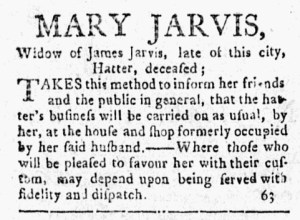
“The hatter’s business will be carried on as usual, by her.”

Mary Jarvis assumed responsibility for the family business following the death of her husband, James, a hatter.  In an advertisement that ran in the New-York Journal for several weeks in November and December 1774, she “inform[ed] her friends and the public and general, that the hatter’s business will be carried on as usual, by her, at the house and shop formerly occupied by her said husband.”  Like many others who advertised goods and services in colonial newspapers, she promised that “those who will be pleased to favour her with their custom, may depend upon being served with fidelity and dispatch.”  Jarvis may have consulted with John Holt, the printer, on the wording for her notice when she made arrangements for its publication, though that may not have been necessary.  Considering that she knew enough about the enterprise to continue its operations following the death of her husband, she may very well have been familiar enough with the usual contents of newspaper advertisements to compose it herself.  In addition, she could have perused similar notices many times as a consumer and learned for herself what they should contain.

The widow’s role in the business changed following the death of her husband, yet she likely had experience with many of the tasks from assisting him over the years.  When she declared that “the hatter’s business will be carried on as usual, by her,” she suggested that she did the work herself rather than managing employees previously affiliated with the business or hired after her situation changed.  Although James had been the public face of the venture, Mary no doubt made valuable contributions and learned much about the trade.  She sought to leverage that knowledge to support herself through her own industry, joining many other women – milliners and seamstresses – in the garment trades.  Historian Laurel Thatcher Ulrich distinguishes between what was probable for women and what was possible for women in early America.  In this case, Jarvis embodied both.  It was probable that she assisted James in his business as a “deputy husband” (a concept developed by Ulrich) and that made it possible for her to work as a hatter in her own right when circumstances demanded.

September 10

What was advertised in a colonial American newspaper 250 years ago today?

Providence Gazette (September 10, 1774).

“He has removed his Shop to … the Sign of the Hat in Hand.”

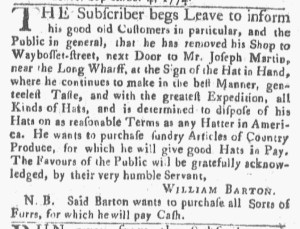
When William Barton moved to a new location as the summer came to a close in 1774, he placed an advertisement in the Providence Gazette to inform “his good old Customers in particular, and the Public in general” where to find him.  Having established a clientele, the hatter did not wish to miss out on subsequent business if customers went to his former shop and did not discover him there.  All prospective customers, whether or not they previously acquired hats from Barton, could recognize his new location by the “Sign of the Hat in Hand.”  The hatter did not indicate whether that marketing device had marked his previous location or if it was an innovation on the occasion of setting up shop on Weybosset Street.  Either way, it became part of the landscape of advertising that colonizers encountered as they traversed the streets “near the Long Wharff” in Providence.

To entice consumers to visit his shop, Barton made a variety of appeals.  He promised quality, stating that he made hats “in the best Manner.”  He emphasized fashion, declaring that his hats reflected “genteelest Taste.”  He touted his own skill and industriousness, asserting that “the greatest Expedition” went into producing his hats.  He offered choices to consumers, proclaiming that his inventory included “all Kinds of Hats.”  For his boldest appeal, he trumpeted that he was “determined to dispose of his Hats on as reasonable Terms as any Hatter in America.”  Barton did not merely compare his prices to his local competitors.  He confidently declared that consumers would not find any better deal anywhere, even if they sent away to Boston or New York or any other city or town in the colonies.  He challenged readers to visit his shop, learn his prices, and judge for themselves.  If his claim could get potential customers through the doors, that increased his chances of making sales.  Though his advertisement was not particularly lengthy, Barton incorporated many of the most common marketing appeals advanced by artisans in eighteenth-century America, anticipating that they collectively became more even more convincing.

August 23

What was advertised in a colonial American newspaper 250 years ago today?

New-London Gazette (August 23, 1771).

“THIS Country manufactured Felt Hats.”

As the end of August approached in 1771, Abiezer Smith placed an advertisement in the New-London Gazette to promote hats he made and sold at his shop in Norwich, Connecticut.  He assured prospective customers that he parted with his hats “as cheap as can be bought in the Colony” for items of similar quality.  In addition, he promised that his hats were “made in the best Manner.”  He also suggested that colonists should acquire “this Country manufactured Felt Hats,” a phrase that appeared twice in his notice, rather than the imported alternatives that many shopkeepers kept in stock.

Indeed, Smith devoted nearly half of his advertisement to encouraging retailers and consumers to support local artisans rather than choosing hats made in England.  “If Persons would but duly and properly consider the difference there really is between this County manufactured Felt Hats and those Imported from Great-Britain,” he declared, “they would doubtless conclude that they are much cheaper for the Customer than those that are Imported.”  Yet this was not merely a matter of cost.  He continued by asserting that “certainly there is in this Colony a sufficiency of Hatters to supply it’s Inhabitants with Hats.”   Smith spoke on behalf of all hatters in Connecticut.  Rather than consider other hatters in the colony to be competitors, he made common cause with them in cultivating a market for hats produced locally.  That market depended not only on the selections ultimately made by consumers but also the choices that merchants and shopkeepers made when it came to acquiring and distributing inventory.

Smith limited his arguments in favor of domestic manufactures to price, quality, and supporting the livelihoods of colonists rather than hatters on the other side of the Atlantic.  He did not make explicitly political arguments against Parliament or Great Britain, but within the past decade colonial consumers witnessed (and many supported) nonimportation agreements enacted by merchants in response to the Stamp Act and the Townshend Acts.  While those nonimportation agreements had expired at the time Smith placed his advertisement in the New-London Gazette, both merchants and consumers would have been familiar with that context for favoring “this Country manufactured Felt Hats” as well.  Smith allowed potential customers to draw their own conclusions about the politics of purchasing his hats, likely well aware that his advertisement echoed others that much more explicitly linked domestic manufactures and the imperial crisis in the recent past.

July 26

What was advertised in a colonial American newspaper 250 years ago today?

New-Hampshire Gazette (July 26, 1771).

“Hatts of all kinds.”

John Beck, a hatter, placed advertisements in the New-Hampshire Gazette on multiple occasions during the summer of 1771.  Although the copy remained consistent, the format varied, an unusual situation when it came to early American advertising.  Printers and compositors usually conserved time and effort by setting type for advertisements just once and then running them in that format for as long as advertisers wished for them to continue to appear.  For some reason, however, that was not the case with Beck’s advertisement.

When the advertisement appeared in the July 5 edition, it occupied only three lines.  In its entirety, it informed readers of “HATTS of all Kinds, made and Sold by JOHN BECK, as usual, at the Sign of the HATT and BEVER, in Queen Street, Portsmouth.”  The advertisement did not run again until July 26.  It did not appear in the same format.  The copy remained the same, including the variations in spelling, but the new version made use of larger fonts, distributed the copy across five lines that occupied twice as much space as the previous iteration, and discontinued the use of italics.  The revised version then ran several times in August.

New-Hampshire Gazette (July 5, 1771).

Who made decisions about changing the format of the advertisement, someone in the printing office or the advertiser?  Unfortunately, that question is impossible to answer from the sources available.  Certain aspects of the advertisements allow for reasonable conjectures about a portion of the process, but not all the details.  The identical copy, for instance, testifies to an attribute seen in other advertisements placed in multiple newspapers.  Advertisers usually exercised control over the copy.  Advertisements with identical copy placed in multiple newspapers also demonstrate that compositors usually made decisions about format, including font size and the use of capitals and italics.  This instance, however, concerns an advertisement placed multiple times in one newspaper, not an advertisement placed in multiple newspapers.  It presents the possibility that Beck, dissatisfied with the original advertisement, negotiated for a different format.  Yet that may not have been the case at all.  Alternately, the compositor may have inadvertently broken down the type after Beck’s advertisement ran the first time and then someone had to set it again, making new choices in the process.  Or something else altogether may have occurred.  Something unusual happened, deviating from the standard practices for producing newspaper advertisements in the eighteenth century.  This raises questions about the roles of the advertiser and the compositor, the influence of each, but no definitive answers that might better illuminate the evolution of business practices associated with advertising in early America.

August 16

What was advertised in a colonial American newspaper 250 years ago today?

Aug 16 - 8:16:1770 Massachusetts Gazette and Boston Weekly News-Letter
Massachusetts Gazette and Boston Weekly News-Letter (August 16, 1770).

“Orders having been left with Mr. Jennings for that purpose.”

Advertisements for lost, missing, and stolen items frequently appeared in newspapers from New England to Georgia in the eighteenth century.  For lost and missing items, advertisers often offered rewards to those who returned them.  For stolen items, advertisers usually offered rewards not only for the return of their items but also for information about the thieves and burglars who had taken them.

An advertisement in the August 16, 1770, edition of the Massachusetts Gazette and Boston Weekly News-Letter took a different approach.  The advertiser noted that on August 6 “a Man’s HAT was taken out of the House of William Sheaffe, Esq; in Queen-street.”  The hat may have belonged to Sheaffe or to a visitor; the remainder of the advertisement never specified who owned the hat or made the offer that followed.  Rather than expressing anger about the theft, the “Owner of [the hat] would charitably suppose that the Person who took it away was under a pressing Necessity for a little Money, or much in want of a Hat.”  The anonymous advertiser acknowledged that some colonists participated in the consumer revolution through informal means, wearing stolen apparel or selling stolen goods.  Having chosen to take a charitable approach, the advertiser informed whoever had his hat that “if he will return it to Mr. Levi Jennings, Hatter, in King-Street, he shall receive a New One in Lieu thereof.”  The advertiser also offered assurances of “Orders having been left with Mr. Jennings for that purpose.”  Instead of calling for the arrest and punishment of whoever took the hat, the advertiser made a bargain to purchase a new hat in return for the old, perhaps because it held sentimental value.

Whoever took that hat was not the only one who stood to come out ahead.  Jennings, the hatter, benefited from the compassionate approach taken by the anonymous advertiser.  Not only did he sell a hat, he also saw his business promoted in the public prints in connection to an interesting story.  The advertisement did not include the usual hallmarks of how artisans promoted their wares, but it did make Jennings part of a narrative that readers were likely to remember.

May 25

What was advertised in a colonial American newspaper 250 years ago today?

May 25 - 5:25:1770 New-London Gazette
New-London Gazette (May 25, 1770).

I the Subscriber now carry on the Hatting Business.”

Witnessing the sense of accomplishment that undergraduate students experience when they work with digitized primary sources is one of my favorite parts of having them serve as guest curators for the Adverts 250 Project and the Slavery Adverts 250 Project when they enroll in my Colonial America, Revolutionary America, Slavery in America, Public History, and Research Methods courses.  Much of that sense of accomplishment comes from learning to read eighteenth-century newspapers, a more difficult task than some initially expect.

Consider this advertisement from the May 25, 1770, edition of the New-London Gazette.  It is not indecipherable, but it does require some effort to read, even for those with experience working with eighteenth-century newspapers.  The quality of the printing and the paper, including text bleeding through from the other side of the page, makes the advertisement more difficult to read than the crisp and clear text in books and articles students are more accustomed to reading.  They discover that historians must work with primary sources of varying condition.  The deviations in spelling compared to twenty-first century standards also present a minor challenge, including “Hatts” for “Hats,” “Furr” for “Fur,” and “chuse” for “choose” in this advertisement.  Shifts in the meaning of words over a quarter of a millennium also allow opportunities to consider context in the process of understanding what advertisers said when they used language that now seems strange.  In this advertisement, William Capron described himself as “I the Subscriber,” but he did not mean that he paid to receive the newspaper.  Instead, he deployed the common eighteenth-century usage of the word “subscriber” to mean “a person who signs his or her name to a document,” in this case the advertisement itself.

Perhaps the most significant sense of achievement for many students comes from decoding the “long “s” that they initially mistake for an “f” in eighteenth-century newspapers and other primary sources.  In this advertisement, Capron addressed his “former Customers, present Creditors, and the Public in general,” but to students with less experience reading such sources this phrase initially appears to say “former Cuftomers, prefent Creditors, and the Public.”  “Hatting Business” looks like “Hatting Bufinefs” and “too short for spinning” looks like “too fhort for fpinning.”  That Capron’s advertisement appeared in italics further compounds the difficulty for some readers.  For my part, I’ve become so accustomed to the “long s” that I no longer notice it.  When I began working with students on the Adverts 250 Project and the Slavery Adverts 250 Project, however, I quickly became aware that I took for granted how easily others with less experience reading eighteenth-century newspapers would adapt to the “long s.”  As an instructor, I’ve learned to take more time and to make more allowances for students to become comfortable with that particular element of eighteenth-century print culture.  I also reassure them that they will eventually recognize the “long s” merely as an “s.”  They might not even realize when the transition happens!

Primary sources of any sort are the cornerstone of college-level history courses.  In the absence of special collections and research libraries with original documents, access to digitized primary sources allows me to replicate the experience of working with materials from the eighteenth century.  In the process, students get a better sense of what how historians “do” history as they encounter and overcome these and other challenges.

April 20

What was advertised in a colonial American newspaper 250 years ago today?

Apr 20 - 4:20:1770 New-London Gazette
New-London Gazette (April 20, 1770).

“He makes and sells all Kinds of FELT HATS.”

In the late 1760s and early 1770s the New-London Gazette carried fewer advertisements than most other newspapers printed in the colonies, in large part due to being published in a smaller town than most of its counterparts.  Those advertisements that did appear in the New-London Gazette, however, tended to replicate the marketing strategies deployed in advertisements published in other newspapers.  T.H. Breen asserts that colonists experienced a standardization of consumer goods available for purchase from New England to Georgia.[1]  They also encountered a standardization in advertising practices when they read the notices in colonial newspaper.

Consider an advertisement that Abiezer Smith, “HATTER, at NORWICH-LANDING,” placed in the April 20, 1770, edition of the New-London Gazette.  He informed prospective customers that he had “served a regular Apprenticeship to the FELT MANUFACTURE.”  Artisans frequently listed their credentials, especially upon arriving in town from elsewhere or opening a new business.  Since they did not benefit from cultivating a reputation among local consumers over time, they adopted other means of signaling that they were qualified to follow the trade they advertised.  In addition to consumers, Smith addressed retailers, the “Merchants and Shopkeepers in the Country” that he hoped would stock his hats.

Smith also made an appeal to quality and connected it to contemporary political discourse, just as advertisers in Boston and New York were doing during at the time.  The hatter at Norwich Landing proclaimed that his hats were “equal in goodness to any manufactured in this Country.”  Yet that assurance of quality was not sufficient.  He also declared his wares were preferable to any imported from Europe or elsewhere.”  Although the duties on most imported goods had been repealed, news had not yet arrived in the colonies.  For the moment, Smith stood to benefit from nonimportation agreements that prompted consumers to purchase “domestic manufactures” instead, provided that he made prospective customers aware of his product.  For retailers, he offered a new source of merchandise.  Even though his appeal would have less political resonance in the coming months, the quality remained consistent.  Many colonial consumers tended to prefer imported goods, but Smith offered an alternative that did not ask them to sacrifice the value for their money.

Smith’s advertisement could have appeared in any other newspaper in the colonies.  Indeed, given the scarcity of advertising in the New-London Gazette, he very well may have consulted (or at least had in mind) newspapers from other towns and cities when he wrote the copy for his advertisement.  His appeals that invoked his training, the quality of his wares, and the political significance of purchasing his hats made his advertisement resemble others placed by American artisans in the late 1760s and early 1770s.

**********

[1] T.H. Breen, “‘Baubles of Britain’: The American and Consumer Revolutions of the Eighteenth Century,” Past and Present 119 (1988): 81-84

January 4

What was advertised in a colonial American newspaper 250 years ago this week?

jan-4-131767-providence-gazette
Providence Gazette (January 3, 1767).

“FOUND … a Silver Knee Buckle.”

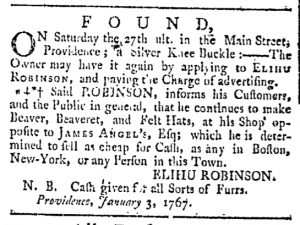
Lost and found notices frequently appeared in eighteenth-century newspapers. Colonists not only purchased consumer goods; they sometimes misplaced their possessions and placed advertisements in hopes of reclaiming them. Colonists who found lost items also sometimes helped to reunite them with their owners. Such was the case in today’s advertisement: Elihu Robinson announced that he had “FOUND” a silver knee buckle “in the Main Street, Providence,” a week earlier on December 27. He wanted to return it to its owner, but only once the owner paid “the Charge of advertising.”

That would have been the extent of most lost and found notices, but Robinson opted to add a few lines about the business he operated. He reminded former customers “and the Public in general” that he made “Beaver, Beaveret, and Felt Hats” at his shop. In the process, he incorporated an appeal to price, stating that he was “determined to sell as cheap for Cash, as any in Boston, New-York, or any Person in this Town.” In so doing, he followed a recent trend in advertisements published in the Providence Gazette by expressing concern that too many local consumers purchased their goods from shopkeepers, artisans, and suppliers in other urban ports in the region, especially the larger and more bustling cities of Boston and New York. In another advertisement in the same issue, shopkeeper James Green pledged that he sold his merchandise “at as low a rate as can be bought in this town, or any of the neighbouring governments.” More so than in any other colony, advertisers in Rhode Island encouraged prospective customers to shop locally.

Robinson’s advertisement may appear disjointed at first glance. The headline in a larger font, “FOUND,” described a silver knee buckle, but most of the advertisement promoted the hats Robinson made and sold at his shop and promises about low prices. Although seemingly unrelated, the lost-and-found notice served an important purpose. Robinson signaled to customers that they could trust his claims about offering lower prices than anywhere else in Providence or other cities because he was such an honest man that he attempted to return a silver knee buckle that he found in the street to its rightful owner. Many eighteenth-century advertisers assured readers about the quality of their character. Elihu Robinson provided a practical demonstration. Customers could trust him.