What was advertised in a colonial American newspaper 250 years ago today?

“A large Assortment of Hard-Ware GOODS, Cutlery, Jewellery, Goldsmith’s, Clock and Watch Articles.”
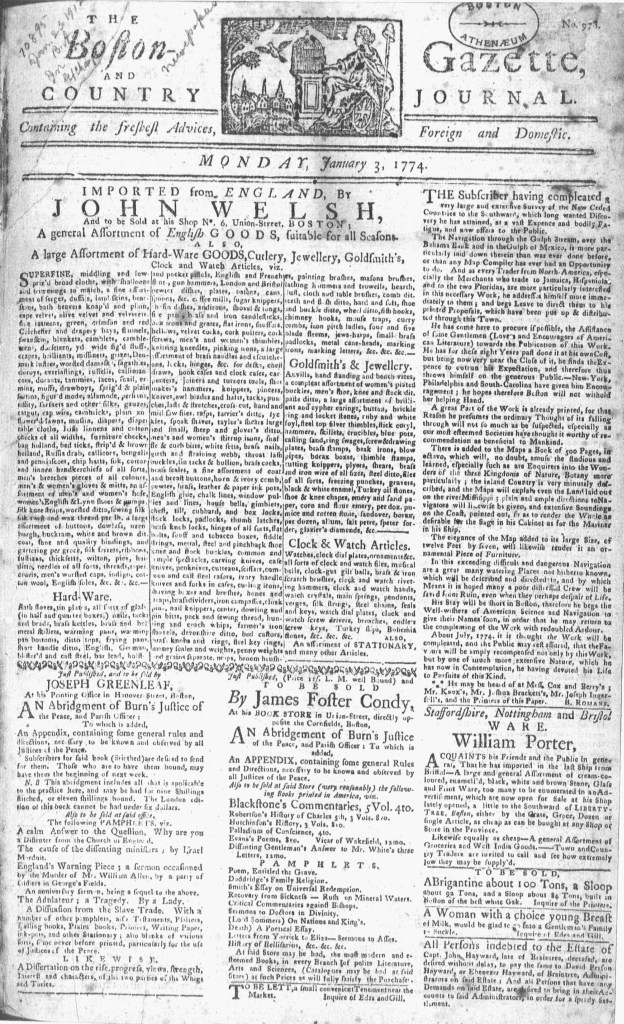
Readers almost certainly noticed John Welsh’s advertisement in the January 3, 1774, edition of the Boston-Gazette. The shopkeeper announced that he imported and sold “A general Assortment of English GOODS, suitable for all Seasons” and “A large Assortment of Hard-Ware GOODS, Cutlery, Jewellery, Goldsmith’s, Clock and Watch Articles.” To demonstrate the selection he offered to consumers, Welsh published an extensive list of his inventory.
The length of that list alone distinguished Welsh’s advertisement from others that ran in that issue of the newspaper. More significantly, the format and placement made his notice notable. Rather than extending in one column and continuing in the next, the advertisement spanned two of the regular columns, an unusual format in the Boston-Gazette or any other colonial newspaper. Within the space occupied by the advertisement, the list of goods was divided into three columns with lines, but no space, separating them. While that made the dense text more difficult to navigate, Welsh did provide some guidance with a series of headers. The “English GOODS,” mostly textiles and accessories, that appeared first did not have a header, but “Hard-Ware,” “Goldsmith’s & Jewellery,” and “Clock & Watch Articles” each had headers that directed readers to items of interest.
The advertisement’s position on the page also enhanced its visibility. It ran in the upper left corner on the first page, right below the masthead, making it the first item that readers saw when they perused the first issue of the Boston-Gazettepublished in 1774. Even if readers who knew that the latest news often appeared on the second and third pages rather than the front page immediately flipped past the first page, they likely noticed Welsh’s advertisement as they skimmed to make sure they did not miss any news that might have appeared on the front page. After all, the organization did vary from week to week depending on the amount of “intelligence” and advertisements submitted to the printing office. Welsh’s advertisement dominated the first page, as it would have done on any page. The unusual format underscored the wide selection of merchandise that he made available to customers.