June 2

What was advertised in a colonial American newspaper 250 years ago today?
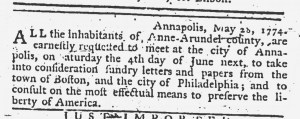
Maryland Gazette (June 2, 1774).

“Meet … to consult on the most effectual means to preserve the liberty of America.”

Advertisements in eighteenth-century newspapers served a variety of purposes.  Sometimes they carried news.  During the imperial crisis, colonizers used advertisements to help them organize.  Consider a notice that ran in the June 2, 1774, edition of the Maryland Gazette.  It advised, “ALL the inhabitants of Anne-Arundel county, are earnestly requested to meet at the city of Annapolis, on Saturday the 4th day of June next, to take into consideration sundry letters and papers from the town of Boston, and the city of Philadelphia.”  The organizers also planned for the participants to “consult on the most effectual means to preserve the liberty of America.”  Those “sundry letters and papers” referred to news of the Boston Port Act.  As punishment for the Boston Tea Party, Parliament closed and blockaded Boston Harbor, starting June 1 and continuing until the residents of that town paid for the tea destroyed the previous December.

More details from some of those “sundry letters and papers” appeared elsewhere in that issue of the Maryland Gazette, including “Extracts of private letters from London, dated April 7 and 8, to private persons in New-York and Philadelphia” on the front page, yet the call to meeting was not among the news items.  It appeared among the advertisements, though it received a privileged place as the first advertisement.  It ran immediately after the list of vessels that entered and cleared the customs house in Annapolis, traditionally the final news item.  The printers, Anne Catherine Green and Son, also ran a note that the “conclusion of the essay on the advantages of a classical education, is postponed for want of room” and “Advertisements omitted will be inserted next week.”  Yet they not only made certain to include the advertisement about the meeting to discuss news related to the Boston Port Act and how to respond but also placed it where readers who might not read the advertisements as closely as the news and editorials would be more likely to see it.  John Holt had done the same with a call to meeting that ran in the May 19 edition of the New-York Journal.  The press played an important role in “preserv[ing] the liberty of America” during the era of the American Revolution, but not solely in the sections of newspapers that carried coverage of current events.  Advertisements also contributed to keeping readers informed and mobilizing colonizers to resist legislation passed by Parliament.

May 21

What was advertised in a colonial American newspaper 250 years ago today?

Providence Gazette (May 21, 1774).

ENGLISH LIBERTIES, Or, The free-born Subject’s Inheritance.”

Like the issue of the Connecticut Journal and New-Haven Post-Boy published the previous day, the May 21, 1774, edition of the Providence Gazette devoted much less space to advertising than in most issues.  News items, especially those concerning the Boston Port Act, accounted for almost all the content, leaving room for six brief advertisements in the final column on the third page and two in the bottom right corner on the last page.  The “Substance of the DEBATES on the BOSTON PORT-BILL” filled the entire front page and spilled over onto the next.  Other news from London, followed by updates from Philadelphia and Boston followed.  Updates from Boston continued on the third page, eventually giving way to coverage of a “Town-Meeting held a Providence, on the 17th Day of May.”  A speech delivered in Parliament in opposition to the Boston Port Act and calling for the “immediate REPEAL OF THE TEA DUTY” comprised most of the final page.  John Carter, the printer, included a brief note about the paucity of advertising in that issue: “To make Room for the interesting Advices in this Day’s Gazette, we are obliged to omit several Advertisements.”

Carter did not choose to omit his own advertisement about publishing “ENGLISH LIBERTIES, Or, The free-born Subject’s Inheritance” by subscription.  For a year and a half, the printer had circulated subscription papers, advertised in the Providence Gazette and other newspapers published in New England, and encouraged colonizers to reserve copies of a book that became even more timely as the imperial crisis intensified.  The Boston Port Act served as an advertisement for the volume, as did the speech warning against its passage and other news that Carter included in the May 21 edition of the Providence Gazette.  Coverage of the recent town meeting in Providence included resolutions that the residents “will heartily join with the Province of the Massachusetts Bay, and the other Colonies, in such Measures as shall be generally agreed on by the Colonies, for the protecting and securing their invaluable Natural Rights and Privileges.”  Furthermore, the resolutions called on the “Committee of Correspondence of this Town … to assure the Town of Boston, that we consider ourselves greatly interested in the present alarming Conduct of the British Parliament towards them.”  They went on to recommend a “Stoppage of all Trade” until the repeal of the Boston Port Act, using commerce as political leverage.

Carter’s advertisement for English Liberties did not merely appear in proximity to all this news.  He very intentionally gave it a privileged position.  It appeared on the final page, immediately after the speech against the Boston Port Act, the news item seamlessly leading into the advertisement for a book that provided justification for colonizers demanding their rights.  Yet its placement on the page had even more significance considering the methods for producing eighteenth-century newspapers.  Like other newspapers, the Providence Gazette consisted of four pages created by printing two pages on each side of a broadsheet and folding it in half.  That meant that printers typically set the type and printed the first and last pages before the second and third pages.  That Carter’s advertisement for English Liberties ran in the bottom right corner of the fourth page indicates that he gave it priority over all other advertisements.  Considering the other news flowing into his printing office, he did not know how much space he might have for advertisements on the second and third pages, so he made sure that his advertisement appeared on the first side of the broadsheet that went to press.  It turned out that he had room for half a column of advertising on the third page, but Carter did not wait to find out whether that would be the case.  Like many other printers, he simultaneously used current events to sell books and pamphlets about political philosophy and he published those items to influence current events.

May 16

What was advertised in a colonial American newspaper 250 years ago today?

Newport Mercury (May 16, 1774).

“Fresh Imported … direct from LONDON … English & India GOODS.”

The crisis over tea hit the boiling point as Christopher Champlin inserted a new advertisement in the May 16, 1774, edition of the Newport Mercury.  Relying on standard language that appeared in notices placed by merchants and shopkeepers, he informed readers in Rhode Island that he stocked a “general assortment of English & India GOODS, Suitable for the Season, Which he continues to sell, by WHOLESALE and RETAIL.”  His merchandise was “Fresh Imported” on two ships “direct from LONDON.”  In a final appeal, Champlin asserted that he sold his wares “As low, for cash, as at any store or shop in the colony.”  Considering the news that ran immediately to the left of his advertisement, Champlin’s marketing strategy may not have been resonated differently than he originally intended.

Word of the Boston Port Act had arrived in Newport.  A news update with a headline that proclaimed, “JOIN or DIE!!” described the “act of parliament for blockading the harbour of Boston, in order to reduce its spirited inhabitants to the most servile and mean compliance ever attempted to be imposed on a free people” as leading to a fate “worse than death—SLAVERY.”  The editor had the news from “a gentleman” who recently arrived in Newport from Boston.”  That source stated that “a number of the first merchants in London had wrote the manufacturers in inland towns of England, not to send them any more goods, and had wrote to the merchants in Boston, that the surest way to settle the present difference, between the two countries, is to stop all trade immediately, and advised a strict union between all the colonies in this measure.”  Whether merchants in London had actually done any of that or it was wishful thinking on the part of patriots who sought allies on the other side of the Atlantic, colonizers had experience with nonimportant agreements (or boycotts) as political leverage in response to the Stamp Act and the Townshend Acts.  The update reminded readers “that hydra the Stamp Act … was destroyed by our firmness and union.”

By the end of October, the First Continental Congress adopted the Continental Association, a trade boycott intended to pressure Parliament into repealing the Boston Port Act and the rest of the Coercive Acts passed in retaliation for the Boston Tea Party as well as address other grievances.  For the moment, however, no boycott was in place when Champlin published his advertisement promoting his “Fresh Imported” goods.  The news that accompanied that notice perhaps caused some consumers to reconsider what they might purchase, but it might also have served to encourage sales among colonizers who suspected that it was only a matter of time before another boycott went into effect.  They could buy what they wished with a clear conscience and without others censuring them for doing so.  Whatever they chose to do in May 1774, consumers in Rhode Island made decisions in the context of news arriving from Boston, London, and other places.

October 19

What was advertised in a colonial American newspaper 250 years ago today?

Essex Gazette (October 19, 1773).

“The REPRESENTATIONS of Governor Hutchinson, and others, Contained in certain LETTERS transmitted to England.”

Among the various advertisements in the October 19, 1773, edition of the Essex Gazette, Samuel Hall and Ebenezer Hall, the printers of the newspaper, offered a pamphlet “Just published in Boston” and available at their printing office.  Many readers likely already knew about the contents of the pamphlet, “The REPRESENTATIONS of Governor Hutchinson, and others, Contained in certain LETTERS transmitted to England, and afterwards returned from thence, and laid before the GENERAL ASSEMBLY of the MASSACHUSETTS-BAY, Together with the RESOLVES of the two Houses thereon.”  Acquiring the pamphlet and reading the correspondence for themselves, however, gave colonizers an opportunity to see for themselves exactly what Thomas Hutchinson and others had reported to ministers and members of Parliament in letters that had not been intended for public consumption.  Purchasing and perusing the pamphlet also presented another means of participating in politics.

As Jordan E. Taylor explains in Misinformation Nation: Foreign News and the Politics of Truth ion Revolutionary America, this was not the first instance of printers publishing private letters from colonial officials to associates in London.[1]  In the wake of the arrival of British soldiers in Boston in 1768, Benjamin Edes and John Gill, printers of the Boston-Gazette, published Letters to the Ministry from Governor Bernard, General Gage, and Commodore Hood.  The Halls reprinted the pamphlet and sold it in Salem.  Taylor describes the letters as “quite benign – dull even,” yet a “few passages, nevertheless, aroused indignation,” including “Bernard’s suggestion that the Massachusetts charter be altered to weaken the council and strengthen the office of the governor.”  In addition, letters from customs commissioners recommended “two or three Regiments” to “restore and support Government” in Boston.  From the perspective of the printers and many colonizers, these letters were “hard evidence that a group of officials was conspiring to intentionally exaggerate the disorder in Massachusetts and bring troops into Boston.”

In 1773, the Representations of Governor Hutchison and Others further misrepresented the situation in Massachusetts, at least according to colonizers who advocated for the patriot cause and who recognized a pattern in how the misunderstandings between the colonies and Parliament occurred.  This pamphlet included letters from Thomas Hutchinson, Andrew Oliver, the lieutenant governor, and Charles Paxton, a customs officer.  One passage written by Hutchinson addressed “the abridgment of the colonists’ liberties,” though the governor “claimed that he was predicting, rather than prescribing, that those liberties might eventually be limited.”  Paxton requested “two or three regiments” or else “Boston will be in open rebellion.”  Taylor notes that printers “widely shared the letters in their newspapers,” making them widely accessible and perhaps even generating demand for a volume that collected them together.  The letters gained sufficient interest for the pamphlet to go through ten editions as colonizers examined what Hutchinson and others had written for themselves and constructed their own narrative that the Representations and representations of colonial officials amounted to misrepresentations that caused and exacerbated the imperial crisis.

**********

[1] For a more complete account of Letters to the Ministry and Representations of Governor Hutchinson, see Jordan E. Taylor, Misinformation Nation: Foreign News and the Politics of Truth in Revolutionary America (Baltimore: Johns Hopkins University Press, 2022), 52-54.

July 19

What was advertised in a colonial American newspaper 250 years ago today?

Jul 19 - 7:19:1770 Pennsylvania Journal
Pennsylvania Journal (July 19, 1770).

“Ah—Liberty!  …. An empty sound alone remains of thee.”

John Mason, an upholsterer, did not merely seek to sell paper hangings (or wallpaper) and bedding materials when he placed an advertisement in the Pennsylvania Journal in the summer of 1770.  His entire advertisement was a short sermon about the current political crisis and the fate of the nonimportation agreement adopted by the merchants of Philadelphia in response to the duties imposed on certain imported goods by the Townshend Acts.  All of those duties had been recently repealed, with the exception of the duty on tea, prompting merchants in New York to bring an end to their nonimportation agreement and begin trading with English merchants once again.  Residents of other cities and towns debated whether they would continue their own boycotts.  The nonimportation agreement in Philadelphia was on the verge of collapse.  It came to an end on September 20.

Mason apparently did not agree with the direction he saw the merchants and traders in his city heading.  He used his advertisement to encourage the continuation of the nonimportation agreement as well as condemn the merchants in New York for so hastily resuming trade as soon as they heard about the repeal of most of the duties.  The nonimportation agreements were intended to stay in effect until Parliament repealed all the duties, yet the duties on tea remained.

Mason began his advertisement with a play on words, stating that he “STILL prays for liberty to inform the public, that he would be glad to dispose of his property.”  He implied that all liberty was at stake, not just his ability to hawk goods in the marketplace.  He deployed the same turn of phrase in another advertisement that doubled as a political lecture a year earlier.  In his new epistle, he informed prospective customers that he sold papers hangings “not lately imported,” making clear that he continued to abide by the nonimportation agreement, as well as variety of bedding materials that he presumably made in his upholstery shop.  “The utility of these beds,” he proclaimed, “is not duly attended to, as they say, by sleeping on them.”  If the purpose of beds was not for sleeping then what was it?  Mason believed his bedding materials served a more important purpose as symbols of American liberty.  Consumers should purchase them to demonstrate their own commitment to the cause, especially during “this crisis, when our Liberty is tottering, like our Neighbour’s Resolutions*.”  Just in case readers missed his meaning, an asterisk confirmed that he critiqued recent actions in “*NEW YORK.:”

To underscore his point, he inserted a short poem for the edification of both merchants and consumers in Philadelphia:

Ah—Liberty!  How loved, how valued once, avail thee not
To whom retail’d, or by whom begot,
An empty sound alone remains of theee,
And its all thy one pretended Votaries‡ shall be—

Mason contended that liberty had been valued for a time, but all that remained of it was an “empty sound” because its “pretended Votaries,” the merchants in New York, prematurely abandoned the cause by withdrawing from the nonimportation agreement before all the duties had been repealed.  He inserted two more lines of commentary about those “pretended Votaries‡.”  Mason accused them of a “sad blunder, never to be mended” and accused them of causing the entire enterprise to fail.  “This one bad step, the contest ended,” he lamented.  Merchants in New York and other cities saw the repeal of most of the duties on imported goods as a victory.  They believed their nonimportation agreement had served its purpose (or at least well enough to return to business and resume trading).  Mason disagreed.  Until Parliament repealed the duties on tea, bringing an end to the boycotts was nothing more than capitulation.  Parliament had not met the terms that stated the nonimportation agreements would remain in effect until all the duties were repealed.  Mason took a harder line than many other colonists, using a newspaper advertisement to express his views to the general public.

August 7

What was advertised in a colonial American newspaper 250 years ago today?

Aug 7 - 8:7:1769 Pennsylvania Chronicle
Pennsylvania Chronicle (August 7, 1769).

“JOHN MASON, Upholsterer, PRAYS for LIBERTY to inform his friends and customers that he has removed his PROPERTY, to a new built house.”

As the imperial crisis intensified in the late 1760s, newspaper advertisements for consumer goods and services increasingly incorporated political messages intended to sway prospective customers. Many such advertisements underscored the benefits of encouraging “domestic manufactures” to achieve greater self-sufficiency and the virtues of purchasing those locally produced goods. Those advertisements often connected their “Buy American” appeals to faithful adherence to nonimportation agreements adopted to resist Parliament’s attempts to enact new taxes, first via the Stamp Act and later through imposing duties on certain imported goods via the Townshend Acts.

Such advertisements became a genre that deployed similar language and took similar forms. In his attempt to sell mattresses and market his services as an upholsterer, John Mason took an even bolder approach. Like other purveyors of goods and services, he turned to the public prints to inform prospective customers when he moved locations. The language he used, however, had distinct political overtones that certainly resonated with debates taking place in newspapers as well as in taverns, coffeehouses, and the public square. Mason trumpeted that he “PRAYS for LIBERTY to inform his friends and customer that he removed his PROPERTY, to a new built house … where he carries on the Upholstery Business.” The word “PRAYS” appeared in capitals because it was the first word in the body of the advertisement. “LIBERTY” and “PROPERTY,” however, apparently appeared in capitals because Mason specified that they needed appropriate emphasis. The upholsterer invoked two of the most important concepts animating resistance to Parliament.

Readers could hardly have missed the point when they considered “LIBERTY” and “PROPERTY” in combination with the nota bene that Mason appended to his advertisement. “No WONDER that Liberty is the Common Cry,” Mason lectured, “for if it was not the inanimate creation would cry out against us, for the very flowers, they, when deprived of their Liberty, Choose Death Rather, than be Confined in the softest bosom.—Methinks a Moment’s Reflections would Convince those that would Deprive us of our Liberty and property that they are Doing WRONG – for if our Fathers have No Right to Deprive us of our Liberty and property after Twenty-one Years, Certainly out Mother* can have No Right after we have enjoyed it near an Hundred Years. *Mother Country.” In this sermon on liberty, Mason looked to the history of the colonies for guidance and precedents. Parliament could not suddenly impose regulations the colonies after more than a century of allowing them to govern themselves through their own colonial assemblies. Furthermore, the stark choice between liberty and death so was evident that it could be witnessed even in the natural world, as Mason attested in his example of flowers that dies when held too closely, even in the most loving embrace.

At a time when many purveyors of consumer goods and services crafted advertisements that either implicitly or softly invoked politics to influence prospective customers, Mason made a full-throated declaration of his political sentiments. Inserting this editorial into his advertisement allowed him to demonstrate his politics to customers. In addition to adding his voice to the discourse unfolding in the public prints, Mason also intended to encourage customers to support his business because they agreed with his politics and admired his bold stance.

March 26

Who was the subject of an advertisement in a colonial American newspaper 250 years ago today?

Mar 26 - 3:26:1768 New-York Journal Supplement
Supplement to the New-York Journal (March 26, 1768).

“TO BE SOLD, A Likely young Negro Girl.”

John Holt published the New-York Journal on Thursdays in 1768. According to schedule, he distributed a standard four-page issue on Thursday, March 24. A two-page supplement filled mostly with news and a limited number of advertisements accompanied that issue. Two days later, Holt distributed an additional two-page supplement on Saturday, March 26. He explained that it contained “Articles left out of last for Want of Room,” apparently items that either could not wait for inclusion the following week or that would crowd out more recent news if held that long. The March 26 supplement consisted almost entirely of news items. One advertisement appeared at the bottom of the final column on the second page.

That advertisement offered a “Likely young Negro Girl about 13 Years of Age” for sale. It stood in stark juxtaposition to the remainder of the content of the supplement. Holt devoted four of the six columns to news from Boston, including several editorial pieces reprinted from the Boston-Gazette. One reprinted letter, signed “A TRUE PATRIOT,” warned that the colonists “soon will find themselves in chains” if they did not “support their own RIGHTS, and the Liberty of the PRESS” in the face of abuses by Parliament. Another correspondent, “POPULUS,” underscored that there was “nothing so justly TERRIBLE to tyrants, and their tools and abettors, as FREE PRESS.” The press played such an important role that “it is ever watched by those who are forming plans for the destruction of the people’s liberties, with an envious and malignant eye.”

In addition to these editorials, Holt inserted a circular letter “written by the hon. the House of Representatives” in Massachusetts “in the last Session of the General Assembly and sent to the respective Assemblies on the Continent.” In it, that body expressed “their humble opinion, which they express with the greatest deference to the wisdom of the parliament; that the acts made there, imposing duties on the people of this province, with the sole and express purpose of raising a revenue, are infringements on their natural and constitutional rights; because, as they are not represented in the British parliament, his Majesty’s commons in Britain, by those acts, grant their property without their consent.” In other words, colonists in Massachusetts objected to taxation without representation. Holt amplified their sentiments by reprinting their letter for readers in New York and its hinterlands.

All of this discussion of freedom of the press and theories of constitutional liberty took place alongside an advertisement for a “young Negro Girl.” The revenues generated from that advertisement contributed to the dissemination of the arguments voiced by “A TRUE PATRIOT,” “POPULUS,” and the assembly of the “Province of MASSACHUSETTS-BAY.” As white colonists fretted about their liberties, they also perpetuated a system that enslaved a “young Negro Girl” and countless others, holding their bodies in bondage even as they lamented potential challenges to their own speech. Resistance led to revolution as the imperial crisis intensified over the course of a decade, but many colonists were inconsistent in their conceptions of liberty and applying them to all who resided in the colonies. Even as they challenged Parliament to recognize their “natural constitutional right” colonists continued to purchase and peddle slaves from New England to George. The evidence for each appeared side-by-side in the pages of their newspapers.