February 10

What was advertised in a colonial American newspaper 250 years ago today?
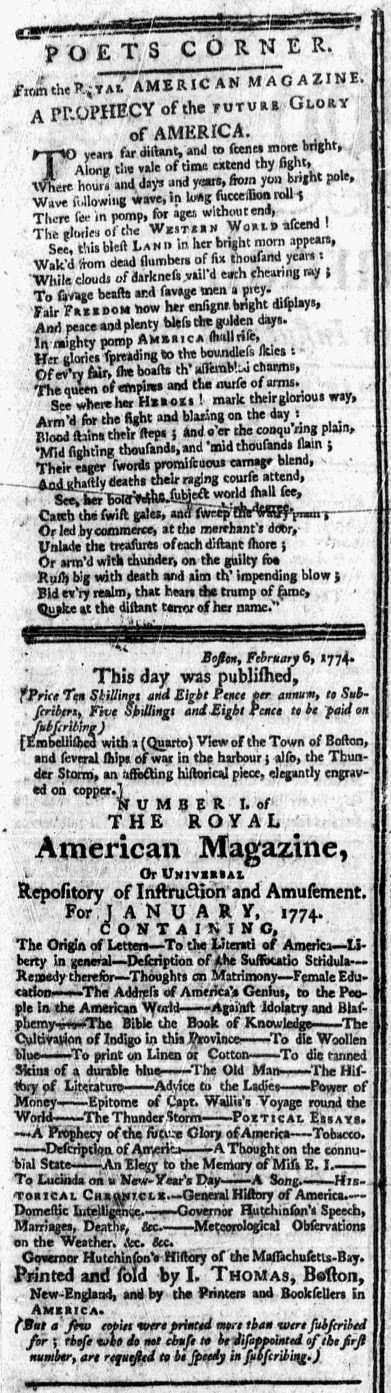
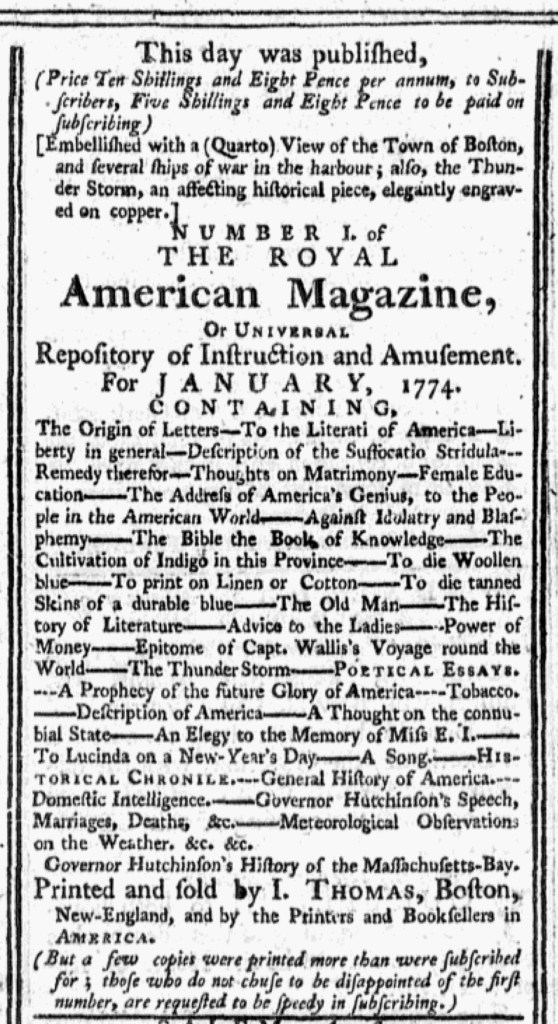
Massachusetts Spy (February 10, 1774).

Those who do not chuse to be disappointed of the first number, are requested to be speedy in subscribing.”

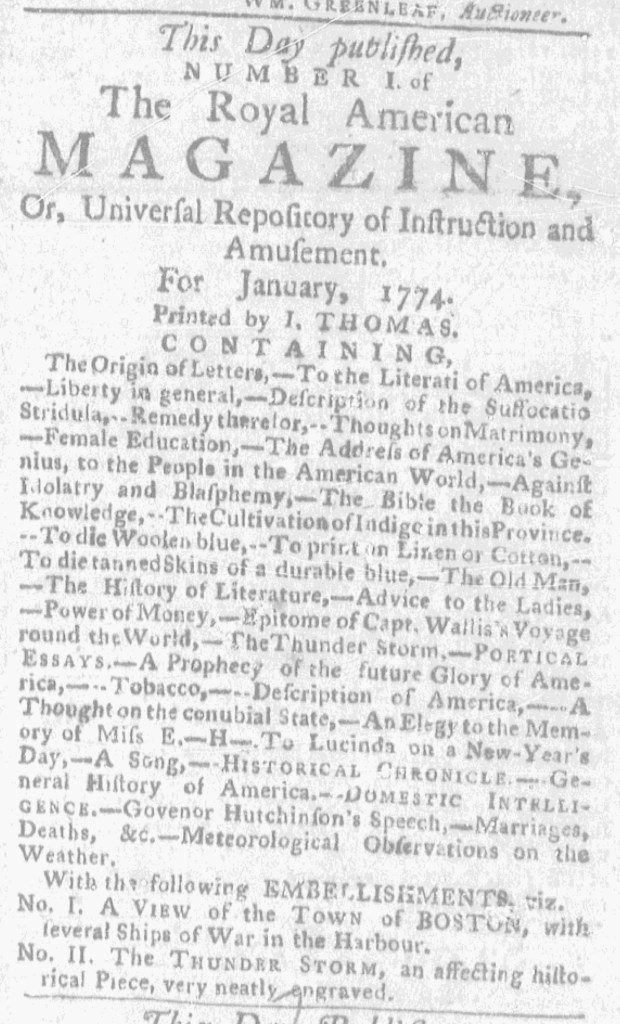
After months of distributing subscription proposals, advertising in newspapers from New Hampshire to Maryland, seeking submissions, and providing updates, Isaiah Thomas finally published the first issue of the Royal American Magazine on February 7, 1774.  He ran advertisements to that effect in the Boston-Gazette and the Massachusetts Gazette and Boston Post-Boy on the day the magazine became available to current and prospective subscribers.  Three days later, when he published the next edition of his own weekly newspaper, the Massachusetts Spy, Thomas inserted an even more elaborate advertisement.  He ran a similar notice, a slightly shorter variation, in the Massachusetts Gazette and Boston Weekly News-Letter on the same day.

Thomas began the version in the Massachusetts Spy with the pronouncement, “This day was published.”  Readers understood that meant that printed material, whether book, magazine, pamphlet, or almanac, was available to purchase, not necessarily that it was first printed that very day.  After all, newspaper advertisements proclaiming, “This day was published,” usually ran for weeks and sometimes even months without revision.  Thomas then reviewed the price, ten shillings and eight pence per year, with just over half, five shillings and eight pence, “to be paid on subscribing,” and promoted the copperplate engravings that “Embellished” the first issue of the magazine.  Only after providing that information did Thomas name the publication, “NUMBER I. of THE ROYAL American Magazine, Or UNIVERSAL Repository of Instruction and Amusement, For JANUARY, 1774.”  That Thomas published the January edition in early February likely did not seem odd to colonizers.  The few magazines published in eighteenth-century America tended to be printed and distributed at the end of the month rather than the beginning.

Massachusetts Gazette and Boston Weekly News-Letter (February 10, 1774).

Thomas devoted about half of the advertisement to a list of contents of the January issue of the Royal American Magazine, including essays on “Liberty in General,” “Thoughts on Matrimony,” and “Advice to the Ladies,” instructions “To die Woollen blue,” “To print on Linen or Cotton,” and “To die tanned Skins of a durable blue,” and several items under the headings “POETICAL ESSAYS” and “HISTORICAL CHRONICLE.”  Several authors apparently heeded his earlier calls for submissions, “requesting the Favour of their LUCUBRATIONS, which he promises to convey to the World with the greatest Care and Attention.”  Thomas also listed “Governor Hutchinson’s History of Massachusetts-Bay” at the end of the contents.  In the subscription proposals for the magazine, he offered Hutchinson’s History as a premium, pledging to include a portion with each issue of the magazine “in such a manner as to be bound up by itself.”  Subscribers could opt to have multiple issues of the magazine bound together into a single volume at the same time they had bookbinders collate and bind the pages of Hutchinson’s History.

Thomas concluded with a note to encourage prospective subscribers who had hesitated to submit their names soon or risk missing out.  “But a few copies were printed more than were subscribed for,” he declared, so “those who do not chuse to be disappointed of the first number, are requested to be speedy in subscribing.”  Customers could purchase the magazine from Thomas and “Printers and Booksellers in AMERICA.”  With all the fanfare around the first issue of the magazine, Thomas hoped to entice even more subscribers for his latest venture.  An advertising campaign that began months earlier continued with the publication of “NUMBER I” of the Royal American Magazine.

February 7

GUEST CURATOR:  Kolbe Bell

What was advertised in a colonial American newspaper 250 years ago today?

Massachusetts Gazette and Boston Post-Boy (February 7, 1774).

“Embellished with a (Quarto) View of the Town of Boston … neatly engraved on Copper.”

The Royal American Magazine was a popular magazine during a run cut short due to the fighting of the American Revolution.  It was first published in 1774 by Isaiah Thomas, a renowned printer who ran the Massachusetts Spy, a newspaper, since 1770.  The Royal American Magazine lasted from January 1774 to early spring of 1775.  Not many successful magazines were started in America before the American Revolution.  Frank Luther Mott states that there were only fifteen magazines published in America before the Royal American started, most of them lasting a year or less.[1]  Isaiah Thomas’s advertisement campaign for the Royal American, however, helped to make it one of the most successful American magazines prior to independence.

The Royal American Magazine was known for having many more engravings than other American magazines at the time; engravings are visual images inserted into a written work, and were made by carefully carving a reverse image onto a copper plate, coating it with ink, and then transferring the image to paper in a printing press.  The engravings representing a “View of the Town of Boston, and a Representation of a Thunder Storm,” as mentioned in this advertisement, enticed more people to subscribe to the magazine.  According to Mott, “its distinctive feature was a little series of engravings by Paul Revere.”[2]  The fact that the advertisement does not include the name of Paul Revere as the engraver for the magazine shows that Paul Revere’s fame increased after the American Revolution.  Despite the Royal American Magazine containing so many engravings and other content, it did not last much longer than a year.  Nevertheless, it was one of the most popular magazines printed in America before the American Revolution.

Visit the “Royal American Magazine Plates,” part of the “Illustrated Inventory of Paul Revere’s Works at the American Antiquarian Society,” to view the engravings and learn more about them.

**********

ADDITIONAL COMMENTARY:  Carl Robert Keyes

Later than he intended (and later than he had advertised), Isaiah Thomas published the first issue of the Royal American Magazine in early February 1774.  The Adverts 250 Project has tracked Thomas’s extensive advertising campaign over many months in 1773 and 1774, including his announcements that he would publish the first issue in January 1774 and an explanation that a ship running aground delayed delivery of the types for the magazine to Boston.  On Thursday, February 3, he inserted a brief notice in his own newspaper, the Massachusetts Spy, pledging that “MONDAY next will be published … NUMBER I. of The Royal AMERICAN MAGAZINE.”  Just as he would do four days later in the advertisement Kolbe examines today, he promoted copperplate engravings of a “View of the Town of Boston, and a Representation of a Thunder Storm.”  Subscribers could leave the engravings intact or, as many likely did, remove them to display in their homes, shops, or offices.

Boston-Gazette (February 7, 1774).

Thomas had aggressively advertised in other newspapers, including several published in Boston.  He once again did so when he finally took the magazine to press.  In addition to the version that ran in the Massachusetts Gazette and Boston Post-Boy on February 7, featured above, he placed a shorter notice in the Boston-Gazette on the same day.  Extending only three lines, it declared, “THIS DAY PUBLISHED, (by I. THOMAS,) Number I. of The Royal American MAGAZINE.”  Perhaps he submitted copy that included the blurb about the copperplate engravings to the printing office only to have the compositors edit it for length to fit on the page with the rest of the news and advertising in that issue.  Whatever the case, Thomas fulfilled the promise he made in the Massachusetts Spy on February 3.  He did indeed publish the Royal American Magazine on the following Monday.  He followed up with much more extensive advertisements in the Massachusetts Spy and the Massachusetts Gazette and Boston Weekly News-Letter on February 10, announcing his success and encouraging more readers to subscribe.

**********

[1] Frank Luther Mott, A History of American Magazines, 1741-1850 (Cambridge: Harvard University Press, 1939), 787-788.

[2] Mott, History of American Magazines, 26.

February 2

What was advertised in a colonial American newspaper 250 years ago today?

Essex Journal (February 2, 1774).

“He assures the Public that No. I. for January 1774, will this week be put in the Press.”

Isaiah Thomas, printer of the Massachusetts Spy, continued promoting a new venture, the Royal American Magazine, throughout January and into February 1774.  As the month began, he once again placed an update in the Essex Journal, the newspaper the industrious printer recently began publishing in partnership with Henry-Walter Tinges in Newburyport.  That update advised the public that publication of the first issue of the magazine had been delayed because the ship carrying new types “was cast ashore at Cape Cod … and although the cargo was saved” the types did not arrive in Boston in time for “the day intended for Publication.”

The Adverts 250 Project has tracked Thomas’s advertising campaign for the Royal American Magazine throughout June, July, August, September, October, November, and December 1773.  The printer and his associates advertised in Boston, throughout New England, in New York and Pennsylvania, and as far south as Maryland.  Eighteen more advertisements for the Royal American Gazette appeared in newspapers in January 1774, half of them the update about the types.

A notice that “Subscription Papers will be returned to the intended Publisher in a few Days” that previously circulated widely made its final appearance in the Maryland Gazette, published in Annapolis, in that newspaper’s first issue of the year.  An earlier update, that one addressed to “generous Patrons and Promoters of useful KNOWLEDGE throughout AMERICA,” that had also circulated widely ran twice in the Connecticut Courant, published in Hartford, and once in the Maryland Journal, published in Baltimore.  That notice had not previously appeared in the Connecticut Courant.  It was the first time that any advertisement about the Royal American Magazine ran in the Maryland Journal, extending the reach of Thomas’s marketing efforts.

He also opted to insert the complete subscription proposals in the Massachusetts Spy once again.  In the January 13 edition, he added a note of explanation:  “It being a considerable time since the PROPOSALS for the ROYAL AMERICAN MAGAZINE (which is now in the Press) were first published, and many Gentlemen and Ladies being desirous of seeing them, they are for that reason again inserted in this paper.”  Thomas had not published the complete subscription proposals in the Massachusetts Spy since August 19, 1773.  He claimed that he merely responded to the wishes of “many Gentlemen and Ladies,” though that may have been a ploy to suggest the sort of interest and demand that might prompt prospective subscribers to reserve their copies.  Running the complete subscription proposals once again also buttressed his update about the types that appeared on another page of that issue, while his assertion that the magazine “is now in the Press” underscored that those who had hesitated to subscribe until it became clear that Thomas would actually publish the magazine could no longer wait.  In the next issue, the complete subscription proposals and the update about the types ran one after the other on the first page of the January 20 edition of the Massachusetts Spy.

The update about the types ran in various newspapers at least nine times in January.  It may have first appeared in the January 3 edition of the Massachusetts Gazette and Boston Post-Boy, an issue no longer extant.  When it ran in the January 10 edition, the dateline read, “Boston, January 3, 1774,” suggesting that it could have been in the previous issue as well.  Throughout the rest of the month, the update appeared in the Essex Journal four times and in the Massachusetts Spy three times.  Newspapers published by Thomas almost exclusively carried that update, circulating it throughout Massachusetts and other colonies in New England as post riders delivered subscriptions far and wide.  In addition to the Massachusetts Gazette and Boston Post-Boy, the New-Hampshire Gazette also carried the update about the types in January.  Dated “January 2d,” it ran in the January 28 edition.

Connecticut Gazette (January 7, 1774).

One other advertisement about the Royal American Magazine ran in January, this one exclusively in the Connecticut Gazette, published in New London.  A brief notice informed readers that “Subscriptions for the Royal-American MAGAZINE are taken in by the Printer of this Paper.”  Thomas may or may not have arranged with Timothy Green to publish this advertisement.  It appeared in three consecutive issues before being discontinued, standard practice for other advertisements submitted to the printing office.  Thomas could have sent instructions (and promised to pay) for the advertisement.  That seems most likely, especially since it was the first time that any advertisements for the Royal American Magazine ran in the Connecticut Gazette.  On the other hand, Green may have taken the initiative, aware from his participation in a network of printers that crisscrossed New England and other colonies that Thomas would soon publish the first issue of the magazine.  Green may have collected subscriptions as a service to his local customers as much as a favor to Thomas, encouraging them to visit his printing office to acquire reading materials rather than purchase them elsewhere.

Thomas’s advertising campaign for the Royal American Magazine continued in January 1774, though it also continued to taper off compared to previous months.  He exerted more effort in disseminating the subscription proposals widely and inciting interest in the prospects of the new magazine than in promoting it once publication commenced.  Once he achieved sufficient demand to make the magazine viable, he did not advertise as widely.

**********

“Subscription Papers will be returned” Update

  • January 6 – Maryland Gazette (tenth appearance)

“generous Patrons” Update

  • January 4 – Connecticut Courant (first appearance)
  • January 11 – Connecticut Courant (second appearance)
  • January 20 – Maryland Journal (first appearance)

Subscription Proposals

  • January 13 – Massachusetts Spy (ninth appearance)
  • January 20 – Massachusetts Spy (tenth appearance)

“Types are now arrived” Update

  • January 5 – Essex Journal (first appearance)
  • January 6 – Massachusetts Spy (first appearance)
  • January 10 – Massachusetts Gazette and Boston Post-Boy (first known appearance; possible second appearance)
  • January 12 – Essex Journal (second appearance)
  • January 13 – Massachusetts Spy (second appearance)
  • January 19 – Essex Journal (third appearance)
  • January 20 – Massachusetts Spy (third appearance)
  • January 26 – Essex Journal (fourth appearance)
  • January 28 – New-Hampshire Gazette (first appearance)

“Subscriptions … taken in”

  • January 7 – Connecticut Gazette (first appearance)
  • January 14 – Connecticut Gazette (second appearance)
  • January 21 – Connecticut Gazette (third appearance)

Happy Birthday, Isaiah Thomas!

Isaiah Thomas, patriot printer and founder of the American Antiquarian Society, was born on January 19 (New Style) in 1749 (or January 8, 1748/49, Old Style).  It’s quite an historical coincidence that the three most significant printers in eighteenth-century America — Benjamin Franklin, Isaiah Thomas, and Mathew Carey — were all born in January.

isaiah_thomas1818
Isaiah Thomas (January 30, 1739 – April 4, 1831). American Antiquarian Society.

The Adverts 250 Project is possible in large part due to Thomas’s efforts to collect as much early American printed material as he could, originally to write his monumental History of Printing in America.  The newspapers, broadsides, books, almanacs, pamphlets, and other items he gathered in the process eventually became the initial collections of the American Antiquarian Society.  That institution’s ongoing mission to acquire at least one copy of every American imprint through 1876 has yielded an impressive collection of eighteenth-century advertising materials, including newspapers, magazine wrappers, trade cards, billheads, watch papers, book catalogs, subscription notices, broadsides, and a variety of other items.  Exploring the history of advertising in early America — indeed, exploring any topic related to the history, culture, and literature of early America at all — has been facilitated for more than two centuries by the vision of Isaiah Thomas and the dedication of the curators and other specialists at the American Antiquarian Society over the years.

Thomas’s connections to early American advertising were not limited to collecting and preserving the items created on American presses during the colonial, Revolutionary, and early national periods.  Like Mathew Carey, he was at the hub of a network he cultivated for distributing newspapers, books, and other printed goods — including advertising to stimulate demand for those items.  Sometimes this advertising was intended for dissemination to the general public (such as book catalogs and subscription notices), but other times it amounted to trade advertising (such as circular letters and exchange catalogs intended only for fellow printers, publishers, and booksellers).

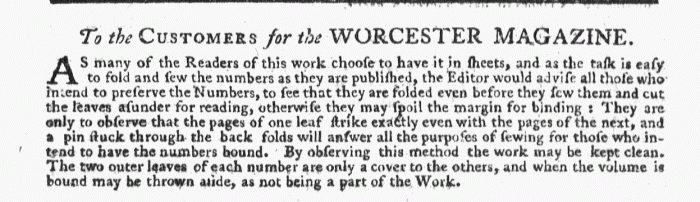
Thomas also experimented with advertising on wrappers that accompanied his Worcester Magazine, though he acknowledged to subscribers that these wrappers were ancillary to the publication:  “The two outer leaves of each number are only a cover to the others, and when the volume is bound may be thrown aside, as not being a part of the Work.”[1]

jan-30-worcerster-magazine-april-1786
Detail of Advertising Wrapper, Worcester Magazine (Second Week of April, 1786).

Thomas’s patriotic commitment to freedom of the press played a significant role in his decision to develop advertising wrappers.  As Thomas relays in his History of Printing in America, he discontinued printing his newspaper, the Massachusetts Spy, after the state legislature passed a law that “laid a duty of two-thirds of a penny on newspapers, and a penny on almanacs, which were to be stamped.”  Such a move met with strong protest since it was too reminiscent of the Stamp Act imposed by the British two decades earlier, prompting the legislature to repeal it before it went into effect.  On its heels, however, “another act was passed, which imposed a duty on all advertisements inserted in the newspapers” printed in Massachusetts.  Thomas vehemently rejected this law as “an improper restraint on the press. He, therefore, discontinued the Spy during the period that this act was in force, which was two years. But he published as a substitute a periodical work, entitled ‘The Worcester Weekly Magazine,’ in octavo.”[2] This weekly magazine lasted for two years; Thomas discontinued it and once again began printing the Spy after the legislature repealed the objectionable act.

jan-30-advertising-wrapper-worcester-magazine-4th-week-may-1786
Third Page of Advertising Wrapper, Worcester Magazine (Fourth Week of May, 1786).

Isaiah Thomas was not interested in advertising for its own sake to the same extent as Mathew Carey, but his political concerns did help to shape the landscape of early American advertising.  Furthermore, his vision for collecting American printed material preserved a variety of advertising media for later generations to admire, analyze, ponder, and enjoy.  Happy 275th birthday, Isaiah Thomas!

**********

[1] Isaiah Thomas, “To the CUSTOMERS for the WORCESTER MAGAZINE,” Worcester Magazine, wrapper, second week of April, 1786.

[2] Isaiah Thomas, The History of Printing in America: With a Biography of Printers, and an Account of Newspapers, vol. 2 (Worcester, MA: Isaac Sturtevant, 1810), 267-268.

January 12

What was advertised in a colonial American newspaper 250 years ago today?

Essex Journal (January 12, 1774).

“Said MAGAZINE was not published on Saturday last, agreeable to his promise.”

Throughout the second half of 1773, Isaiah Thomas, the printer of the Massachusetts Spy, attempted to launch another publication, the Royal American Magazine.  If he could attract a sufficient number of subscribers to take the project to press, it would be the only magazine published in the colonies at the time.  After a few months, Thomas announced that subscribers had indeed answered his call, responding to the proposals and other advertisements he placed in newspapers in Massachusetts, New Hampshire, Rhode Island, Connecticut, New York, Pennsylvania, and Maryland.  He planned to distribute the first issue of the Royal American Magazine on January 1, 1774.

That, however, did not come to pass.  In the January 6 edition of the Massachusetts Spy, the first issue of the new year, Thomas inserted an update that explained that “the only Reason why said MAGAZINE was not published on Saturday last, agreeable to his Promise, was, that he sent to England for a compleat Set of Types, for said Work” and the ship that was supposed to deliver them to Boston ran ashore on Cape Cod about three weeks earlier.  Fortunately, “the Cargo was saved.”  Thomas eventually received the new type, but not by “the Day intended for Publication.”  He assured subscribers that the magazine “will THIS WEEK be put in the Press, and published on the first Day of February next.”  In the eighteenth century, monthly magazines often came out during the final days of the month rather than the beginning of the month, so this plan still allowed Thomas to produce a January issue.

This misfortune also presented an opportunity for “Gentlemen and Ladies who intend subscribing for the Royal AMERICAN MAGAZINE” but had not yet done so to “send in their Names immediately, otherwise they may be disappointed of having the first Number.”  In addition to encouraging more subscribers, Thomas also continued soliciting “LUCUBRATIONS” or essays for the inaugural issue.  Given the delay caused by not receiving the type by the expected date, Thomas had more time to collect content produced by American authors for the magazine.

After this update ran in the Massachusetts Spy on January 6, Thomas placed it in the Massachusetts Gazette and Boston Post-Boy on January 10 and the Essex Journal, published in Newburyport, Massachusetts, on January 12.  Thomas had recently commenced publishing the Essex Journal in partnership with Henry-Walter Tinges.  Not surprisingly, his advertisement was the only one to appear on the front page of Essex Journal.  Other advertisements appeared elsewhere in the issue.

December 30

What was advertised in a colonial American newspaper 250 years ago today?

Massachusetts Spy (December 30, 1773).

“THE Editor of the ROYAL AMERICAN MAGAZINE, presents his most respectful Compliments.”

After advertising the Royal American Magazine more widely than in any previous month in November 1773, Isaiah Thomas placed fewer advertisements in December.  In total, he ran twenty advertisements in seven newspapers in six towns in five colonies, compared to the forty-three advertisements he published in November.  The success of his marketing efforts in June, July, August, September, October, and November likely explains the decline in the number of advertisements for December.  Thomas distributed subscription proposals to determine whether or not he could entice enough subscribers to make the magazine a viable venture and, if so, how many copies he needed to print.  Once he determined that sufficient interest existed to merit moving forward with the project, he did not need to disseminate the subscription proposals or notices about submitting them to his printing office as widely.  He could instead devote more attention to launching a newspaper, the Essex Journal, in Newburyport in partnership with Henry-Walter Tinges.

Thomas also shifted his attention to the production of the magazine, including gathering contents.  His advertisement addressed to the “generous Patrons and Promoters of useful KNOWLEDGE throughout AMERICA” solicited “the Favour of their LUCUBRATIONS” or essays to publish in the magazine.  In November, that notice appeared only in Boston, but in December it ran in newspapers published in Boston and Newburyport, Massachusetts; Portsmouth, New Hampshire; and Newport, Rhode Island.  Still, Thomas’s own publications carried the notice six of the twelve times it ran in December, five times in the Massachusetts Spy, where it originated, and once in the free inaugural issue of the Essex Journal.  That advertisement included a request for “PRINTERS of all the Public Papers in America” to insert it “as soon as may be,” but fewer took note of it than a notice asserting that “subscription papers will be returned to the intended publisher in a few days.”  That advertisement appeared five times in October, thirty-two times in November, and eight more times in December.  Only two newspapers, the Maryland Gazette and the Norwich Packet, carried it in December.  Having commenced publication the previous month, the Norwich Packet may have been eager for both the content and, especially, advertising revenue.

Thomas continued to advertise the Royal American Magazine in 1774.  He regularly announced the publication of new issues each month.  He did not, however, place such advertisements as widely as the subscription proposals and other notices calling on subscribers to submit their names as soon as possible or risk missing out on the magazine.  His marketing campaign concentrated on establishing the magazine rather than promoting it once it began publication.

**********

“Subscription Papers will be returned” Update

  • December 2 – Maryland Gazette (fifth appearance)
  • December 2 – Norwich Packet (third appearance)
  • December 9 – Maryland Gazette (sixth appearance)
  • December 9 – Norwich Packet (fourth appearance)
  • December 16 – Maryland Gazette (seventh appearance)
  • December 16 – Norwich Packet (fifth appearance)
  • December 23 – Maryland Gazette (eighth appearance)
  • December 30 – Maryland Gazette (ninth appearance)

“generous Patrons” Update

  • December 2 – Massachusetts Spy (second appearance)
  • December 3 – New-Hampshire Gazette (first appearance)
  • December 4 – Essex Journal (first appearance)
  • December 6 – Newport Mercury (first appearance)
  • December 9 – Massachusetts Spy (third appearance)
  • December 13 – Boston-Gazette (third appearance)
  • December 13 – Newport Mercury (second appearance)
  • December 16 – Massachusetts Spy (fourth appearance)
  • December 20 – Newport Mercury (third appearance)
  • December 23 – Massachusetts Spy (fifth appearance)
  • December 24 – New-Hampshire Gazette (second appearance)
  • December 30 – Massachusetts Spy (sixth appearance)

December 29

What was advertised in a colonial American newspaper 250 years ago today?

Essex Journal (December 29, 1773).

“The Number of at present, is insufficient to defrey the expence attending the Printing of a News-Paper.”

After published an inaugural issue of the Essex Journal and distributing it gratis to incite interest in the first newspaper published in Newburyport, Massachusetts, Isaiah Thomas and Henry-Walter Tinges paused publication to gather the names of subscribers.  More than three weeks after that first issue appeared on December 4, 1773, Thomas and Tinges commenced weekly publication of the Essex Journal.  In a notice on the first page, they confessed to “such Gentlemen and Ladies who wish well to this undertaking and have not yet subscribed that THEIR helping hands are wanted to bear up this Fabrick, … which if not well supported will fall, and lay the Foundation in Ruins.”  In other words, “the Number of Subscribers at present, is insufficient to defrey the expence attending the Printing of a News-Paper.”

Still, Thomas and Hinges took a chance, hoping that publishing a second and subsequent issues would convince prospective customers who intended to subscribe but had not yet done so to submit their names to the printing office.  According to the printers, some had indicated that was their plan: “we were assured that many intended to subscribe on the appearance of a second paper, and others would, at times, drop in.”  The fate of the newspaper depended on the “kindness and generosity” of subscribers.

In addition to printing a second issue to demonstrate the usefulness of the venture to readers in Newburyport and other towns in Massachusetts and New Hampshire, Thomas and Hinges adjusted the publication date to suit the needs of the community.  They distributed the inaugural issue on a Saturday, but learned that “meets not the public approbation,” so they “altered the day of publication to WEDNESDAY, which is greatly approved of.”  In turn, that required a new investment on the part of the printers: “we intend establishing a rider from Boston to this place, that we may have the most early and authentic intelligence.”  Thomas also published the Massachusetts Spy in Boston on Thursdays.  He may have originally thought that the Essex Journal could reprint content from that newspaper on Saturdays, but delivering “the most early and authentic intelligence” on Wednesdays likely meant drawing more content from the Boston Evening-Post, the Boston-Gazette, and Massachusetts Gazette and Boston Post-Boy, all of them published on Mondays.  Thomas and Hinges noted the “not very inconsiderable” expense, but also declared their commitment “to spare no pains or cost in our power to tender, in future, THIS paper as useful and entertaining as any News-Paper in America.”

Thomas and Hinges apparently gained more subscribers as well as advertisers.  They published the Essex Journal on every Wednesday in 1774 and Hinges and a new partner continued into 1775.  Then publication became sporadic in May, following the fighting at Lexington and Concord, and moved to Fridays for the remainder of the year, throughout most of 1776, before moving to Thursdays and ceasing in February 1777.

December 19

What was advertised in a colonial American newspaper 250 years ago this week?

Massachusetts Spy (December 16, 1773).

“SUBSCRIPTIONS for the SPY are also taken in by J. Larkin, Chairmaker, and Mr. W. Calder, Painter, in Charlestown.”

A colophon could include all sorts of information or little information at all.  Isaiah Thomas could have confined the colophon for the Massachusetts Spy to its first line: “BOSTON: Printed by ISAIAH THOMAS.”  However, he devised one of the most extensive colophons in colonial newspapers.  His colophon gave directions to his printing office, gave the price for annual subscriptions, and solicited advertisements and “Articles of Intelligence” to include among the contents of his weekly publication.  Thomas also announced, “PRINTING in its various Branches, performed in a neat Manner, with the greatest Care and Dispatch, on the most reasonable terms.”  Job printing orders included “Small HAND-BILLS” ready “at an Hour’s Notice.”  Other printers who used their colophons as perpetual advertisements at the bottom of the final page of each newspaper included some or all of these elements.

Thomas included a unique feature in the colophon for the Massachusetts Spy.  It was the only newspaper that listed a network of local agents in other towns who accepted subscriptions and forwarded them to the printing office.  “SUBSCRIPTIONS for the SPY,” the colophon advised, “are also taken in by J. Larkin, Chairmaker, and Mr. W. Calder, Painter, in Charlestown; Mr. J. Hillers, Watch-maker, in Salem; Mr. B. Emerson, Bookseller, in Newbury-Port; Mr. M. Belcher, in Bridgewater; and by Dr. Elijah Hewins, in Stoughtonham.”  Printers who published newspapers established networks for exchanging their newspapers with their counterparts in other towns, readily reprinting items from one publication to another to fill the pages.  They also forged relationships with printers and booksellers for the purposes of collecting subscriptions for proposed books, magazines, and pamphlets.  Throughout the second half of 1773, Thomas advertised his plans to publish the Royal American Magazine, enlisting printers and booksellers in towns in New England, New York, Pennsylvania, and Maryland to aid in the endeavor.  His colophon indicates that his efforts to promote his newspaper extended beyond fellow members of the printing and book trades to include associates from a variety of occupations.  At least in the case of the Massachusetts Spy, chairmakers, painters, watchmakers, and doctors all participated in creating an infrastructure for disseminating the news during the era of the American Revolution.

December 4

What was advertised in a colonial American newspaper 250 years ago today?

Essex Journal (December 4, 1773).

“THOSE LADIES and GENTLEMEN who are desirous of seeing the curious ART of PRINTING, are hereby informed that on MONDAY next the Printing Office, will be opened for their reception.”

When Isaiah Thomas and Henry-Walter Tinges formed a partnership to publish the Essex Journal and Merrimack Packet: Or, the Massachusetts and New-Hampshire General Advertiser in the fall of 1773, they devised a savvy marketing campaign.  Thomas already published the Massachusetts Spy in Boston.  He continued overseeing that newspaper, while Tinges ran the printing office in Newburyport.  To generate interest in the new publication, the partners inserted a notice in the November 26 edition of the Massachusetts Spy, informing both prospective subscribers and prospective advertisers that they would distribute the inaugural issue of the Essex Journal “GRATIS” on December 4.  They envisioned “a very large Number will be printed off, and distributed throughout the Provinces of Massachusetts Bay and New-Hampshire.”

Thomas and Tinges used that first issue as a vehicle for further promoting the newspaper as well as several ventures Thomas already had underway.  An extensive address “To the PUBLIC” from the printers and “PROPOSALS For CONTINUING the ESSEX JOURNAL” filled most of the first page, appearing below a masthead that included woodcuts of the arms of the colony, an indigenous man holding an arrow in one hand and a bow in the other, on the left and a packet ship under sail, presumably carrying newspapers and letters, on the right.  The title of the newspaper ran between the images.  At short advertisement for a magazine that Thomas already marketed extensively completed the final column: “SUBSCRIPTIONS for the ROYAL AMERICAN MAGAZINE, which will speedily be published by I. THOMAS, in Boston, are taken in at the Printing-Office.”  A longer advertisement addressed to “the generous Patrons and Promoters of useful KNOWLEDGE, throughout AMERICA,” a notice that previously appeared in several newspapers published in Boston, appeared on the final page of the inaugural issue.  In it, Thomas solicited articles for the Royal American Magazine and warned prospective subscribers to submit their names soon or risk missing the first issue.  A shorter advertisement on the final page promoted “Thomas’s Boston Sheet ALMANACK for the year ensuing, proper for all Merchants, Shopkeepers, &c. to paste or hang up in their Stores or Shops.”

Essex Journal (December 4, 1773).

On the third page, the first advertisement immediately following the news invited “LADIES and GENTLEMEN who are desirous of seeing the curious ART of PRINTING” to visit the printing office on the following Monday.  The printers planned to open their shop to the public, prepared to “wait on all who will do them the honour of their company.”  Thomas and Tinges highlighted demonstrations scheduled for “eleven o’clock in the forenoon, and at three in the afternoon.”  They hoped that such exhibitions would help convince prospective subscribers and prospective advertisers to do business with them.  Opening the printing office to the public “for their reception” anticipated open houses that many businesses now host to draw attention to new endeavors.  Another advertisement, this one on the final page, asked “GENTLEMEN and LADIES in this and the neighbouring towns who will encourage the Publication of this Paper” to “send in their names with all convenient speed.”  Thomas and Tinges suggested that publishing subsequent issues of the Essex Journal was not a foregone conclusion.  Instead, they needed prospective subscribers to confirm their commitment before the next issue would go to press.  A second issue depended on “a sufficient number of Subscribers.”  As a final bonus, a supplement accompanied the inaugural issue.  It featured news about “the detestable TEA sent out by the East-India Company, part of which being just arrived in [Boston] harbour,” that made its way to Newburyport the previous day via “Friday’s Post.”  With the supplement, Thomas and Tinges made the point that subscribers to the Essex Journal could expect to receive the latest news as soon as it arrived in Newburyport rather than waiting for the Essex Gazette, published in Salem, the New-Hampshire Gazette, published in Portsmouth, or any of the newspapers published in Boston.

Despite these efforts, it took a few weeks for Thomas and Tinges to collect enough subscriptions to convince them of the viability of publishing the Essex Journal.  The various marketing strategies incorporated into the inaugural issue, from distributing free copies to the extensive subscription proposals to the open house at the printing office to the news supplement, likely helped generate interest, but the process took time.  Thomas and Tinges did not publish the second issue of the Essex Journal for more than three weeks.  It appeared on December 29, once again carrying the proposals and conditions to entice readers who had not yet subscribed.

November 27

What was advertised in a colonial American newspaper 250 years ago today?

Providence Gazette (November 27, 1773).

“The Introduction to the Royal American Magazine … will be published on the first Day of January next.”

Isaiah Thomas’s efforts to promote the Royal American Magazine in the public prints intensified in November 1773.  The Adverts 250 Project has traced his marketing efforts, starting with an announcement, in May, that he would soon publish proposals for the magazine and the first insertion of those proposals in Thomas’s newspaper, the Massachusetts Spy, at the end of June.  The printer ran ten advertisements in July, thirteen in August, fourteen in September, twenty in October, and forty-three in November.

Boston Evening-Post (November 1, 1773).

The month began with the Boston-Evening Post running Thomas’s “To be, or not to be” update for the first time and the Massachusetts Gazette and Boston Post-Boy carrying it a second time on November 1.  Every newspaper then discontinued that notice, likely an acknowledgement of a note at the end of the version in the Boston Evening-Post: “by the appearance of the Subscription Papers in [Thomas’s] possession, there is great probability of [the magazine] going forward.”  Three days later, Thomas published an advertisement that appeared only three times, each time in his own Massachusetts Spy.  That brief notice called on local agents to send lists of subscribers to Thomas: “THOSE gentlemen, in this and the other provinces, who have subscription papers in their hands for the ROYAL AMERICAN MAGAZINE, are earnestly desired to return them.”

Massachusetts Spy (November 4, 1773).

An advertisement that made its first appearance in some newspapers in the final week of October accounted for most of the notices that ran in November.  That advertisement advised “gentlemen and ladies, who incline to encourage the publication of the ROYAL AMERICAN MAGAZINE” that “Subscription Papers will be returned to the intended Publisher in a few Days.”  That notice ran thirty-two times in November, supplementing its five appearances in October.  It became Thomas’s most widely disseminated newspaper advertisement for the proposed magazine.  The Maryland Gazette, published in Annapolis, carried the notice four times in November, the first time any of Thomas’s advertisements ran in the public prints that far south.  Previously, only newspapers in New England, New York, and Pennsylvania carried it.  The Norwich Gazette, a newspaper established in Connecticut in October, also ran the advertisement in late November.  It may have featured the advertisement earlier, but the first issues of that newspaper have not survived.  This advertisement did not appear in any newspapers published in Massachusetts.  Thomas relied on his other advertisements there.  Overall, the “Subscription Papers will be returned” advertisement ran in fourteen newspapers published in ten cities and towns in six colonies.

Thomas devised one more advertisement in November 1773.  It first appeared in the Massachusetts Spy, but by the end of the month the Boston-Gazette and the Massachusetts Gazette and Boston Post-Boy both heeded Thomas’s plea for “PRINTERS of all the Public Papers in America … to insert this Advertisement.”  In it, Thomas stated that the first issue of the Royal American Magazine “will undoubtedly appear on the first of January next.”  He solicited essays to include in the new publication.  He also made another appeal to prospective subscribers to send their names “if they chuse not to be disappointed” by missing the first issue.

Launching the only magazine published in the colonies at that time was a significant undertaking.  That Thomas would eventually take the magazine to press was not inevitable.  He needed to cultivate a community of subscribers that extended beyond Boston.  To achieve that goal, he devised an extensive advertising campaign, one surpassed only by Robert Bell in his efforts to create an American literary market.

**********

Newspaper Advertisements for November 1773

To be, or not to be” Update

  • November 1 – Boston Evening-Post (first appearance)
  • November 1 – Massachusetts Gazette and Boston Post-Boy (second appearance)

“Subscription Papers will be returned” Update

  • November 1 – Newport Mercury (first appearance)
  • November 1 – Pennsylvania Chronicle (first appearance)
  • November 1 – Pennsylvania Packet (first appearance)
  • November 2 – Connecticut Courant (first appearance)
  • November 3 – Pennsylvania Journal (first appearance)
  • November 4 – Maryland Gazette (first appearance)
  • November 4 – New-York Journal (second appearance)
  • November 8 – Newport Mercury (first appearance)
  • November 8 – New-York Gazette and Weekly Mercury (first appearance)
  • November 8 – Pennsylvania Chronicle (second appearance)
  • November 8 – Pennsylvania Packet (second appearance)
  • November 9 – Connecticut Courant (second appearance)
  • November 10 – Pennsylvania Gazette (first appearance)
  • November 10 – Pennsylvania Journal (second appearance)
  • November 11 – Maryland Gazette (second appearance)
  • November 11 – New-York Journal (third appearance)
  • November 12 – New-Hampshire Gazette (second appearance)
  • November 12 – New-London Gazette (second appearance)
  • November 15 – Newport Mercury (second appearance)
  • November 15 – New-York Gazette and Weekly Mercury (second appearance)
  • November 15 – Pennsylvania Chronicle (third appearance)
  • November 18 – Maryland Gazette (third appearance)
  • November 18 – Norwich Packet (first known appearance)
  • November 20 – Providence Gazette (first appearance)
  • November 22 – New-York Gazette and Weekly Mercury (third appearance)
  • November 22 – Pennsylvania Chronicle (fourth appearance)
  • November 24 – Pennsylvania Gazette (second appearance)
  • November 25 – Maryland Gazette (fourth appearance)
  • November 25 – Norwich Packet (second appearance)
  • November 26 – New-Hampshire Gazette (third appearance)
  • November 27 – Providence Gazette (second appearance)
  • November 29 – Pennsylvania Chronicle (fifth appearance)

“subscription papers in their hands” Update

  • November 4 – Massachusetts Spy (first appearance)
  • November 11 – Massachusetts Spy (second appearance)
  • November 18 – Massachusetts Spy (third appearance)

“generous Patrons” Update

  • November 18 – Massachusetts Spy (first appearance)
  • November 22 – Boston-Gazette (first appearance)
  • November 22 – Massachusetts Gazette and Boston Post-Boy (first appearance)
  • November 26 – Massachusetts Spy (second appearance)
  • November 29 – Boston-Gazette (second appearance)
  • November 29 – Massachusetts Gazette and Boston Post-Boy (second appearance)