What was advertised in a colonial American newspaper 250 years ago this week?
Massachusetts Spy (December 16, 1773).
“SUBSCRIPTIONS for the SPY are also taken in by J. Larkin, Chairmaker, and Mr. W. Calder, Painter, in Charlestown.”
A colophon could include all sorts of information or little information at all. Isaiah Thomas could have confined the colophon for the Massachusetts Spy to its first line: “BOSTON: Printed by ISAIAH THOMAS.” However, he devised one of the most extensive colophons in colonial newspapers. His colophon gave directions to his printing office, gave the price for annual subscriptions, and solicited advertisements and “Articles of Intelligence” to include among the contents of his weekly publication. Thomas also announced, “PRINTING in its various Branches, performed in a neat Manner, with the greatest Care and Dispatch, on the most reasonable terms.” Job printing orders included “Small HAND-BILLS” ready “at an Hour’s Notice.” Other printers who used their colophons as perpetual advertisements at the bottom of the final page of each newspaper included some or all of these elements.
Thomas included a unique feature in the colophon for the Massachusetts Spy. It was the only newspaper that listed a network of local agents in other towns who accepted subscriptions and forwarded them to the printing office. “SUBSCRIPTIONS for the SPY,” the colophon advised, “are also taken in by J. Larkin, Chairmaker, and Mr. W. Calder, Painter, in Charlestown; Mr. J. Hillers, Watch-maker, in Salem; Mr. B. Emerson, Bookseller, in Newbury-Port; Mr. M. Belcher, in Bridgewater; and by Dr. Elijah Hewins, in Stoughtonham.” Printers who published newspapers established networks for exchanging their newspapers with their counterparts in other towns, readily reprinting items from one publication to another to fill the pages. They also forged relationships with printers and booksellers for the purposes of collecting subscriptions for proposed books, magazines, and pamphlets. Throughout the second half of 1773, Thomas advertised his plans to publish the Royal American Magazine, enlisting printers and booksellers in towns in New England, New York, Pennsylvania, and Maryland to aid in the endeavor. His colophon indicates that his efforts to promote his newspaper extended beyond fellow members of the printing and book trades to include associates from a variety of occupations. At least in the case of the Massachusetts Spy, chairmakers, painters, watchmakers, and doctors all participated in creating an infrastructure for disseminating the news during the era of the American Revolution.
What was advertised in a colonial American newspaper 250 years ago today?
Essex Journal (December 4, 1773).
“THOSE LADIES and GENTLEMEN who are desirous of seeing the curious ART of PRINTING, are hereby informed that on MONDAY next the Printing Office, will be opened for their reception.”
When Isaiah Thomas and Henry-Walter Tinges formed a partnership to publish the Essex Journal and Merrimack Packet: Or, the Massachusetts and New-Hampshire General Advertiser in the fall of 1773, they devised a savvy marketing campaign. Thomas already published the Massachusetts Spy in Boston. He continued overseeing that newspaper, while Tinges ran the printing office in Newburyport. To generate interest in the new publication, the partners inserted a notice in the November 26 edition of the Massachusetts Spy, informing both prospective subscribers and prospective advertisers that they would distribute the inaugural issue of the Essex Journal “GRATIS” on December 4. They envisioned “a very large Number will be printed off, and distributed throughout the Provinces of Massachusetts Bay and New-Hampshire.”
Thomas and Tinges used that first issue as a vehicle for further promoting the newspaper as well as several ventures Thomas already had underway. An extensive address “To the PUBLIC” from the printers and “PROPOSALS For CONTINUING the ESSEX JOURNAL” filled most of the first page, appearing below a masthead that included woodcuts of the arms of the colony, an indigenous man holding an arrow in one hand and a bow in the other, on the left and a packet ship under sail, presumably carrying newspapers and letters, on the right. The title of the newspaper ran between the images. At short advertisement for a magazine that Thomas already marketed extensively completed the final column: “SUBSCRIPTIONS for the ROYAL AMERICAN MAGAZINE, which will speedily be published by I. THOMAS, in Boston, are taken in at the Printing-Office.” A longer advertisement addressed to “the generous Patrons and Promoters of useful KNOWLEDGE, throughout AMERICA,” a notice that previously appeared in several newspapers published in Boston, appeared on the final page of the inaugural issue. In it, Thomas solicited articles for the Royal American Magazine and warned prospective subscribers to submit their names soon or risk missing the first issue. A shorter advertisement on the final page promoted “Thomas’s Boston Sheet ALMANACK for the year ensuing, proper for all Merchants, Shopkeepers, &c. to paste or hang up in their Stores or Shops.”
Essex Journal (December 4, 1773).
On the third page, the first advertisement immediately following the news invited “LADIES and GENTLEMEN who are desirous of seeing the curious ART of PRINTING” to visit the printing office on the following Monday. The printers planned to open their shop to the public, prepared to “wait on all who will do them the honour of their company.” Thomas and Tinges highlighted demonstrations scheduled for “eleven o’clock in the forenoon, and at three in the afternoon.” They hoped that such exhibitions would help convince prospective subscribers and prospective advertisers to do business with them. Opening the printing office to the public “for their reception” anticipated open houses that many businesses now host to draw attention to new endeavors. Another advertisement, this one on the final page, asked “GENTLEMEN and LADIES in this and the neighbouring towns who will encourage the Publication of this Paper” to “send in their names with all convenient speed.” Thomas and Tinges suggested that publishing subsequent issues of the Essex Journal was not a foregone conclusion. Instead, they needed prospective subscribers to confirm their commitment before the next issue would go to press. A second issue depended on “a sufficient number of Subscribers.” As a final bonus, a supplement accompanied the inaugural issue. It featured news about “the detestable TEA sent out by the East-India Company, part of which being just arrived in [Boston] harbour,” that made its way to Newburyport the previous day via “Friday’s Post.” With the supplement, Thomas and Tinges made the point that subscribers to the Essex Journal could expect to receive the latest news as soon as it arrived in Newburyport rather than waiting for the Essex Gazette, published in Salem, the New-Hampshire Gazette, published in Portsmouth, or any of the newspapers published in Boston.
Despite these efforts, it took a few weeks for Thomas and Tinges to collect enough subscriptions to convince them of the viability of publishing the Essex Journal. The various marketing strategies incorporated into the inaugural issue, from distributing free copies to the extensive subscription proposals to the open house at the printing office to the news supplement, likely helped generate interest, but the process took time. Thomas and Tinges did not publish the second issue of the Essex Journal for more than three weeks. It appeared on December 29, once again carrying the proposals and conditions to entice readers who had not yet subscribed.
What was advertised in a colonial American newspaper 250 years ago today?
Providence Gazette (November 27, 1773).
“The Introduction to the Royal American Magazine … will be published on the first Day of January next.”
Isaiah Thomas’s efforts to promote the Royal American Magazine in the public prints intensified in November 1773. The Adverts 250 Project has traced his marketing efforts, starting with an announcement, in May, that he would soon publish proposals for the magazine and the first insertion of those proposals in Thomas’s newspaper, the Massachusetts Spy, at the end of June. The printer ran ten advertisements in July, thirteen in August, fourteen in September, twenty in October, and forty-three in November.
Boston Evening-Post (November 1, 1773).
The month began with the Boston-Evening Post running Thomas’s “To be, or not to be” update for the first time and the Massachusetts Gazette and Boston Post-Boy carrying it a second time on November 1. Every newspaper then discontinued that notice, likely an acknowledgement of a note at the end of the version in the Boston Evening-Post: “by the appearance of the Subscription Papers in [Thomas’s] possession, there is great probability of [the magazine] going forward.” Three days later, Thomas published an advertisement that appeared only three times, each time in his own Massachusetts Spy. That brief notice called on local agents to send lists of subscribers to Thomas: “THOSE gentlemen, in this and the other provinces, who have subscription papers in their hands for the ROYAL AMERICAN MAGAZINE, are earnestly desired to return them.”
Massachusetts Spy (November 4, 1773).
An advertisement that made its first appearance in some newspapers in the final week of October accounted for most of the notices that ran in November. That advertisement advised “gentlemen and ladies, who incline to encourage the publication of the ROYAL AMERICAN MAGAZINE” that “Subscription Papers will be returned to the intended Publisher in a few Days.” That notice ran thirty-two times in November, supplementing its five appearances in October. It became Thomas’s most widely disseminated newspaper advertisement for the proposed magazine. The Maryland Gazette, published in Annapolis, carried the notice four times in November, the first time any of Thomas’s advertisements ran in the public prints that far south. Previously, only newspapers in New England, New York, and Pennsylvania carried it. The Norwich Gazette, a newspaper established in Connecticut in October, also ran the advertisement in late November. It may have featured the advertisement earlier, but the first issues of that newspaper have not survived. This advertisement did not appear in any newspapers published in Massachusetts. Thomas relied on his other advertisements there. Overall, the “Subscription Papers will be returned” advertisement ran in fourteen newspapers published in ten cities and towns in six colonies.
Thomas devised one more advertisement in November 1773. It first appeared in the Massachusetts Spy, but by the end of the month the Boston-Gazette and the Massachusetts Gazette and Boston Post-Boy both heeded Thomas’s plea for “PRINTERS of all the Public Papers in America … to insert this Advertisement.” In it, Thomas stated that the first issue of the Royal American Magazine “will undoubtedly appear on the first of January next.” He solicited essays to include in the new publication. He also made another appeal to prospective subscribers to send their names “if they chuse not to be disappointed” by missing the first issue.
Launching the only magazine published in the colonies at that time was a significant undertaking. That Thomas would eventually take the magazine to press was not inevitable. He needed to cultivate a community of subscribers that extended beyond Boston. To achieve that goal, he devised an extensive advertising campaign, one surpassed only by Robert Bell in his efforts to create an American literary market.
**********
Newspaper Advertisements for November 1773
“To be, or not to be” Update
November 1 – Boston Evening-Post (first appearance)
November 1 – Massachusetts Gazette and Boston Post-Boy (second appearance)
“Subscription Papers will be returned” Update
November 1 – Newport Mercury (first appearance)
November 1 – Pennsylvania Chronicle (first appearance)
November 1 – Pennsylvania Packet (first appearance)
November 2 – Connecticut Courant (first appearance)
November 3 – Pennsylvania Journal (first appearance)
November 4 – Maryland Gazette (first appearance)
November 4 – New-York Journal (second appearance)
November 8 – Newport Mercury (first appearance)
November 8 – New-York Gazette and Weekly Mercury (first appearance)
November 8 – Pennsylvania Chronicle (second appearance)
November 8 – Pennsylvania Packet (second appearance)
November 9 – Connecticut Courant (second appearance)
November 10 – Pennsylvania Gazette (first appearance)
November 10 – Pennsylvania Journal (second appearance)
November 11 – Maryland Gazette (second appearance)
November 11 – New-York Journal (third appearance)
November 12 – New-Hampshire Gazette (second appearance)
November 12 – New-London Gazette (second appearance)
November 15 – Newport Mercury (second appearance)
November 15 – New-York Gazette and Weekly Mercury (second appearance)
November 15 – Pennsylvania Chronicle (third appearance)
November 18 – Maryland Gazette (third appearance)
November 18 – Norwich Packet (first known appearance)
November 20 – Providence Gazette (first appearance)
November 22 – New-York Gazette and Weekly Mercury (third appearance)
November 22 – Pennsylvania Chronicle (fourth appearance)
November 24 – Pennsylvania Gazette (second appearance)
November 25 – Maryland Gazette (fourth appearance)
November 25 – Norwich Packet (second appearance)
November 26 – New-Hampshire Gazette (third appearance)
November 27 – Providence Gazette (second appearance)
November 29 – Pennsylvania Chronicle (fifth appearance)
“subscription papers in their hands” Update
November 4 – Massachusetts Spy (first appearance)
November 11 – Massachusetts Spy (second appearance)
November 18 – Massachusetts Spy (third appearance)
“generous Patrons” Update
November 18 – Massachusetts Spy (first appearance)
November 22 – Boston-Gazette (first appearance)
November 22 – Massachusetts Gazette and Boston Post-Boy (first appearance)
November 26 – Massachusetts Spy (second appearance)
November 29 – Boston-Gazette (second appearance)
November 29 – Massachusetts Gazette and Boston Post-Boy (second appearance)
What was advertised in a colonial American newspaper 250 years ago today?
Massachusetts Spy (November 26, 1773).
“THOSE who incline to ADVERTISE in said paper … may find it GREATLY to their ADVANTAGE.”
At the same time that Isaiah Thomas, printer of the Massachusetts Spy, set about launching the Royal American Magazine, he made plans to publish another newspaper, the Essex Journal, and Merrimack Packet: Or the Massachusetts and New-Hampshire General Advertiser. For that endeavor, Thomas entered into partnership with Henry-Walter Tinges. Thomas planned to remain in Boston, overseeing his printing office there, while Tinges would manage the Essex Journal at the printing office in Newburyport. The proposed publication would become only the second newspaper in Massachusetts printed outside of Boston, joining the Essex Gazette published in Salem since August 1768.
To incite interest in the Essex Journal, Thomas inserted an advertisement in the November 26, 1773, edition of the Massachusetts Spy, announcing that the first issue of a “New Weekly NEWS-PAPER” would be “distributed and given, GRATIS, to the Inhabitants of both Provinces,” Massachusetts and New Hampshire. He hoped that the free issue would encourage those who received it to become subscribers. Yet he did not focus solely on prospective subscribers. The printer also advised merchants, shopkeepers, artisans, and others that they did not want to miss this opportunity to place their notices before the eyes of so many readers. “THOSE who incline to ADVERTISE in said paper, in this or the neighbouring Towns,” Thomas proclaimed, “may find it GREATLY to their ADVANTAGE, especially the Merchants and Shopkeepers in BOSTON, as a very large Number will be printed off, and distributed throughout the Provinces of Massachusetts Bay and New-Hampshire.” He reiterated that the inaugural issue would be “[Gratis],” underscoring that advertisers could expect many colonizers, even those who did not subscribe to other newspapers, to receive copies and peruse the contents.
Thomas accepted advertisements at his printing office in Boston. Tinges also accepted them at his printing office in Newburyport. The printer promoted “very reasonable prices” for placing notices in the new newspaper, but did not specify the rates. When the first issue of the Essex Journal went to press, it included two dozen advertisements that accounted for slightly more than four of the twelve columns. Thomas and Hinges placed a quarter of the notices, but they managed to attract several advertisers who sought the advantages interested in reaching readers who received free copies of the new newspaper.
What was advertised in a colonial American newspaper 250 years ago this week?
Massachusetts Spy (November 18, 1773).
“Humbly requesting the Favour of their LUCUBRATIONS, which he promises to convey to the World with the greatest Care and Attention.”
Isaiah Thomas, printer of the Massachusetts Spy, advertised widely in his efforts to launch the Royal American Magazine. On November 18, 1773, he once again published a notice calling on “gentlemen, in this and the other provinces, who have subscription papers in their hands … to return them as soon as possible.” As readers very well knew, taking the magazine to press depended on generating a sufficient number of subscribers in advance to make it a viable endeavor. Fortunately for both the printer and the “generous Patrons and Promoters of useful KNOWLEDGE, throughout AMERICA” who supported the project, that critical number of subscribers did present themselves by the middle of November.
Thomas inserted an update to inform subscribers and the public “that the first Number will undoubtedly appear on the first of January next.” Now he needed another sort of assistance, “the Favour of their LUCUBRATIONS” or essays to publish in the magazine. An American magazine needed content contributed by Americans. In the proposals, Thomas acknowledged that he would select some pieces “from the labours of our European brethren,” but “shall not fail of making the strictest searches after curious anecdotes, and interesting events in British America.” He requested “the assistance of the learned, the witty, the curious, and the candid, of both sexes, throughout this extensive continent” in sending their correspondence “for the public benefit.” In his latest update, Thomas solicited those “LUCUBRATIONS” and “promises to convey [them] to the World with the greatest Care and Attention” after submitting them to a “Society of Gentlemen, for their Inspection and Approbation.” In other words, Thomas would not publish every essay he received, but did intend to print those that earned the approval of an informal editorial board.
The printer also took the opportunity to make another appeal to “Gentlemen and Ladies who incline to encourage theRoyal American Magazine” who had not yet subscribed to submit their names as soon as possible. If they did not do so, they ran the risk of “be[ing] disappointed of the first Number” when Thomas distributed the inaugural issue to subscribers. He also inserted a note to “PRINTERS of all the Public Papers in America,” knowing that they perused newspapers for material to reprint and that many already served as local agents for the magazine so updates that appeared in the Massachusetts Spy would catch their attention. Thomas requested that printers of other newspapers “insert this Advertisement as soon as may be, for which they shall be fully satisfied by their humble servant.” Rather than expecting fellow printers to run his advertisement as an in-kind favor, Thomas indicated that he would send payment. From recruiting subscribers to soliciting essays to publish to coordinating a marketing campaign, Thomas’s advertisements revealed several aspects of establishing the Royal American Magazine.
What was advertised in a colonial American newspaper 250 years ago this month?
Boston-Gazette (October 25, 1773).
“American Magazine. ‘To be, or not to be.’”
In the summer and fall of 1773, Isaiah Thomas advertised widely in his efforts to attract subscribers for the Royal American Magazine, a proposed publication that would become the only magazine published in the colonies at the time if the printer managed to generate enough interest to make it a viable venture. On October 25, he placed advertisements in the Boston-Gazette and the Massachusetts Gazette and Boston Post-Boy with a secondary headline that proclaimed “To be, or not to be,” a familiar quotation from Shakespeare’s Hamlet, to indicate that the prospects of the publication remained uncertain. In both newspapers, Thomas requested that anyone who recruited subscribers return the subscription papers with the lists of names by the middle of November “as by that Time he shall be able to determine, whether the said Magazine will be Published or not.” The advertisement in the Boston-Gazette also included a nota bene in which Thomas confided that “by the Appearance of the Subscription papers, in his Possession, there is the greatest Probability of its going forward.” Thomas would indeed publish the first issue in January 1774, though the magazine lasted only sixteen months due to the disruptions of the imperial crisis and, eventually, the war that began with the skirmishes at Lexington and Concord in April 1775.
The Adverts 250 Project has traced the advertising campaign that promoted the Royal American Magazine in June, July, August, and September. An even greater number of advertisements appeared in colonial newspapers in October than in any previous month, a total of twenty advertisements in ten newspapers in eight towns in six colonies. Three of those advertisements ran in Thomas’s own Massachusetts Spy, while other newspapers carried the vast majority of them. Fourteen of the advertisements appeared in newspapers published beyond Boston. Thomas sought subscribers who read newspapers published in Salem, Massachusetts; Portsmouth, New-Hampshire; Newport, Rhode Island; New Haven and New London in Connecticut; and New York and Philadelphia. Previously, the Connecticut Courant, published in Hartford, and the Providence Gazette also carried the subscription proposals for the Royal American Magazine. Thomas knew the number of prospective subscribers in Boston alone would not justify an investment of the time and resources required to publish a magazine. He devised an advertising campaign that extended to all of the colonies in New England as well as New York and Pennsylvania.
Newport Mercury (October 4, 1773).
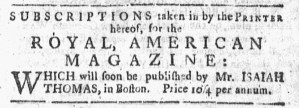
In October 1773, the subscription proposals appeared once again in the Connecticut Journal and the Pennsylvania Journal. The printer’s update addressed “To the Public” made additional appearances in the Boston-Gazette and the Massachusetts Spy. It also ran for the first time in the Essex Gazette, published in Salem, and had two more insertions during the month. Having published the subscription proposals in July and August, the Newport Mercury carried a unique advertisement, likely devised by Solomon Southwick, the printer and Thomas’s local agent for collecting the names of subscribers, rather than by Thomas himself. It announced, “SUBSCRIPTIONS taken in by the Printer hereof, FOR THE ROYAL AMERICAN MAGAZINE: WHICH will soon be published by Mr. ISAIAH THOMAS, in Boston. Price 10s4 per annum.”
Connecticut Journal (October 22, 1773).
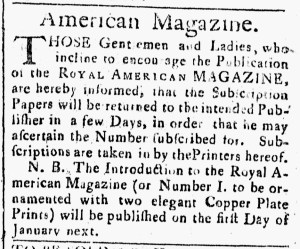
That advertisement expressed greater certainty about the prospects for the magazine than Thomas’s “To be, or not to be” notice that ran in Boston later in the month, as did another update that Thomas placed in newspapers in Connecticut, New Hampshire, and New York near the end of the month. That advertisement informed “Gentlemen and Ladies, who incline to encourage the Publication of the ROYAL AMERICAN MAGAZINE … that the Subscription Papers will be returned to the intended Publisher in a few Days, in order that he may ascertain the Number subscribed for.” Those who had not yet submitted their names to the local printing office had only a limited time to do so. As an enticement to those still contemplating whether they wished to subscribe, a nota bene promoted “two elegant Copper Plate Prints” that would accompany the first issue of the magazine. The nota bene also indicated a publication date, “the first Day of January next.” Along with the magazine, prospective subscribers did not have much time to qualify for these premiums. If they decided to subscribe at some time in the future, they would miss out on the gift given to those who supported the magazine even before the first issue went to press.
Thomas hoped to publish the Royal American Magazine, but first he needed to determine if a market existed to support it. His subscription proposals and other advertisements served a dual purpose: they incited demand for the magazine while also assessing interest and determining the total number of subscribers willing to pay for the publication. Some subscription proposals, no matter how widely they circulated, never resulted in publishing the proposed book, magazine, map, or other item. Over the course of several months, Thomas managed to identify and incite sufficient demand to publish the Royal American Magazine.
**********
Newspaper Advertisements for October 1773
Subscription Proposals
October 8 – Connecticut Journal (second known appearance; fourth possible appearance)
October 20 – Postscript to the Pennsylvania Journal (second appearance)
“To the PUBLIC” Update
October 4 – Boston-Gazette (third appearance)
October 7 – Massachusetts Spy (third appearance)
October 12 – Essex Gazette (first appearance)
October 14 – Massachusetts Spy (fourth appearance)
October 19 – Essex Gazette (second appearance)
October 21 – Massachusetts Spy (fifth appearance)
October 26 – Essex Gazette (third appearance)
“SUBSCRIPTIONS” Notice
October 4 – Newport Mercury (first appearance)
October 11 – Newport Mercury (second appearance)
October 18 – Newport Mercury (third appearance)
October 25 – Newport Mercury (fourth appearance)
“Subscription Papers will be returned” Update
October 22 – Connecticut Journal (first appearance)
October 22 – New-Hampshire Gazette (first appearance)
October 22 – New-London Gazette (first appearance)
October 28 – New-York Journal (first appearance)
October 29 – Connecticut Journal (second appearance)
“To be, or not to be” Update
October 25 – Boston-Gazette (first appearance)
October 25 – Massachusetts Gazette and Boston Post-Boy (first appearance)
What was advertised in a colonial American newspaper 250 years ago this week?
Massachusetts Gazette and Boston Post-Boy (September 20, 1773).
“The Royal American Magazine is likely in a short Time to make its Appearance.”
Throughout September 1773, Isaiah Thomas, printer of the Massachusetts Spy, continued marketing the Royal American Magazine. He hoped to attract enough subscribers to make the publication a viable venture. Although printers from New Hampshire to Georgia supplied colonizers with more than two dozen newspapers, including five printed in Boston, none of them published a magazine. Instead, printers, booksellers, and shopkeepers imported magazines from England. Realizing that he likely needed subscribers from beyond Massachusetts if he wished to take the magazine to press, Thomas advertised in several colonies.
In the first half of September, Thomas ran the proposals for the Royal American Magazine six more times, inserting them in four newspapers in two colonies. The proposals appeared for the first time in the Connecticut Journal, published in New Haven, on September 3 and in the Pennsylvania Journal, published in Philadelphia, on September 8. By the end of the month, they had their second and third insertions in the Connecticut Courant, published in Hartford, and the New-London Gazette. The proposals may have run again in the Connecticut Journal on September 17 and 24. Those issues are not available via America’s Historical Newspapers. While Thomas may have sent subscription papers in the form of broadsides, handbills, or pamphlets to local agents in other colonies, he did not arrange to have the proposals printed in newspapers south of Pennsylvania. The proposals did state that “the printers and booksellers in Americas” accepted subscriptions.
Starting on September 9, Thomas circulated an update, a much shorter notice that first appeared in the Massachusetts Spy and then in other newspapers published in Boston. This announcement, addressed “To the PUBLIC,” advised readers that the magazine “is likely in a short Time to make its Appearance” as a result of the “generous Encouragement of a great Number of Gentlemen in this Province.” Thomas requested that “those Gentlemen and Ladies, who incline to be Promoters of this useful Undertaking” submit their names “with all convenient Speed” because he planned to commenced publication “as soon as he hears what Numbers of Subscribers there are in the other Colonies.” Subscribers did not need to send any payment “until the delivery of the first Number.” Thomas published and distributed the first issue of the Royal American Magazine in January 1774.
The printer devised an extensive advertising campaign in preparation of launching the magazine, coordinating newspaper advertisements in several colonies and corresponding with printers and other local agents. Other printers pursued similar strategies when they set about new projects, using subscription proposals to incite demand. Those advertisements simultaneously served as market research, informing printers whether they should take a project to press and, if so, how many copies to produce.
**********
Subscription Proposals
September 3 – Connecticut Journal (first appearance)
September 3 – New-London Gazette (second appearance)
September 7 – Connecticut Courant (second appearance)
September 8 – Pennsylvania Journal (first appearance)
September 10 – New-London Gazette (third appearance)
September 14 – Connecticut Courant (third appearance)
September 17 – possible second appearance in Connecticut Journal
September 24 – possible third appearance in Connecticut Journal
“To the PUBLIC” Update
September 9 – Massachusetts Spy (first appearance)
September 13 – Boston Evening-Post (first appearance)
September 13 – Massachusetts Gazette and Boston Post-Boy (first appearance)
September 16 – Massachusetts Spy (second appearance)
September 20 – Boston-Gazette (first appearance)
September 20 – Massachusetts Gazette and Boston Post-Boy (second appearance)
September 27 – Supplement to the Boston-Gazette (second appearance)
September 27 – Massachusetts Gazette and Boston Post-Boy (third appearance)
What was advertised in a colonial American newspaper 250 years ago this week?
Massachusetts Spy (September 9, 1773).
“The Royal American MAGAZINE is likely in a short time to make its appearance.”
Isaiah Thomas, printer of the Massachusetts Spy, continued his efforts to solicit subscribers for a new endeavor, the Royal American Magazine, in the fall of 1773. Like many other projects proposed by printers, publishers, and booksellers, he would not take the magazine to press until his subscription proposals garnered sufficient interest to justify further investment. Thomas began with a brief announcement in his own newspaper on May 27, declaring that he would soon publish “PROPOSALS for printing by Subscription, The ROYAL American MAGAZINE.” On June 24, the proposals appeared in the Massachusetts Spy. Thomas may have also distributed the proposals as a separate broadside or handbill.
After inserting the proposals in his own newspaper, Thomas set about disseminating them to an even broader market by placing them in all of the newspapers printed in Boston as well as newspapers published in other colonies. In July, the proposals ran fourteen times, appearing in seven newspapers printed in Boston, Newport, New York, Philadelphia, and Providence. In August, the proposals appeared thirteen more times in eight newspapers. They ran for the first time in newspapers published in Hartford and New London. Along the way, Thomas, who had achieved a reputation for opposing the British government with the news and editorials in the Massachusetts Spy, issued a separate clarification that the Royal American Magazine “will never be GUIDED or INFLUENCED by any PARTY whatever,” despite allegations to the contrary. However, when Thomas began publishing the magazine in January 1774, it quickly became a vehicle for delivering propaganda that favored the patriot cause.
In September 1773, Thomas dispensed with running the lengthy proposals in the Massachusetts Spy in favor of a shorter notice that encouraged the public, presumably familiar with the project, to become “promoters of this useful undertaking” by “send[ing] in their names with all convenient speed.” He required “NO Money” until subscribers received the first issue, which he planned to publish “as soon as he hears what number of subscribers there are in the other colonies.” Thomas pledged that the magazine “is likely in a short time to make its appearance” thanks to “the generous encouragement of a great number of gentlemen in this province.” Through reporting that the magazine already had so many subscribers, Thomas leveraged existing demand in hopes of generating more demand among those who had not yet subscribed. To increase the likelihood that prospective subscribers would see and take note of this shorter advertisement, he gave it a privileged place immediately after the news in the September 9 edition of the Massachusetts Spy.
What was advertised in a colonial American newspaper 250 years ago today?
Connecticut Courant (August 24, 1773).
“PROPOSALS, For printing by SUBSCRIPTION, A NEW Periodical Production, entitled, The ROYAL American Magazine.”
Isaiah Thomas, the printer of the Massachusetts Spy, continued his efforts to garner subscribers for a new publication, the Royal American Magazine, in August 1773. He previously disseminated subscription proposals in his own newspaper, first on June 24 and then in four of the five issues published in July. By the end of that month, he inserted the extensive proposals in two other newspapers published in Boston (the Massachusetts Gazette and Boston Post-Boyand the Massachusetts Gazette and Boston Weekly News-Letter) as well as both newspapers published in Rhode Island (the Newport Mercury and the Providence Gazette) and one each in New York (the New-York Journal) and Philadelphia (the Pennsylvania Chronicle). In total, subscription proposals for the Royal American Magazine appeared fourteen times in seven newspapers in five towns in July.
In August, those proposals ran another thirteen times, as listed below. Thomas inserted them in his own newspaper three more times. He also concluded the cycle in three other newspapers. Most printers charged a set rate for an advertisement to run three times and then additional fees for each insertion after that. The proposals made their second and third appearances in both the Newport Mercury and the Pennsylvania Chronicle in August (and already made three appearances in the Massachusetts Gazette and Boston Post-Boy in July). According to the colophon for the New-York Journal, advertisements ran four times before the printer assessed additional fees. The proposals made their third and fourth appearances in the New-York Journal in August 1773. They also ran for the first time in the Boston Evening-Post and the Boston-Gazette. That meant that all of the newspapers published in Boston carried the proposals at least once, reaching readers in that city and beyond who did not regularly read the Massachusetts Spy. Thomas may have struck a deal with his fellow printers in town since three of those newspapers printed the proposals only once. Thomas also added another newspaper to the roster of those that disseminated the subscription proposals. The Connecticut Courant, published in Hartford, carried them on August 24, the first time for a newspaper in that colony. The proposals filled nearly two columns (out of twelve) in that issue. Three days later, the proposals ran in the New-London Gazette.
Thomas realized that to successfully attract enough subscribers to make the only magazine published in America at the time a viable venture, he needed to market the proposed publication widely. That meant saturating the market in Boston as well as establishing a network that included towns in other colonies. Advertisements in newspapers published in New York, Philadelphia, Providence, New London, Newport, and Hartford reached even wider audiences than the Massachusetts Spy and its counterparts in Boston. Thomas engaged “the printers and booksellers in America,” near and far, to act as local agents who collected subscriptions for the Royal American Magazine on his behalf.
August 2 – Boston-Gazette (first appearance)
August 2 – Newport Mercury (second appearance)
August 2 – Pennsylvania Chronicle (second appearance)
August 5 – Massachusetts Spy (sixth appearance)
August 5 – New-York Journal (third appearance)
August 9 – Newport Mercury (third appearance)
August 9 – Pennsylvania Chronicle (third appearance)
August 12 – Massachusetts Spy (seventh appearance)
August 12 – New-York Journal (fourth appearance)
August 16 – Boston Evening-Post (first appearance)
August 19 – Massachusetts Spy (eighth appearance)
August 24 – Connecticut Courant (first appearance)
What was advertised in a colonial American newspaper 250 years ago today?
Providence Gazette (July 31, 1773).
“SUBSCRIPTIONS for the Royal American Magazine are taken in by the Printer hereof.”
Although it took longer for Isaiah Thomas to publish the subscription proposals for the Royal American Magazine than he first anticipated, once they appeared in his newspaper, the Massachusetts Spy, on June 24, 1773, he set about building an advertising campaign to attract subscribers from Boston and beyond. In the month of July, the subscription proposals appeared in newspapers fourteen times. In the initial insertion, Thomas declared that he accepted subscriptions, as did “many gentlemen in the country whose name will short be published” and “the printers and booksellers in AMERICA.” He had plans to create an extensive network.
By the end of July, the subscription proposals ran in the Massachusetts Spy four more times (July 1, 8, 15, and 29) and in six other newspapers. They first appeared in another newspaper published in Boston and then in newspapers in four other cities.
July 12 – Massachusetts Gazette and Boston Bost-Boy
July 19 – Massachusetts Gazette and Boston Post-Boy
July 22 – New-York Journal
July 24 – Providence Gazette
July 26 – Massachusetts Gazette and Boston Post-Boy
July 26 – Newport Mercury
July 26 – Pennsylvania Chronicle
July 29 – Massachusetts Gazette and Boston Weekly News-Letter
July 29 – New-York Journal
July 31 – Providence Gazette
Booksellers throughout the colonies imported magazines from England, but no other colonial printers published magazines. Thomas intended that the Royal American Magazine would serve all of the colonies rather than one city or region. He also realized that he needed to enlist subscribers from beyond Boston and the surrounding towns if he wanted to make the magazine a viable venture. Printers had attempted about a dozen magazines in the colonies over the past thirty years, but most of them folded within a year. None lasted longer than three years. Thomas marketed a monthly publication of “essays, instructive and entertaining to all classes of men,” that “men of the greatest abilities in the literary world” would collect and preserve in their libraries, unlike newspapers “only noticed for a day, and then thrown neglected by.” At ten shillings and four pence, the Royal American Magazine cost more than a subscription to the Massachusetts Spy, at six shillings and eight pence, for only twelve issues rather than fifty-two weekly issues throughout the year. Even if the contents appealed “to all classes of men,” only certain colonizers could afford to subscribe. That meant that Thomas needed to widen his marketing efforts far beyond Boston. Inserting the subscription proposals in newspapers published in New York and Philadelphia, two of the largest cities in the colonies, as well as Newport and Providence, two more busy ports, helped the printer reach the sorts of genteel and affluent colonizers likely to have an interest in supporting an American magazine that catered to them as an alternative to imported English publications.