What was advertised in a colonial American newspaper 250 years ago today?
Essex Journal (August 17, 1774).
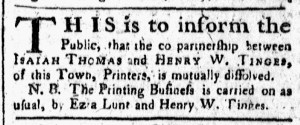
“The co partnership between ISAIAH THOMAS and HENRY W. TINGES, of this Town, Printers, is mutually dissolved.”
When the Essex Journal commenced publication on December 4, 1773, Henry-Walter Tinges printed it in partnership with Isaiah Thomas. Tinges managed the printing office in Newburyport, while Thomas continued printing the Massachusetts Spy in Boston. Less than a year passed before their partnership ended. On August 17, 1774, “No. 35” of the Essex Journal carried a notice “to inform the Public, that the co partnership between ISAIAH THOMAS and HENRY W. TINGES, of this Town, Printers, is mutually dissolved.” A nota bene further explained, “The Printing Business is carried on as usual, by Ezra Lunt and Henry W. Tinges.” The young printer had a new partner. He also updated the colophon on the final page to reflect this change.
Many decades later, Thomas provided a brief account of his partnership with Tinges in The History of Printing in America (1810). Thomas recollected that he “opened a printing house” in Newburyport “[a]t the request of several gentlemen,” taking Tinges as a partner “who had the principal management of the concerns at Newburyport.”[1] The young man had previously “served part of his apprenticeship with [John] Fleming,” one of the Tory printers of the Boston Chronicle, “and the residue with Thomas.”[2] Although the newspaper’s colophon stated that the new printing office in Newburyport accepted job printing orders that would be completed “in a neat manner, on the most reasonable Terms, with the greatest Care and Dispatch,” Tinges devoted most of his time to printing the Essex Journal. Thomas did not specify why the partnership was “mutually dissolved,” though he may have been frustrated that the printing office did not attract more business or distracted with the responsibilities of running his busy shop in Boston at the same time that the closure of the harbor mandated by the Boston Port Act introduced all sorts of challenges. Whatever the reason, Thomas “sold the printing materials to Ezra Lunt, the proprietor of a stage, who was unacquainted with printing; but he took Tinges as a partner.”[3] Tinges contributed his experience and knowledge of the printing trade, while Lunt provided the capital for the necessary equipment. Even though Tinges performed the bulk of the labor in the printing office, his name appeared second in the colophon during his partnership with Thomas and again during his partnership with Lunt. Although he may have taken direction from his partners on occasion, Tinges collated the news, engaged with subscribers, advertisers, and other customers, and disseminated additional information in response to “enquire of the printer” advertisements in the Essex Journal.
Essex Journal (August 17, 1774).
**********
[1] Isaiah Thomas, The History of Printing in America: With a Biography of Printers and an Account of Newspapers (1810; New York; Weathervane Books, 1970), 179.
What was marketed in a colonial American newspaper 250 years ago this month?
Massachusetts Spy (July 21, 1774).
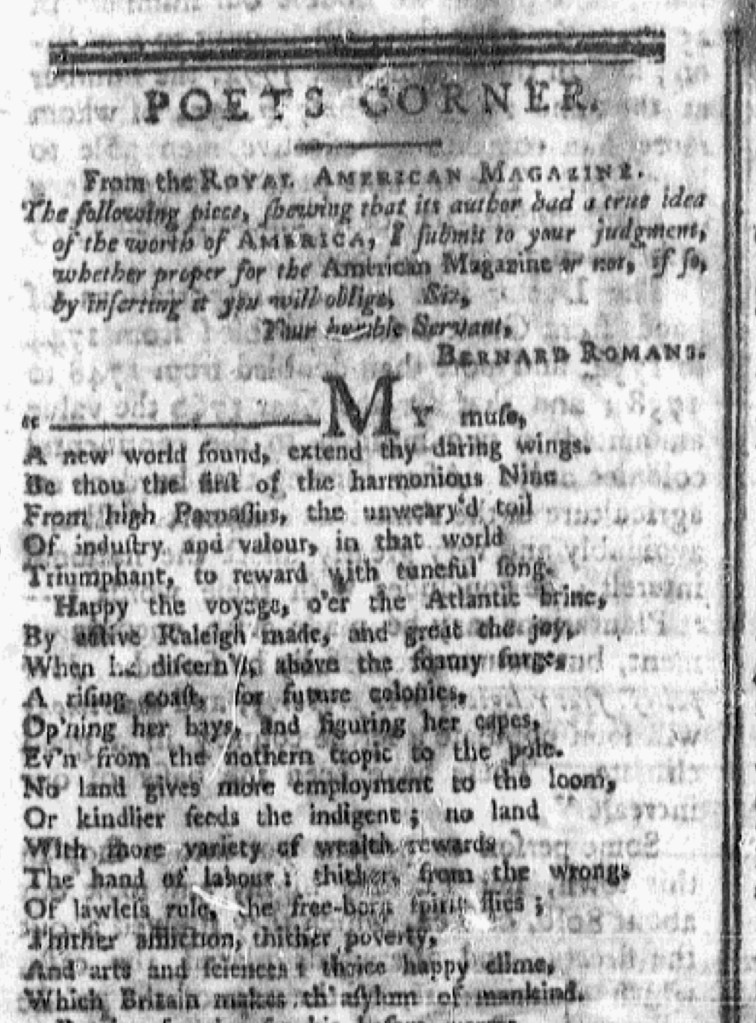
“From the ROYAL AMERICAN MAGAZINE.”
Isaiah Thomas did not publish any newspaper advertisements for the Royal American Magazine in July 1774. When he first proposed the magazine and sought subscribers, he ran advertisements in newspapers from New Hampshire to Maryland, sometimes dozens of them a month, yet once he published and distributed the first issue the extensive advertising campaign tapered off and, eventually, went on hiatus. The Adverts 250 Project has tracked Thomas’s efforts to promote the Royal American Magazine from the first time he announced his intention to circulate subscription proposals in May 1773 through the advertisements in newspapers in June, July, August, September, October, November, and December 1773 and January, February, March, April,May, and June 1774.
In the eighteenth century, publishers typically distributed new issues at the end of the month, unlike today’s practice of circulating magazines in advance of the publication date. Readers considered the January 1774 issue, for instance, an overview of that month, expecting to receive it just as February arrived. Even by those standards, Thomas was perpetually behind in delivering the Royal American Magazine to subscribers. He published the January issue on February 7 following a delay in receiving new types ordered for the magazine. The May 1774 issue did not appear until June 17.
Newspaper advertisements do not reveal when the June 1774 issue became available to readers. Thomas did not place any advertisements for the Royal American Magazine in July 1774, not even in his own newspaper, the Massachusetts Spy. As Frank Luther Mott documents, Thomas did announce in the June issue that “he was under the necessity of suspending the publication of his magazine ‘for a few Months, until the Affairs of this Country are a little better settled.’”[1] He lamented “the Distresses of the Town of Boston, by the shutting up of our Port, and throwing all Ranks of Men into confusion.”[2] The Boston Port Act, one of the repercussions Parliament instituted following the Boston Tea Party, took its toll on the Royal American Magazine. The magazine resumed publication in September, though by then Joseph Greenleaf was at the helm.
Although Thomas did not advertise the Royal American Magazine in July 1774, it did not go unreferenced in the public prints. The “POETS CORNER,” a regular feature on the final pages of many colonial newspapers, in the July 21 edition of the Massachusetts Spy featured a poem by Bernard Romans “From the ROYAL AMERICAN MAGAZINE.” It filled nearly an entire column. On occasion, Thomas inserted excerpts from the magazine in the Massachusetts Spy or the Essex Journal, the newspaper that his junior partner, Henry-Walter Tinges, published in Salem. That gave readers who had not yet subscribed a glimpse of the magazine’s content. For previous issues, Thomas had also attempted to incited interest by including an extensive table of contents in his advertisements along with descriptions of the engravings that accompanied each issue. Yet the lack of advertising for the June 1774 issue meant that he did not promote the frontispiece, “The Able Doctor, or America Swallowing the Bitter Draught.” That political cartoon condemning the Boston Port Act, engraved by Paul Revere, fit with the politics of the magazine. It remains one of the most significant images advocating the patriot cause produced in the colonies during the imperial crisis. As savvy as Thomas was about publishing propaganda, he missed an opportunity to call attention to such a powerful image.
**********
[1] Frank Luther Mott, A History of American Magazines, 1741-1850 (Cambridge: Harvard University Press, 1939), 85.
[2] Quoted in Mott, History of American Magazines, 85.
What was advertised in a colonial American newspaper 250 years ago this month?
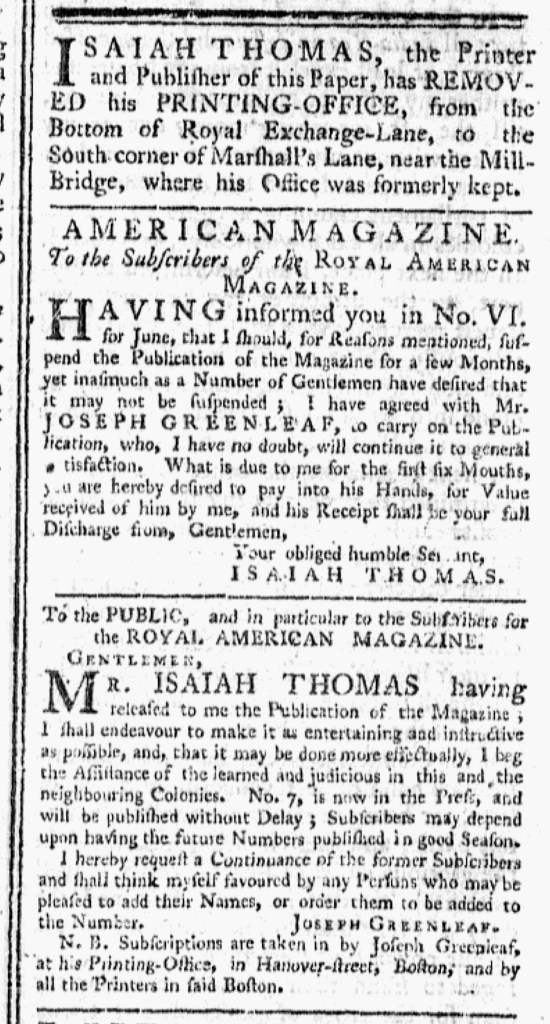
Massachusetts Spy (June 23, 1774).
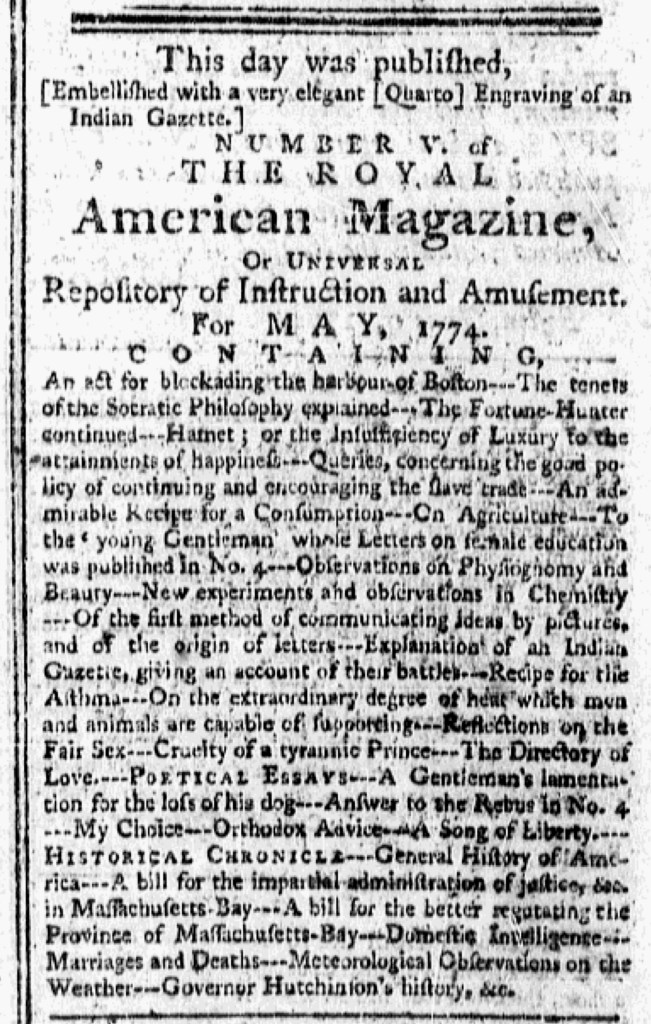
“NUMBER V. of THE ROYAL American Magazine.”
Isaiah Thomas significantly scaled down advertising for the Royal American Magazine in June 1774 compared to previous months. The Adverts 250 Project has chronicled the printer’s marketing efforts from the first time he announced his intention to publish a magazine, the only one in America at the time, in May 1773 through the advertisements that appeared in newspapers from New England to Maryland in June, July, August, September, October, November, and December 1773 and January, February, March, April, and May 1774.
Thomas did not publish the May 1773 issue of the Royal American Magazine until well into June. That accounts for some of the lack of advertising. His first notice for the month ran in the June 16 edition of his own newspaper, the Massachusetts Spy. In a brief update, he informed the public that “TO-MORROW will be published, No. V. of the ROYAL AMERICAN MAGAZINE,” but he did not mention any reason for the delay. Six days later, the Essex Journal carried a notice that “Friday last was published in Boston, NUMBER V. of THE Royal AMERICAN MAGAZINE OR UNIVERSAL Repository of Instruction and Amusement.” It was “Printed and sold by I. THOMAS, in Boston; sold also at the Printing-Office in Newbury-Port.” Henry-Walter Tinges operated that printing office, where he published the Essex Journal in partnership with Thomas. As Tinges had done in connection with the first issue of the magazine, he previewed some of the contents in the Essex Journal. For the weekly selection in the “Poets Corner” on the final page, he reprinted “FEMALE ADVICE,” a poem “From the ROYAL AMERICAN MAGAZINE.”
The most extensive advertisement for the magazine first appeared in the June 23 edition of the Massachusetts Spy. It resembled advertisements from previous months, announcing publication of the latest issue, promoting the copperplate engraving that “Embellished” the magazine, and listing the contents, starting with “An act for blockading the harbour of Boston” that had attracted so much attention in that city and throughout the colonies. That advertisement ran a second time in the Massachusetts Spy a week later. That Thomas did not publish and distribute the May 1774 issue of the Royal American Magazine until June 17 offers a cautionary tale about using dates on eighteenth-century magazines to assess when readers gained access to the information contained in them. In contrast to modern magazines distributed in advance of the dates on their covers, early American magazines were typically published at the end of the month. The May issue, for instance, would come out during the final days of May … yet in this instance the May issue of the Royal American Magazine did not appear until the middle of June.
In total, only four newspaper advertisements promoted the Royal American Magazine in June 1774, all of them in newspapers published by Thomas. Unlike previous months, he did not insert announcements in any of the other newspapers printed in Boston. In addition, he did not publish other sorts of notices related to the magazine, such as calls for contributors to make submissions. The unfolding political situation in combination with his efforts to continue publishing the Massachusetts Spy may have occupied more of his time than in previous months, making it less of a priority to advertise the magazine.
**********
“TO-MORROW will be published, No. V”
June 16 – Massachusetts Spy (first appearance)
“Friday last was published in Boston, NUMBER V”
June 22 – Essex Journal (first appearance)
“This day was published … NUMBER V” (with contents)
What was advertised in a colonial American newspaper 250 years ago today?
Massachusetts Spy (June 9, 1774).
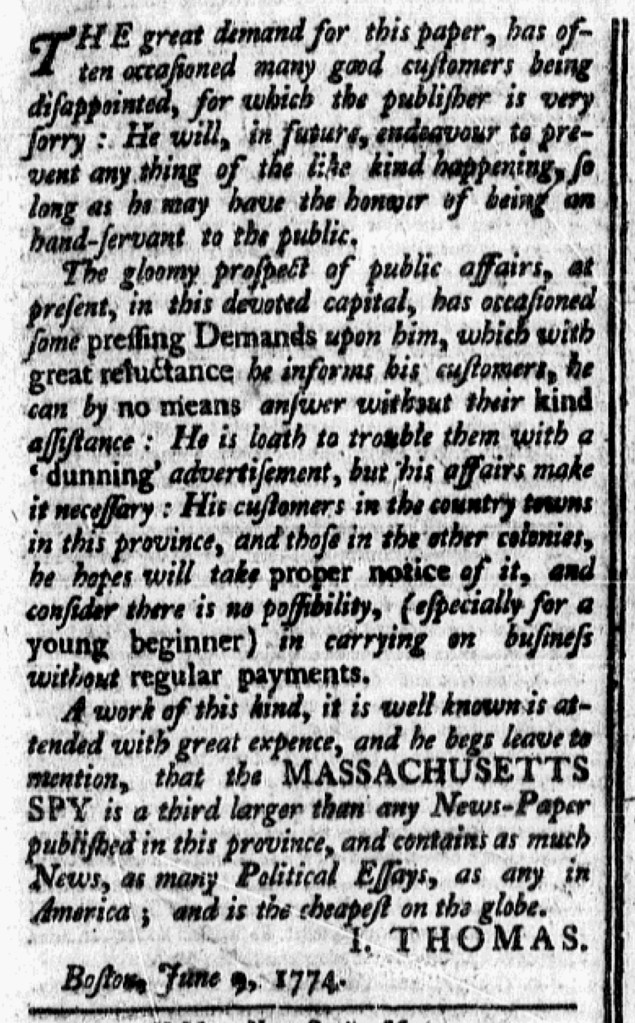
“Contains as much news, as many Political Essays, as any in America.”
Printers and other entrepreneurs often published notices calling on customers and associates to settle accounts. Isaiah Thomas, the printer of the Massachusetts Spy, did so in June 1774, though he confessed that he “is loath to trouble them with a ‘dunning’ advertisement.” Still, “his affairs make it necessary.” Many printers threatened legal action against those who did not submit payment, but Thomas opted for a different strategy. His “‘dunning’ advertisement” focused primarily on the service to the public he provided in publishing the Massachusetts Spy, especially considering the “gloomy prospect of public affairs, at present.” Readers knew, of course, that he referred to the Boston Port Act that initiated a blockade of the harbor and halted trade at the beginning of the month as well as a series of troubling events over the past decade.
Zechariah Fowle and Thomas commended publishing the Massachusetts Spy in July 1770, four months after the Boston Massacre. At the age of twenty-one, Thomas became the sole proprietor just a few months later. In the four years that the newspaper had been published, the young printer sought to establish its reputation in Boston and beyond. When he asked subscribers to pay what they owed, he underscored that “the MASSACHUSETTS SPY is a third larger than any News-Paper published in this province.” That distinguished it from the Boston Evening-Post, the Boston-Gazette, the Massachusetts Gazette and Boston Post-Boy, and the Massachusetts Gazette and Boston Weekly News-Letter as well as the Essex Gazette, published in Salem, and the Essex Journal, published in Newburyport. At the time, no other city or colony had as many newspapers, which meant that Thomas faced significant competition for subscribers and advertisers. Furthermore, Thomas’s newspaper “contains as much News, [and] as many Political Essays, as any in America,” making it a valuable resource for readers far and wide. Thomas also asserted that the Massachusetts Spy “is the cheapest on the globe,” making it a good value that merited support (and payment) from readers.
In return for “the honour of being an hand-servant to the public,” Thomas requested the “kind assistance” of his customers. He asked that they “take proper notice” of his appeal, warning that “there is no possibility … in carrying on business without regular payments.” The June 9 edition of his newspaper featured extensive coverage of the “PROCEEDINGS in the HOUSE of COMMONS” from April, including an “Authentic account of Tuesday’s Debate on the Motion for repealing the Tea-Duty in America,” and editorials “To the FREE and BRAVE AMERICANS” from “AN AMERICAN” and “To the ADRESSERS of the late Governor HUTCHINSON” from “A MODERATE MAN.” Thomas compiled and circulated such news and opinion as a service, but could not afford to continue that endeavor without receiving subscription fees from his customers. Rather than an explicit threat to take them to court to force them to pay what they owed, Thomas made a much more subtle insinuation about what they would lose if they did not settle accounts. By his accounting, no other newspaper compared to the Massachusetts Spy.
What was advertised in a colonial American newspaper 250 years ago this month?
Massachusetts Spy (May 26, 1774).
“NUMBER IV. of THE ROYAL American Magazine … For APRIL, 1774.”
A year after he first announced plans to distribute subscription proposals for the Royal American Magazine, Isaiah Thomas continued advertising the only magazine published in the colonies at the time. It took more than half a year to engage enough subscribers to make the venture viable. Thomas intended to publish the first issue in January 1774, but the types did not arrive in time, so the inaugural edition came out in early February (though still bearing January as its date). Once the magazine began circulating among subscribers and other readers, Thomas promoted it in the public prints, especially his own Massachusetts Spy, though not in as many newspapers as carried the subscription proposals. The Adverts 250 Project has tracked advertisements for the Royal American Magazine that appeared in June, July, August, September, October, November, and December 1773 and January, February, March, and April 1774. This entry provides an overview of Thomas’s marketing campaign in May 1774.
Two advertisements ran simultaneously in the Massachusetts Spy on May 5. In one, Thomas announced that “Tuesday next will be published, No, IV of the Royal American Magazine … For APRIL, 1774.” Publication continued to lag behind the date of the publication, but magazines followed a different schedule in the eighteenth century compared to today. Modern magazines often circulate with dates that have not yet arrived, while eighteenth-century publishers tended to distribute a magazine for a particular month at the end of that month. Such magazines featured content compiled during that month, not material intended to be read that month. In the other advertisement in that issue of the Massachusetts Spy, Thomas called on “THOSE Gentlemen who are inclined to favour the Royal American Magazine, for MAY, with their Productions … to send them with all convenient Speed, to the Publisher.” Thomas worked throughout May to gather the contents for that month’s issue of the magazine. That notice appeared each week. In contrast, he did not run announcements about the impending publication of the April edition in any newspapers except the Massachusetts Spy.
On May 12, Thomas announced publication of “NUMBER IV. of THE ROYAL American Magazine … For APRIL, 1774” in the Massachusetts Spy. Similar to advertisements for previous editions, this one included a list of the contents to entice prospective subscribers as well as a header that highlighted the “elegant Engravings” that accompanied the magazine. For April, those illustrations included “The Bust of Mr. Samuel Adams,” an influential leader in the dispute with Parliament over taxing tea and blockading the harbor as punishment for the Boston Tea Party, and “The Hill-Tops: A new Hunting Song, set to Music, with a Representation of the Death of the Stag.” Paul Revere engraved the portrait of Adams, but Thomas did not consider that notable enough to mention in the advertisement. The publisher inserted this notice in the Massachusetts Spy for three consecutive weeks. It also appeared once in the Boston Evening-Post on May 16.
The Boston-Gazette and the Essex Journal each ran an abbreviated version of that advertisement on two occasions. That variation included only the header about the engravings and the announcement that the magazine “was Published,” but not the list of contents. Henry-Walter Tinges printed the Essex Journal in Salem in partnership with Thomas, helping to explain the multiple insertions in that newspaper. The second time that the advertisement appeared in the Boston-Gazette, it was on the final page of a supplement. Thomas may have arranged for a second insertion in that newspaper, but the printers might have opted to fill remaining space in the supplement with type already set for advertisements that ran in previous issues. Thomas did not arrange to have an advertisement in the Massachusetts Gazette and Boston Post-Boy nor the Massachusetts Gazette and Boston Weekly News-Letter. His advertising efforts in even Boston’s newspapers contracted in May 1774, down to only three of the five newspapers published there.
Only one advertisement for the Royal American Magazine ran in a newspaper published beyond Boston in May 1774. On May 20, a notice announced the publication of the April issue, but did not include the header about the engravings or the list of contents. It did advise “Subscribers in Portsmouth, York, Berwick, New-Castle, Dover, Windham, and Kittery … to apply to Mr. Isaac Williams of Portsmouth for their Books.” Apparently local agents in other towns and colonies distributed the new issue of the magazine without resorting to newspaper advertisements.
Overall, five distinct advertisements for the Royal American Magazine appeared a total of fourteen times in American newspapers in May 1774, including eight insertions of three of those advertisements in Thomas’s own Massachusetts Spy and two more insertions of one of the other notices in the Essex Journal, the newspaper operated by Tinges in partnership in Boston. Thomas continued to actively promote the magazine in his own newspapers, but advertising in other publications did not range as far and wide as in previous months, especially the period for attracting subscribers before taking the first issue of the magazine to press.
**********
“Tuesday next will be published”
May 5 – Massachusetts Spy (first insertion)
“with their Productions”
May 5 – Massachusetts Spy (first insertion)
May 12 – Massachusetts Spy (second insertion)
May 19 – Massachusetts Spy (third insertion)
May 26 – Massachusetts Spy (fourth insertion)
“This Day was published … NUMBER IV” (variation with contents and header)
May 12 – Massachusetts Spy (first insertion)
May 16 – Boston Evening-Post (first insertion)
May 19 – Massachusetts Spy (second insertion)
May 26 – Massachusetts Spy (third insertion)
“This Day Published … NUMBER IV” (variation with header and without contents)
May 16 – Boston-Gazette (first insertion)
May 18 – Supplement to the Essex Journal (first insertion)
May 25 – Essex Journal (second insertion)
May 30 – Supplement to the Boston-Gazette (second insertion)
What was advertised in a colonial American newspaper 250 years ago today?
Massachusetts Spy (April 28, 1774).
“He will carry this and other papers, and the Royal American MAGAZINE.”
Following the successful launch of the Royal American Magazine a few months earlier, Isaiah Thomas continued advertising the new publication in April 1774. His marketing efforts that month, however, were not as robust as in previous months. Only twelve advertisements appeared in April, with seven of them in Thomas’s own Massachusetts Spy. The Adverts 250 Project has examined his advertising campaign, starting with an announcement, published in May 1773, that he planned to distribute subscription proposals and then the subsequent advertisements, appearing in newspapers from New Hampshire to Maryland, in June, July, August, September, October, November, and December 1773 and January, February, and March 1774.
The first advertisement for the month ran in the April 4 edition of the Massachusetts Gazette and Boston Post-Boy, the only newspaper (other than the Massachusetts Spy) that carried more than one notice about the Royal American Magazine in April. It advised that “Monday next will be published, NUMBER II. of THE ROYAL American Magazine, For MARCH, 1774.” The compositor made an error with “NUMBER II” instead of “NUMBER III.” That advertisement gave a week’s notice of publication of the March issue. Thomas had fallen behind on the intended publications dates as a result of new types for the magazine not arriving when expected. He published the January issue in early February and the February issue in early March. Accordingly, the March issue came out in April. On April 7, Thomas ran the same advertisement (correctly specifying “NUMBER III”) in the Massachusetts Spy.
On the same day, his newspaper also ran Moses Cleveland’s notice about establishing a “post to ride weekly between NORWICH and BOSTON,” carrying the Norwich Gazette, the Massachusetts Spy, other newspapers, and the Royal American Gazette. Cleveland’s original advertisement in the Norwich Gazette and subsequent advertisement in the Massachusetts Gazette and Boston Post-Boy did not mention the Royal American Gazette, suggesting that Thomas adapted the post rider’s notice for his own purposes. He seized an opportunity to promote the magazine to prospective subscribers who lived in towns in Massachusetts and Connecticut along the proposed route. Cleveland’s advertisement ran in all four issues of the Massachusetts Spy published in April, accounting for one-third of the advertisements that month.
On April 15, the Connecticut Gazette carried a brief notice that “The Ist. And IId. Numbers Of the ROYAL AMERICAN MAGAZINE, are ready to be delivered to those who subscribed for them with T. GREEN,” the printer of that newspaper and local agent for the magazine. That was the only advertisement for the Royal American Magazinepublished in a newspaper beyond Boston in April. Timothy Green likely placed it of his own volition, rather than acting on instructions from Thomas, upon receiving copies of the magazine he was responsible for distributing to subscribers in and near his town.
Massachusetts Spy (April 15, 1774).
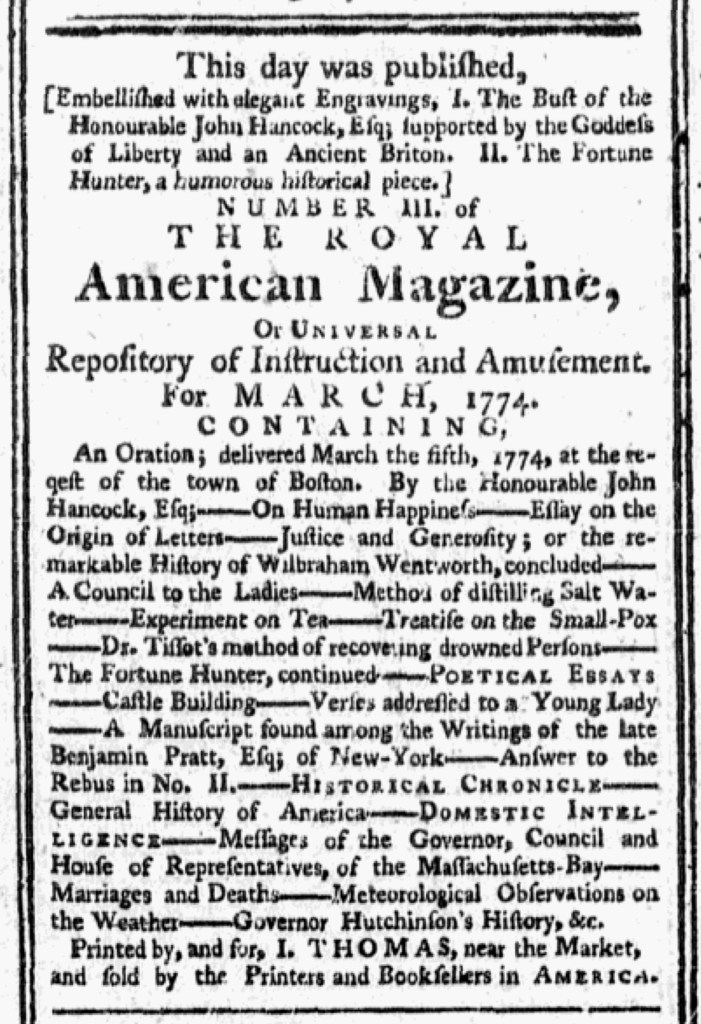
Also on April 15, Thomas announced that “NUMBER III” of the magazine “was published.” As he had done with previous issues, he listed the contents to entice readers, including essays on “Justice and Generosity” and an “Experiment on Tea,” “POETICAL ESSAYS,” a new entry for an ongoing “HISTORICAL CHRONICLE,” and “DOMESTIC INTELLIGENCE.” The March issue was “Embellished” with two copperplate engravings, one of a “Bust of the Honourable John Hancock, Esq; supported by the Goddess of Liberty and an Ancient Briton” and the other depicting “The Fortune Hunter, a humorous historical piece.” Thomas ran this advertisement once more in the Massachusetts Spy on April 22. In the time between its appearances in that newspaper, he inserted it once in the Boston Evening-Post (on April 18), the Massachusetts Gazette and Boston Post-Boy (on April 18), and the Massachusetts Gazette and Boston Weekly Newsletter (on April 21). Of the newspapers published in Boston at the time, only the Boston-Gazette, printed by Benjamin Edes and John Gill, did not carry this advertisement. Perhaps the printers objected to the inclusion of the first item in the list of contents, “An Oration; delivered March the fifth, 1774, at the reqest of the town of Boston. By the Honourable John Hancock, Esq.” Edes and Gill printed and marketed a pamphlet containing Hancock’s address commemorating the fourth anniversary of the Boston Massacre. They may not have appreciated the competition from Thomas distributing the oration via other means.
Thomas may not have considered it necessary to advertise as aggressively following the launch of the Royal American Magazine as he had in the months that he encouraged subscribers to show their support for the venture. With the assistance of local agents in many cities and towns, he may have garnered a sufficient number of subscribers that allowed him to shift his focus to producing the magazine and other responsibilities in his printing office. He continued running Moses Cleveland’s advertisement, which he first adapted in March, but did not oversee extensive announcements about the publication of the newest issue of the magazine. Maybe he learned from similar campaigns for the first and second issues that such advertisements did not attract enough new subscribers to justify the investment. The April 15 and 22 editions of the Massachusetts Spy appeared on Fridays instead of Thursdays, a day later than usual, suggesting that the printer was preoccupied with matters other than marketing the Royal American Magazine.
**********
“will be published … NUMBER III”
April 4 – Massachusetts Gazette and Boston Post-Boy (first appearance)
April 7 – Massachusetts Spy (first appearance)

“MOSES CLEVELAND”
April 7 – Massachusetts Spy (second appearance)
April 15 – Massachusetts Spy (third appearance)
April 22 – Massachusetts Spy (fourth appearance)
April 28 – Massachusetts Spy (fifth appearance)
“Ist. And IId. Numbers”
April 15 – Connecticut Gazette (first appearance)
“NUMBER III” with contents
April 15 – Massachusetts Spy (first appearance)
April 18 – Boston Evening-Post (first appearance)
April 18 – Massachusetts Gazette and Boston Post-Boy (first appearance)
April 21 – Massachusetts Gazette and Boston Weekly News-Letter (first appearance)
What was advertised in a colonial American newspaper 250 years ago this week?
Massachusetts Spy (March 24, 1774).
“Numb. III. is now in the press.”
Isaiah Thomas continued marketing the new Royal American Magazine in March 1774. The Adverts 250 Project has traced his efforts to promote and launch the magazine in 1773 and 1774, starting with his initial announcement, published in May 1773, that he intended to circulate subscription proposals and his advertising campaign undertaken from New Hampshire to Maryland in throughout June, July, August, September, October, November, and December 1773 and January and February 1774 . Newspaper announcements beyond Massachusetts tapered off once Thomas took the first issue to press.
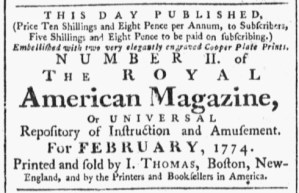
March 1774 opened with the third and final insertion of an advertisement that Thomas had “Lately PUBLISHED … NUMBER I” of the magazine in the Essex Journal, the newspaper that his partner, Henry-Walter Tinges, printed in Newburyport. On Thursday, March 3, Thomas placed a new notice in the newspaper he printed in Boston, the Massachusetts Spy, alerting the public that “Monday next will be published, NUMBER II. of THE ROYAL American Magazine … For FEBRUARY, 1774.” He remained behind schedule following the late arrival of new types for the magazine, but he did indeed release the second issue of the magazine the following Monday. An advertisement in the Massachusetts Gazette and Boston Post-Boy on March 7 proclaimed, “THIS DAY PUBLISHED … NUMBER II. of THE ROYAL American Magazine.” It asserted that “the Printers and Booksellers in America” sold the magazine, though few advertised it in March 1774. The Massachusetts Gazette and Boston Post-Boy carried that advertisement for three consecutive weeks, the only newspaper printed in Boston (with the exception of Thomas’s own Massachusetts Spy) to run more than one notice about the Royal American Magazine in March 1774.
Beyond Boston and beyond Massachusetts, the Newport Mercury featured an advertisement about the first issue of the magazine on the same day that the Massachusetts Gazette and Boston Post-Boy ran Thomas’s notice that the second issue was published. “THE first number of the ROYAL AMERICAN MAGAZINE is come to hand,” it stated, also providing instructions that “all those persons who subscribed with the printer hereof for it, and have not had theirs, are desired to send for the same.” That advertisement ran for two weeks. A few days later, on March 11, the New-Hampshire Gazette circulated an advertisement about the magazine “FOR JANUARY AND FEBRUARY 1774,” informing subscribers in Portsmouth, York, Berwick, New Castle, Dover, Windham, and Kittery to apply to Isaac Williams in Portsmouth for their copies. That notice also ran for two weeks.
The remaining advertisements for the Royal American Magazine published in March 1774 all ran in newspapers printed in Boston. On March 10, Thomas inserted his own “This day published” notice in the Massachusetts Spy, supplementing the copy with a list of the contents and a note that the second edition was “Embellished with elegant engravings of Sir Wilbraham Wentworth; and a Night Scene.” He inserted the same advertisement once again on March 24 and may have done so on March 17 (a missing page in the digitized edition causing the confusion). The Boston Evening-Post carried the same advertisement on March 14, while the Massachusetts Gazette and Boston Weekly News-Letter carried it on March 17. It appeared in both newspapers only once, compared to two insertions of a similar advertisement about the first issue of the magazine in each newspaper the previous month. The Boston-Gazette did not carry any notices about the Royal American Magazine in March 1774. Perhaps Thomas did not consider it imperative to advertise as aggressively once the magazine began circulating in Boston.
Thomas took to the pages of the Massachusetts Spy once again on March 17, that time with a brief notice that “Numb. III. is now in the press.” He called on “Those Gentlemen who have original pieces, useful extracts, &c. prepared for said number” to submit them for publication. That notice ran once again the following week. At the end of the month, on March 31, Thomas revised Moses Cleveland’s advertisement to indicate that the post rider carried the Royal American Magazine as well as newspapers printed in Boston on his route between that city and Norwich, Connecticut. It was a clever means of gaining more exposure for the magazine and encouraging more subscriptions, a return, however brief, to the more expansive advertising campaign and marketing strategies that Thomas had adopted in previous months.
**********
“NUMBER I” (“Lately PUBLISHED” variant)
March 2 – Essex Journal (third appearance)
“will be published, NUMBER II”
March 3 – Massachusetts Spy (first appearance)
“THIS DAY PUBLISHED … NUMBER II”
March 7 – Massachusetts Gazette and Boston Post-Boy (first appearance)
March 14 – Massachusetts Gazette and Boston Post-Boy (second appearance)
March 21 – Massachusetts Gazette and Boston Post-Boy (third appearance)
“first number … come to hand”
March 7 – Newport Mercury (first appearance)
March 14 – Newport Mercury (first appearance)
“This day published … NUMBER II” with contents
March 10 – Massachusetts Spy (first appearance)
March 14 – Boston Evening-Post (first appearance)
March 17 – Massachusetts Gazette and Boston Weekly News-Letter (first appearance)
March 10 – Massachusetts Spy (possible second appearance)
March 10 – Massachusetts Spy (second known appearance; possible third appearance)
“FOR JANUARY AND FEBRUARY 1774”
March 11 – New-Hampshire Gazette (first appearance)
March 18 – New-Hampshire Gazette (second appearance)
What was advertised in a colonial American newspaper 250 years ago today?
Massachusetts Gazette and Boston Post-Boy (March 7, 1774).
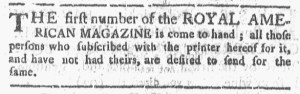
“THE first number of the ROYAL AMERICAN MAGAZINE is come to hand.”
It took time to distribute copies of Isaiah Thomas’s new Royal American Magazine to subscribers beyond Boston. For months, the industrious printer advertised the project in newspapers from New Hampshire to Maryland, calling on prospective subscribers to add their names to the roster and prospective contributors to forward their “LUCUBRATIONS” to include among its contents. Misfortune delayed publication of the first issue. Thomas finally announced that the January 1774 issue was available on February 7. It was not the inaugural issue alone that fell behind schedule. A month later, Thomas informed subscribers that “NUMBER II. Of THE ROYAL American Magazine” was “THIS DAY PUBLISHED” and sold at his printing office and “by the Printers and Booksellers in America.”
Newport Mercury (March 7, 1774).
The same day that notice ran in the Massachusetts Gazette and Boston Post-Boy, the Newport Mercury carried a short advertisement about the previous issue: “THE first number of the ROYAL AMERICAN MAGAZINE is come to hand; all those persons who subscribed with the printer hereof for it, and have not had theirs, are desired to send for the same.” It was the first time that an advertisement for the magazine appeared in a newspaper outside of Massachusetts since Thomas took the Royal American Magazine to press. He advertised widely in Boston’s newspapers and the Essex Journal, a newspaper he operated in partnership with Henry-Walter Tinges in Newburyport, but not elsewhere. Solomon Southwick, the printer of the Newport Mercury, became the first of Thomas’s associates to mention the magazine in the public prints after publication commenced.
Subscribers in Boston may have expected to receive the January issue sometime in January and the February issue sometime in February, but subscribers who lived at any distance had no such expectation. Southwick’s notice suggests that some subscribers likely received the January issue sometime in February, but others did not get their hands on it until March. Given the logistics of shipping books, pamphlets, newspapers, and magazines to other cities and towns, subscribers in Connecticut, New York, Pennsylvania, Maryland, and other colonies understood they would experience some delay in receiving their copies of the Royal American Magazine. Subscribers in many places eventually had access to the same content as their counterparts in Boston, but that imagined community of readers consumed the essays and poetry in the new magazine on a staggered schedule.
What was advertised in a colonial American newspaper 250 years ago this month?
Massachusetts Spy (February 3, 1774).
“NUMBER I. of The Royal AMERICAN MAGAZINE.”
February 1774 was an important month for Isaiah Thomas and the Royal American Magazine. The enterprising printer of the Massachusetts Spyfirst announced his intention to publish a magazine in May the previous year. At the time, no other magazines were published in the colonies. Instead, colonizers purchased and read magazines that printers and booksellers imported from England. Over the past several decades, American printers attempted to establish magazines, but most lasted about a year before folding. Hoping for better results, Thomas marketed the Royal American Magazine in newspapers from New Hampshire to Maryland. The Adverts 250 Project has traced his advertising campaign throughout June, July, August, September, October, November, and December 1773 and January 1774. This entry provides an overview of advertisements for the Royal American Magazine published in February 1774.
All the advertisements for that month ran in newspapers published in Boston or the Essex Journal, the newspaper that Thomas recently began publishing in partnership with Henry-Walter Tinges in Newburyport. During the months that Thomas attempted to drum up sufficient demand to make publishing the Royal American Magazine a viable endeavor, the subscription proposals and other notices appeared in newspapers far and wide. Once he took the magazine to press, however, he apparently did not consider it necessary to advertise as widely. Perhaps he was satisfied, for the most part, with the number of subscribers, though his advertisements did continue to encourage others to subscribe or risk missing out on the first issue.
In the February 2 edition of the Essex Journal, Thomas repeated, for the last time, an advertisement that explained the delay in publication of the first issue, originally planned for January. The next day, he announced in his own newspaper that the magazine would be published the following Monday. On that day, February 7, variant notices appeared in the Boston-Gazette and the Massachusetts Gazette and Boston Post-Boy, both announcing that Thomas had indeed published the first issue of the Royal American Magazine. The same notice ran in the Boston-Gazette a week later, the last time that newspaper carried an advertisement about the new magazine that month.
Boston Evening-Post (February 14, 1774).
A few days later, the first two of four variants of longer advertisements ran in the Massachusetts Spy and the Massachusetts Gazette and Boston Weekly News-Letter. The version in Thomas’s own newspaper led with the price, promoted the copperplate engravings that accompanied the issue, listed the contents, and warned those who had not yet subscribed that they risked missing out on the inaugural issue. A shorter version in the Massachusetts Gazette and Boston Weekly News-Letter included the contents and listed the engravings, but did not carry the other material. That was the only appearance of that variant. As the month progressed, that newspaper published a third variant that first ran in the Boston Evening-Post on February 14. It made all the same appeals as the one in the Massachusetts Spy, but in a different order. The Massachusetts Gazette and Boston Post-Boy, on the other hand, used the same copy as the Massachusetts Spy, perhaps as early as February 14 (that issue is missing) and in subsequent issues. On February 16, the Essex Journal carried its own variant, with the headline, “Lately PUBLISHED,” the only primary difference from the version in the Massachusetts Spy. Thomas likely dispatched the copy he used in Boston to his partner in Newburyport. Those two newspapers were the only ones that carried excerpts from the Royal American Magazine to entice readers. Except for the Boston-Gazette, each of the newspapers published in Boston carried one of the longer advertisements more than once in February.
Massachusetts Spy (February 17, 1774).
Midway through the month, in an advertisement in the Massachusetts Spy, Thomas ran yet another advertisement, that one asking “Gentlemen” to submit essays for the magazine because “Numb. II. is now in the Press.” There was still time for new submissions to appear, but only if they were “sent with all speed” to Thomas’s printing office. That February issue would not be available until March. Thomas continued disseminating newspapers advertisements via the public prints, seeking to enhance the visibility of the new magazine, secure its reputation, and attract additional subscribers.
**********
“Types are now arrived” Update
February 2 – Essex Journal (fifth appearance)
“MONDAY next will be published”
February 3 – Massachusetts Spy (first appearance)
“THIS DAY PUBLISHED” (shorter variant)
February 7 – Boston-Gazette (first appearance)
February 14 – Boston-Gazette (second appearance)
“This Day published” (variant promoting engravings)
February 7 – Massachusetts Gazette and Boston Post-Boy (first appearance)
“NUMBER I” (contents and engravings variant)
February 10 – Massachusetts Gazette and Boston Weekly News-Letter (first appearance)
“NUMBER I” (price, engravings, contents, and subscribers variant)
February 10 – Massachusetts Spy (first appearance)
February 14 – Massachusetts Gazette and Boston Post-Boy (possible first appearance)
February 17 – Massachusetts Spy (second appearance)
February 21 – Massachusetts Gazette and Boston Post-Boy (first known appearance; possible second appearance)
February 24 – Massachusetts Spy (third appearance), accompanied by excerpt
February 28 – Massachusetts Gazette and Boston Post-Boy (second known appearance; possible third appearance)
“NUMBER I” (price, contents, engravings, and subscribers variant)
February 14 – Boston Evening-Post (first appearance)
February 17 – Massachusetts Gazette and Boston Weekly News-Letter (first appearance)
February 21 – Boston Evening-Post (second appearance)
February 24 – Massachusetts Gazette and Boston Weekly News-Letter (second appearance)
“NUMBER I” (“Lately PUBLISHED” variant)
February 16 – Essex Journal (first appearance)
February 23 – Essex Journal (second appearance), accompanied by excerpt
“Numb. II. is now in the Press”
February 17 – Massachusetts Spy (first appearance)
What was advertised in a colonial American newspaper 250 years ago today?
Massachusetts Spy (February 24, 1774).
“POETS CORNER. From the ROYAL AMERICAN MAGAZINE.”
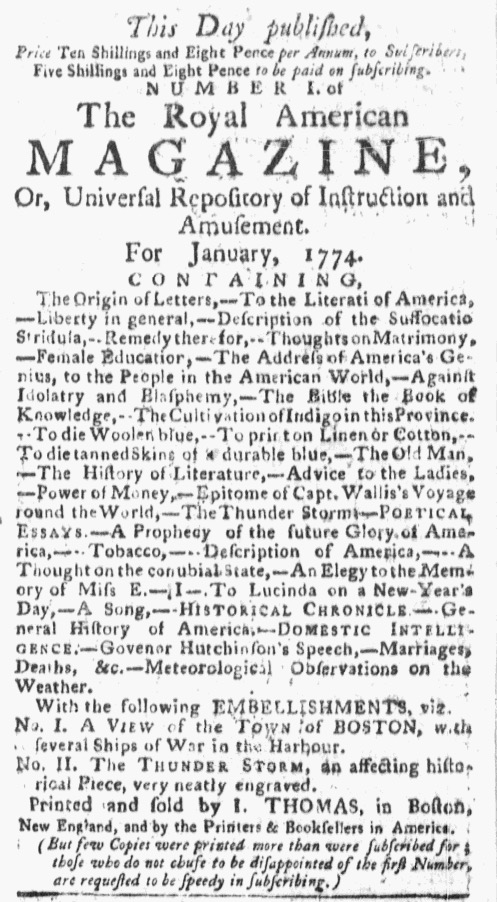
Isaiah Thomas, printer of the Massachusetts Spy, continued promoting a new venture, the Royal American Magazine, in the February 24, 1774, edition of his newspaper. He once again ran an advertisement announcing that “This day was published … NUMBER I. of THE ROYAL American Magazine,” noting the price, promoting the two copperplate engravings that accompanied the inaugural issue, listing the contents, and encouraging “those who do not chuse to be disappointed of the first number … to be speedy in subscribing.” That was not the extent of Thomas’s efforts to market the Royal American Magazine in that issue of the Massachusetts Spy. The “POETS CORNER,” a regular feature in the upper left corner of the final page, featured a poem entitled, “A PROPHECY of the FUTURE GLORY of AMERICA.” A note of introduction indicated that the verses came “From the ROYAL AMERICAN MAGAZINE.” Thomas conveniently placed the advertisement for the magazine immediately below the poem, guiding readers toward subscribing.
That was not the only instance of the industrious printer publishing an excerpt from the magazine in his efforts to increase its visibility and gain new subscribers. On February 23, the Essex Journal, a newspaper that Thomas recently launched in Newburyport in partnership with Henry-Walter Tinges, carried the advertisement on the final page and an excerpt “From the Royal American Magazine” on the first page. In this instance, the excerpt was a short essay “Against IDOLATRY and BLASPHEMY” that critiqued the practice of using “epithets” including “Most gracious Sovereign” and “Most excellent Majesty” because they “can justly be applied to none but GOD; and therefore, applying them to men, is idolatry.” The author, identified only as “A CHRISTIAN,” took the opportunity to take a swipe at “Roman catholics … paying divine honours to a vain empty Pope.” Yet they were not much better than “protestants and Englishmen” who were “in some degree partakers of the same guilt.” Americans, on the other hand, could avoid “this sin” by “pay[ing] honour to whom honour is due, among men” and “pay[ing] supreme honour to none by the SUPREME.” In selecting that piece to excerpt, Thomas played to the prejudices of Protestants in New England, many of them descended from Puritans who first colonized the region. The excerpt on the first page and the advertisement on the last page bookended the contents of that issue of the Essex Journal, the reiterating reminding readers to subscribe and read the new magazine.
In both newspapers, Thomas inserted excerpts to create a buzz around the Royal American Magazine. He offered previews to prospective subscribers, both in the list of contents and the excerpts themselves, in hopes of inciting curiosity and demand for the new publication.