
What was advertised in a revolutionary American newspaper 250 years ago this week?
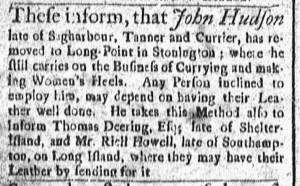
“John Hudson, late of Sagharbour, … has removed to Long-Point in Stonington.”
The November 8, 1776, edition of the Connecticut Gazette, published in New London, carried an advertisement for the purpose of informing readers that John Hudson, “late of Sagharbour” on Long Island, “Tanner and Currier, has removed to Long-Point in Stonington” on the Connecticut coast. At his new location, he “still carries on the Business of Currying” or processing leather “and making Women’s Heels.” New to the area, he assured prospective customers that “Any Person inclined to employ him, may depend on having their Leather well done.” Hudson hoped to build a clientele in the region.
At the same time, he also used the advertisement to communicate with customers who had hired him when he still lived and worked in Sag Harbor. “He takes this Method,” he added to his notice, “also to inform Thomas Deering, Esq; late of Shelter-island, and Mr. Riell Howell, late of Southampton, on Long Island, where they may have their Leather by sending for it.” That Deering was “late of Shelter-island” and Howell was “late of Southampton,” just as Hudson was “late of Sagharbour,” suggested that all three had moved to other places because of the British invasion of Long Island. In addition to capturing New York City, the British also occupied Sag Harbor and used it as a base for monitoring Long Island Sound. Hudson may have attempted to contact Deering and Howell directly before he moved his shop from Sag Harbor to Stonington, but he could not locate them in the turmoil caused by the war. Whether or not he had dispatched messages to those customers, Hudson expected that an advertisement in the Connecticut Gazette had a reasonable chance of coming to the attention of Deering and Howell. At the very least, the tanner and currier could assert that he had not absconded with the leather entrusted to him for processing without making some attempt to let his customers know where they could collect it.
Following the battles of Lexington and Concord and the siege of Boston in the spring of 1775, newspapers published in other towns in New England carried advertisements by former residents of Boston who introduced themselves to prospective customers in their new communities. Similar advertisements began appearing in newspapers in New England and Pennsylvania once the British took possession of New York City and Long Island.