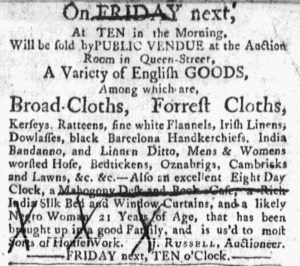
What was advertised in a colonial American newspaper 250 years ago today?
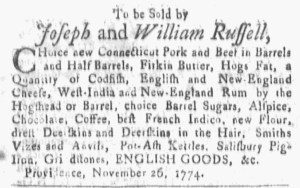
“ENGLISH GOODS, &c. Providence, November 26, 1774.”
Joseph Russell and William Russell, two of the most prosperous merchants in Providence on the eve of the American Revolution, regularly advertised a variety of wares in the Providence Gazette. On December 3, 1774, they ran an advertisement for several commodities, including “Connecticut Pork and Beef in Barrels and Half Barrels, … a Quantity of Codfish, … West-India and New-England Rum by the Hogshead or Barrell, … Chocolate, Coffee, … and “drest Deerskins and Deerskins in the Hair.” They concluded their notice with “ENGLISH GOODS,” indicating that they stocked and sold merchandise imported from Britain.
This advertisement appeared two days after the Continental Association, a nonimportation agreement adopted by the First Continental Congress, went into effect. However, that was not the first time that it ran in the Providence Gazette. A date appended to the end of the advertisement established that the Russells composed it on November 26, matching the date of the first issue of the newspaper that carried it. Advertisements usually ran for a minimum of three weeks, though advertisers could arrange for notices to appear for much longer. In this instance, the Russells opted for four weeks, commencing just days before the Continental Association went into effect and continuing when that pact was supposed to constrain buying and selling imported goods. In the December 3 edition of the Providence Gazette, their advertisement appeared one column over from a notice promoting the Extracts from the Votes and Proceedings of the American Continental Congress, a pamphlet that included “the Association” along with “a List of Grievances” and “occasional Resolves.” By including the date, the Russells may have sought to offer prospective customers some leeway in purchasing “ENGLISH GOODS” that had been received before the nonimportation agreement went into effect. They made it easier for readers to feel comfortable with that decision than Richard Mathewson did. His advertisement, which also ran before the Continental Association went into effect and continued into December, proclaimed that he sold a “large and general Assortment of GOODS” that were “Just imported from London.” That notice did not include a date, making it less apparent when he received the goods. Readers could reasonably conclude that Mathewson had ordered that merchandise before learning of the Continental Association, but that required more work on their part than the Russells did when they included a date in their advertisement.