
What was advertised in a revolutionary American newspaper 250 years ago today?
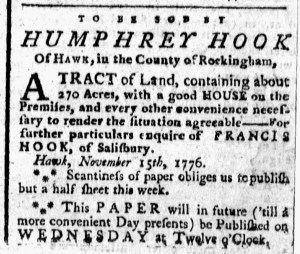
“Scantiness of paper obliges us to publish but half a sheet this week.”
The November 15, 1776, edition of the Essex Journal consisted of only two pages rather than the usual four. In a notice that appeared among the few advertisements that ran at the bottom of the last column on the second page, John Mycall, the printer, offered an explanation to subscribers and other readers: “Scantiness of paper obliges us to publish but a half sheet this week.” Newburyport, Massachusetts, certainly was not the only town in that situation. Throughout the new nation, printers sometimes had difficulty acquiring paper to publish their newspapers during the war.
Mycall provided another update for readers: “This PAPER will in future (‘till a more convenient Day presents) be Published on WEDNESDAY at Twelve o’Clock.” The Essex Journal had been published on Fridays, so that meant readers could expect to see the next issue sooner than anticipated. As promised, Mycall published the next issue on Wednesday, November 20. Again, he distributed a half sheet, but this time he explained that the “time for publication, has this week been so short, that it was not in our power to print a whole sheet.”
He also determined that a “more convenient Day” had indeed presented itself. “We find, that by publishing on Thursday,” the printer announced, “we shall be able to entertain our readers with fresher southern intelligence.” Mycall depended on letters and other newspapers carried to Newburyport by post riders for content to fill the pages of the Essex Gazette. Like other printers, he reprinted liberally from other sources to keep his readers informed of the latest developments from the Continental Congress and the Continental Army. Given when newspapers from Boston and other towns to the south arrived in Newburyport, Mycall “therefore determine[d] to make choice of [Thursday] for the future.” Eight days later, he circulated a complete issue consisting of four pages. He (mostly) maintained that schedule, sometimes resorting to smaller sheets, until he discontinued publishing the Essex Gazette in February 1777. The challenges of publishing the newspaper during the war apparently became too significant to overcome.