Who was the subject of an advertisement in a colonial American newspaper 250 years ago today?
New-York Gazette and Weekly Mercury (July 4, 1774).
“RAN AWAY … a Negro Man named GEORGE.”
On June 4, 1774, a “Negro Man named GEORGE” liberated himself from his enslaver, Abraham Lawrence of “Flushing on Long-Island,” by running away. In hopes of recovering George and returning him to slavery, Lawrence ran an advertisement in the New-York Gazette and Weekly Mercury. It first appeared in the June 13 edition and continued for several issues, including the one published on July 4. The enslaver hoped to enlist the aid of the public, offering “FIVE DOLLARS Reward” and providing a description of George so readers could identify him as they engaged in surveillance of Black men they encounter. Lawrence also issued a standard warning: “All Masters of Vessels and others, are forbid carrying off, or harbouring said Run-away, as they will be dealt with according to Law.” Already utilizing the power of the press, Lawrence was prepared to deploy the power of the state to return George to slavery and punish anyone who assisted this fugitive from slavery.
Lawrence’s description of George differed significantly from how George would have described himself, focusing on physical characteristics. According to the enslaver, George “is of a yellowish Complexion, has black bushy Hair, which he commonly wears tied behind; 5 feet 8 Inches high.” Lawrence did not indicate George’s approximate age, which language(s) he spoke, any skills he possessed or trades he followed, or whether he had been born in the colonies or Africa, nor did he mention any relations with other enslaved people. Other advertisements often included such details. Lawrence devoted the most attention to George’s clothing: “a whitish Linen Coat, a grey homespun Coat, blue Jacket, Buff coloured half-worn Velvet Breeches, with some Patches, black Stockings, and old Shoes.” The enslaver reporter that George “most commonly wears his Hat cocked” and suspected that he “may change his Coat to a brown.” In so doing, Lawrence acknowledged that George was clever, but condemned him for applying his intelligence to what the enslaver considered nefarious purposes.
Quite possibly, this may be the only trace of George that survives in the historical record, an account of his escape from slavery written not by himself but by an enslaver seeking his capture and return. It tells an exceptionally truncated account of George’s life. Despite the intentions of its author, this advertisement tells a story of courage, resilience, and resistance during the era of the American Revolution. News coverage and editorials elsewhere in the July 4, 1774, edition of the New-York Gazette and Weekly Mercury focused on the imperial crisis, especially the aftermath of the Boston Port Act devised as punishment for the Boston Tea Party. George may or may not have heard rumblings about that. Either way, he made his own declaration of independence on June 4, 1774, much to the dismay of his enslaver.
For other stories of enslaved people liberating themselves originally published on July 4 during the era of the American Revolution, see:
Who was the subject of an advertisement in a colonial American newspaper 250 years ago today?
Connecticut Courant (May 24, 1774).
“RUN away … a negro man about 27 years of age.”
An advertisement in the May 24, 1774, edition of the Connecticut Courant offered a reward for the capture and return of an unnamed “negro man about 27 years of age” who liberated himself by running away from Thomas Moses, his enslaver. Moses provided a description, declaring that the “negro man … lisps in his speech” and wore “a brown coat and red waistcoat, a white holland shirt, a new castor hat, a new pair of leather breeches, [and] a pair of blue stockings.” He also took other clothing with him, items that he could use to vary his appearance or sell in his efforts to make good on his escape. Moses stated that he would present ten dollars to “Whoever shall take up said negro and return him to me” or five dollars to whoever would “secure him in any of his majesty’s goals [jails] and send me word so that I may have him again.” In a nota bene, he warned, “All persons are hereby forbid to harbour said negro on penalty of law.”
The first half of that advertisement appeared at the bottom of a column that featured an editorial with a headline that proclaimed, “JOIN OR DIE!!!” A more extensive version first ran in the May 16 edition of the Newport Mercury as a combination of news and opinion. An abbreviated version, the first paragraph, then circulated in other newspapers as printers followed the common practice of reprinting items from one publication to another. The shorter version featured an additional exclamation mark for emphasis. The editorial commented on the Boston Port Act and Parliament’s intention “to reduce its spirited inhabitants to the most servile and mean compliance ever attempted to be imposed on a free people.” This new legislation was “infinitely more alarming and dangerous to our common liberties, than even that hydra the Stamp Act.” While directed at Boston in retaliation for the destruction of tea the previous December, the Boston Port Act, according to the anonymous author, was also “a direct hostile invasion of every province on the continent.” The people of Boston “nobly stood as a barrier against slavery.” Now residents of other towns needed to do the same “to stand … for the relief, support, and animation of our brethren in the insulted, besieged capital of Massachusetts-Bay” because “nothing but unity, resolution, and perseverance, can save ourselves and posterity from what is worse than death — SLAVERY.”
Connecticut Courant (May 24, 1774).
Twice in a single paragraph, the author of the editorial invoked slavery as the consequence of Parliament’s treatment of the colonies. Ebenezer Watson, the printer of the Connecticut Courant, selected that piece to feature in his newspaper and placed it in proximity to an advertisement that offered a reward for capturing an enslaved man who liberated himself. A single advertisement, a probate notice, separated the editorial from the “RUN away” advertisement. Perhaps even as he generated revenue from publishing the latter, Watson recognized the juxtaposition of very different concepts of slavery and could not position one item right after the other. Just as likely, however, that juxtaposition did not register. After all, Moses’s advertisement was one of at least eighty-five advertisements about enslaved people that ran in nineteen newspapers, including nine published in New England, that week. Even as many printers advocated for liberty for colonizers who faced the prospect of figurative enslavement by Parliament, the early American press participated in perpetuating the literal enslavement of Africans, African Americans, and Indigenous Americans with advertisements for buying and selling enslaved people and notices calling on colonizers to capture enslaved people who liberated themselves by running away from their enslavers. The proximity of such advertisements to content similar to the “JOIN OR DIE!!!” editorial was a common feature of newspapers published during the era of the American Revolution.
Who were the subjects of advertisements in colonial American newspapers 250 years ago this week?
Pennsylvania Journal (June 30, 1773).
“RUN AWAY … a Negro Man named Peter.”
For the past six years, the Adverts 250 Project has marked Independence Day by featuring the (incomplete) stories of enslaved men and women who made their declarations of independence when they liberated themselves by escaping from their enslavers during the era of the American Revolution. These stories are incomplete because they are drawn from newspaper advertisements placed by enslavers who enlisted the aid of readers in scrutinizing Black people in hopes of capturing and returning to enslavement fugitives seeking freedom. Still, despite their intentions in placing the advertisements, those enslavers who sought to maintain slavery and racial hierarchies provided truncated accounts of courage, resilience, and devotion to liberty that resonate today.
July 4 fell on a Sunday in 1773. Sunday was the one day of the week that no printer published and distributed a new edition of their weekly newspaper anywhere in the colonies. Rather than select a single advertisement from 250 years ago this week to feature on Independence Day, the Adverts 250 Project presents this census of all of the advertisements about enslaved men and women who liberated themselves that appeared in newspapers from New England to South Carolina during the week before July 4, 1773. As these advertisements demonstrate, enslaved people knew the value of freedom throughout the era of the American Revolution and certainly before July 4, 1776.
On Monday, June 28, 1773, the New-York Gazette and Weekly Mercury carried an advertisement about “a certain Mulatto fellow named Harry” who liberated himself from his enslaver in Newark, New Jersey. Harry “speaks good English” and “understands the Pot-Ash Business.”
On the same day, the Supplement to the Pennsylvania Packet ran a notice offering a reward for “a negro man named STANHOPE.” He had been enslaved in Philadelphia, but made his escape from his most recent enslaver at Trenton Ferry on the Pennsylvania side of the Delaware River.
Also on June 28, 1773, the South-Carolina Gazette featured an advertisement offering a reward for “A New Negro Fellow, named Johnny, Of the Gambia Country” who liberated himself from a plantation in Prince William’s Parish. Johnny endured the Middle Passage, resolving to claim his freedom after arriving in the colonies.
In the same issue, another notice described “A sensible Country born FELLOW, Named BILLY” who fled from his enslaver in St. Thomas’s Parish. Andrew Deveaux described Billy as “about five Feet five Inches high, Twenty-one Years of Age, and has a Scar over one of his Eyes.” Billy did not have the opportunity to tell his own story in the public prints.
On Tuesday, June 29, 1773, the Connecticut Courant carried an advertisement about “a negro man named TONEY” who liberated himself from his enslaver at Hebron. Samuel Gilbert, Jr., suspected that Toney and Samuel Gilbert, a white “hired man,” found common cause and cooperated in escaping from him.
On Wednesday, July 30, 1773, the Pennsylvania Gazette featured a notice about “a Negroe man slave, named RAGON” who fled from his enslaver in New Castle, Delaware. Richard McWilliam suspected that Ragon “keeps near Ogletown” where he had previously been enslaved. If Ragon had written his own story, he may have mentioned family and friends in the area.
Another advertisement in that newspaper offered a reward for “a young Negroe man, named ANDREW” who liberated himself from Christiana Hundred in New Castle County, Delaware. To make good on his escape, “it is probably he will change his clothes” to avoid detection by readers of newspapers who participated in the surveillance of Black men and women.
Also on June 30, 1773, the Pennsylvania Journal ran an advertisement about “a Negro Man named Peter” who escaped from John McCalla in Philadelphia. His enslaver believed that Peter “will endeavour to pass for a free man” and would likely visit his mother, “a free woman named Violet,” in Trenton.
One Thursday, July 1, 1773, the Maryland Gazette featured an advertisement about “a negro man named Till” who liberated himself from his enslaver in Anne Arundel County. Till apparently made a previous attempt. Benjamin Lane reported that Till “was heard to say if he ever went away again he should endeavour to get on the Eastern shore” where he formerly lived. Like others who seized their liberty, Till may have been headed to family and friends.
In the same issue, another advertisement described “a certain negro man named BOB” who escaped from his enslaver at Mount Pleasant in Spotsylvania County, Virginia. Bob planned carefully. He stole some clothing to disguise himself, “procured a forged pass,” and presented himself as a free man named Robert Alexander.
That edition of the Maryland Gazette also carried an advertisement about “a mulatto slave named JACK” who “plays on the violin.” Jack liberated himself from his enslaver in Garrison Forest, about ten miles from Baltimore. He likely stole a horse from a nearby tavern to aid in making his escape.
Another advertisement in that newspaper described “a negro man, named Frank,” who seized his liberty from his enslaver at Piscataway in Prince George’s County. Thomas Clagett expressed dismay that Frank “has lately taken upon himself the practice of physick, in which employment he has against my consent been countenanced by a few people.” Claggett considered such “encouragement” the cause of Frank’s “elopement.”
Also on July 1, 1773, the New-York Journal carried the advertisement about “a Mulatto Fellow, called HARRY” that appeared in the New-York Gazette and Weekly Mercury three days earlier. In both advertisements, Thomas Brown reported that Harry might head toward Albany.
On the same day, the Virginia Gazette featured an advertisement about “a Negro Man named JAMES” who liberated himself from his enslaver in Mecklenburg. John Armistad described James as “an artful Fellow” who “may endeavour to pass for a Freeman.”
In another notice in the Virginia Gazette, an enslaver described “a likely Virginia born NEGRO FELLOW,” but did not give the name of the Black man who escaped to freedom. John Puryear expected that the unnamed “NEGRO FELLOW” would “change his Dress, endeavour to pass for a Freeman, and make for York Town, where he was raised, and brought up as a Waiting Man.”
That issue also carried an advertisement about “a likely Virginia born Negro Man named SAM” who liberated himself from his enslaver in Prince George County more than six months earlier. Michael Nicholson thought that Sam “will probably endeavour to get on Board a Vessel, in Order to make his Escape” and “forewarned” captains “from carrying him out of the Colony, at their Peril” of being punished as accomplices.
Just below that advertisement, another notice described another unnamed “NEGRO MAN” who seized his liberty when he escaped from his enslaver in Hertford County, North Carolina. The unnamed “NEGRO MAN” could “read and write tolerably,” skills that he might use “to pass for a Freeman.”
The July 1, 1773, edition of the Virginia Gazette also featured an advertisement about “a very light Mulatto Fellow named JESSE, about eighteen Years of Age,” who fled for freedom from his enslaver in Charles City. Given Jesse’s light skin, Charles Christian thought it possible that the young man “will endeavour to pass for a Freeman.”
One more notice from that newspaper described “a Negro Man named JACK, alias Phil,” who made his escape “from on Board the Matty, lying in Pagan Creek.” James Prudden offered a physical description of Jack, alias Phil. Like so many other enslaved men and women who liberated themselves, Jack, alias Phil, did not have an opportunity to record his own story in his own words.
Who was the subject of an advertisement in a colonial American newspaper 250 years ago today?
Providence Gazette (July 4, 1772).
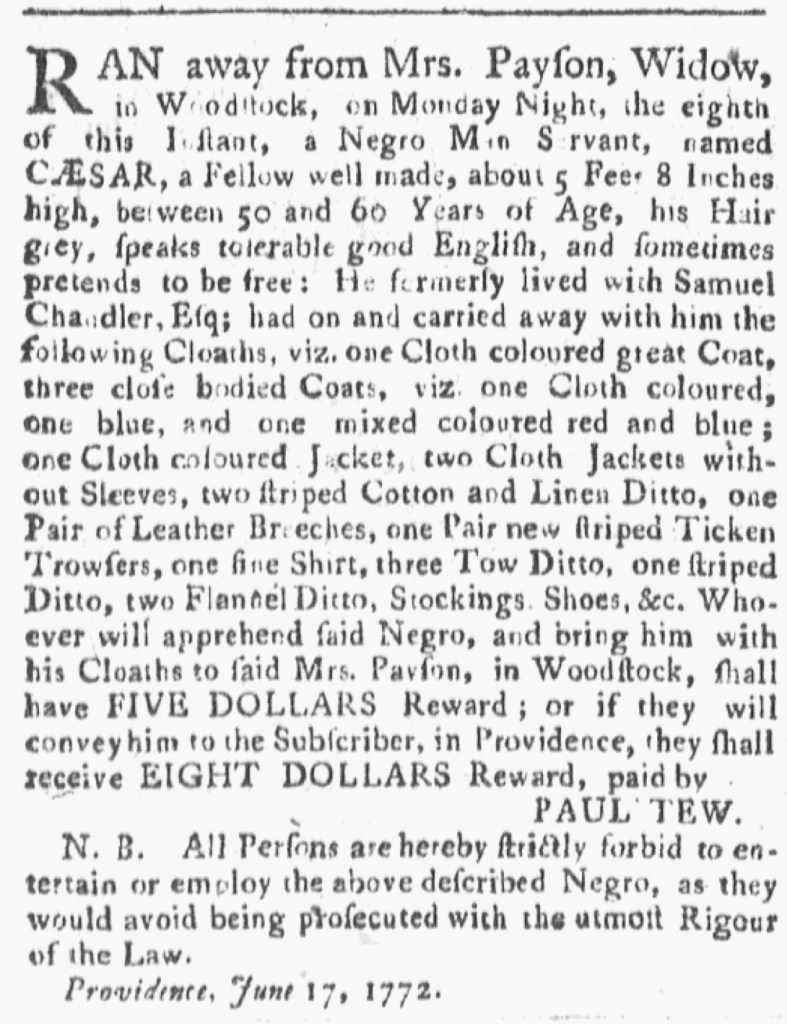
“RAN away … a Negro Man Servant, named CAESAR … sometimes pretends to be free.”
On July 4, 1772, American colonizers did not know that on that day just four years later the Continental Congress would declare the independence of a new nation. They did know that for the better part of a decade they experienced an increasingly turbulent relationship with Great Britain. Following the empire’s victory in the Seven Years War and the expulsion of France from North America, the George III issued the Royal Proclamation of 1763. In it, the king decreed colonizers were not to settle west of the Appalachians. Instead, he reserved that territory for the crown’s new Indian subjects. Colonizers felt betrayed. They fought and died to gain access to that land, but the king chose favor the Indians who allied with the French. After the war, Parliament sought to regulate trade more systematically, imposing first the Stamp Act in 1765 and the Townshend Acts a few years later. Colonizers responded with protests of various sorts, including boycotts of imported goods. In addition, Britain quartered troops in American cities. On March 5, 1770, some of those troops fired into a crowd in Boston, killing several people. Colonizers continued to protest, sometimes resorting to violence. On June 9, colonizers in Rhode Island boarded and burned the Gaspee, a British customs schooner, when it ran aground in Narragansett Bay.
Throughout this period, colonizers discussed their rights and demanded their freedom. They did so in the town square, in taverns, in coffeehouses, in newspapers, and in petitions. Simultaneously, enslaved people liberated themselves throughout the era of the American Revolution. Black men and women “RAN away” from their enslavers rather than endure bondage. Caesar, “a Negro Man Servant” enslaved by “Mrs. Payson, Widow,” in Woodstock, Connecticut, liberated himself in June 1772. He “RAN away” at the same time that word spread about colonizers striking a blow against Britain by burning the Gaspee. The Providence Gazette carried Caesar’s story, at least a truncated version of it as written by enslavers and their accomplices, in an advertisement that ran for several weeks, including on July 4. That notice described Caesar, “a Fellow well made, about 5 Feet 8 Inches high, between 50 and 60 Years of Age, his Hair grey, speaks tolerable good English,” and offered a reward for his capture and return. In so doing, the advertisers encouraged colonizers to participate in the surveillance of Black men they encountered to determine if any of them matched the description in the newspaper. They also threatened legal penalties for anyone who assisted Caesar, warning that “All Persons are hereby strictly forbid to entertain or employ the above described Negro, as they would avoid being prosecuted with the utmost Rigour of the Law.”
The advertisement also mentioned that Caesar “sometimes pretends to be free.” As colonizers proclaimed that they deserved freedom from British oppression and participated in protests of various sorts, Caesar determined that he was done pretending. He did not need a Declaration of Independence to assert his freedom. Instead, he declared independence by refusing to remain enslaved in Woodstock. He was one of countless enslaved men, women, and children who liberated themselves in the eighteenth century.
For other stories of enslaved people liberating themselves originally published on July 4 during the era of the American Revolution, see:
Who was the subject of an advertisement in a colonial American newspaper 250 years ago today?
Pennsylvania Journal (July 4, 1771).
“RUN-AWAY … a Mulatto Woman Slave, named VIOLET.”
On July 4, 1771, Philip Kearney told the story of Violet, an enslaved woman who liberated herself, though he certainly did not do so in celebration of her fortitude and courage. In an advertisement that ran in both the Pennsylvania Gazetteand the Pennsylvania Journal, Kearney provided a brief account of what he knew about Violet’s whereabouts for the past decade. Violet first liberated herself in October 1762. In 1764, she was spotted “in company with one James Lock, somewhere on the Susquehanna.” That led to her capture and imprisonment at the jail in Fredericks-Town (now Frederick), Maryland, “on suspicion of having runaway.” Violet escaped and for seven years managed to elude detection by those who sought to return her to bondage. In the spring of 1771, however, she “was discovered about fifteen miles from Ball-Fryer’s ferry” in Maryland.
According to Kearney, Violet now had three children. He wished to enslave the entire family, including children who had only known freedom in the wake of their mother liberating herself. According to the law, children followed the condition of the mother, and the law still considered Violet a slave. When Kearney purchased Violet from the executors of Edward Bonnel’s estate, he also acquired any of her children born after the transaction. Kearney offered ten pounds as a reward for the capture and return of Violet and fifteen pounds for Violet and her children. Kearney was determined to re-enslave Violet, but she was equally determined to preserve her liberty and protect her children. Kearney warned that anyone “who may take her up must secure her strictly, or she will certainly escape again, being remarkably artful.” That artfulness already resulted in nearly a decade of freedom. With three children, Violet now had even more reason to outwit anyone who attempted to capture her. Kearney’s advertisement had the potential to bring Violet’s liberty to an end, but it may have also alerted her, her friends, or sympathetic members of her community that she and her children faced new danger.
As the American colonies experienced an imperial crisis that ultimately culminated in a war for independence, Violet seized freedom for herself, repeatedly. In 1771, colonists did not know the significance that July 4 would gain five years later, but they did discuss liberty and lament their figurative enslavement to Parliament. Violet, in contrast, experienced literal enslavement before liberating herself. More than a decade prior to the first shots at Lexington and Concord, she waged her own fight for freedom, an ongoing battle that she might lose at any moment despite the many victories she won. While certainly not Kearney’s intention, his advertisement told a story of hope and resistance … but it was an unfinished story because the enslaver most certainly aimed to enslave a family who experienced freedom as a result of a woman’s steadfast determination.
On Independence Day, the Adverts 250 Project commemorates the complicated history of the founding of the nation, the grand ideals and the unfulfilled promises, by recounting the experiences of enslaved people who liberated themselves during the era of the American Revolution. Newspaper advertisements that offered rewards for their capture and return told incomplete stories of freedom, for each a tenuous liberation that brave men and women sought to make permanent but without any guarantee. Violet and so many others waged their own battled for liberty, as countless advertisements from the early eighteenth century through the late nineteenth century demonstrate.
For other stories of enslaved people liberating themselves originally published on July 4 during the era of the American Revolution, see:
What do newspaper advertisements published 250 years ago today tell us about the era of the American Revolution?
Pennsylvania Journal (February 21, 1771).
“LIBERTY. A POEM.”
“RUN-AWAY … a Negro Boy named SAY.”
Like every other newspaper printer in colonial America, William Bradford and Thomas Bradford published advertisements about enslaved people. The pages of the Pennsylvania Journal contained advertisements offering enslaved men, women, and children for sale as well as notices that described enslaved people who liberated themselves and offered rewards for their capture and return to their enslavers. The Bradfords generated revenues from both kinds of advertisements. In the process, they facilitated the buying and selling of enslaved Africans and African Americans. Their newspaper became part of a larger infrastructure of surveillance of Black people, encouraging readers to scrutinize the physical features, clothing, and comportment of every Black person they encountered in order to determine if they matched the descriptions in the advertisements.
Simultaneously, the Bradfords published news about politics and current events that informed readers about colonial grievances and shaped public opinion about the abuses perpetrated by Parliament. In addition, advertisements underscored concerns about the erosion of traditional English liberties in the colonies when they underscored the political dimensions of participating in the marketplace. Purveyors of goods encouraged consumers to support “domestic manufactures” by purchasing goods produced in the colonies as alternatives to imported items. News, editorials, and many advertisements all supported the patriot cause.
Those rumblings for liberty, however, stood in stark contrast to advertisements that perpetuated the widespread enslavement of Black men, women, and children. The two ideologies did not appear in separate portions of the Pennsylvania Journal or any other newspaper. Instead, they ran side by side. Readers who did not spot the juxtaposition chose not to do so. Consider, for instance, two advertisements in the February 21, 1771, edition of the Pennsylvania Journal. The Bradfords advertised “LIBERTY. A POEM” available at their printing office. Their advertisement appeared next to a notice about “a Negro Boy named SAY,” a chimneysweeper born in the colonies. Isaac Coats offered a reward to whoever “secures [Say] so that his Master may have him again.” For his part, Say seized the liberty that so animated the conversations of those who attempted to keep him in bondage.
That was not the first time that the Bradfords placed advertisements about liberty and slavery in such revealing proximity to each other. Three months earlier, they advertised the same poem and placed an advertisement offering a young man and woman for sale immediately below it. “LIBERTY” in capital letters and a larger font appeared right above the words “To be sold by JOHN BAYARD, A Healthy active young NEGRO MAN, likewise a NEGRO WENCH.” This paradox of liberty and slavery was present at the founding of the nation, not only in the ideas expressed by the founding generation but also plainly visible among the advertisements in the public prints.
What was advertised in a colonial American newspaper 250 years ago today?
Pennsylvania Journal (November 22, 1770).
“LIBERTY.”
“To be sold … A Healthy active young NEGRO MAN.”
Liberty and enslavement were intertwined in the 1770s, a paradox that defines the founding of the United States as an independent nation. As white colonists advocated for their own liberty and protested their figurative enslavement by king and Parliament, they continued to enslave Africans and African Americans. Even those who did not purport to be masters of Black men and women participated in maintaining an infrastructure of exploitation. The juxtaposition of liberty and enslavement regularly found expression in the pages of newspapers during the era of the American Revolution as news items and editorial letters rehearsed arguments made by patriots and advertisements encouraged consumers to factor political considerations into the choices they made in the marketplace while other news items documented fears of revolts by enslaved people and other advertisements offered Black men, women, and children for sale or announced rewards for capturing enslaved people who liberated themselves by running away from those who held them in bondage.
Such contradictory items always appeared within close proximity to one another, especially considering that newspapers of the era usually consisted of only four pages. In some instances, the juxtaposition should have been nearly impossible for readers to miss. Consider two advertisements that ran in the November 22, 1770, edition of the Pennsylvania Journal. William Bradford and Thomas Bradford, the printers of the newspaper, inserted a short notice about “LIBERTY. A POEM” available for sale at their printing office. Immediately below that notice appeared John Bayard’s advertisement offering a “Healthy active young NEGRO MAN” and an enslaved woman for sale. The word “LIBERTY” in the Bradfords’ very brief notice appeared in all capitals and such a large font that it could have served as a headline for the next advertisement, an exceptionally cruel and inaccurate headline. Both advertisements represented revenues for the Bradfords, the first potential revenues of potential sales and the second actual revenues paid by Bayard to insert the advertisement.
Examining either advertisement in isolation results in a truncated history of the era of the era of the American Revolution. The advertisement for “LIBERTY. A POEM” must be considered in relation to the advertisement for a “Healthy young NEGRO MAN” and woman to tell a more complete story of the nation’s past, even when some critics charge that the inclusion of the latter is revisionist and ideologically motivated. It is neither. Instead, it is a responsible and accurate rendering of the past. The Bradfords positioned these advertisements together on the page 250 years ago. We cannot separate them today.
What was advertised in a colonial American newspaper 250 years ago today?
South-Carolina Gazette (July 26, 1770).
“LIBERTY. A POEM”
“A NEGRO CARPENTER.”
On July 26, 1770, at least thirty-one advertisements about enslaved men, women, and children appeared in newspapers published throughout the thirteen colonies that declared independence from Great Britain later in the decade. Those advertisements ran in newspapers in every region of colonial America, not just the southern colonies with the largest populations of enslaved people. In New England, the Massachusetts Gazette and Boston Weekly Mercury carried such advertisements, as did the New-York Journal, the Pennsylvania Gazette, and the Pennsylvania Journal in the Middle Atlantic. In the Chesapeake, the Maryland Gazette and Rind’s Virginia Gazette ran more of these advertisements. Purdie and Dixon’s Virginia Gazette almost certainly did as well, but the July 26, 1770, edition has not been digitized for consultation by scholars and other readers.
In the Lower South, the South-Carolina Gazette also circulated advertisements about enslaved men, women, and children, including one that offered a “NEGRO CARPENTER” and a “young NEGRO WENCH” for sale. That advertisement ran immediately below an advertisement for “LIBERTY. A POEM. Dedicated to the SONS OF LIBERTY in SOUTH-CAROLINA” offered for sale in the printing offices where Peter Timothy published the South-Carolina Gazette and Charles Crouch published the South-Carolina Gazette and Country Journal, another newspaper that regularly distributed advertisements offering enslaved people for sale or offering rewards for the capture of enslaved people who liberated themselves by running away from colonists who attempted to hold them in bondage.
As the Slavery Adverts 250 Project demonstrates, advertisements about enslaved people were ubiquitous in newspapers printed throughout the colonies. The same newspapers that carried those advertisements also documented the events and debates of the imperial crisis that culminated in the American Revolution. As printers shaped public discourse about how Parliament abused the colonies, they simultaneously profited from publishing advertisements that perpetuated the enslavement of Africans and African Americans. David Waldstreicher offered an overview in “Reading the Runaways: Self-Fashioning, Print Culture, and Confidence in Slavery in the Eighteenth-Century Mid-Atlantic” in 1999.[1] In 2020, Jordan E. Taylor provides a much more extensive examination in “Enquire of the Printer: Newspaper Advertising and the Moral Economy of the North American Slave Trade, 1704-1807.”[2] Colonial printers facilitated the slave trade and played an integral role in the surveillance of Black bodies in eighteenth-century America.
Those activities occurred within the same pages of newspapers that ran articles and editorials … and advertisements for consumers goods … that advocated “LIBERTY” for white colonists. Sometimes advertisements about enslaved people and editorials about liberty appeared on different pages, but considering that most newspapers of the era consisted of only four pages (or six when they included a supplement) they were always within close proximity. Such was the case for an advertisement for a “Likely young Negro Girl” that ran in the supplement that accompanied the March 26, 1768, edition of the New-York Journal. The supplement also included letters from “A TRUE PATRIOT” and “POPULUS” that warned that Parliament actively eroded American liberties. In other instances, as Taylor demonstrates, advertisements about enslaved people ran next to articles and editorials that demanded liberty for white colonists. Sometimes advertisements delivered the news, such as a notice about a “new Non-Importation Agreement” that ran immediately above an advertisement offering an enslaved man and woman for sale in the January 25, edition of the New-York Journal.
Other times, advertisements about consumer goods and commerce played slavery and liberty in stark juxtaposition. Consider an advertisement for a “Likely Negro LAD,” a skilled cooper, that ran immediately above Nathaniel Frazier’s advertisement for “a very good assortment of Fall and Winter GOODS” in the October 3, 1769, edition of the Essex Gazette, published in Salem, Massachusetts. Frazier assured prospective customers and the entire community that he acquired those goods prior to the nonimportation agreement adopted to protest the duties on certain imported goods imposed by the Townshend Acts. Frazier offered white colonists an opportunity to defend American liberties and practice politics via their choices about consumption at the same time that an “Enquire of the Printer” advertisement reduced an enslaved cooper to a commodity to be traded in the marketplace.
The paradox of liberty and enslavement was vividly apparent in the advertisements that ran in the South-Carolina Gazette 250 years ago today. In a single glance, readers encountered an invitation to purchase an ode to “LIBERTY” dedicated to the Sons of Liberty and a notice that perpetuated the enslavement of a Black carpenter and a young Black woman who possessed several domestic skills. This example provides a particularly stark demonstration of unevenly applied ideologies of liberty in the era of the American Revolution and the founding of the nation. Eighteenth-century readers regularly encountered such contradictions in the contents of newspapers.
**********
[1] David Waldstreicher, “Reading the Runaways: Self-Fashioning, Print Culture, and Confidence in Slavery in the Eighteenth-Century Mid-Atlantic,” William and Mary Quarterly, 3rd ser., 56, no. 2 (April 1999): 243–272.
[2] Jordan E. Taylor, “Enquire of the Printer: Newspaper Advertising and the Moral Economy of the North American Slave Trade, 1704-1807,” Early American Studies: An Interdisciplinary Journal 18, no. 3 (Summer 2020): 287-323.
Who was the subject of an advertisment in a colonial American newspaper 250 years ago today?
South-Carolina and American General Gazette (July 4, 1770).
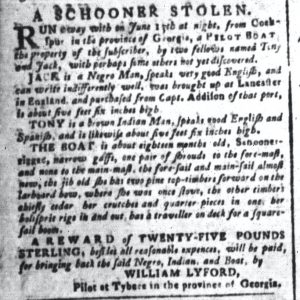
“RUN away … JACK is a Negro Man … TONY is a brown Indian Man.”
The July 4, 1770, edition of the South-Carolina and American General Gazette include an advertisement that advised readers of “A SCHOONER STOLEN” and the two enslaved men responsible for absconding with it. Although the advertisement asserted that Jack, “a Negro Man,” and Tony, “a brown Indian Man,” had “RUN away … with perhaps some others not yet discovered,” it actually told a truncated story of enslaved men who liberated themselves. Such advertisements had been a regular feature of colonial American newspapers since the Boston News-Letter commenced publication in 1704. Enslaved people had been liberating themselves long before that.
According to William Lyford, Jack and Tony stole his “PILOT BOAT” and made their escape “from Cockspur in the province of Georgia.” To help readers identify the two men, Lyford noted their heights and also reported that Tony spoke “good English and Spanish,” while Jack spoke “very good English, and can write indifferently well,” a skill that he might have planned to put to use in evading capture. Lyford also indicated that Jack “was brought up at Lancaster inEngland, and purchased from Capt. Addison of that port.” He did not insert other details about the two men, but instead provided an extensive description of the boat before offering a reward “for bringing back the said Negro, Indian, and Boat.”
This advertisement tells a story of disobedience and disorder from the perspective of an enslaver for the consumption of others that he hoped would assist in perpetuating slavery even if they did not themselves hold others in bondage. Lyford, like so many other enslavers, sought to use the power of the press to encourage and direct surveillance of Black and Indigenous men. His descriptions of Jack and Tony also served as instructions for scrutinizing all Black and Indigenous men to determine whether they were the enslaved men who had stolen the pilot boat and made their escape. Lyford attempted to frame Jack and Tony’s actions as unruly and dangerous, but their rebelliousness did not neatly fit within that narrative. In making their escape, appropriating Lyford’s boat for that purpose, Jack and Tony engaged in a powerful act of resistance. They liberated themselves. Despite Lyford’s best efforts to set the terms, he could not deprive Jack and Tony of the agency they exerted in pursuing their own destiny. Contrary to his intentions, Lyford’s advertisement resonates as a memorial to the courage of Jack and Tony and a truncated narrative of their resistance.
Jack and Tony liberated themselves while the colonies were in the middle of the imperial crisis that culminated in the American Revolution and independence for the United States. White colonists lamented their figurative enslavement to Parliament, all while literally enslaving Black and Indigenous people. Yet enslaved people understood the value of freedom and self-determination long before the upheaval between Britain and the colonies; they did not require the philosophizing of white colonists to recognize the injustices imposed upon them. Thousands of newspaper advertisements for “runaways,” for enslaved people who liberated themselves, published throughout the colonies before and during the era of the American Revolution demonstrate that was the case.
In 1770, colonists did not know that July 4 would become such an important date. It was not yet known as Independence Day, but it was a day of independence for Jack and Tony, just as it was for other enslaved people who liberated themselves, some of them documented in newspaper advertisements. Since the inception of the Slavery Adverts 250 Project, the Adverts 250 Project has featured advertisements about enslaved people who liberated themselves on July 4, both in celebration of their acts of resistance and as a reminder of the tension between liberty and enslavement that was the paradox of the American founding. In addition to the story of Jack and Tony in 1770, read more about the story of Caesar in 1767, the story of Harry, Peg, and their two children in 1769, and the story of Guy and Limehouse in 1769. They all made their own declarations of independence when they liberated themselves from their enslavers.
What was advertised in a colonial American newspaper 250 years ago today?
New-York Journal (January 25, 1770).
“A new Non-Importation Agreement.”
“A Likely Negro Man and a Wench.”
The first two advertisements that appeared in the January 25, 1770, edition of the New-York Journal tell very different stories about the era of the American Revolution. The first addressed efforts to resist the abuses of Parliament, the figurative enslavement of the colonies. The second offered a Black man and woman for sale, perpetuating their enslavement rather than setting them free. That one advertisement followed immediately after the other testifies to the uneven rhetoric of the era as well as the stark tension between liberty (for some) and slavery (for many) at the time of the nation’s founding.
The first advertisement called on the “Signers of the Agreement relative to the Traders of Rhode-Island” to meet and discuss how to proceed in their dealings with the merchants in that nearby colony. The trouble arose when Rhode Island did not adhere to nonimportation agreements adopted throughout the rest of New England as well as in New York and Pennsylvania. In response, merchants, shopkeepers, and others in New York decided that they would no longer engage in trade with their counterparts in Rhode Island, broadening the nonimportation agreement to include fellow colonists who acted contrary to the interests of the colonies. When New York received word from Newport of “a new Non-importation Agreement, lately come into at that Place,” those who had ceased trade with the colony met to reconsider once the merchants there had been brought into line.
The second advertisement presented “A Likely Negro Man and a Wench,” instructing “Any person inclining to purchase them” to enquire of the printer. The unnamed advertiser described the enslaved man and woman as “fit for a Farmer, or any private Family” and offered assurances of their health by noting that they “both had the Small-Pox and Measles” so would not contract those diseases again. The advertiser added a nota bene asserting that the man and woman treated no differently than commodities were “Both young,” one more attempt to incite interest from potential buyers. The anonymous enslaver opened with advertisement with an explanation that that Black man and women were “To be sold, for no Fault, but Want of Cash.” In other words, they were not disobedient, difficult to manage, or ill. The enslaver simply needed to raise some ready money; selling the man and woman provided a convenient means of doing so.
One advertisement addressed a widespread movement to use commerce as a political tool to prevent the colonies from being enslaved by Parliament. The other depicted the continued enslavement and disregard for a “Negro Man and a Wench” not entitled to the same liberty that white New Yorkers claimed for themselves. The colonial press, in collaboration with colonists who placed newspaper notices, maintained and even bolstered the contradictory discourse contained in the two advertisements.