February 15

What was advertised in a colonial American newspaper 250 years ago today?
Essex Gazette (February 15, 1774).

“He will sell … at so cheap as Rate as he doubts not will give Satisfaction to every Purchaser.”

George Deblois regularly advertised in the Essex Gazette.  On February 15, 1774, he placed a lengthy notice to promote a “fine Assortment of ENGLISH and HARD-WARE GOODS” that he “just received … from LONDON.”  He asserted that these items were “Suitable for the approaching Season,” encouraging consumers to purchase in advance or at least keep his shop in Salem in mind when they were ready to shop for in the coming weeks and months.  A catalog of his merchandise, divided into two paragraphs, accounted for most of the advertisement.  The first paragraph listed the “ENGLISH” goods, mostly textiles and accessories.  Deblois stocked “Scotch Plaids,” “Devonshire Kersies,” “stampt linen Handkerchiefs,” “a fine assortment of men’s worsted Stockings,” and “Hatter’s Trimmings of all sorts.”  He devoted the other paragraph to housewares and hardware, including the “best of London pewter Dishes,” “hardmetal Tea-Pots,” “steel and iron plate Saws of all sorts and sizes,” and “Brads, Tacks and Nails of all sorts.”

The merchant concluded his advertisement with two common appeals, one about consumer choice and the other about his prices.  The lengthy lists of goods already demonstrated the many choices available to his customers, but he insisted that he also stocked “a great Variety of other Articles, too tedious to enumerate in an Advertisement.”  Readers would have to visit his store to discover what else they might want or need that happened to be on his shelves.  No matter what they selected, his customers could depend on paying low prices.  Deblois declared that “he will sell by Wholesale and Retail … at so cheap a Rate as he doubts not will give Satisfaction to every Purchaser.”  Other advertisers frequently made a nod to low prices.  Elsewhere in the same issue of the Essex Gazette, for instance, John Appleton offered his wares “very cheap.”  Deblois embellished his appeal about prices, hoping to draw the attention of prospective customers and convince them that he offered the best deals.  They would depart his store not only pleased with the goods they acquired but also with a sense of “Satisfaction” about how much they paid.  Deblois encouraged consumers to visit his shop by setting favorable expectations for their shopping experiences.

January 3

What was advertised in a colonial American newspaper 250 years ago today?

Boston-Gazette (January 3, 1774).

“A large Assortment of Hard-Ware GOODS, Cutlery, Jewellery, Goldsmith’s, Clock and Watch Articles.”

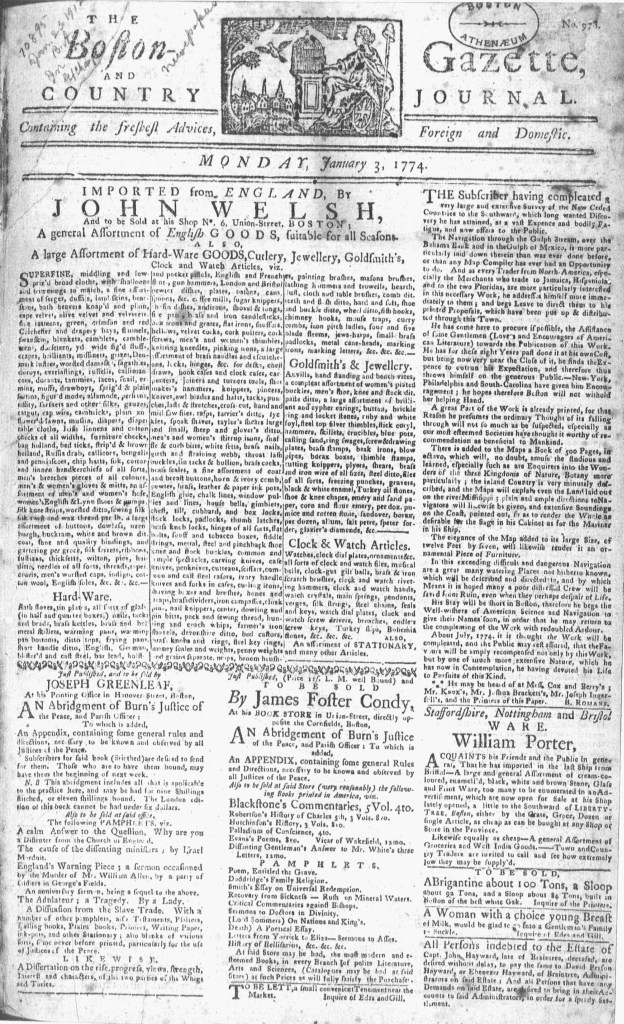
Readers almost certainly noticed John Welsh’s advertisement in the January 3, 1774, edition of the Boston-Gazette.  The shopkeeper announced that he imported and sold “A general Assortment of English GOODS, suitable for all Seasons” and “A large Assortment of Hard-Ware GOODS, Cutlery, Jewellery, Goldsmith’s, Clock and Watch Articles.”  To demonstrate the selection he offered to consumers, Welsh published an extensive list of his inventory.

The length of that list alone distinguished Welsh’s advertisement from others that ran in that issue of the newspaper.  More significantly, the format and placement made his notice notable.  Rather than extending in one column and continuing in the next, the advertisement spanned two of the regular columns, an unusual format in the Boston-Gazette or any other colonial newspaper.  Within the space occupied by the advertisement, the list of goods was divided into three columns with lines, but no space, separating them.  While that made the dense text more difficult to navigate, Welsh did provide some guidance with a series of headers.  The “English GOODS,” mostly textiles and accessories, that appeared first did not have a header, but “Hard-Ware,” “Goldsmith’s & Jewellery,” and “Clock & Watch Articles” each had headers that directed readers to items of interest.

The advertisement’s position on the page also enhanced its visibility.  It ran in the upper left corner on the first page, right below the masthead, making it the first item that readers saw when they perused the first issue of the Boston-Gazettepublished in 1774.  Even if readers who knew that the latest news often appeared on the second and third pages rather than the front page immediately flipped past the first page, they likely noticed Welsh’s advertisement as they skimmed to make sure they did not miss any news that might have appeared on the front page.  After all, the organization did vary from week to week depending on the amount of “intelligence” and advertisements submitted to the printing office.  Welsh’s advertisement dominated the first page, as it would have done on any page.  The unusual format underscored the wide selection of merchandise that he made available to customers.

Boston-Gazette (January 3, 1774).

October 22

What was advertised in a colonial American newspaper 250 years ago today?

New-Hampshire Gazette (October 22, 1773).

“A neat and elegant Assortment of MERCERY, HABERDASHERY, and WOOLEN GOODS.”

Daniel Fowle, the printer of the New-Hampshire Gazette, apparently experienced some sort of disruption in his paper supply in the fall of 1773.  For several weeks, he issued a broadsheet newspaper with four columns on each side rather than the usual standard edition that consisted of three columns on each of four pages.  That meant that he delivered eight columns of news, advertising, and other contents rather than twelve.  It was not the first time in recent years that Fowle made some sort of substitution when he did not have access to sheets of the usual size.

In this instance, that meant Thomas Achincloss’s lengthy advertisement in the October 22 edition accounted for an even greater proportion of the space on the broadsheet than if it had appeared in a standard issue at some other time.  It filled half a column.  Achincloss advised readers that he recently imported and offered for sale a “neat and elegant Assortment of MERCERY, HABERDASHERY, and WOOLEN GOODS,” though most of the advertisement consisted of an extensive list of his wares.  He stocked “Calicoes, newest Patterns,” a “Genteel Assortment of Chintzes,” and “Laces, Knee Straps, [and] Necklaces, different qualities, newest and most fashionable,” along with a variety of other textiles and accessories enumerated in his notice.  Achincloss supplemented that merchandise with a “neat Assortment of Hardware,” an “assortment of Bibles and Testaments, also of various Books and Stationary Ware,” and “Men’s Saddles” and “Riding Whips.”  He presented a multitude of choices to consumers in Portsmouth and nearby towns.

Achincloss realized that promoting this selection may not have been enough to draw prospective customers to his shop.  To incite demand, he made appeals to price before and after describing his inventory.  He initially stated that he sold his goods “at a very low advance” (or only a small markup), but went into more detail in a nota bene at the end of the advertisement.  “The Public may depend, and be assured,” Achincloss declared, “that the Goods being from first Hands and Manufacturers, will be afforded upon as low terms, as any in the place can.”  In other words, Achincloss claimed that he acquired these goods directly from the producers rather than middlemen merchants.  That kept his costs low, allowing him to pass along the savings to his customers.  In turn, he set competitive prices that matched the best deals available in Portsmouth.

The amount of space that Achincloss’s advertisement occupied may have attracted attention.  Once readers perused it, they encountered an array of choices, especially among the dozens of textiles that the shopkeeper listed, as well as assurances of low prices.  In crafting this notice, Achincloss deployed some of the most common marketing strategies in use throughout the colonies.

October 20

What was advertised in a colonial American newspaper 250 years ago today?

Pennsylvania Gazette (October 20, 1773).

Sprogell is, and will be, constantly supplied with every article upon the very best terms.”

In the fall of 1773, Lodowick Sprogell took to the pages of the Pennsylvania Gazette to advertise a “GENERAL and neat assortment of GOODS, suitable to the present and ensuing season” available at his store on Second Street in Philadelphia.  To give prospective customers a sense of the selection, he listed some of his merchandise, including “mens, womens, boys, girls, and childrens stockings, of various colors,” “black silk mitts,” “worsted caps,” and “scarlet, light and dark blue, copper, London brown, copper and dark mixtures, and pearl coloured superfine, fine and coarse broadcloths.” He stocked many other kinds of textiles as well as accessors, like “buttons, buckles, [and] ribbons,” as well as “a variety of other articles.”  Like many other advertisers, Sprogell presented some of his wares and encouraged readers to use their imaginations to conjure what else they might discover when they visited his store.

The merchant also made appeals to price, noting that he acquired his inventory “upon the very best terms” and would pass along the bargains to his customers.  Before listing any of the goods, Sprogell suggested that readers could indeed afford them by stating the he was “determined to sell … at the most reasonable rates.  In a nota bene at the end of his advertisement, he reiterated this appeal, declaring that he had been “supplied with every article upon the very best terms” and, as a result, “he flatters himself that it is in his power to sell as low as can possibly be purchased elsewhere in the city.”  Among the many merchants and shopkeepers who hawked their wares in the largest city in the colonies, Sprogell vowed to set prices that matched or beat his competitors.

He also attempted to entice prospective customers with promises of future shipments, asserting that he “will be, constantly supplied” with new merchandise.  Most merchants and shopkeepers focused exclusively on goods already in their stores when they advertised, but some occasionally strove to create a sense of anticipation among prospective customers.  This also signaled that shoppers would not encounter leftovers in the coming months because Sprogrell already had a plan in place to regularly update his inventory.  In his advertisement, he looked to the future, not just the present, as an additional means of convincing consumers to take advantage of the large selection and low prices at his store.

October 12

What was advertised in a colonial American newspaper 250 years ago today?

South Carolina Gazette and Country Journal (October 12, 1773).

“A great variety of articles in the highest taste.”

In his efforts to sell his merchandise to prospective customers in Charleston and nearby town in the fall of 1773, James McCall emphasized the array of choices available at his shop.  Like many other purveyors of consumer goods, he listed many of his wares in a newspaper advertisement.  His merchandise included everything from “superfine bright scarlet broad-cloth” and “rich black Genoa velvet” to “elegant china” and “neat portmantua and other trunks” to “handsome tall candlesticks” and chamber and street lamps.”  He stocked “Morocco slippers” in a range of colors, including “red, blue, green, and yellow.”  Similarly, customers could choose “mens velvet caps, with and without tassels,” to suit their tastes.

McCall introduced consumers to his catalog of goods by describing his inventory as a “very large ASSORTMENT” and explaining that he included only certain items in his advertisement.  The list commenced with “AMONG OTHER ARTICLES” and concluded with a promise of “a great variety of articles in the highest taste.”  The word “variety” also appeared elsewhere in the advertisement, “a variety of pewter, copper, tin, and iron ware” and “writing, printing, and [a] variety of paper,” to encourage prospective customers to imagine the items on his shelves and visit his shop to see for themselves.  In addition, “&c.” (an abbreviation for et cetera), deployed more than once in the advertisement, suggested even more choices.  In case that did not lure readers, the shopkeeper expected “Further supplies in the next vessels” to arrive in port.

The competition for customers sometimes manifested itself in competitions for placing the longest newspaper advertisements.  Listing dozens of items and occupying approximately one-third of a column, McCall’s advertisement matched others that ran in the October 11 edition of the South-Carolina Gazette and the October 12 edition of the South-Carolina Gazette and Country Journal.  On other occasions, however, that advertisement would have seemed brief in comparison to those placed by other merchants and shopkeepers.  In listing so many choices, McCall and others may not have merely attempted to meet consumer demand.  Instead, they may have intended for their catalogs of goods to incite greater demand by demonstrating many of the available choices and prompting prospective customers to envision selecting among them.

October 6

What was advertised in a colonial American newspaper 250 years ago today?

Pennsylvania Gazette (October 6, 1773).

“He flatters himself, it is in his power to sell as low as any shop or store in the city.”

Philip Marchinton commenced a new advertising campaign at the beginning of October 1773.  His advertisements in the October 6 issues of the Pennsylvania Gazette and the Pennsylvania Journal both included a notation, “6 W,” that advised the compositors to run them for six weeks and then remove them from those newspapers.  Marchinton did not anticipate that anyone outside the printing offices would pay much attention to those notations.  Instead, he wanted prospective customers to focus on the “LARGE and neat assortment of EUROPEAN and INDIA GOODS” that he recently imported “by the last ships from LONDON, LIVERPOOL, and HULL.”

Marchinton’s advertisements followed a familiar format.  They commenced with a brief description of where and when he acquired his merchandise, suggesting to consumers that he did not merely peddle leftovers that he had not been able to sell.  The merchant declared that his new inventory was “suitable to the season” and made an appeal to price, offering “the very lowest terms.”  He devoted most of the advertisement to demonstrating the choices available his “assortment” of goods, listing a variety of textiles as well as “silk and worsted stockings” and “jewellery and cutlery.”  In addition, he claimed to stock “almost every article commonly imported,” putting him in competition with Andrew Bunner, William Price, and other merchants and shopkeepers who ran advertisements in the several newspapers published in Philadelphia.

Marchinton deviated from that familiar format in the final lines of his advertisement.  He appended a nota bene in which he provided a short explanation about how he could “sell at the very lowest terms,” circling back to the appeal that he made before listing his wares.  The merchant explained that he “doth import and buy every article from the very best market.”  In the process, he avoided unnecessary markups.  As a result, “it is in his power to sell as low as any shop or store in the city.”  He did not go into greater detail, content with reminding prospective customers of his low prices before making a final pledge “to make it particular study to please all, that are so kind as to favour him with their good custom.”  Low prices and good customer service went hand in hand at Marchington’s store.  Like many other merchants and shopkeepers, Marchinton mostly adhered to a familiar format while choosing a small variation to distinguish his advertisement from others.

March 15

What was advertised in a colonial American newspaper 250 years ago today?

Pennsylvania Chronicle (March 15, 1773).

“A great variety of calicoes, whole and half chintzes, and printed cottons.”

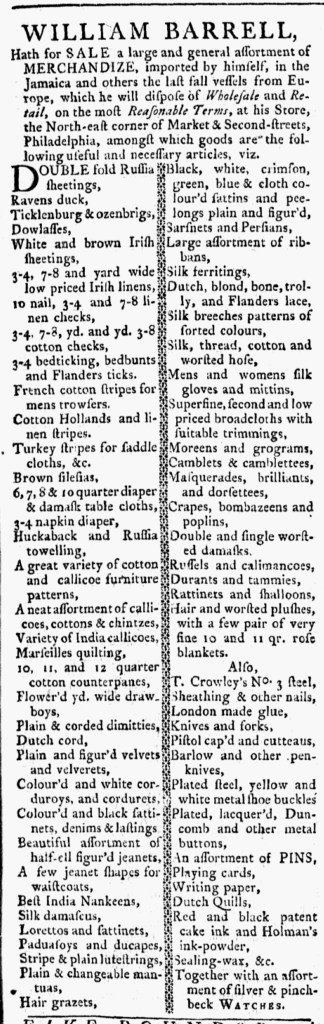
It was not a full-page advertisement, but it came close.  Daniel Benezet’s advertisement in the March 15, 1773, edition of the Pennsylvania Chronicle filled the first column on the front page, extended throughout the second column, and overflowed into the final column.  Eight much shorter advertisements filled the remainder of the page.  As was often the case in eighteenth-century newspapers, news articles, letters, and editorials began on the second page.

Benezet announced that he recently imported a variety of goods from London, Bristol, and Holland.  To demonstrate the choices that he made available to consumers, he published an extensive catalog of his merchandise.  Benezet’s inventory included “Blue, green, scarlet, claret, brown, cinnamon, drab, copper and mixt coloured, middling and low priced broadcloths,” a “large assortment of men’s women’s and children’s Bath, white metal, steel, block tin, and pinchbeck shoe buckles,” “Best English hammered brass kettles,” and “Newest fashion’d snuff-boxes.”  He concluded with “&c. &c. &c.”  Repeating an abbreviation for et cetera suggested even more wonders available at his store on Arch Street in Philadelphia, too many to appear in the already lengthy newspaper advertisement.  In the first advertisement that followed Benezet’s notice, Peter Wikoff and Isaac Wikoff stated that they “joined both their stocks in trade together … and now have a very large and compleat assortment of dry goods on hand.”  The Wikoffs invited prospective customers to imagine their wares; in contrast, Benezet encouraged consumers to browse through his inventory in the pages of the public prints.  He likely believed that if readers spotted items they wanted or needed in his catalog of goods that they would be more likely to shop at his store.

To aid prospective customers in navigating the advertisement and discovering items that interested them, the compositor divided each column into two columns, ran a dividing line down the center, and listed only one item or category of items on each line.  In most instances, those descriptions required more than one line, with second and subsequent lines indented.  That created additional white space that made Benezet’s advertisement easier to read than notices that clustered merchandise together in paragraphs of dense text.  Benezet and the compositor leveraged graphic design in their efforts to engage readers of the Pennsylvania Chronicle and entice them to become customers.  The compositor apparently did not consider it sufficient to publish a lengthy advertisement, but instead believed that good design made it more effective.

Pennsylvania Chronicle (March 15, 1773).

February 18

What was advertised in a colonial American newspaper 250 years ago today?

New-York Journal (February 18, 1773).

“With many other articles too numerous for an advertisement.”

Samuel Deall sold a variety of merchandise at his shop on Broad Street in New York in 1773.  In an advertisement in the February 18 edition of the New-York Journal, he listed only some of his wares, informing prospective customers that he carried “a large assortment of haberdashery and hosiery of all sort,” “Gentlemen and Ladies gloves of all sorts,” “gilt, bordered and plain message cards,” “Bayley’s boxes of improved soap with brushes for shaving,” “fine tooth brushes,” and “the fine new invented Cakes for shining liquid blacking for shoes and boots.”  The merchant listed a variety of other items and concluded by noting that he stocked “many other articles too numerous for an advertisement.”

In adopting that means of suggesting that he offered a wide array of choices to consumers, Deall deployed a strategy popular among merchants and shopkeepers.  Elsewhere in that issue of the New-York Journal, several other advertisers published short catalogs of their merchandise and added that space did not permit them to go into even greater detail.  For instance, Robert G. Livingston, Jr., stated that he sold “Sundry other goods in the store way, too tedious to mention.”  Similarly, Wigglesworth, Kent, and Company concluded their litany of goods with a promise that they had “many other Articles too tedious to enumerate.”  William Wikoff once again placed his advertisement that enticed consumers with “many more articles, too tedious to insert” in the newspaper.  Gerardus Duycknick ended his advertisement for his Universal Store, so named because he supposedly stocked everything, with a note about “a Variety of other Articles … too tedious to mention.”

Each of these advertisers used lists of goods to demonstrate some of the choices they made available to customers.  To enhance those lists, each also suggested that going into greater detail in a newspaper advertisement was neither practical nor entertaining.  Instead, they implied that prospective would have more satisfying and enjoyable experiences by visiting their stores, browsing their merchandise, and seeing for themselves the many choices that might suit their tastes and budgets.  As colonizers participated in a transatlantic consumer revolution in the eighteenth century, offering choices became one of the most popular marketing strategies deployed by merchants and shopkeepers.

November 9

What was advertised in a colonial American newspaper 250 years ago today?

New-York Gazette and Weekly Mercury (November 9, 1772).

“L / Leather dog collars / [Leather] Bottle stands.”

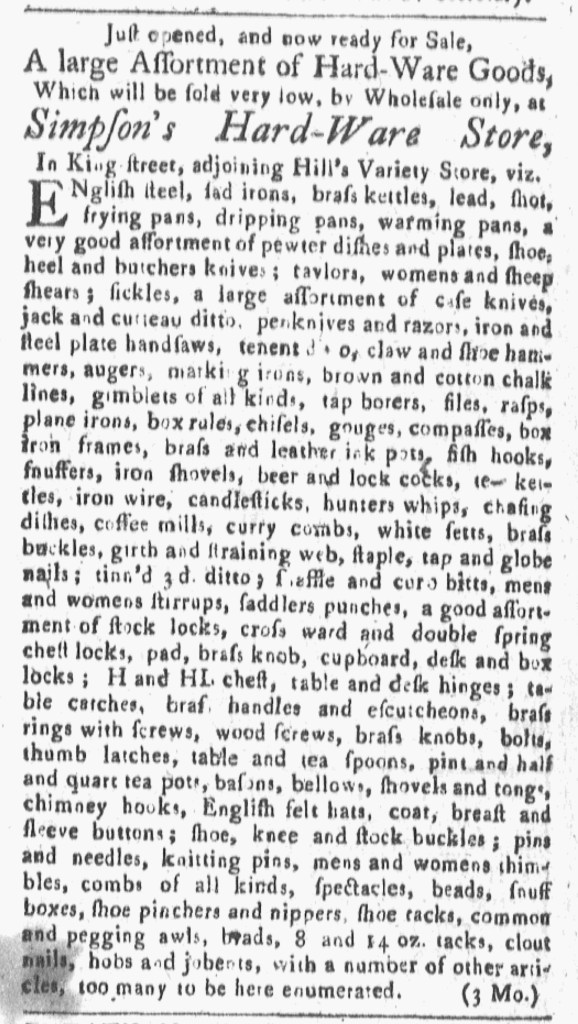
Several merchants, shopkeepers, and other entrepreneurs included lengthy lists of their merchandise in the November 9, 1772, edition of the New-York Gazette and Weekly Mercury.  Richard Sause, a cutler, listed scores of items in a dense advertisement that consisted of a single paragraph.  William Neilson did as well.  John Morton resorted to two dense paragraphs, a longer one for his general merchandise and a shorter one with a headline, “CHINA,” to direct prospective customers to those items.

In contrast, other advertisers attempted to make it easier for readers to navigate their notices and spot items of interest by dividing their advertisements into two columns with only one item per line.  Shaw and Long published a short advertisement for wine, beer, spirits, tea, and groceries that featured two columns.  Robert G. Livingston, Jr., stocked all sorts of textiles and housewares, neatly arranged in two columns in a lengthy advertisement.  Similarly, William Prince, a gardener, listed a “large collection of Fruit Trees” as well as “Timber trees and flowering shrubs” in an advertisement that extended an entire column.  He included headers for various kinds of trees, ranging from “Apricots” to “Pears” to “Apples.”  Prince also gave prices for some of his trees.

Among those advertisements, William Bayley experimented with another method of making his merchandise accessible to prospective customers.  In addition to using two columns with one item per line, the merchant also alphabetized his wares.  In 1772, that approach was rather extraordinary.  Booksellers occasionally took that approach in their newspaper notices and book catalogs, but not always.  Merchants, shopkeepers, and others beyond the book trades, however, did not alphabetize their wares, making Bayley’s approach innovative.

Bayley inserted headers for each category, starting with “B” for “BATH stove grates” and “Brass ditto.”  (Advertisers often saved space by deploying ditto.  Readers knew that Bayley meant “Brass stove grates” as an alternative to “BATH stove grates.”)  He concluded with “W” for “Wire fenders,” the only item under that letter.  Bayley did not strictly adhere to alphabetization under the various headers.  For instance, “Copper sauce pans” appeared under “C” before “Cases with silver handle knives and forks.”  The various “Brass” and “Japan’d” items also appeared in groups but not alphabetized.  “Brass headed shovels & tongs” ran above “— Dog collars” and “Japan’d tea tables” ran above “Plate Warmers.”  Each category was short enough that Bayley likely did not consider it necessary to be rigid about alphabetizing the items under each header.

Bayley devised a format that made his advertisement more readable for consumers while also directing them to similar and related items.  He may not have been the first to introduce readers to an alphabetized list of general merchandise, but few advertisers had used that method when Bayley experimented with it in 1772.  Even if prospective customers did not require the aid of alphabetization in advertisements, Bayley still delivered a format that differentiated his newspaper notice from others, perhaps making it memorable as a result.

November 3

What was advertised in a colonial American newspaper 250 years ago today?

South-Carolina Gazette and Country Journal (November 3, 1772).

“A compleat ASSORTMENT of fashionable GOODS.”

Below the masthead, the entire front page of the November 3, 1772, edition of the South-Carolina Gazette and Country Journal consisted entirely of advertisements.  The one placed by William Stukes dominated the page, due in large part to its size and unusual format.  That newspaper ran three columns per page.  Stukes’s advertisement extended across two columns.  This was not a case of a lengthy advertisement that overflowed from one column into another.  Instead, it had been designed to take up space in more than one column.  The notice ran at the top of the first two columns, making it the first item in that issue.  That enhanced its visibility, though readers could hardly have missed an advertisement that occupied about half the space on the page.

The notice opened with a standard headline and introduction, similar to those in other advertisements for consumer goods.  The advertiser’s name in capital letters, “WILLIAM STUKES,” served as the headline.  The introduction stated that he “ACQUAINTS hid Customers and Friends, that he has removed into Broad-Street … and is now opening a complete ASSORTMENT of fashionable GOODS, imported in the last Ships from LONDON.”  In addition, Stukes declared that he would sell his wares “on the most reasonable Terms, at the usual CREDIT, and extraordinary cheap for CASH.”  He used formulaic language even as the format differentiated his advertisement from others on the same page and throughout the rest of the issue.

While the headline and introduction ran across two columns, Stukes’s extensive list of merchandise ran in three narrow columns.  Other advertisers grouped goods together in dense paragraphs.  Stukes made it easier for prospective customers to skim his advertisement and spot items of interest by giving each item its own line.  That resulted in significantly more white space within his advertisement than in the news and other paid notices.  For instance, “Silk gauze handkerchiefs” appeared on their own line without other items crowding them.  That even allowed space for readers to make notations, if they wished.

Stukes deployed popular marketing strategies and incorporated formulaic language into his advertisement, depending on its size and unique format to draw attention to the low prices and range of choices he offered to consumers.  Even though this newspaper notice consisted entirely of text, Stukes effectively used graphic design to distinguish it from advertisements placed by his competitors.