December 19

What was advertised in a colonial American newspaper 250 years ago today?
New-York Gazette and Weekly Mercury (December 19, 1774).

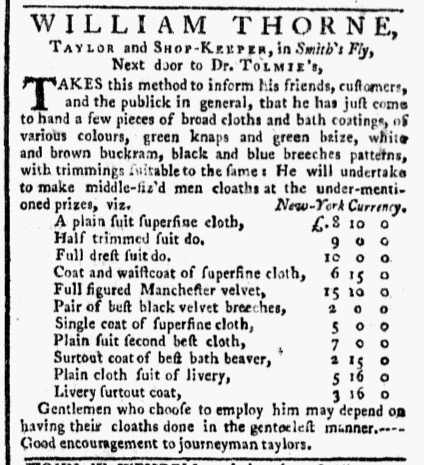
“He will undertake to make middle-siz’d men cloaths at the under-mentioned prices.”

William Thorne, a tailor, took to the pages of the New-York Gazette and Weekly Mercury to advertise his services in late December 1774.  He began his notice with an announcement that he had recently acquired various textiles, trimmings, and patterns, though he devoted half of the space to a list of prices that he charged for “middle-siz’d men cloaths.” Presumably he adjusted the prices accordingly depending on whether a client was tall or short or stout.  The “middle-siz’d” prices at least gave prospective customers an estimate of what they could expect to pay for an array of garments.

For instance, a ”Full figured Manchester velvet,” the most genteel item on the list, cost fifteen pounds and ten shillings “New-York Currency.”  For some items, the list revealed a progression of prices.  A “plain suit [made of] superfine cloth” cost eight pounds and ten shillings, a “Half trimmed suit” of the same material cost nine pounds, and a “Full drest suit,” also of the same material, cost ten pounds.  Clients interested in just a “Coat and waistcoat of superfine cloth” paid only six pounds and fifteen shillings, with a “Single coat of superfine cloth” costing five pounds.  For those of more modest means, a “Plain suit [made of] second best cloth” cost seven pounds.  The prices for the “Half trimmed” and “Full drest” suits made of superfine cloth suggested the likely increase in price for such items made of “second best cloth.”  Thorne also made other garments.  A “Surtout coat” or overcoat “of best bath beaver” cost two pounds and fifteen shillings and a “Pair of best black velvet breeches” went for two pounds.

Tailors only occasionally listed prices in their advertisements.  The list that Thorne published allowed “his friends, customers, and the publick in general” to do some comparison shopping without needing to visit his shop of contact him directly.  Readers could determine for themselves how Thorne’s prices compared to what they paid their own tailors for similar garments, perhaps prompting them to recognize bargains that made Thorne’s services attractive to them.

February 17

What was advertised in a colonial American newspaper 250 years ago today?

Massachusetts Spy (February 17, 1774).

“GARDEN SEEDS.”

It was a sign of the changing seasons for colonizers in Boston.  Each year several female entrepreneurs who sold seeds took to the pages of the several newspapers published in the urban port.  Among them, Lydia Dyar, Elizabeth Greenleaf, and Susanna Renken usually began running notices by the end of February, alerting readers that they sold a variety of seeds.  Renken had been the first to do so in 1768, 1770, and 1773.  On occasion, men joined the women, including John Adams and Ebenezer Oliver, who took up the trade following the death of his mother, Bethiah Oliver.

Renken was not the first to advertise seeds and announce that spring was on its way in 1774.  Instead, that distinction went to John White, “Gardner, and Seeds-Man, in SEVEN-STAR LANE.”  White first advertised in the Massachusetts Spy on February 3 and then again on February 10 and 17.  No other seed sellers, male or female, joined the chorus in the Massachusetts Spy or any of the other newspapers in Boston in that time, not even Renken.  For a few weeks, White was alone in hawking a “large assortment of GARDEN SEEDS” imported from London and an “assortment of AMERICAN SEEDS.”

His female competitors tended to run their advertisements in multiple newspapers, but White confined his initial efforts to the Massachusetts Spy.  He did, however, experiment with a format that differed from the dense paragraphs that listed all sorts of seeds that Renken and her sorority of seed sellers usually inserted in the public prints.  White organized his advertisement as a catalog, dividing it into two columns.  In each column, he included only one type of seed per line and the price for either a bushel or a pound.  That likely made it easier for prospective customers to peruse his notice and spot items of interest.  In addition, Renken and others did not usually include their prices.  White’s method allowed readers to spot bargains without needing to visit his shop.

White was the first to herald the arrival of spring in 1774, making his notices memorable with a format that differed from what Dyar, Greenleaf, Renken, and others published in previous years.  He may have hoped that a head start and providing prices in his advertisement would give him an edge in what would become a very competitive market in the coming months.

November 14

What was advertised in a colonial American newspaper 250 years ago today?

Nov 14 - 11:14:1767 Providence Gazette
Providence Gazette (November 14, 1767).

He has two swift-sailing small Sloops, which ply constantly between Providence and Newport.”

Readers of the Providence Gazette encountered two advertisements for ferries between Providence and Newport on the final page of the November 14 edition. The operators adopted different strategies in promoting their services. Thomas Lindsey and Benjamin Lindsey inserted a short, streamlined advertisement to announce that their “STAGE-BOATS … ply twice a Week … with GOODS and PASSENGERS.” They made a nod toward customer service, assuring prospective customers that they “may depend on being faithfully served,” and concluded with standard language about the “excellent Accommodations for Passengers.” They dressed up their advertisement with a woodcut of a ship, which likely attracted attention since it was the only image that accompanied an advertisement in the entire issue.

Joshua Hacker devised a much more extensive advertisement. Even without a woodcut, its length and the table of fees distinguished it visually from the other advertisements on the same page. Hacker elaborated on many of the marketing appeals made by the Lindseys; he also launched additional appeals intended to convince prospective clients to choose him over his competitors. While the Lindseys sailed twice a week, Hacker’s sloops “set off every Day … Wind and Weather permitting.” Instead of using formulaic phrases that consistently appeared in other advertisements offering passage, Hacker expanded on the “exceeding good Accommodations,” promising that passengers “can be as comfortable on board … as in their Parlours.” Hacker did not merely reiterate stock phrases used in advertisements throughout the colonies. He exerted additional effort in writing copy to make it resonate with potential customers.

He also incorporated additional justifications for selecting his business over others. Not only did he make an appeal to price – “the very cheapest rates” – he provided a list of more than a dozen specific rates, including nine pence for a single passenger, three shillings for a four-wheeled carriage, and three shillings for a barrel of cargo. To cultivate customers, he also offered some services gratis. He informed those who wished to ship goods between the two ports that “he hath a convenient Store for depositing such Goods,” a warehouse where they would be stored for free. Hacker also made an appeal to his long experience, noting that he had “for upwards of ten Years, carried on this Business.”

Neither the Lindseys nor Hacker merely announced that they operated ferry and freight service between Providence and Newport. Both advanced appeals intended to make their businesses attractive to prospective clients, yet their approaches differed significantly. The Lindseys relied on methods already in use by their counterparts who advertised similar services in other colonial ports. Hacker, however, offered a much more innovative advertisement that further developed existing marketing strategies.

November 12

What was advertised in a colonial American newspaper 250 years ago today?

Nov 12 - 11:12:1767 Massachusetts Gazette
Massachusetts Gazette (November 12, 1767).

“Joshua Blanchard Going into another Trade, Is selling his GOODS.”

It would have been difficult for readers not to notice Joshua Blanchard’s advertisement in the November 12, 1767, edition of the Massachusetts Gazette. It occupied the entire first column on the first page. In addition, it had a different format than most other advertisements that listed consumer goods. On the left Blanchard listed his inventory; on the right he indicated prices. Approximately fifty entries included specific prices that potential customers could expect to pay at Blanchard’s shop. Throughout the eighteenth century, merchants and shopkeepers rarely inserted prices in their advertisements. When they did, they usually confined themselves to a small number of items. Blanchard, on the other hand, provided an extensive guide to retail prices at his shop on Dock Street.

Why did Blanchard take this extraordinary step? He had previously emphasized the “VERY LOW Price at which he sells” in other advertisements, but had mocked the popular practice of “enumerating every Particular, even to Pins and Needles.” Apparently he changed his mind when he decided to have a going-out-of-business sale. He opened his advertisement by explaining that because he was “Going into another Trade” that he was “selling his GOODS.” He listed specific prices as a means of attracting attention, inciting demand for his merchandise, and demonstrating that he meant business. Prospective customers did not need to worry that Blanchard would lure them into his shop with promises of low prices only to end up haggling over prices similar to those of his competitors. Instead, they knew in advance how much he charged for dozens of items.

Blanchard ceased listing prices about two-thirds of the way through his advertisement, switching to two columns that merely listed other merchandise. Space constraints and the cost of placing a lengthier advertisement may have prevented him from providing prices for every item. Or, he might not have intended to list prices for his entire inventory, preferring instead to use the first items in his advertisement to draw customers into his shop and trusting that they would then encounter other bargains that they could not resist.

Eighteenth-century retailers did not usually use sales as a means of marketing their wares, certainly not to the extent that the practice became standard in the twentieth and twenty-first centuries, but some did experiment with the concept. In effect, Joshua Blanchard advertised a going-out-of-business sale in the fall of 1767.

April 27

What was advertised in a colonial American newspaper 250 years ago today?

Apr 27 - 4:27:1767 New-York Mercury
New-York Mercury (April 27, 1767).

“I will work for the following prices.”

Charles Oliver Bruff, “Gold-smith and Jeweler,” was in a price war with “three different Silver-smiths” in New York. Bruff frequently advertised in the New-York Mercury, but he departed from his usual description of his merchandise and promises to provide good service to “the Gentlemen and Ladies of this city and country” to address a problem created by some of his competitors. He accused those “three different Silver-smiths” of undervaluing his work, making it seem as though he charged unreasonable prices.

To protect his reputation and avoid losing more business to his unscrupulous competitors, Bruff went to the rather extraordinary measure of listing his prices for the entire community to see, assess for themselves, and compare to the rates charged by other “Gentlemen of the trade.” He specified nine prices, including “For making a silver tankard, 3s. per ounce,” and “For making a soop-spoon, 20s.”

Bruff may not have been the innocent victim that he tried to portray himself. His initial prices may have been inflated, but he could not admit to that in his advertisement. Instead, he offered an alternate narrative that depicted his competitors as lacking in sound judgment when it came to assessing the quality of his work and the value of products in their trade more generally. At the same time, he lowered his own prices, seemingly forced to do so in order to continue to attract clients. As a result, new customers would receive quite a bargain since Bruff did not wish to “hurt myself for others” by charging full value for his workmanship only to be undercut by competitors. He concluded his advertisement by stating definitively that he would “work as cheap as any in this city.” Even if Bruff had overcharged in the past, intentionally or not, potential patrons need not worry about that happening if they now chose to deal with him.

December 10

What was advertised in a colonial American newspaper 250 years ago today?

dec-10-12101765-georgia-gazette
Georgia Gazette (December 10, 1766).

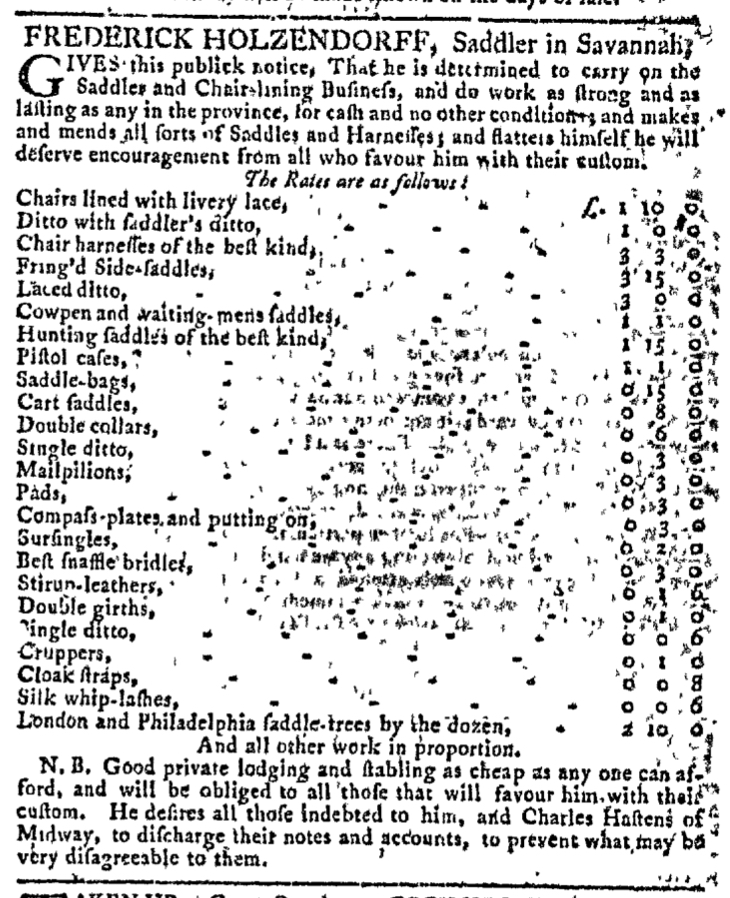
“Chairs lined with livery lace,     –     –     £.1   10   0.”

With the exception of subscription notices for books, prints, and other printed items, eighteenth-century advertisements rarely included prices for goods offered for sale. Merchants and shopkeepers sometimes indicated prices for limited numbers of items listed in their lengthy advertisements, but rarely did they associate specific prices with more than two or three products. Instead, they tended to promise low and competitive prices. Merchants who sold wholesale also indicated they offered discounts to those who purchased in bulk. Sometimes producers and suppliers published shorter advertisements that promoted just one or two commodities and indicated specific prices. Rarely, however, did an advertisement listing more than half a dozen items include prices for each of those items.

Frederick Holzendorff, a saddler in Savannah, took a unique approach to his advertisement when he specified prices for every items listed in his advertisement, from “Fring’d Side-saddles” (his most expensive product at 3 pounds and 15 shillings) to “Silk whip-lashes” and “Single girths” (his least expensive at only 6 pence each). The saddler let prospective customers know exactly what they could expect to pay for “Chairs lined with livery lace,” “Cart saddles,” “Best snaffle bridles,” and nearly two dozen other products. This allowed for comparison shopping, but may have also attracted customers who remembered approximately how much they paid for similar goods when they previously dealt with any of Holzendorff’s competitors.

Such an advertisement represented an investment by the saddler. In column inches it was the longest advertisement that appeared in the December 10, 1766, issue of the Georgia Gazette, thanks to the table that carefully listed one product per line along with its price in pounds, shillings, and pence. In and of itself, the table of “Rates” for each item visually distinguished Holzendorff’s advertisement from others. Though a couple of the dense real estate and legal notices may have had higher word counts, Holzendorff’s advertisement had more words than any that offered consumer goods and services.

Holzendorff experimented with indicating a price for every item he listed in his advertisement, presumably believing that this strategy would attract sufficient business to offset any additional costs of his lengthy advertisement compared to the shorter notices that appeared in his local newspaper.