November 4

What was advertised in a revolutionary American newspaper 250 years ago today?

Supplement to the Pennsylvania Evening Post (November 4, 1775).

“Those gentlemen who have taken subscriptions … are requested to return the lists speedily.”

A notice in the Supplement to the Pennsylvania Evening Post for November 4, 1775, advised that “THOSE gentlemen who intend to subscribe for HANSON’s EVOLUTIONS, and have not sent in their names, are requested to be speedy in forwarding them.”  Thomas Hanson, “Adjutant to the 2d Battalion” and author of the work, expected that the readers he addressed knew that he referred to The Prussian Evolutions in Actual Engagements; Both in Platoons, Sub, and Grand-Divisions; Explaining, all the Different Evolutions, and Manoeuvres, in Firing, Standing, Advancing, and Retreating, Which Were Exhibitted before His Present Majesty, May 8, 1769; and before John Duke of Argyle , on the Links, near Edenburgh, in 1771; with Some Additions, Since that Time, Explained with Thirty Folio Copper-Plates; To Which Is Added, the Prussian Manual Exercise; Also the Theory and Practices of Gunnery.  To include the entire title of the book would have doubled the length of the advertisement!  An advertisement published in July had included most of the title as a means of inciting interest among prospective subscribers.

Hanson had been marketing the book since early May, apparently embarking on the project almost as soon as residents of Philadelphia learned of the battles at Lexington and Concord that took place on April 19.  When he ran the newspaper advertisement in July, he anticipated that the “said work will be completed in three or four weeks from this date,” but it took longer than expected since more than three months later he ran a new advertisement that indicated the “first edition” had not yet been printed.  Subscribers needed to submit their names quickly, Hanson asserted, or else their names would not appear in the subscription list incorporated into the book with the other content.  That subscription list eventually filled five pages and included prominent military officers, such as “His Excellency George Washington” and “His Excellency Philip Schuyler,” and members of the Second Continental Congress, such as “The Honourable Benjamin Franklin” and “The Hon. John Hancock.”  Peyton Randolph also appeared among the list of subscribers, though he died before Hanson published the book.  In his newest advertisement, he once again instructed prospective subscribers to submit their names because “otherwise a list of them cannot be printed.”

In the earlier advertisement, Hanson listed about a dozen local subscription agents who collected orders, including merchants and printers.  This time, he told prospective subscribers that they could submit their names directly to him or “to the bar of the London Coffee-house,” a popular place for gathering to socialize, conduct business, and discuss politics.  Hanson did acknowledge those “gentlemen who have taken subscriptions” and requested that they “return the lists speedily” so he could compile them for publication.  It seemed to be the last chance to submit orders before the book was published.  The title page did not include a date, but historians believe it was printed in late 1775.

March 1

What was advertised in a colonial American newspaper 250 years ago today?

Pennsylvania Journal (March 1, 1775).

“THE American Edition of Swan’s British Architect.”

Less than a year after arriving in Philadelphia from London, John Norman, an engraver, embarked on producing an “American Edition of Swan’s British Architect” in the spring of 1775.  He unveiled the project with an advertisement in the March 1 edition of the Pennsylvania Journal, advising the public that he was “Now PUBLISHING” the volume “by SUBSCRIPTION” and seeking supporters to reserve their copies.  He asked those who did so to make a deposit and pay the remainder “at the delivery of the book,” noting that the total price “is Ten Shillings less than the London edition.”

The Continental Association, a nonimportation, nonconsumption, and nonexportation agreement devised by the First Continental Congress in response to the Coercive Acts, was in effect at the time that Norman advertised his American edition of Swan’s British Architect.  His project adhered to the eighth article, which called for “promot[ing] Agriculture, Arts, and the Manufacturers of this Country,” while the subject matter, all sorts of architectural elements in fashion in England, suggested that colonizers continued to value transatlantic cultural ties and their identity as members of the British empire.  The dispute with Parliament had intensified, but most still hoped for a redress of grievances and return to amiable relations.

In addition to the newspaper advertisement, Norman printed more extensive “proposals, with a specimen of the plates and letter press,” that interested parties could view at his house.  Prospective subscribers could learn more about the project and assess the quality of the engravings before placing their orders.  To further entice them, Norman declared that the “names of the subscribers to this useful and ornamental work will be published.”  Just as disseminating subscription proposals was a common marketing strategy in eighteenth-century America, so was publishing the list of subscribers.  In other circumstances, the “gentlemen” who subscribed wanted to see their names alongside those of other genteel members of their community.  That was still the case for this book, yet they likely also wished to see their names in print as they for supporting for an American edition.  Norman offered an opportunity to simultaneously demonstrate their commitment to both the arts and the Continental Association.

April 23

What was advertised in a colonial American newspaper 250 years ago today?

Providence Gazette (April 23, 1774).

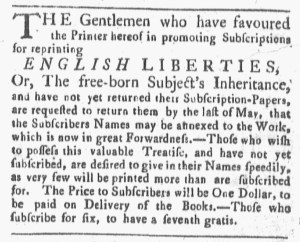
“Subscribers Names may be annexed to the Work.”

When John Carter, the printer of the Providence Gazette, set about publishing a new edition of English Liberties, Or the Free-Born Subject’s Inheritance: Containing Magna Charta, Charta de Foresta, the Statute de Tallagio non Concedendo, the Habeas Corpus Act, and Several Other Statutes, with Comments on Each of Them, he started with subscription proposals.  Early American printers often did not take books directly to press.  Instead, they disseminated proposals that described their intended projects, simultaneously seeking to gauge the market and to incite demand.  In requesting that subscribers reserve their copies in advance, sometimes asking them to pay a deposit, printers determined whether publishing proposed books would be viable ventures and, if so, how many copies to print to avoid producing surplus copies that cut into profits.  Subscription proposals ran as advertisements in newspapers and, for some proposed works, “Subscription-Papers” circulated separately as handbills, broadsides, and pamphlets.

Many printers recruited local agents to assist them in collecting the names of subscribers and how many copies each wished to reserve.  Carter did so with English Liberties.  In an update in the April 23, 1774, edition of the Providence Gazette, he advised that the book “is now in great Forwardness.”  Most likely much of the type had been set and supplies, such as paper, acquired by the printing office.  Carter instructed the “Gentlemen who have favoured the Printer hereof in promoting Subscriptions … to return [their subscription papers] by the last of May.”  He needed to receive them by that time so “the Subscribers Names may be annexed to the Work.”  That was a popular strategy for inciting demand among prospective customers, promising that their names would appear along with others who also subscribed.  They became part of a community of readers, even if they never met, and, in this instance, a community of citizens committed to those “ENGLISH LIBERTIES” that had been “The free-born Subject’s Inheritance” for generations.  Printers suggested to those who had not yet subscribed that they needed to do so if they wished to be recognized alongside their friends and acquaintances and the most prominent members of their communities who already made a statement about the causes that they supported by subscribing for one or more copies.

Carter deployed other marketing strategies to encourage subscriptions for English Liberties.  He warned that “very few will be printed more than are subscribed for,” so anyone who even had an inkling that they might want a copy should not depend on waiting to purchase the book after it went to press.  In addition, Carter offered a premium: “Those who subscribe for six, to have a seventh gratis.”  Subscribers who purchased multiple copies would receive a free one as a reward.

Carter did indeed insert a list of “SUBSCRIBERS NAMES” at the end of the book.  They appeared in somewhat alphabetical order, with last names starting with “A” coming first, followed by “B,” and so on.  Carter indicated the town for subscribers who did not reside in Providence and, within each letter, clustered subscribers from the same town together.  That made it easier for subscribers to determine which of their neighbors had joined them in supporting the enterprise.  Most were from towns in Rhode Island, Massachusetts, and Connecticut, but some subscribed from greater distances, including Robert Johnston of Chester County in Pennsylvania and Thomas Tillyer in Philadelphia.  The roster of subscribers included nearly five hundred names, mostly men, but also Mrs. Elizabeth Belvher of Wrentham, Massachusetts, several lawyers and ministers, and even Darius Sessions, the deputy governor of Rhode Island.  For those who subscribed for multiple copies, Carter listed how many.  A few purchased two or three copies, but more commonly subscribers purchased six, a sign of the effectiveness of the printer’s marketing strategy.

Not all subscription proposals resulted in publishing books.  Printers sometimes learned that they could not generate sufficient demand.  In this case, however, the combination of the subject matter’s relationship to the political climate, widespread distribution of subscription papers to local agents, publishing the names of subscribers, and free copies for those who purchased at least six contributed to the success of the venture, though it had taken more than a year.

March 27

What was advertised in a colonial American newspaper 250 years ago today?

Providence Gazette (March 27, 1773).

“Very few will be printed that are not subscribed for.”

For several months John Carter, the printer of the Providence Gazette, disseminated subscription proposals for “reprinting ENGLISH LIBERTIES, or THE FREE-BORN SUBJECT’S INHERITANCE” in his own newspaper and in other newspapers published in New England.  He recruited local agents in Providence and other towns to collect the names of subscribers who reserved copies in advance, a rudimentary form of market research that allowed him to assess demand and the number of copies he needed to print.  In an advertisement that ran in the New-Hampshire Gazette in December 1772, for instance, he indicated that “Subscriptions are received by JOHN CARTER, the Publisher, and by T. and J. FLEET, at the Heart and Crown, in Boston” as well as “by a Number of Gentlemen in the neighbouring Towns and Governments, to whom Subscription Papers are sent.”

On March 27, 1773, Carter inserted a new notice in the Providence Gazette, one that called on “[t]hose Gentlemen who have favoured the Printer in promoting Subscriptions” to return their subscription papers, those broadsides, handbills, or pamphlets that described the proposed volume and had space for subscribers to add their names and the number of copies they wished to reserve.  He also issued another call for those who had not yet subscribed to do so quickly, noting that they would have their “Names prefixed, as Patrons of a Work that contains … a full and compleat View of our Rights as Freemen and British Subjects.”  Books published by subscription often included a list of subscribers, a means of giving credit to those who supported the project and made publication possible.  Such lists also testified to membership in a community that shared common ideals, in this instance a desire to understand and to protect their “Rights as Freemen and British Subjects.”  Carter anticipated that political sympathies and current events might convince some prospective customers that they did indeed want their names among the subscribers to the project, visible to the rest of the subscribers and anyone else who read the book.  The copy in the collections of the American Antiquarian Society includes a six-page list of subscribers at the end.  The placement may have been a decision made by the purchaser or the bookbinder rather than the order intended by the publisher.

Carter made other pitches as he prepared to take the book to press.  He cautioned, “Very few will be printed that are not subscribed for,” so anyone interested needed to reserve their copies in advance or risk the publisher running out.  In addition, the limited number of surplus copies “will be sold at an advanced Price.”  In other words, Carter planned to charge more for those books than the “One Dollar” subscribers paid.  Finally, the printer offered bonus content, declaring that he planned to insert “some valuable Remarks and Additions … by a Gentleman learned in the Law.”  That, Carter confidently stated, would “render the Work still more worthy of the public Attention.”  In his efforts to market an American edition of English Liberties, Carter incorporated several strategies commonly deployed by printers, publishers, and booksellers in eighteenth-century America.

December 18

What was advertised in a colonial American newspaper 250 years ago today?

New-Hampshire Gazette (December 18, 1772).

“PROPOSALS for Re-printing by Subscription, ENGLISH LIBERTIES.”

In the first week of November in 1772, John Carter, printer of the Providence Gazette, issued a proposal for “Re-printing by Subscription, ENGLISH LIBERTIES, OR, The free-born Subject’s INHERITANCE,” a volume “Compiled first by HENRY CARE, and continued with large Additions, by WILLIAM NELSON, of the Middle Temple, Esq.”  The contents of the book included the “Magna Charta, or the Great Charter of English Liberties,” “a short History of the Succession, not by any hereditary Right,” “a Declaration of the Liberties of the Subject, and of the Oath of Allegiance and Supremacy,” and other essays.

Carter inserted the subscription proposal in the Providence Gazette, sometimes placing it on the front page to give it greater prominence.  Except for notices about goods and services available at his printing office, advertisements appeared on the final pages of that newspaper.  Carter also arranged to have the subscription proposal published in other newspapers in New England, including in the New-Hampshire Gazette.  The proposal stated that ‘SUBSCRIPTIONS are received by JOHN CARTER, the Publisher, and by T. and J. FLEET,” printers of the Boston Evening-Post, as well as “by a Number of Gentlemen in the neighbouring Towns and Governments, to whom Subscription Papers are sent.”  Daniel Fowle and Robert Fowle, printers of the New-Hampshire Gazette, likely had subscription proposals, either broadsides posted in their office or handbills to distribute to customers, and collected names of those who wished to reserve copies of the book.

In the proposal, Carter advised that he would not take the work to press without first knowing that he had generated sufficient interest to make it a viable venture.  “As soon as the Names and Residences of 500 Subscribers are collected,” he declared, “the Work will be immediately put to the Press, & compleated with all Expedition.”  It apparently took some time for Carter to convince that many consumers to subscribe to the project.  Unlike many books advertised via subscription proposal, however, he was eventually successful, publishing English Liberties more than a year later in 1774.  True to his word, Carter included a list of subscribers, six pages at the end of the book.  The “Friends of Libertyand useful Knowledge” that the printer addressed in the subscription notice could see their names listed among other “Friends of Liberty and useful Knowledge.”

July 31

What was advertised in a colonial American newspaper 250 years ago today?

Jul 31 - 7:31:1770 South-Carolina Gazette and Country Journal
South-Carolina Gazette and Country Journal (July 31, 1770).

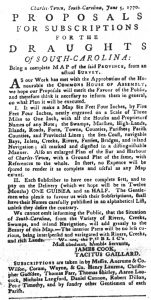
“The Gentlemen who please to favour us with their Subscriptions, shall have their Names carefully published in an alphabetical List.”

Like many books, maps were often published by subscription in the eighteenth-century.  Mapmakers published subscription notices to incite demand as well as gauge interest in their projects.  Doing so also allowed them to avoid some of the risk inherent in the enterprise.  Upon attracting a sufficient number of subscribers, they moved forward with confidence in the financial viability of the project.  On occasions that they lacked subscribers, they knew that it was not worth the time and resources required to publish a book or print a map.  Subscription lists also gave them a sense of how many copies to produce in order to avoid producing a large quantity that did not sell and counted against the financial success of the venture.

In the summer of 1770, James Cook and Tacitus Gaillard published “PROPOSALS FOR SUBSCRIPTIONS FOR THE DRAUGHTS Of SOUTH-CAROLOINA,” their subscription notice for a map of the colony.  They presented this undertaking as a community endeavor, first noting that their work “has met with the Approbation of the Honourable the COMMONS HOUSE OF ASSEMBLY” and stating that they hoped their “Proposals will merit the Favour of the Public.”  Subscribers did not need to contact Cook and Gaillard directly.  Instead, they designated local agents who gathered names on their behalf, listing them at the conclusion of the advertisement.  Those agents included several prominent merchants and planters as well as Peter Timothy, the printer of the South-Carolina Gazette.  In addition, “sundry other Gentlemen of each Parish” also accepted subscriptions and reported them to Cook and Gaillard.  The mapmakers gave the impression that their project already had the support – and the financial backing through subscriptions of their own – of some of the most prominent men in the colony.

Cook and Gaillard offered subscribers an opportunity to join the ranks of those prominent men … and to enjoy public recognition that they had done so.  “The Gentlemen who please to favour us with their Subscriptions,” the mapmakers promised, “shall have their Names carefully published in an alphabetical List, unless they desire the contrary.”  Books and maps published by subscription often featured such lists that acknowledged the benefactors that made the projects possible.  Publishing subscription lists drew together in one place all the members of the community that supported these projects, giving subscribers the chance to associate with others in a manner that remained visible to the public long after they subscribed, paid for, and collected their books and maps.  These lists became lasting records of which colonists supported the publication of books and maps.  Cook and Gaillard’s marketing strategy suggested that securing a spot on their subscription list was nearly as alluring as acquiring a copy of their beautifully rendered map.  Subscribers purchased prestige along with the map.