December 23

What was advertised in a revolutionary American newspaper 250 years ago today?

Virginia Gazette [Dixon and Hunter] (December 23, 1775).

“A large and exact VIEW of the late BATTLE at CHARLESTOWN.”

Like other printers, John Dixon and William Hunter sold books, pamphlets, almanacs, stationery, and other merchandise to supplement the revenues they generated from newspaper subscriptions, advertisements, and job printing.  They frequently placed advertisements in their newspaper, the Virginia Gazette, to generate demand for those wares.  The December 23, 1775, edition, for instance, included three of their advertisements, one for “SONG BOOKS and SCHOOL BOOKS For SALE at this OFFICE” and another for the “Virginia ALMANACK” for 1776 with calculations “Fitting VIRGINIA, MARYLAND, [and] NORTH CAROLINA” by “the ingenious Mr. DAVID RITTENHOUSE of Philadelphia,” the same mathematician who did the calculations for Father Abraham’s Almanack marketed in Philadelphia and Baltimore.

Their third advertisement promoted memorabilia related to the hostilities that erupted at Lexington and Concord earlier in the year.  “Just come to Hand, and to be SOLD at this PRINTING-OFFICE,” Dixon and Hunter proclaimed, “A large and exact VIEW of the late BATTLE at CHARLESTOWN,” now known as the Battle of Bunker Hill.  The copies they stocked were “Elegantly coloured” and sold for “one Dollar.”  Dixon and Hunter apparently carried a print, “An Exact View,” engraved by Bernard Romans and published by Nicholas Brooks, rather than a striking similar (and perhaps pirated) print, “A Correct View,” that Robert Aitken included in a recent issue of the Pennsylvania Magazine, or American Monthly Museum and sold separately.  Romans and Brooks had advertised widely and designated local agents to accept subscriptions for the print.  Dixon and Hunter also advertised another collaboration between Romans and Brooks, “an accurate MAP of The present SEAT of CIVIL WAR, Taken by an able Draughtsman, who was on the Spot at the late Engagement.”  The map also sold for “one Dollar.”  Previous efforts to market the map included a broadside subscription proposal that listed local agents in various towns, including “Purdie and Dixon, Williamsburgh.”  Romans and Brooks apparently had not consulted with all the printers, booksellers, and other men they named as local agents when they drew up the list or else they would have known that Alexander Purdie and John Dixon had dissolved their partnership in December 1774.  Dixon took on Hunter as his new partner while Purdie set about publishing his own Virginia Gazette.  Those details may have mattered less to Romans and Brooks than their expectation that printers, booksellers, and others with reputations for supporting the American cause would indeed aid them in marketing and selling a map depicting the conflict underway in Massachusetts.  Whether or not Purdie or Dixon and Hunter collected subscriptions, local agents in Williamsburg did eventually sell the print and the map that supplemented newspaper accounts and encouraged feelings of patriotism among the consumers who purchased them.
September 16

What was advertised in a revolutionary American newspaper 250 years ago today?

Pennsylvania Ledger (September 16, 1775).

“It is proposed to PRINT An Exact VIEW of the late BATTLE at CHARLESTOWN.”

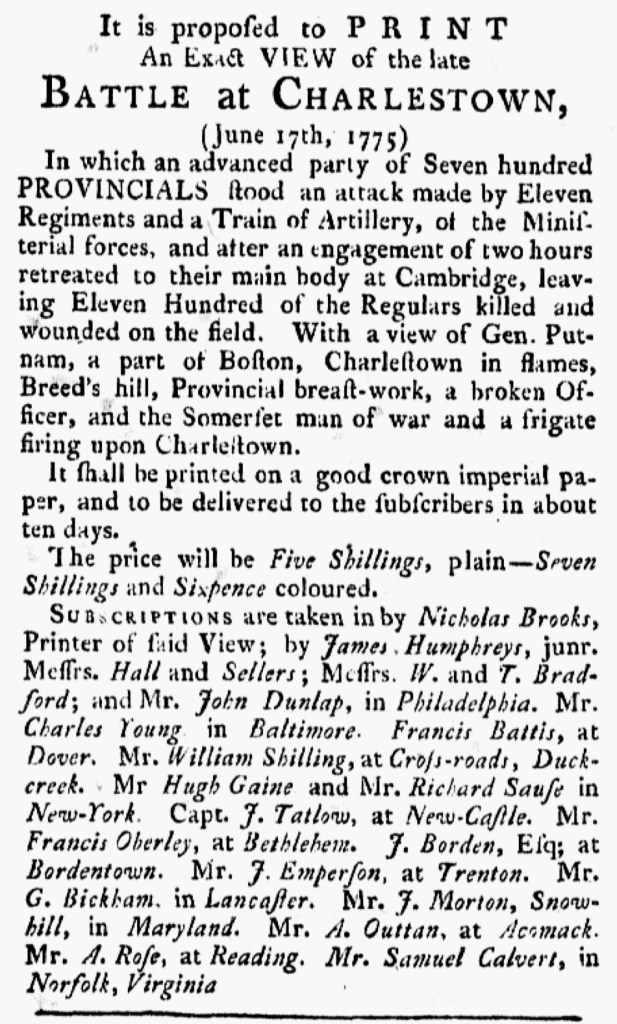
Bernard Romans, a cartographer, apparently met with sufficient success in marketing and publishing his “MAP, FROM BOSTON TO WORCESTER, PROVIDENCE AND SALEM” in the summer of 1775 that he launched a similar project as fall arrived.  He placed a subscription proposal for a print depicting “An Exact VIEW of the late BATTLE at CHARLESTOWN,” known today as the Battle of Bunker Hill, in the September 16, 1775, edition of the Pennsylvania Ledger.  The proposal stated that it “shall be printed on a good crown imperial paper” at a price of five shillings, “plain,” or seven shilling and six pence, “coloured.”

In promoting the print, Romans summarized the battle, though most readers likely already knew the details.  “[A]n advanced party of Seven hundred PROVINCIALS,” the cartographer narrated, “stood an attack made by Eleven Regiments and a Train of Artillery, of the Ministerial forces, and after an engagement of two hours retreated to their main body at Cambridge, leaving Eleven Hundred of the Regulars killed and wounded on the field.”  Even though the British prevailed, it was such a costly victory in terms of casualties that officers that British General Henry Clinton wrote in his diary, “A dear bought victory, another such would have ruined us.”  The Americans had reason to feel proud despite retreating.  Romans hoped to capitalize on that even as he aimed to publish a print that helped colonizers far from Boston visualize the battle.  The print included “a view of Gen. [Israel] Putnam,” an American officer, “a part of Boston, Charlestown in flames, Breed’s hill, Provincial breast-work, a broken Officer, and the Somerset man of war and a frigate firing upon Charlestown.”

As had been the case with his map, Romans collaborated with Nicholas Brooks, a shopkeeper and “Printer of said View” as well as local agents in several cities and towns from New York to Virginia.  The subscription proposal indicated that the print would be ready “to be delivered to the subscribers in about ten days,” not nearly enough time to disseminate the proposal and collect the names of subscribers before making the first impressions.  In both instances, Romans likely felt confident that consumers would be so interested in purchasing items that commemorated the newest chapter in the struggle against Britain that the demand for the map and the print would justify the expense of producing initial copies as well as prompt him to issue even more as local agents submitted their lists of subscribers.

September 6

What was advertised in a revolutionary American newspaper 250 years ago today?

Pennsylvania Journal (September 6, 1775).

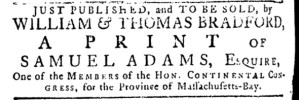
“A PRINT OF SAMUEL ADAMS, ESQUIRE, One of the MEMBERS of the HON. CONTINENTAL CONGRESS.”

The Second Continental Congress convened in Philadelphia after the battles of Lexington and Concord.  It met through most of the summer of 1775, took a recess during August, and started meeting again in September.  The delegates had just resumed their deliberations when William Bradford and Thomas Bradford, the printers of the Pennsylvania Journal, ran an advertisement promoting “A PRINT OF SAMUEL ADAMS, ESQUIRE, One of the MEMBERS of the HON. CONTINENTAL CONGRESS, for the Province of Massachusetts-Bay.”

Even though their advertisement stated, “JUST PUBLISHED, and TO BE SOLD, by WILLIAM & THOMAS BRADFORD,” this seems to have been another instance of printers treating those two phrases separately.  “TO BE SOLD” did indeed refer to the Bradfords stocking and selling the print at their printing office, but “JUST PUBLISHED” did not indicate that they had published the published the print, only that someone had recently published it and made it available for sale.  The Bradfords did not previously attempt to incite demand or gauge interest in a print of Adams among residents of Philadelphia with a subscription notice or other advertisement.

They most likely acquired and sold copies of the print that Charles Reak and Samuel Okey advertised in the Newport Mercury, the Massachusetts Spy, and the Boston-Gazette several months earlier.  In February, Reak and Okey took to the pages of the Newport Mercury to announce their intention to print a “striking likeness of that truly staunch Patriot, the Hon, SAMUEL ADAMS, of Boston.”  Near the end of March, a truncated advertisement in the Massachusetts Spy and the Boston-Gazette advised that “[i]n a few days will be published … A FINE mezzotinto print of that truly worthy Patriot S. A. … executed and published by and for Charles Reak and Samuel Okey, in Newport, Rhode-Island.”  The version in the Massachusetts Spy indicated that more information would appear in the next issue, but the printer, Isaiah Thomas, did not supply additional details in the last few issues printed in Boston before he suspended the newspaper for several weeks and relocated to Worcester just before hostilities commenced at Lexington and Concord.  Those events gave Reak and Okey an expanded market for a print of a Patriot leader already famous in New England.  Their advertisements in Boston’s newspapers listed local agents who would sell their print there.  The Bradfords likely became local agents in Philadelphia rather than publishers of another print of Adams.

August 5

What was advertised in a revolutionary American newspaper 250 years ago today?

Pennsylvania Ledger (August 5, 1775).

“Romans’s map of the seat of war near Boston.”

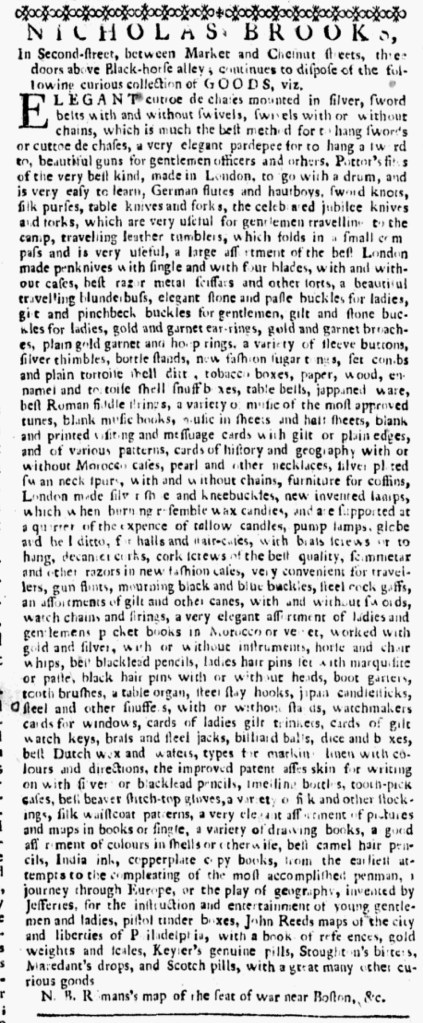
At the end of July 1775, Nicholas Brooks began running a new advertisement in the Pennsylvania Ledger.  It first appeared on July 29 and then again in the next two issues.  In it, Brooks hawked a “curious collection of GOODS” that he sold at his shop on Second Street in Philadelphia.  He listed everything from sword belts and “beautiful guns for gentlemen officers” and “gilt and stone buckles for ladies” to “razors in new fashion cases, very convenient for traveling” and “cork screws of the best quality” to “a very elegant assortment of ladies and gentlemans pocket books in Morocco velvet, worked with gold and silver” and “a variety of music of the most approved tunes.”  He also stocked “a very elegant assortment of pictures and maps in books or single.”  Brooks had already established “PRINTS and PICTURES” as a specialty.

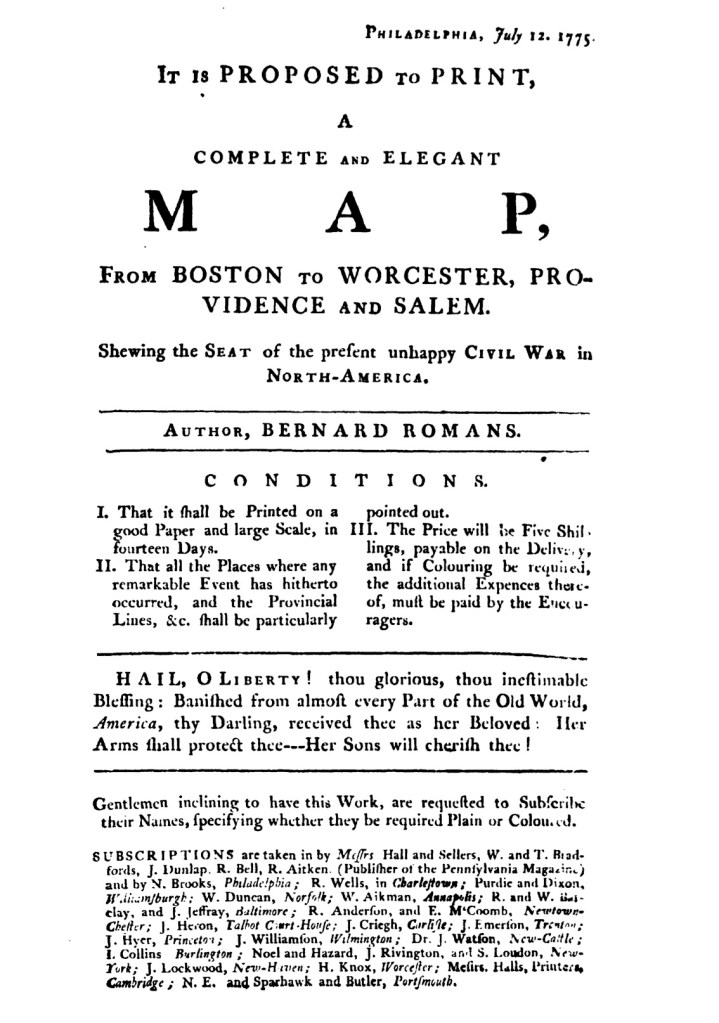
He concluded this advertisement with a nota bene that indicated he sold “Romans’s map of the seat of war near Boston,” but he did not say anything more about that item.  In addition, neither Brooks nor Bernard Romans, the cartographer and “AUTHOR” of the map, previously advertised the project in the Pennsylvania Ledger or any of the other newspapers printed in Philadelphia at the time.  Perhaps Brooks expected that readers were familiar with a broadside subscription proposal, dated July 12, that had been circulating or posted around town and beyond.  The subscription proposal featured the same copy as the advertisement for the map that ran in the August 3 edition of Rivington’s New-York Gazetteer, though the newspaper notice listed only local agents while the broadside gave a much more extensive list of printers, booksellers, and others who collected subscriptions in towns from New England to South Carolina.  James Rivington apparently adapted the broadside rather than composing copy for the advertisement when he inserted it in his newspaper.  That broadside documented a sophisticated network for inciting demand for the map and distributing it to subscribers.  In addition to the five printers and booksellers who collected subscriptions in Philadelphia, twenty-two local agents in eighteen towns in ten colonies collaborated with Brooks and Romans.  That list represented an “imagined community,” a concept developed by Benedict Anderson, of readers and consumers near and far who simultaneously examined the same map “Shewing the SEAT of the present unhappy CIVIL WAR in NORTH-AMERICA.”

Brooks did not limit his marketing of the map to the broadside subscription proposal and the nota bene at the end of an advertisement that cataloged dozens of items available at his shop.  He eventually ran newspaper advertisements devoted exclusively to the map, seeking to generate more interest and demand for such a timely and important work.

Broadside Subscription Proposal: “It Is Proposed to Print, A Complete and Elegant Map” (Philadelphia, 1775). Courtesy Library Company of Philadelphia.

**********

The Massachusetts Historical Society has digitized Romans’s map, accompanied by a brief overview of its significance and a short essay about Romans and other cartographers active during the era of the American Revolution.

July 26

What was advertised in a revolutionary American newspaper 250 years ago today?

Pennsylvania Gazette (July 26, 1775).

“A SERMON, on the present Situation of American Affairs … to distribute … among the Military Associators.”

A few days ago, I examined an advertisement for “A sermon on the present Situation of American Affairs” by William Smith that ran in the July 21, 1775, edition of the South-Carolina and American General Gazette.  I concluded that Wells likely sold copies of the pamphlet printed by James Humphreys, Jr., in Philadelphia and shipped to his “GREAT STATIONARY & BOOK STORE” in Charleston.  An advertisement in the July 26, 1775, edition of the Pennsylvania Gazette suggests that was indeed the case.

That notice listed several printers who stocked the sermon.  It gave top billing to James Humphreys, Jr., and noted that “the other Printers in Philadelphia” also sold the sermon.  Radiating outward from the city, the list next named Matthias Slough and Francis Bailey in Lancaster and then Hugh Gaine, the printer of the New-York Gazette and Weekly Mercury, in New York.  The list concluded with “Mr. ROBERT WELLS, in Charlestown, South-Carolina.”  Humphreys apparently dispatched copies to associates both in his own city and in other towns and colonies.

Another aspect of that advertisement indicates that Wells most likely sold copies of the sermon printed by Humphreys in Philadelphia.  Wells did not mention the price in his advertisement, but Humphreys gave prices for a single copy and multiple copies: nine pence for one copy, six shillings for a dozen, and six dollars for one hundred copies.  That pricing structure concluded with a note that Humphreys intended the discount for purchasing in volume as a benefit “for such Persons as may desire to distribute them among the Military Associators.”  He encouraged officers and other Patriots to disseminate the sermon widely by making a gift of it to those who volunteered to defend American liberties.  Humphreys was not alone in envisioning that officers would give books and pamphlets about current affairs as gifts.  George Washington had recently ordered eight copies of Thomas Hanson’s Prussian Evolutions in Actual Engagements to distribute among his subordinates.

The details in Humphreys’s advertisement strengthen the case that Wells did not publish his own edition of Smith’s sermon but instead advertised and sold copies that Humphreys printed in Philadelphia and distributed to printers and booksellers in several cities and towns.  Doing so contributed to the creation of what Benedict Anderson terms an “imagined community” grounded in print.  Newspapers played an important role as printers reprinted news and editorials from one to another, yet colonizers also had access to pamphlets, tracts, and sermons that circulated widely.  They did not have to be present when Smith delivered his sermon to engage with the ideas and arguments that the minister offered for consideration.

April 18

What was advertised in a colonial American newspaper 250 years ago today?

“An elegant Edition of the MANUAL EXERCISE [with] the various Positions of a Soldier under Arms.”

Pennsylvania Evening Post (April 18, 1775).

Advertisements for The Manual Exercise as Ordered by His Majesty in 1764: Together with Plans an Explanations of the Method Generally Practised at Reviews and Field-Days appeared in several newspapers printed in New England in 1774, one indication of how colonizers reacted to the trouble brewing with Great Britain.  Printers in five towns produced their own editions, including Ezra Lunt and Henry-Walter Tinges in Newburyport, Massachusetts, John Carter in Providence, Rhode Island, Judah Paddock Spooner in Norwich, and Thomas Green and Samuel Green in New Haven, Connecticut.  In Boston, Isaiah Thomas printed the book and Thomas Fleet and John Fleet issued three variant editions.  They may have also published a previous edition in 1773, based on an inscription that appears in one surviving copy.

In 1775, printers beyond New England produced other editions after the skirmishes at Lexington and Concord and the ensuing military actions.  In New York, Hugh Gaine published one edition; another printed by J. Anderson has been dated to that year.  William Bradford and Thomas Bradford issued the book in Philadelphia.  So did Robert Aitken, meeting with sufficient demand to issue a second edition.  Francis Bailey in Lancaster, Pennsylvania, James Adams in Wilmington, Delaware, and John Dixon and William Hunter in Williamsburg, Virginia, each published local editions in 1775.

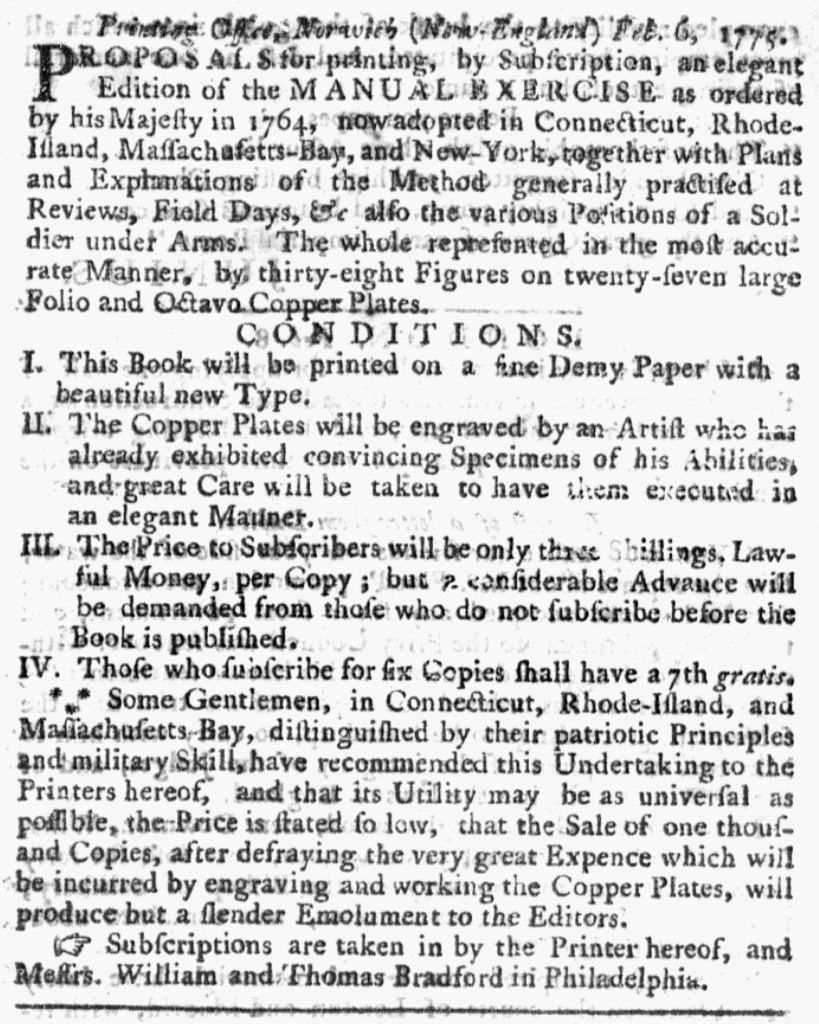
Alexander Robertson, James Robertson, and John Trumbull in Norwich, Connecticut, were among the printers who published an edition in 1774.  In the October 13 edition of the Norwich Packet, they advertised that they had “Just published … THE MANUAL EXERCISE, AS ORDERED BY HIS MAJESTY, And now adopted in the Colonies of CONNECTICUT, RHODE-ISLAND, and Province of MASSACHUSETTS-BAY.”  On February 23, 1775, they ran much more elaborate subscription proposals for another edition, an “ELEGANT EDITION” that would include “38 Figures on 27 large Folioand Octavo Copper Plates” that depicted the “various POSITIONS of a SOLDIER UNDER ARMS.”  They explained that “Some Gentlemen, distinguished by their patriotic Principles and military Skill, have recommended this Undertaking to the Printers” as a service to the public.  In the interest of disseminating the book widely so “its Utility may be as universal as possible,” the printers set a low price, “only three Shillings … per Copy” for subscribers who ordered theirs in advance.  Those “who do not subscribe before the Book is published,” on the other hand, could expect to pay “a considerable Advance” (or higher price).  The Robertsons and Trumbull set the price such that “the Sale of 500 Copies” would defray “the very great Expence which will be incurred by the engraving and working the Copper Plates” and yield “but a slender Emolument to the Editors.”

In those proposals, the printers listed local agents who collected subscriptions in Boston, Chelsea, Newburyport, and Salem in Massachusetts, Portsmouth in New Hampshire, and Providence in Rhode Island.  In addition, three post riders also took orders from subscribers.  Eventually, a version of the proposals ran in the Pennsylvania Evening Post.  It did not include the lengthy list of local agents in New England, but instead specified that Benjamin Towne, the printer of the Pennsylvania Evening Post, and William Bradford and Thomas Bradford, the printers of the Pennsylvania Journal, collected subscriptions in Philadelphia.  Perhaps the Bradfords had not yet determined to publish their own edition.  Those proposals also doubled the number of subscribers necessary for “defraying the great Expence” of the engravings to one thousand.

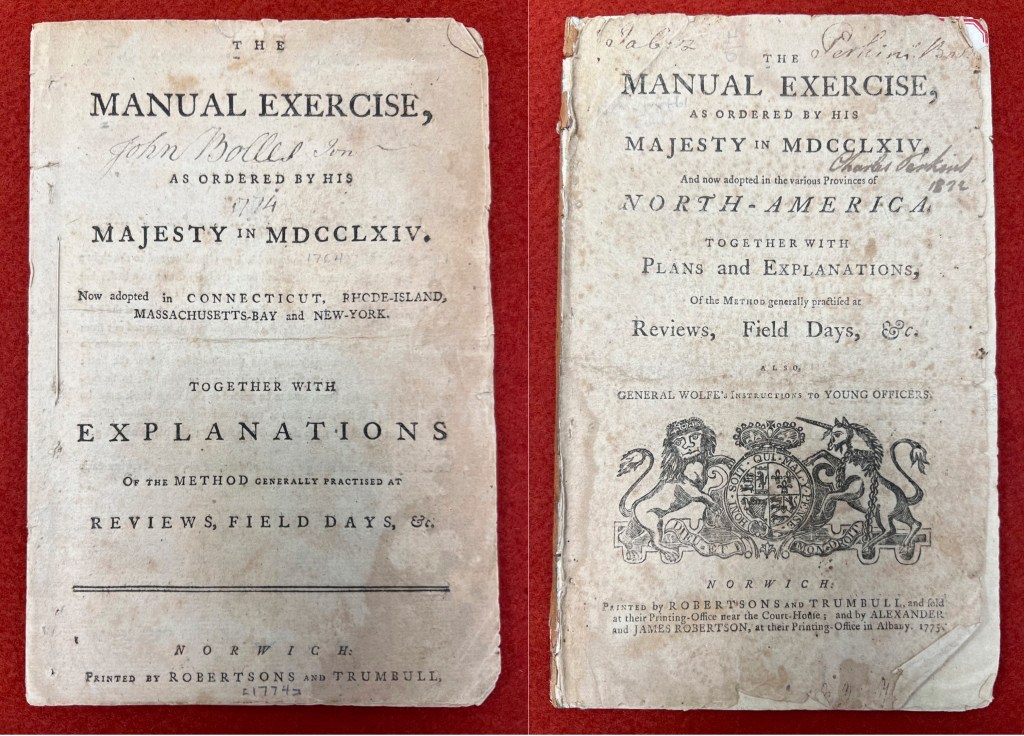
Even though the Robertsons and Trumbull promoted the copper plates, asserting that they “will be engraved by an Artists who has already exhibited convincing Specimens of his Abilities, and great Care will be taken to have them executed in an elegant Manner,” they did not include those illustrations with the new edition they published in 1775.  That edition closely paralleled their previous edition, though it did have a new title page and “Instructions for young OFFICERS.  By GENERAL WOLFE” on the final page, which had been blank in the 1774 edition.  While it is possible that the engravings were removed from the copy in the collections of the American Antiquarian Society at some point over the past 250 years, it seems more likely that events overtook the printers.  Once the imperial crisis became a war, they may have been less concerned about commissioning copperplate engravings and more interested in issuing a new edition of the Manual Exercise to meet the demand of colonizers who believed more than ever that they needed the instructions in that volume.

Copies of The Manual Exercise printed by Robertsons and Trumbull in the collections of the American Antiquarian Society. Left: 1774 edition. Right: 1775 edition.

March 23

What was advertised in a colonial American newspaper 250 years ago today?

Massachusetts Spy (March 23, 1775).

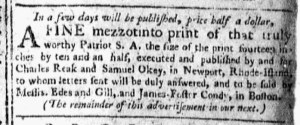
“A FINE mezzotinto print of that truly worthy Patriot S.A.”

When Charles Reak and Samuel Okey set about publishing a “FINE mezzotinto print of that truly worthy Patriot” Samuel Adams in the spring of 1775, they believed that they could generate interest in their project in Boston.  Accordingly, they placed advertisements in the March 23 edition of the Massachusetts Spy and the March 26 edition of the Boston-Gazette. Reak and Okey chose among the five newspapers published in Boston at the time, selecting the two that consistently took the strongest stance in favor of the American cause during the imperial crisis that eventually became a war for independence.  The savvy entrepreneurs knew which publications would put their notice before the eyes of readers most likely to form a market for a print of the influential and vocal advocate for American liberties.

The advertisement did not go into much detail about the print.  It did not even name Adams, trusting that prospective customers would recognize him from the description and his initials, “S.A.”  They did give the size, “fourteen inches by ten and an half,” so readers could envision framing and displaying the print.  A note at the end of Reak and Okey’s notice in the Massachusetts Spy suggested that they had provided more information to the printing office and “[t]he remainder of this advertisement [will appear] in our next [issue].”  The Boston-Gazette, however, carried the same copy without any additions.  The Massachusetts Spy did not run any version of the advertisement again, neither the original nor an updated variation.  Isaiah Thomas, the printer, published only two more issues in Boston before the political situation got too hot for him to remain there.  He re-established the Massachusetts Spy in Worcester, safely away from British authorities, in May.  The Boston-Gazette did run Reak and Okey’s advertisement one more time, on April 3, but Benjamin Edes and John Gill, the printers (and local agents designated to sell the print of Adams) suspended the newspaper after publishing the April 17 edition.  Following the skirmishes at Lexington and Concord on April 19, they dissolved their partnership.  Edes moved to Watertown and continued publishing the newspaper from there in June.  The outbreak of hostilities almost certainly disrupted Reak and Okey’s plans for advertising and distributing their print of Samuel Adams.

March 5

What was advertised in a colonial American newspaper 250 years ago this week?

Supplement to the New-York Journal (March 2, 1775).

“PARCHMENT … Made and sold … [in] Philadelphia.”

In the early 1770s, Robert Wood made and sold parchment in Philadelphia, yet he did not confine his marketing or distribution of his product to that city and its hinterland.  As spring approached in 1775, he ran an advertisement in the supplement that accompanied the March 2 edition of the New-York Journal, advising prospective customers that they could acquire his parchment from local agents.  John Holt, the printer of the New-York Journal, and Hugh Gaine, the printer of the New-York Gazette and Weekly Mercury, each stocked Wood’s parchment along with books, stationery, and writing supplies at their printing offices.  In addition, Joseph Dunkley, a painter and glazier, also supplied Wood’s parchment at his workshop “opposite the Methodist Meeting House.”  The New-York Journal circulated beyond the city, so some prospective customers would have found it more convenient to acquire Wood’s parchment from Isaac Collins, a printer in Burlington, New Jersey.  According to previous advertisements, Collins had been peddling Wood’s parchment to “friends to American Manufactures” for several years.

Wood asserted that the “Demand for this Parchment [was] much increased of late,” though he left it to readers to imagine why that was the case.  Most would assume that the Continental Association, a nonimportation agreement that went into effect on December 1, 1774, played a role in increased demand for parchment produced in the colonies.  Wood likely intended for prospective customers to draw the conclusion that the quality of his product, not merely its availability, contributed to the demand.  He declared that “those who have tried it … esteemed [it] superior to most imported from England.”  He was bold enough to resort to superlatives, claiming that customers considered his parchment better than any imported to the colonies, yet he offered firm assurances about it quality.  Wood had recently met with so much demand for his parchment that he “extend[ed] his Works … to be able to supply his Customers in a manner more satisfactory than heretofore, without Fear of a Disappointment.”  In other words, he stepped up production to expand his inventory so every customer who wished to purchase his parchment could do so.  Wood answered the call of the eighth article of the Continental Association with his own “Industry” in producing “Manufactures of this Country” as alternatives to imported goods.

December 8

What was advertised in a colonial American newspaper 250 years ago today?

Rivington’s New-York Gazetteer (December 8, 1774).

“It is therefore hoped that it will meet with a kind preference by all friends of America, and its manufactures.”

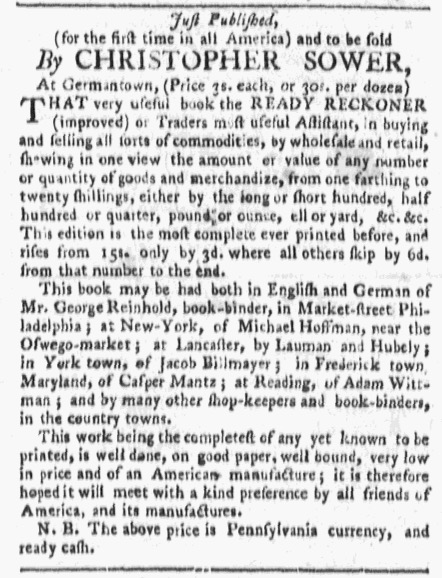
As the final days of 1774 approached, Christopher Sower, the printer of the Germantowner Zeitung, advertised an American edition of Daniel Fenning’s The Ready Reckoner; or Trader’s Most Useful Assistant, in Buying and Selling All Sorts of Commodities Either Wholesale or Retail.  The handy reference volume had been through several London editions, published it “for the first time in all America” and established a network of local agents to sell copies “both in English and German” in several cities and towns.  His advertisement in the December 8, 1774, edition of Rivington’s New-York Gazetteer listed his own printing office in Germantown, Pennsylvania, and named associates in Lancaster, Reading Philadelphia; New York City; Fredericktown, Maryland; and Yorktown, Virginia.  In addition, Sower claimed that “many other shop-keepers and book-binders, in the country towns” stocked the volume.  For those interested in selling copies at their shops, he offered a discount, thirty shilling for a dozen copies compared to three shillings for a single copy.  In other words, those who bought ten copies received two additional copies for free.

Sower declared that he issued an “improved” edition, “the most complete ever printed.”  The table it contained were supposed to save time and avoid errors in calculations, as the lengthy subtitle explained: “shewing at one view the amount or value of any number of quantity of goods from one farthing to twenty shillings … in so plain and easy a manner, that persons quite unacquainted with arithmetic may hereby ascertain the value of any number … at any price whatever.”  Sower considered it the “most complete” edition because it featured increments of three pence instead of six pence.  Yet that element alone did not recommend the book to prospective customers.  The publisher described it as “well done, on good paper, well bound and of an American manufacture.”  He did not specify whether “American manufacture” referred to the “good paper” as well as the labor undertaken in setting type, working the press, and binding the book.  Still, he expected that an American edition “will meet with a kind preference by all friends of America, and its manufactures” who might otherwise opt for a London edition published in 1773.  Sower’s call to purchase the American edition likely had even greater resonance given that the Continental Association, a nonimportation agreement adopted in response to the Coercive Acts, had recently gone into effect.

November 9

What was advertised in a colonial American newspaper 250 years ago today?

Pennsylvania Journal (November 9, 1774).

“Dr. Hill’s own direction is wrapped about each bottle.”

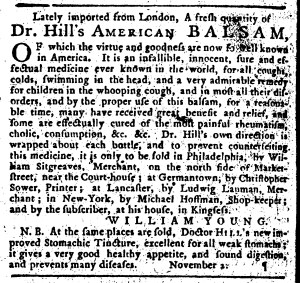
In the fall of 1774, William Young and his associates offered consumers exclusive access to “Dr. Hill’s AMERICAN BALSAM.”  According to an advertisement in the November 9 edition of the Pennsylvania Journal, this patent medicine “is an infallible, innocent, sure and effectual” cure for “coughs, colds, [and] swimming in the head” as well as a “very admirable remedy for children in the whooping cough, and in most all their disorders.”  Young implied that such recommendations may not have been necessary since the “virtue and goodness” of the medicine “are now so well known in America,” yet figured that trumpeting the efficacy of Dr. Hill’s American Balsam would aid in convincing consumers not yet familiar with this product.

As a means of guarding the reputation of this medicine and “to prevent counterfeiting,” a limited number of local agents stocked and sold this medicine.  Young made it available in Kingsess (or Kingsessing), just outside of Philadelphia.  William Sitgreaves, a merchant in Philadelphia, Christoper Sower, a printer in Germantown, and Ludwig Lauman, a merchant in Lancaster, each sold it as well.  Young also distributed Dr. Hill’s American Balsam to Michael Hoffman, a shopkeeper in New York, to sell there.  He had relied on that method for some time, having placed similar advertisement in May and October 1772.  Unlike some popular patent medicines widely stocked by apothecaries, merchants, shopkeepers, printers, booksellers, and other retailers throughout the colonies, only a select few carried Dr. Hill’s American Balsam.  The medicine came with “Dr. Hill’s own direction … wrapped about each bottle” to instruct patients how to use it to relieve or even cure “the most painful rheumatism, cholic, consumption,” and other maladies.  Such packaging represented another layer of marketing for this product, continuing to promote it to customers after they purchased it and took it home.

Young apparently considered these various strategies effective given that he invested in them on several occasions.  His marketing of Dr. Hill’s American Balsam incorporated the same elements in November 1774 that he deployed two and a half years earlier in May 1772.  That does not demonstrate the impact those methods had on consumers yet does suggest that Young considered them successful enough to repeat when he advertised once again.