June 3

What was advertised in a revolutionary American newspaper 250 years ago today?
Providence Gazette (June 3, 1775).

“POLLY and LUCY ALLEN, from Boston.”

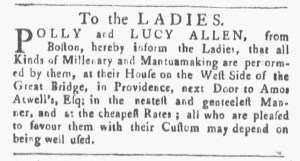
On June 3, 1775, Polly Allen and Lucy Allen published an advertisement addressed “To the LADIES” in the Providence Gazette.  That notice served as an introduction upon their arrival in the city, informing prospective customers and the community that “all Kinds of Millenary and Mantuamaking are performed by them, at their House on the West Side of the Great Bridge.”  Since the Allens were new to town, they gave further directions that stated their location relative to a resident familiar to readers, stating that they could be found “next door to Amos Atwell’s, Esq.”  New on the scene, they could not rely on their reputation among an established clientele to generate business.  Instead, they assured prospective customers that they made hats and garments “in the neatest and genteelest Manner, and at the cheapest Rates.”  In addition to skillful work on fashionable clothing at the lowest prices, the Allens also pledged exemplary customer service, stating that “all who are pleased to favour them with their Custom may depend on being well used.”

As part of their introduction, the Allens described themselves as “from Boston.”  That made them refugees, of sorts, who had been displaced during the first weeks of the Revolutionary War.  Following the battles at Lexington and Concord on April 19, militias from throughout Massachusetts, joined by companies from other colonies, besieged Boston.  The Massachusetts Provincial Congress, meeting in Watertown, negotiated with General Thomas Gage, the governor, to allow Loyalists who wished to enter the city to do so.  In return, Patriots and other “Inhabitants of the Town of Boston” could leave.  In each case, they could take their effects with them, “excepting their Fire-Arms and Ammunition.”  The Allens apparently took advantage of safe passage out of the city, along with between 12.000 and 13,000 other residents.  When they introduced themselves in the Providence Gazette as “POLLY and LUCY ALLEN, from Boston,” they did not need to say more for readers to piece together why they chose to relocate at that moment.  The Allens may have hoped that their situation would evoke some sympathy among prospective customers or even some curiosity among those who wanted to hear for themselves what conditions had been like since the Boston Port Act closed the harbor a year earlier and, especially, during the siege in recent weeks.  Some clients may have headed to the Allens’ shop in hope of stories as well as new hats and dresses.
February 10

What was advertised in a colonial American newspaper 250 years ago today?

South-Carolina and American General Gazette (February 10, 1775).

“JOHN HERRDENG, HAIR-DRESSER and PERFUMER.”

“MRS. HERRDING carries on the MANTUA-MAKING Business.”

“MISS HERRDENG will undertake to teach YOUNG LADIES the French Language.”

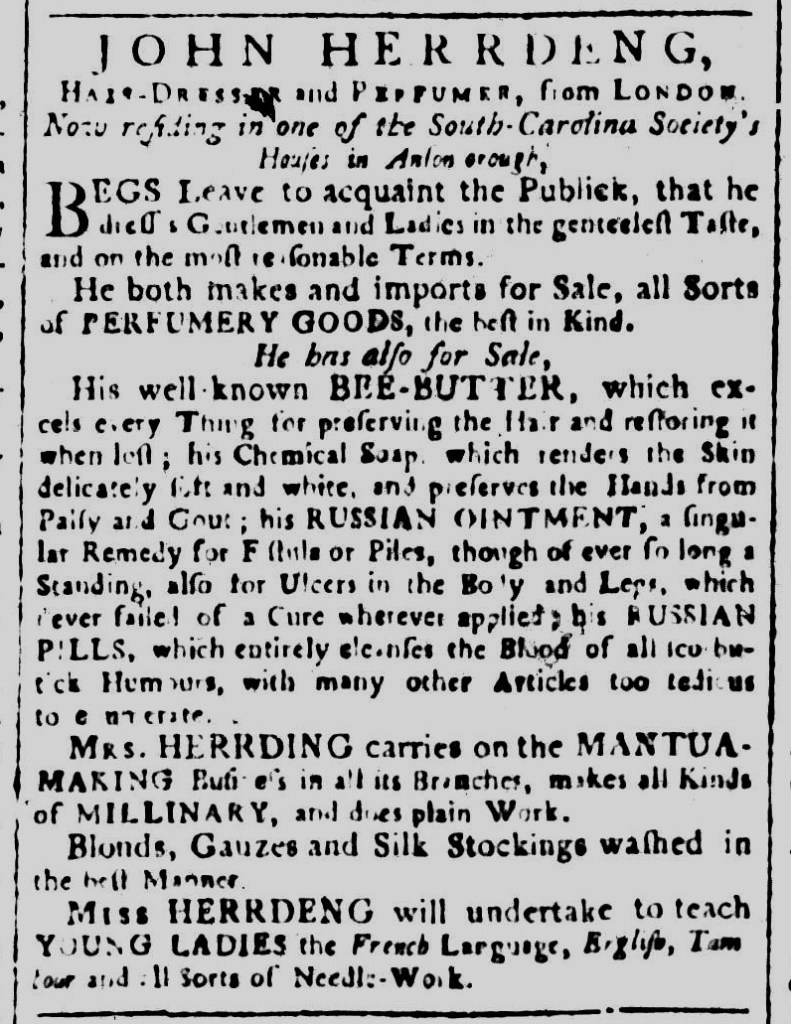
At a glance, the headline for an advertisement in the February 10, 1775, edition of the South-Carolina and American General Gazette promoted goods and services provided by John Herrdeng, a “HAIR-DRESSER and PERFUMER, from LONDON,” yet when they perused it more closely readers discovered that the notice also included entrepreneurial activities undertaken by other members of the Herrdeng household.  Descriptions of “PERFUMERY GOODS” and medicines that Herrdeng made and sold accounted for the first two thirds of the advertisements.  The final third outlined Mrs. Herrdeng’s “MANTUA-MAKING Business” and Miss Herrdeng offering lessons in French, English, and Needlework to the “YOUNG LADIES” of Charleston.

On occasion, the Adverts 250 Project has examined newspaper advertisements jointly placed by husbands and wives, brothers and sisters, or other relations residing in the same household.  This unusual advertisement, however, featured three family members who each pursued their own occupations.  As was often (but not always) the case, the man of the household received top billing.  Not only did the description of John Herrdeng’s goods and services take up the most space in the advertisement, his name, in larger font, appeared as the headline.  The order that the other members of the household appeared indicated their status and, likely, their experience.

Mrs. Herrdeng and Miss Herrdeng were not the only female entrepreneurs who advertised in that issue of the South-Carolina and American General Gazette.  Ann Fowler ran an advertisement for paper hangings and textiles that she also placed in the South-Carolina Gazette and Country Journal.  It filled almost as much space as the Herrdengs’ notice.  At the top of the column, Jane Thomson, a milliner, encouraged consumers to avail themselves of her services.  These advertisements made Fowler’s and Thomson’s presence in the marketplace much more visible in the public prints than Mrs. Herrdeng and Miss Herrdeng.  The Herrdengs made different decisions about how to depict themselves as entrepreneurs, yet their advertisement testifies to the contributions they made to their household beyond assisting a husband and father in his occupation.  The Herrdeng women practiced their own trades, engaged with their own clients, and resorted to advertising to facilitate their work.

November 22

What was advertised in a colonial American newspaper 250 years ago this week?

Maryland Gazette (November 19, 1772).

“They are well acquainted with the newest Fashions.”

When they settled in Annapolis, Jane Nelson and Anne Nelson took out an advertisement in the Maryland Gazette to introduce themselves to the community and encourage “Ladies … to favour them with their Commands” or orders for “all Kind of Milliners and Mantua-makers Work.”  As newcomers to the colony, they could not rely on their reputations to market their services.  Instead, they emphasized their connections to London, the cosmopolitan center of the empire, and their knowledge of current styles there.

In the deadline for their advertisement, the Nelsons proclaimed that they “Just arrived from LONDON.”  Artisans, tailors, milliners, and others often trumpeted that they were “from London” in their advertisements, sometimes long after they crossed the Atlantic.  The Nelsons made it clear that they only recently made that journey.  Accordingly, prospective clients could trust that they were indeed “well acquainted with the newest Fashions” and capable of making hats, cloaks, and other garments “in the most elegant and fashionable manner.”  Having recently come from London, the Nelsons could also provide guidance about “Ladies fashionable dress and undress Caps” and other items.

The Nelsons also aimed to convince prospective clients that they offered exemplary customer service.  They asserted that “Ladies … may depend on having their Work neatly done, and with the utmost Dispatch.”  If given a chance, the Nelsons assured those ladies that “they will not be disappointed in their Endeavours to please, as it shall be their constant Study and greatest Ambition.”  In addition to serving clients who visited them in Annapolis, the Nelsons also took “Orders from the Country,” pledging to punctually complete them.

These “Milliners and Mantua-makers” deployed a two-pronged approach to marketing their services upon arriving in Annapolis.  They promoted their connections to London, underscoring their familiarity with the latest tastes there, while simultaneously vowing to meet and exceed the expectations of their clients in terms of customer service.  The Nelsons hoped that combination of appeals would entice the ladies of Annapolis to engage their services.

September 7

What was advertised in a colonial American newspaper 250 years ago today?

Sep 7 - 9:7:1770 New-Hampshire Gazette
New-Hampshire Gazette (September 7, 1770).

“MANTU-MAKER, FROM BOSTON.”

Over the past few days the Adverts 250 Project has examined the manner in which purveyors of goods and services in the colonies incorporated their origins into their advertisements as part of their marketing campaigns.  We began with James Yeoman, a clock- and watchmaker “FROM LONDON,” who sought to convince readers of the New-York Gazette and Weekly Mercury that his skills eclipsed those of competitors who had not trained or worked in the largest city in the empire.  Next we looked at George Lafong, a “French HAIR-DRESSER,” who informed the ladies and gentlemen of Williamsburg, Virginia, that he styled hair “in the cheapest manner, & TOUT A LA MODE” (all in fashion).  Injecting a few words of French into his advertisement in William Rind’s Virginia Gazette underscored the gentility and cachet associated with hiring a hairdresser from France.

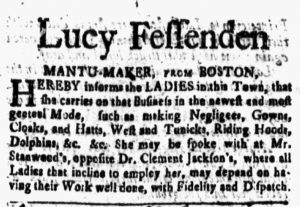
Today we consider the advertisement that Lucy Fessenden inserted into the September 7, 1770, edition of the New-Hampshire Gazette.  She introduced herself as a mantuamaker “FROM BOSTON,” asserting that she pursued her craft “in the newest and most genteel Mode.”  While Yeoman and Lafong’s advertisements testified to migration across the Atlantic, Fessenden’s notice indicated migration within the colonies.  In both instances, advertisers sought to use their origins to their advantage.  Artisans as well as tailors, milliners, and others in the garments trade, including mantuamakers like Fessenden, frequently noted that they formerly lived and worked in some of the largest port cities when they relocated to smaller towns and advertised their services.  Perceptions of skill and associations with gentility seemed to operate on a sliding scale.  Residents of Boston, Charleston, New York, and Philadelphia looked to London and other places on the far side of the Atlantic as models.  Residents of smaller towns did as well, but they also recognized the major ports in the colonies as locations that merited notice.  Unable to make a direct connection to London, Fessenden instead leveraged her time in Boston to suggest her familiarity with “the newest and most genteel Mode” and her ability to deliver on it “with Fidelity and Dispatch.”

May 14

What was advertised in a colonial American newspaper 250 years ago today?

May 14 - 5:14:1770 New-York Gazette and Weekly Mercury
New-York Gazette and Weekly Mercury (May 14, 1770).

“She has had the honour of being employed by several ladies in this city.”

Mary Morcomb did not indicate how recently she had arrived in New York in her advertisement, but it was recently enough that she described herself as a “Mantua-Maker, from London.”  After migrating to the colonies, she hoped to establish a new clientele.  To that end, she informed readers of the New-York Gazette and Weekly Mercury that she made “all sorts of negligees, Brunswick dresses, gowns, and every other sort of lady’s apparel.”  In addition, she extended her skills working with textiles to “cover[ing] UMBRELLOES in the neatest and most fashionable manner.”  Invoking her London origins testified to her access to the latest styles and taste, reassuring prospective customers that she did indeed produce both garments and umbrellas, a new and exotic accessory in the early 1770s, in the “most fashionable manner.”

As a newcomer who could not depend on a reputation established through interacting with clients and acquaintances over time, Morcomb instead attempted to accelerate the process.  She claimed that she already “had the honour of being employed by several ladies in this city.”  Those ladies, Morcomb reported, were satisfied with the garments she made for them and had “declared their approbation of her work.”  This was a secondhand testimonial, delivered by the provider of the goods and services, yet Morcomb hoped it would be sufficient to garner “encouragement from the ladies, in her business.”  She concluded by pledging that if prospective clients put their trust in her that they “May depend upon having their work done with all possible care and dispatch.”

In her effort to attract new customers, Morcomb deployed strategies often used by artisans, especially those in the garment trades, who only recently arrived in the colonies.  Many emphasized their connections to cosmopolitan cities where they had access to the latest fashions and then suggested that this already translated to serving select clients in their new location.  Although unfamiliar to many residents in their communities, Morcomb and other artisans attempted to incite demand by asserting that their services were already in demand.  Prospective customers should be eager to hire them, they proposed, because they had already successfully demonstrated their proficiency at their trades.

February 27

What was advertised in a colonial American newspaper 250 years ago today?

Feb 27 - 2:27:1770 South-Carolina Gazette and Country Journal
South-Carolina Gazette and Country Journal (February 27, 1770).

“HANNAH COLEMAN, … late apprentice to Mrs. Wish.”

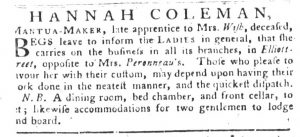
Hannah Coleman made mantuas.  These loose gowns worn by women first came into popularity in the late seventeenth century.  In February 1770, Coleman placed an advertisement in the South-Carolina Gazette and Country Journal to “inform the LADIES in general” that she carried on the business of a “MANTUA-MAKER … in all its branches.”  She used a phrase commonly deployed by artisans to indicate that there was no part of her trade beyond her abilities.  Accordingly, she pledged that customers would have their garments made “in the neatest manner.”  To bolster that claim, Coleman relied on another strategy that often appeared in advertisements placed by artisans, though one usually invoked by men rather than women.  She listed her credentials when she named her occupation.  Rather than “HANNAH COLEMAN, MANTUA-MAKER,” she was “HANNAH COLEMAN, MANTUA-MAKER, late apprentice to Mrs. Wish, deceased.”  She assumed that prospective clients would be familiar with the reputation of the departed Mrs. Wish or at least feel reassured that Coleman had completed an apprenticeship.

Although Coleman adopted a strategy usually reserved for men, her efforts to market mantuas fashioned a world in which women participated in commercial transactions without reference to men.  She addressed “the LADIES in general.”  She established her connection to her mentor, Mrs. Wish.  She even listed her location in relation to another woman, stating that she did business “in Elliott-Street, opposite to Mrs. Peronneau’s” rather than naming male neighbors or using other landmarks.  In a nota bene, Coleman did note that she sought “two gentlemen to lodge and board,” but the portion of the advertisement about her activities as a mantua maker depicted a world of women who created their own networks, taught each other, and traded with each other.  Women in business tended to publish newspaper advertisements less often than their male counterparts in eighteenth-century America, perhaps because they relied on gendered networks as an alternate means of attracting customers.  They participated in the marketplace, but chose means of promoting their enterprises that yielded less visibility among the general public even while generating familiarity among female consumers.

September 4

What was advertised in a colonial American newspaper 250 years ago today?

Sep 4 - 9:4:1769 New-York Gazette or Weekly Post-Boy
New-York Gazette or Weekly Post-Boy (September 4, 1769).

“She has had the Honour of being employed by several Ladies in this City.”

In an advertisement that ran in the September 4, 1769, edition of the New-York Gazette or Weekly Post-Boy, Mary Morcomb, a dressmaker, announced that she made “all Sorts of Negligees, Brunswick Dresses, Gowns, and every other Sort of Lady’s Apparel.” She also applied her skills to covering umbrellas, a fashionable accessory for many women and some men in the 1760s and 1770s.

Morcomb deployed the standard market strategies. She made appeals to price, quality, and fashion, promising prospective customers that she made garments and covered umbrellas “in the neatest, and most fashionable Manner, at the lowest Prices.” Morcomb also realized that reputation was important in attracting clients and building her business. She informed readers that she “has had the Honour of being employed by several Ladies in this City, who have declared their Approbation of her Work.” Given that Morcomb described herself as a “MANTUA-MAKER from LONDON,” she may have arrived in New York relatively recently. The newcomer may not have had time to establish a clientele in the city but had managed to find some work from “several Ladies,” leveraging their approval into a secondhand testimonial. Satisfied customers generated more customers, but word-of-mouth referrals and cultivating a reputation took time. To speed along the process, Morcomb asked the women of New York to trust her that she already served “several Ladies in this City.” In exchange for that trust, Morcomb pledged that new customers “may depend upon having their Work done with all possible Care and Dispatch.” This may not have been enough to convince every prospective client of her skills and the quality of her garments, but it may have been sufficient for some to take a chance with Morcomb. Even if the dressmaker entice only a few more clients with her advertisement, that new business could further enhance her reputation among female consumers in New York.

July 26

What was advertised in a colonial American newspaper 250 years ago today?

Jul 26 - 7:26:1768 South-Carolina Gazette and Country Journal
South-Carolina Gazette and Country Journal (July 26, 1768).

“Mrs. Crane continues to make … the Brunswick dresses, so much esteemed in England.”

In the summer of 1768, John and Sarah Crane placed an advertisement in the South-Carolina Gazette and Country Journal to inform residents of Charleston and the surrounding area that they had “removed from the house” where they formerly kept their workshop to a new location. The tailor and mantuamaker considered it “their duty, not only to acquaint the gentlemen and ladies of this town” that they had moved but also to express “their sincere acknowledgments for the many favours they have received.” The Cranes wanted their existing clientele to follow them to their new location. They anticipated the “pleasing prospect” of the “continuance” of their business, but acknowledging their customers in the public prints served as more than a means of maintaining those relationships. It also communicated to prospective clients that other consumers in the busy port had already sought out their services.

The Cranes may have considered this especially important since they had only recently arrived in Charleston. They described themselves as “Very Lately arrived from LONDON,” though they had been in town for at least five months. They had previously advertised in February, yet they still considered themselves new to the community. Despite the disadvantages of being newcomers, depicting themselves in this manner worked to their advantage in certain ways. It established a direct connection to the cosmopolitan center of the empire, suggesting that they relied on their own knowledge when they pledged to make garments “in the newest taste.” To further make their case, they noted that “Mrs. Crane continues to make … the Brunswick dresses, so much esteemed in England.” The glossary of “Colonial Lady’s Clothing” compiled by historians at Colonial Williamsburg describes the Brunswick as a “three-quarter length jacket worn with a petticoat” that was worn as “an informal gown or a traveling gown. It had a high neck, unstiffened bodice that buttoned, long sleeves, and frequently had a sack back (loose pleats) and a hood.” The Brunswick reached the height of its popularity in the 1760s, indicating that the Cranes were right on message when they chose it as an example to demonstrate their awareness of the “newest taste” in London.

When it came to stating how long they had been in Charleston, the Cranes tried to have it both ways. They had been in the city just long enough to faithfully serve some of its residents, but not so long that their personal observations of popular styles in London had become outdated. They expected both of these factors to appeal to prospective clients.

February 16

What was advertised in a colonial American newspaper 250 years ago today?

Feb 16 - 2:16:1768 South-Carolina Gazette and Country Journal
South-Carolina Gazette and Country Journal (February 16, 1768).

“JOHN & SARAH CRANE, TAYLOR and MANTUA-MAKER, from LONDON.”

Given their participation in the colonial marketplace as the providers of goods and services, women were underrepresented among the advertisements in eighteenth-century newspapers. Some female entrepreneurs did place their own advertisements to promote businesses they operated, but others followed a different strategy when they jointly advertised with men. Such advertisements had several variations. In most, a woman advertised alongside a male relation, most often as wife and husband but sometimes as siblings or as mother and son. On occasion, women advertised with male partners who were not related to them, but such instances were much less common.

Joint advertisements also varied in terms of how prominently they featured women’s activities in the marketplace. Some focused almost exclusively on the activities of a male head of household and only mentioned in passing that a woman also worked in the shop or otherwise provided goods or services on her own. Such advertisements frequently used the man’s name as the headline and did not mention the woman until the final sentence or in a nota bene that almost seemed an afterthought. Others, such as an advertisement by John Holliday and Mrs. Holliday, devoted equal amounts of space to the separate endeavors of both parties, yet still focused primary attention on the husband by using his name as the headline and promoting his business before turning to his wife.

Sometimes, however, men and women placed advertisements that portrayed them as equal partners in their enterprises, especially when they pursued related occupations. That was the case with John and Sarah Crane, “TAYLOR and MANTUA-MAKER, from LONDON,” in an advertisement in the January 16, 1768, edition of the South-Carolina Gazette and Country Journal. The headline featured both of their names in capital letters. The body of the advertisement addressed the qualities they both contributed to the garments they made. A nota bene even promoted certain items made by “Mrs. Crane” beyond those customers might have expected from a mantuamaker, suggesting her skill and versatility. The Cranes apparently continued this egalitarianism into other aspects of their marketing. Their advertisement indicated their shop was marked “With their names in gold letters over the door.” The space there they conducted their business, just like their advertisement, was a shared domain where the Cranes acted as partners. Their story demonstrates what was possible for married women as providers of goods and services in the colonial marketplace, even if it was not the most probable arrangement.

December 29

What was advertised in a colonial American newspaper 250 years ago today?

Dec 29 - 12:29:1767 South-Carolina Gazette and Country Journal Supplement
Supplement to the South-Carolina Gazette and Country Journal (December 29, 1767).

“Fechtman undertakes to make stays and negligees, gowns and slips, without trying, for any lady in the country.”

Christopher Fechtman, a “STAY and MANTUA-MAKER from LONDON,” promoted his services in an advertisement in the supplement to the December 29, 1767, edition of the South-Carolina Gazette and Country Journal. After noting his change of address, he launched several appeals intended to incite demand for his services and instill a preference for obtaining stays, mantuas, and other items from him rather than his competitors.

Fechtman offered a guarantee of sorts, pledging to “give entire satisfaction to those who favour him” with their patronage. He did so with confidence, underscoring his own “knowledge of the business.” Yet Fechtman did not labor alone in his shop. He also employed “some experienced hands, who understand their business to the utmost dexterity.” Artisans commonly noted their skill and expertise in eighteenth-century advertisements. Fechtman assured potential customers that his subordinates who might have a hand in producing their garments were well qualified for the task. He staked his own reputation on that promise.

The staymaker also proclaimed that he would “work at a lower rate than any heretofore,” hoping to entice prospective clients with lower prices. High quality garments produced by skilled workers did not necessarily have to be exorbitantly expensive. Quite the opposite: Fechtman indicated that his prices beat any his competitors had ever charged.

Finally, Fechtman offered his services to women who resided in Charleston’s hinterland, widening his market beyond those who could easily visit his shop on Union Street while they ran other errands around town. To that end, he played up the convenience of procuring his services, noting that he could “make stays and negligees, gowns and slips, without trying, for any lady in the country.” His female clients did not need to visit his shop for a fitting. Presumably they forwarded their measurements when submitting their orders from a distance; tailors and others who made garments sometimes included instructions to send measurements with orders in their advertisements.

Fechtman competed with other stay- and mantua-makers in Charleston, a busy port city. To distinguish his garments and services from the competition, he resorted to several marketing strategies in his advertisement. He emphasized skill and expertise, both his own and that of the “experienced hands” who labored in his shop. He also offered low prices as well as convenience to clients unable to visit his shop for fittings. In the process, he encouraged prospective clients to imagine acquiring “stays and negligees, gowns and slips” from him, stoking demand and desire for his wares.