December 31

What was advertised in a colonial American newspaper 250 years ago this week?

Dec 31 - 12:28:1769 Massachusetts Gazette and Boston Weekly News-Letter
Massachusetts Gazette and Boston Weekly News-Letter (December 28, 1769).

“Induce those Gentlemen who have long been Customers, to renew their Subscription.”

Richard Draper, printer of the Massachusetts Gazette and Boston Weekly News-Letter, marked the end of 1769 with a notice to subscribers in the final edition of the year. He did not so much mark the imminent start of a new calendar year as much as he noted that “This Paper concludes the Year of many of the Subscribers to it.” He took the opportunity to encourage “those Gentlemen who have ling been Customers, to renew their Subscription” for another year.

Draper made this appeal in a crowded media market, the most crowded in the American colonies. Boston, a bustling urban port, was among the largest cities, but others were larger. Despite that fact, printers in Boston published more newspapers in the late 1760s than their counterparts in Charleston, New York, and Philadelphia. As 1769 drew to a close, Draper’s Massachusetts Gazette and Boston Weekly News-Letter competed with four other newspapers published in Boston: the Boston Chronicle (one of the few newspapers anywhere in the colonies published twice a week, but also noted for its Loyalist sympathies and tone), the Boston Evening-Post, the Boston-Gazette (perhaps the most vocal in support of the Patriot cause, but certainly not the only newspaper that took that stance), and the Massachusetts Gazette and Boston Post-Boy.

Given the competition, Draper asked subscribers to consider what distinguished his newspapers from others. “The Publisher hopes by the Carefulness in his Publications of giving Intelligence in the most authentic Manner,” he stated, “that the Paper will retain the Credit it always had of being as judicious … as any other Paper.” Draper suggested that he took his role as editor seriously, carefully selecting the contents of each issue to deliver accurate information rather than propaganda to his readers. An example of his editorial style appeared on the page following his notice to subscribers. He republished three letters from the Essex Gazette, providing a short explanation by way of introduction: “Having in our last published from the Essex Gazette, the Advertisement of the Committee of Merchants at Marblehead, wherein several Gentlemen’s Names were mentioned, Justice requires us to publish the Vindication of themselves, taken from the last Essex Gazette.” Having inserted a portion of the story in one edition, Draper continued coverage as more information became available. More partisan printers might not have been so generous or conscientious. In his monumental History of Printing in America (1810), Isaiah Thomas praised Draper, declaring that he “was esteemed the best compiler of news of his day.”[1] That was the characteristic that Draper marketed to subscribers when he called on them to renew their subscriptions. They could depend on receiving a carefully curated newspaper that kept them well informed of the events of the day.

**********

[1] Isaiah Thomas, The History of Printing in America with a Biography of Printers and an Account of Newspapers, ed. Marcus A. McCorison (1810; New York: Weathervane Books, 1970), 144.

December 28

What was advertised in a colonial American newspaper 250 years ago today?

Dec 28 - 12:28:1769 Advert 1 Massachusetts Gazette and Boston Weekly News-Letter
Massachusetts Gazette and Boston Weekly News-Letter (December 28, 1769).

“Advertisement in Reply to Mr. Samuel Anthony’s, inserted in the first Page of this Paper.”

It began as an advertisement concerning “a Negro Man named Cuffe, about 22 years of Age” who made his escape from Edward Bardin. That advertisement followed a standard format, offering a physical description of Cuffe, listing the clothes he wore when he departed, offering a reward for his capture and return, and warning “Masters of Vessels” and others against “harbouring, concealing or carrying off” Cuffe. Bardin’s advertisement generated a response that called into question whether Cuffe actually escaped from Bardin. Samuel Anthony inserted a notice in the December 25, 1769, edition of the Boston-Gazette to advise the public that Isaac Winslow had sold Cuffe to him and, in turn, Anthony had sold Cuffe to James Lloyd. Anthony suggested that Cuffe had not escaped from Bardin, advising that “All Persons are therefore hereby caution’d against taking up said Negro as they may depend on being prosecuted therefor by Dr. Lloyd, who purchas’d him fairly, and is determined to defend his Right to him by Law against all Persons whatever.” That same advertisement included details of several transactions that had transferred Cuffe from one enslaver to another.[1]

Dec 28 - 12:28:1769 Advert 2 Massachusetts Gazette and Boston Weekly News-Letter
Massachusetts Gazette and Boston Weekly News-Letter (December 28, 1769).

Three days later, the Massachusetts Gazette and Boston Weekly News-Letter carried both advertisements. The compositor helpfully placed them one after another on the front page, inserting a heading to inform readers that Anthony’s notice was a “NOTIFICATION in Answer to the above ADVERTISEMENT.” Bardin had apparently seen Anthony’s advertisement in the Boston-Gazette. He penned a response on December 27, in time for it to appear in the December 28 edition of the Weekly News-Letter, but not early enough for it to run alongside the other advertisements. Instead, the compositor once again devised a header, this one labeling Bardin’s notice as an “Advertisement in Reply to Mr. Samuel Anthony’s, inserted in the first Page of this Paper.” This new addition to the feud between Bardin and Anthony filled as much space as the other two notices combined, going into even more detail about the agreements Bardin, Anthony, Winslow, and Lloyd made concerning Cuffe. Bardin concluded by asserting, “[A]s I am threatned by Doctor Lloyd to be sued to the uttermost of the Law if I dare or any one else to touch the said Negro, as he claims him as his Property, I am determined for to know by the Law who has the best Right to him,” excluding the possibility that Cuffe had the “best Right” to himself.

This series of advertisements suggests that Cuffe never “RAN-away” from Bardin. Instead, Bardin advertised that Cuffe escaped and offered a reward for his capture and return as a ploy for getting him back from others who claimed that they now rightfully held him in bondage. The subsequent advertisements did not report that Cuffe had escaped amid all the confusion over whom “has the best Right to him.” Bardin adapted the standard runaway advertisement to suit other purposes.

**********

[1] Bardin and Anthony both described Cuffe as a “Servant,” but neither provided other details that identified him as an indentured servant rather than an enslaved man. For instance, they both provided extensive details about the agreements they negotiated concerning Cuffe, but neither mentioned how much time remained of his indenture. Although Black men, women, and children were sometimes indentured rather than enslaved in colonial New England, in this instance it appears that Bardin and Anthony conflated the words “servant” and “slave” in describing Cuffe.

December 17

What was advertised in a colonial American newspaper 250 years ago this week?

Dec 17 - 12:14:1769 Massachusetts Gazette and Boston Weekly News-Letter
Massachusetts Gazette and Boston Weekly Mercury (December 14, 1769).

“The lowest Price of Lemmons.”


John Crosby’s advertisements were a familiar sight for readers of the Massachusetts Gazette and Boston Weekly News-Letter in 1769. Every week he advised prospective customers that he sold “Fresh Lemmons” and other citrus fruit “at the Sign of the Basket of Lemmons.” Yet he did more than merely invite residents of Boston to purchase his wares. His marketing efforts included listing his prices. While other purveyors of consumer goods and services frequently made appeals to low prices, most rarely advertised specific prices for their wares. Crosby made a point of promising low prices and demonstrating to prospective customers that he did indeed offer bargains. For instance, on December 14, 1769, he advertised lemons for “Two Pistareens per dozen,” stating that was “the lowest I can get them to yet.” In addition, he sold “very fine LIMES at Six Shillings per dozen.”

When it came to his lemons, Crosby set the same price regardless of how many customers purchased, from “large and small Quantities down to the single Dozen.” Some eighteenth-century merchandisers allowed for discounts for buying in volume, but Crosby took the opposite approach. He advised prospective customers that they did not need to buy in bulk to get a good deal. He made his best prices available to all customers, provided that they bought at least a dozen. He reiterated that point in order to underscore it: “any one that buys to the Amount of one Dozen, shall have them as cheap in proportion as tho’ they bought a Box.”

Crosby also provided regular reports on the price of lemons at his shop, his own abbreviated price current restricted to a single commodity. He emphasized that service in his advertisements, noting that there “will be a Weekly Account as usual in this Day’s Paper, of the lowest Price of Lemmons.” In so doing, he made his advertisements a regular feature in the newspaper, a feature that consumers could depend on finding as they perused each new edition. In an era when many advertisers inserted the same notice for three or four weeks and then allowed it to expire without publishing a new advertisement, Crosby constructed an ongoing advertising campaign that required constant maintenance. His advertisements were more than an invitation or appeal to prospective customers; in updating the prices of lemons and other citrus fruit each week, Crosby’s advertisements provided a service to consumers in Boston.

December 3

What was advertised in a colonial American newspaper 250 years ago this week?

Dec 3 - 11:30:1769 Massachusetts Gazette and Boston Weekly News-Letter
Massachusetts Gazette and Boston Weekly News-Letter (November 30, 1769).

“All the above is the Produce & Manufacture of North-America.”

John Gore sold paint and supplies at his shop at “the Sign of the PAINTERS ARMS, in Queen-Street” in Boston in the late 1760s and early 1770s, a curious time to peddle those products. In addition to imported paper, tea, glass, and lead, the Townshend Acts imposed duties on imported paint. In response to such taxes, colonists in Boston and other cities and towns organized nonimportation agreements that covered a vast array of goods. They intended to use economic pressure to convince Parliament to repeal the Townshend Acts.

Given how politics affected commerce, Gore quite carefully enumerated the items he offered for sale at his shop. He led his advertisement with linseed oil, turpentine, varnish, lacquer, and “very good red, black and yellow Paints.” He then explicitly stated that “All the above is the Produce & Manufacture of North-America.” In other words, he had not violated the nonimportation agreement; prospective customers could safely purchase those items from him without sacrificing their own political principles. Furthermore, he demonstrated his commitment to the cause by offering “domestic manufactures” as an alternative to imported goods. In addition to the Townshend duties, colonists in Boston and elsewhere expressed concern about a trade imbalance with Britain. Many advocated producing goods in the colonies as a means of reducing dependence on imports. Buying and selling goods produced in North America thus served several purposes, including boosting local economies and providing employment for the colonists who made those goods. Advertisers often listed such outcomes when they simultaneously encouraged consumers to purchase domestic manufactures to achieve political purposes. Although Gore did not do so in this advertisement, he likely expected that many readers would make such arguments on his behalf, having encountered them so often in public discourse.

Selling goods produced in the colonies, however, did not prevent Gore from peddling imported goods as well. After first promoting merchandise from North America, Gore then noted that he also carried “An Assortment of Colours” but carefully explained that they had been “imported before the Agreement of the Merchants for Non-importation took Place.” Gore still had inventory imported from England to sell. Rather than take a loss, he stated the terms under which he had acquired those goods. Their presence alongside “the Produce & Manufacture of North-America” quietly testified to the fact that even though colonists attempted to devise appropriate substitutes for many imported goods they were not positioned to sustain themselves. Political rhetoric did not necessarily reflect the realities of commerce, production, and consumption in eighteenth-century America. Gore structured his advertisement to assert as much political virtue as possible in an imperfect situation.

November 13

What was advertised in a colonial American newspaper 250 years ago today?

Nov 13 - 11:13:1769 Massachusetts Gazette and Boston Post-Boy
Massachusetts Gazette and Boston Post-Boy (November 13, 1769).

“My Character of an honest and industrious Woman can be asserted to all who may inquire.”

Runaway wife advertisements were a particular genre of paid notices that frequently appeared in eighteenth-century newspapers. In such an advertisement an aggrieved husband reported that his disobedient wife departed from the household without his permission. The husband warned others that he would not pay any debts contracted in his name by his wife. Some advertisements went into greater detail than others in recording the various offenses committed by runaway wives. No matter how elaborate, publishing such advertisements must have been just as embarrassing, if not more so, for husbands than wives. After all, it was a public confession that a husband had not been able to exercise patriarchal authority or maintain order in his own household. Instead, he turned to the community for assistance in disciplining his wife.

In the fall of 1769, John Kennedy repeatedly inserted a runaway wife advertisement in Green and Russell’s Massachusetts Gazette and Boston Post-Boy. Dated “Bridgewater, Sept. 29, 1769,” it stated, “WHEREAS Margaret Kennedy, the Wife of me the Subscriber, has left my Bed and Board, and refuses to live with me:— This is to forwarn all Persons from trusting the said Margaret on my Account, for I hereby declare I will not pay one Farthing of her contracting from the Day of the Date hereof.”

Rarely did such notices generate a response, but occasionally wives did publish their own advertisements to address the accusations made by their husbands and defend their reputations. Margaret Kennedy did so in the November 13 edition of the Massachusetts Gazette and Boston Post-Boy. In an advertisement dated “Bridgewater, Nov. 10, 1769,” she expressed her dismay that she had been identified in “Green and Russell’s Weekly Paper as an Eloper from the Bed and Board of my Husband.” She did not acknowledge that her husband had placed the advertisement, but instead asserted that “an ill-minded Person” published an account that was “an absolute Falshood.” She also declared that she had never incurred any debt on his behalf, not “one Shilling Lawful Money.” Having been maligned in a newspaper that circulated well beyond Boston, she defended her reputation and references for anyone uncertain about which spouse to believe in the course of this public altercation. “[M]y Character of an honest and industrious Woman,” she declared, “can be asserted to all who may inquire it by a Number of my Friends in Boston, and the Community I belong to.”

Margaret met John’s advertisement with another act of resistance, one exceptionally visible to friends, neighbors, and strangers. His original advertisement continued to run in the November 13 edition of the Massachusetts Gazette and Boston Post-Boy, appearing on the page following Margaret’s response. Readers now had both sides of the story in a single issue, witnessing the Kennedys’ marital discord play out in print, even if not in person.

November 9

What was advertised in a colonial American newspaper 250 years ago today?

Nov 9 - Massachusetts Gazette and Boston Weekly News-Letter
Massachusetts Gazette and Boston Weekly News-Letter (November 9, 1769).

“The Whole of which were imported by himself before the Non-Importation Agreement took Place.”

William Greenleaf’s advertisement in the November 9, 1769, edition of the Massachusetts Gazette and Boston Weekly News-Letter looked much like others that promoted consumer goods. Extending half a column, it listed a vast assortment of items available at his shop, everything from “Silk & worsted Sagathies” to “Ivory, Bone, & Ebony Fans” to “Necklaces and Earings of various sorts” to Persia Carpets three yards square.” In addition to its celebration of consumer culture and encouragement for colonists to acquire more goods, Greenleaf’s advertisement also addressed the politics of the day. The shopkeeper assured the entire community that his entire inventory had been “imported by himself before the Non-Importation Agreement took Place.” In so doing, he protected his reputation and signaled to prospective customers that they could buy his wares without compromising their political principles.

When it came to advertising textiles and accessories, the bulk of Greenleaf’s merchandise, most merchants and shopkeepers emphasized how recently their goods had arrived in the colonies. “Just Imported” implied that these items represented the latest fashions from London and other English cities. In 1769, however, this popular appeal no longer possessed its usual power to entice prospective customers. New merchandise was politically problematic merchandise. The merchants and traders of Boston and other towns in Massachusetts adopted nonimportation agreements to protest the duties Parliament imposed on imported paper, glass, lead, paint, and tea. If Parliament intended to tax those items, then colonists resolved not to import an even greater array of goods from Britain. The goods that merchants and shopkeepers stocked and sold possessed political significance based on when those items arrived in the colonies.

In the late 1760s and early 1770s, colonists observed the commercial practices of their friends, neighbors, and other members of their communities. Greenleaf realized that all merchants and shopkeepers were under scrutiny to detect if they violated the nonimportation agreement. Committees investigated suspected violations and published names and accounts of their actions in newspapers, alerting consumers not to do business with them and warning others to abide by the agreement. In such an environment, Greenleaf considered it imperative to assert that he sold merchandise that did not breach the nonimportation agreement. In his business practices, he expressed a commitment to the patriot cause.

October 12

What was advertised in a colonial American newspaper 250 years ago today?

Oct 12 - 10:12:1769 Massachusetts Gazette and Boston Weekly News-Letter
Massachusetts Gazette and Boston Weekly News-Letter (October 12 1769).

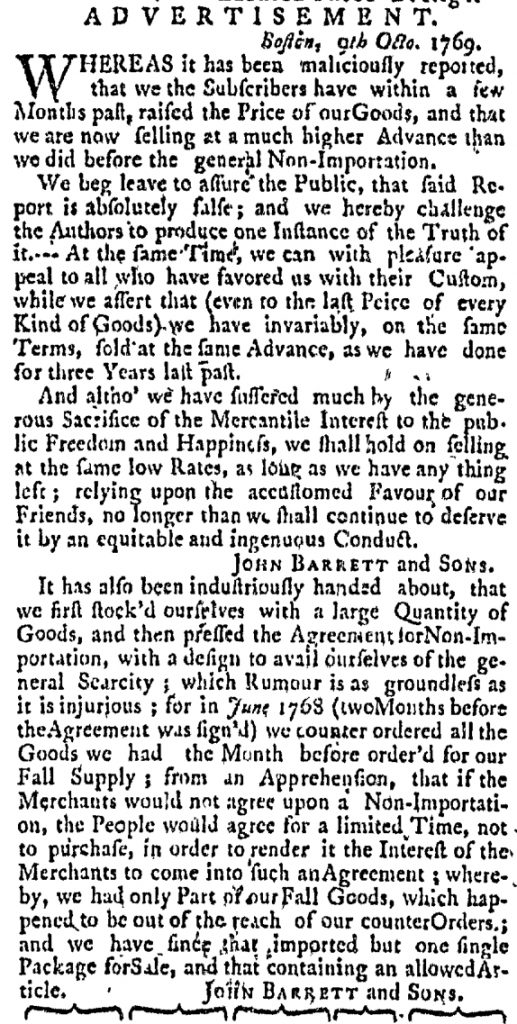
“We have suffered much by the generous Sacrifice of the Mercantile Interest to the public Freedom and Happiness.”

This “ADVERTISEMENT” by John Barrett and Sons most likely was not a paid notice but rather a letter to the editor of the Massachusetts Gazette and Boston Weekly News-Letter. Either the Barretts or the printer used the word “advertisement” to mean a notification or a written statement calling attention to something, common usage in the eighteenth-century but chiefly historical today. Unlike most paid notices that ran for multiple weeks, this “ADVERTISEMENT” appeared only once, suggesting that the printer did indeed insert it as an article of interest for readers. Still, this “ADVERTISEMENT” appeared immediately above a paid notice for consumer goods. It testifies to some of the discourse that animated the appeals made in paid notices that promoted consumer goods and services.

Barrett and Sons sought to address rumors that dogged their business in the midst of the nonimportation agreement. Others had “maliciously reported” that they engaged in price gouging, charging much more than they did “before the general Non-Importation” to take advantage of the perceived scarcity of goods. The Barretts assured readers, both their customers and the general public, that they had “invariably, on the same Terms” sold their wares at the same prices “as we have done for three Years last past.” Just as significantly, they had accepted the ramifications to their business for doing so, indicating that they had “suffered much by the generous Sacrifice of the Mercantile Interest to the public Freedom and Happiness.” They pledged to continue “selling at the same low Rates” as to support the cause. The prospects for their business and their personal interests mattered less than virtuously participating in the nonimportation agreement for the benefit of all colonists.

That being the case, Barrett and Sons addressed a second rumor that accused them of ordering surplus stock ahead of the nonimportation agreement going into effect in order to have plenty of merchandise to continue selling to colonial consumers. The Barretts argued that was exactly the opposite of what happened: the “Rumour is as groundless as it is injurious.” Instead, in June 1768, two months before the merchants of Boston signed the nonimportation agreement, Barrett and Sons cancelled their orders for fall goods. They feared that the merchants would not reach agreement on nonimportation and, if that happened, the general public would then assume adopt nonconsumption as an alternative strategy, refusing to purchase imported goods. The Barretts expected that a broad nonconsumption movement by colonists would sway merchants, convincing them to overcome their hesitation about nonimportation. That had not become necessary, but Barrett and Sons informed the public (and prospective customers) that they envisioned the possibility of such a plan going into effect.

The politics of commerce and consumption tinged every word in this “ADVERTISEMENT” by Barrett and Sons. They defended their reputation to the general public, presenting a narrative of their own actions in relation to nonimportation and nonconsumption intended to enhance, rather than merely rehabilitate, their standing in the community. They sought to convince their fellow colonists that they were savvy but not unscrupulous traders who simultaneously tended their own business interests and promoted the public good … and when the two came into conflict, they opted for the public good over their own enterprises. Civic virtue imbued the decisions they made about their business.

September 28

What was advertised in a colonial American newspaper 250 years ago today?

Sep 28 - 9:28:1769 Boston Chronicle
Boston Chronicle (September 28, 1769).

“Will be READ, THE BEGGARS OPERA.”

The itinerant performer who staged a one-man rendition of The Beggar’s Opera in Providence on the evening of September 18, 1769, did not linger long in that city to offer encore performances. Instead, he quickly moved on to new audiences in Boston, according to advertisements that ran in the Boston Chronicle and the Massachusetts Gazette and Boston Weekly News-Letter on September 28. Perhaps attendance at the Providence performance did not merit remaining for additional shows; alternately, the performer may have planned in advance to move from one city to the next fairly quickly, making arrangements for the venues ahead of his arrival. Whatever the explanation, he attempted to attract as large an audience as possible by inserting an advertisement in both newspapers published in Boston on Thursdays, a day before the performance “At a Large ROOM in BRATTLE STREET, formerly GREEN and WALKER’S Store.”

The performer was consistent in his messaging. Aside from the details about the location of performance and where to purchase tickets, the copy in the Boston newspapers replicated what ran in the Providence Gazette less than two weeks earlier (though the typography varied from newspaper to newspaper according to the discretion of the compositor). “Will be READ,” the notice proclaimed, “THE BEGGARS OPERA, By a Person who has READ & SUNG, IN MOST OF THE GREAT TOWNS IN AMERICA, All the SONGS will be SUNG.” The advertisement further described the performer’s delivery for the prospective audience: “He personates all the CHARACTERS, and enters into the different HUMOURS or PASSIONS, as they change from one to another throughout the OPERA.” When it came to the copy of the advertisements in the Boston newspapers, there was only one small variation. The version in the Massachusetts Gazette and Boston Weekly News-Letter advised, “No Person to be admitted without a Ticket.” The notice in the Providence Gazette included the same warning, a means of suggesting that the event would be so popular that readers risked missing out if they did not secure their tickets quickly. The version in the Boston Chronicle did not express the same urgency. Was the omission the fault of the performer or the compositor? The latter seems more likely considering how carefully the actor attended to marketing his performances.

These advertisements in the Providence Gazette and, later, newspapers published in Boston demonstrate some of the opportunities for colonists to participate in early American popular culture. They also suggest that even though some aspects of popular culture may have been local that others were shared throughout the colonies and beyond. The performer underscored that he had “READ & SUNG, IN MOST OF THE GREAT TOWNS IN AMERICA.” On his current tour, he presented a show already exceptionally popular in England, connecting colonists culturally to Britain even as they experienced political ruptures due to the Townshend Acts and other perceived abuses by Parliament. While the press offered one means of creating an imagined community among colonists, itinerant performers provided another way of cultivating a sense of community. This advertisement encouraged residents of Boston to participate in popular culture shared with colonists in other “GREAT TOWNS.”