August 16

What was advertised in a revolutionary American newspaper 250 years ago today?

Massachusetts Spy (August 16, 1775).

“An unwearied Pedlar of that baneful herb TEA.”

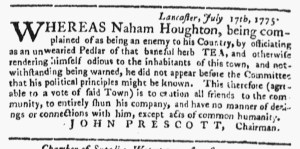
Naham Houghton of Lancaster, Massachusetts, went too far and there had to be consequences.  An advertisement in the August 16, 1775, edition of the Massachusetts Spy gave an abbreviated account of what occurred.  According to John Prescott, chairman of the local Committee of Inspection, there had been complaints that Houghton behaved as “enemy to his Country, by officiating as an unwearied Pedlar of that baneful herb TEA, and otherwise rendering himself odious to the inhabitants of this town.”  Prescott did not elaborate on the other infractions.  Selling tea was enough to get Houghton into hot water.

That violated the Continental Association, a nonimportation agreement devised by the First Continental Congress in response to the Coercive Acts imposed by Parliament in retribution for the Boston Tea Party.  The eleventh article outlined an enforcement mechanism, stating that a “Committee be chosen in every County, City, and Town” to monitor compliance with the pact.  When a majority determined that someone committed a violation, they would “cause the truth of the case to be published in the Gazette, to the End that all such foes to the rights of British America may be publickly known and universally condemned as Enemies.”  In turn, the rest of the community would “break off all Dealings with him, or her.”

The committee in Lancaster apparently sought to work with Houghton in seeking an explanation for his actions, but to no avail.  Prescott reported that Houghton refused to “appear before the Committee that his political principles might be known” even though he had been warned.  Neither the committee nor the town tolerated such defiance.  The town voted “to caution all friends to the community, to entirely shun his company,” as the Continental Association instructed, “and have no manner of dealings or connections with him, except acts of common humanity.”  Selling tea continued to resonate as a political act, yet it was only one of many offenses that made Houghton “odious” to his neighbors.  At the same time that others suspected of Tory sympathies confessed their errors and used newspaper advertisements to rehabilitate their reputations, Houghton steadfastly refused to bow to such pressure exerted by the Committee of Inspection.  He instead became the subject of an advertisement that made clear, far and wide, that he was not in good standing in his community.

August 9

What was advertised in a revolutionary American newspaper 250 years ago today?

Massachusetts Spy (August 9, 1775).

“DESERTED from the service of the Colony of Connecticut … a Soldier named Thomas Cushing.”

Early American newspapers carried various kinds of “runaway” advertisements.  By far, the largest number of those notices concerned indentured servants who left before their contracts expired or enslaved people who liberated themselves by escaping from their enslavers.  A smaller number of such advertisements featured apprentices and convict servants who, like indentured servants, ran away while they still had time to serve.  On occasion, ship captains advertised sailors who did not wish to return to sea, at least not on the same vessel, and seized opportunities to get away while in port.  In addition, advertisements about wives who “eloped” from their husbands warned against extending credit to those misbehaving women.  In each instance, the advertisements told only part of a story as framed by the master, enslaver, captain, or husband who wrote it.

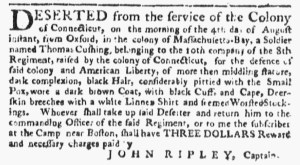
Shortly after the Revolutionary War began, another sort of runaway advertisement began appearing in newspapers, notices about soldier who deserted.  The August 9, 1775, edition of the Massachusetts Spy carried one such advertisement.  It reported on “a Soldier named Thomas Cushing” who had “DESERTED from the service of the Colony of Connecticut” on the morning of August 4 while the “10th company of the 8th Regiment” was encamped at Oxford, just a little to the west of Worcester, Massachusetts.  The regiment had been “raised by the colony of Connecticut, for the defence of said colony and American Liberty.”  The deserter had not fulfilled the commitment he made to the cause, though Captain John Ripley did not indicate Cushing’s reasons for leaving without authorization.  Perhaps family obligations trumped political principles, especially once the man experienced life as a soldier, though even those reasons explained but did not excuse deserting.  Ripley offered a reward to “Whoever shall take up said Deserter and return him to the commanding Officer of the said Regiment.”  The first page of that issue of the Massachusetts Spy featured “RULES and ARTICLES, for the betterGOVERNMENT of the TROOPS raised, or to be raised … by … the TWELVE UNITED ENGLISH COLONIES of NORTH AMERICA.”  Those included “ART. 17. No officer or soldier shall lie out of his quarters, or camp, without leave from the commanding officer of the regiment, upon penalty of being punished according to the nature of his offence, by order of a regimental court martial.”  Cushing certainly faced consequences if captured and returned to his regiment.

At about the same time that some colonizers resorted to advertisements in the public prints to assure the public of their fidelity to the American cause, other advertisements about soldiers who deserted from the American army began appearing.  Newspapers notices provided a means for asserting and assessing loyalty during a time of war.

July 5

What was advertised in a revolutionary American newspaper 250 years ago today?

Massachusetts Spy (July 5, 1775).

“A NARRATIVE OF THE EXCURSION and RAVAGES OF THE KINGS TROOPS, Under the Command of General Gage.”

I am fortunate to live just a few miles from the American Antiquarian Society in Worcester, Massachusetts.  I pass the AAS on my way to campus, take students there to examine primary sources from the era of the American Revolution, and use its collections in my own research.  Over the years that I have been in Worcester, I have become familiar with the stories that scholars and staff affiliated with the AAS most often tell about its founder, Isaiah Thomas.  In recent months, I have used newspaper advertisements to retell some of those stories … and today I want to draw attention to an important detail that I have not heard highlighted nearly as often as the most treasured and repeated parts of the Thomas narrative.

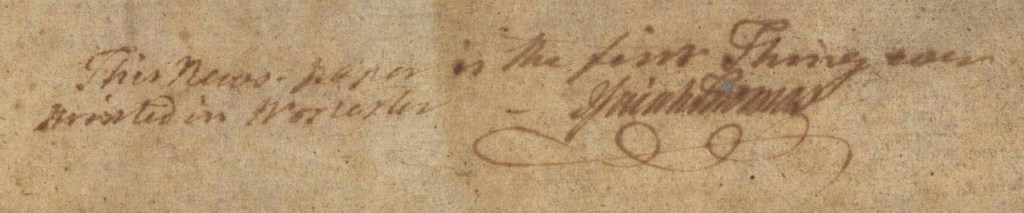
This is a brief version of the story most often told: Thomas was an ardent Patriot whose editorial perspective in the Massachusetts Spy, the newspaper he printed in Boston so angered British officials that for his own safety he left Boston in April 1775, getting out just before the battles at Lexington and Concord and the siege of the city that followed.  Thomas headed to Worcester, taking his press there and continuing to print the Massachusetts Spy in that town.  It took a few weeks for him to acquire the paper necessary to print his newspaper, but when the first Worcester edition appeared on May 3, 1775, it included an account of the events at Lexington and Concord.  Thomas famously signed the bottom of one copy: “This News-paper is the first Thing ever printed in Worcester – Isaiah Thomas.”  (This story does not mention that Thomas previously announced plans to establish a printing office in Worcester and install a junior partner to print the town’s first newspaper or that when he left Boston he advertised that he would publish the next issue of the Massachusetts Spy in Worcester on May 3.)  Thomas settled in Worcester.  He collected as many books, pamphlets, newspapers, broadsides, and other items printed in America as he could to research and publish his History of Printing in America in 1810.  Those items became the initial collections of the American Antiquarian Society, founded in Worcester in 1812.  Thomas did not establish the library and learned society in Boston because he felt Worcester provided greater security as the new nation went to war with Great Britain for a second time.

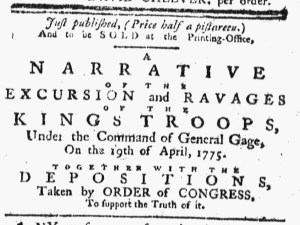
That’s a great story, one that engages students, scholars, and visitors to the American Antiquarian Society … but there’s even more that, from my perspective, makes it an even better story about this Patriot printer and his contributions to the American cause.  Two months after Thomas printed the first issue of the Massachusetts Spy in Worcester, the newspaper carried an advertisement for “A NARRATIVE OF THE EXCURSION and RAVAGES OF THE KINGS TROOPS, Under the Command of General Gage, On the 19th of April, 1775.”  The book also included “DEPOSITIONS, Taken by ORDER of CONGRESS, To support the Truth of it.”  Just as the first newspaper printed in the town featured an account of Lexington and Concord, so did the first book published there.  Once again, Thomas made a notation on the product of his press: “First Book printed in Worcester.”[1]  The imprint at the bottom of the title page stated, “WORCESTER, Printed by ISAIAH THOMAS, by order of the PROVINCIAL CONGRESS.”  To underscore the point, Thomas printed the corresponding resolution on the verso of that page.[2]  Thomas served as printer, even though other printers had offices closer to where the Massachusetts Provincial Congress met in Watertown.  For instance, Samuel Hall and Ebenezer Hall relocated the Essex Gazette from Salem to Cambridge and renamed it the New-England Chronicle.  Benjamin Edes, another prominent Patriot printer, moved to Watertown and printed the Boston-Gazette there.

When Thomas printed A Narrative of the Excursion and Ravages of the King’s Troops and marketed it in the Massachusetts Spy, Patriots fought a war on many fronts.  In addition to the battles at Lexington, Concord, and Bunker Hill, they waged a war of information.  Thomas worked to establish and expand a communications infrastructure to collect and disseminate news from Boston and its environs, the Continental Congress meeting in Philadelphia, and throughout the colonies and beyond.  Yet he competed with misinformation and British officials and Tories who had different perspectives and relayed different versions of recent events and their causes.  That made it even more important to supplement newspaper coverage of the outbreak of hostilities at Lexington and Concord, sometimes confused and contradictory, with “the Truth of it,” not just as presented by a Patriot printer but supported by “DEPOSITIONS, Taken by ORDER of CONGRESS.”  Thomas played an important role in establishing the narrative of what occurred on April 19, 1775.

**********

[1] See the first image on the page linked here.

[2] Advance to the fifth image on the page linked here.

June 21

What was advertised in a revolutionary American newspaper 250 years ago today?

Massachusetts Spy (June 21, 1775).

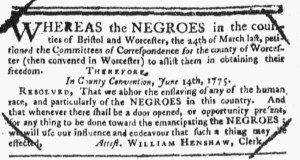
“RESOLVED, That we abhor the enslaving of any of the human race, and particularly of the NEGROES in this county.”

Nathaniel Read’s advertisement describing Tower, an enslaved man who liberated himself by running away, and offering a reward for his capture and return ran in the Massachusetts Spy a second time on June 21, 1775.  It was the last time that advertisement appeared.  Perhaps the notice achieved its intended purpose when someone recognized the Black man with “a little scar on one side [of] his cheek” or perhaps Read discontinued it for other reasons.

Whatever the explanation, Read’s advertisement starkly contrasted with a new notice that relayed a resolution passed “In County Convention” on June 14.[1]  “[T]he NEGROES in the counties of Bristol and Worcester, the 24th of March last, petitioned the Committees of Correspondence for the county of Worcester (then convened in Worcester) to assist them in obtaining their freedom.”  As the imperial crisis intensified and colonizers invoked the language of liberty and freedom from (figurative) enslavement, Black people who were (literally) enslaved in Massachusetts applied that rhetoric to themselves and initiated a process that challenged white colonizers to recognize their rights.  They did so before the Revolutionary War began with the battles at Lexington and Concord in April 1775, though it took a few months for the County Convention to pass a resolution.  That resolution supported the petition: “we abhor the enslaving of any of the human race, and particularly of the NEGROES in this county.”  Furthermore, “whenever there shall be a door opened, or opportunity present, for any thing to be done toward the emancipating the NEGROES; we will use our influence and endeavour that such a thing may be effected.”

During the era of the American Revolution, the press often advanced purposes that seem contradictory to modern readers.  Newspapers undoubtedly served as engines of liberty that promoted the American cause and shaped public opinion in favor of declaring independence, yet they also played a significant role in perpetuating the enslavement of Africans, African Americans, and Indigenous Americans.  News articles reported on the dangers posed by enslaved people, especially when they engaged in resistance or rebellion, and advertisements facilitated the slave trade and encouraged the surveillance of Black men and women to determine whether they matched the descriptions of enslaved people who liberated themselves.  Revenue from those advertisements underwrote publishing news and editorials that supported the patriot cause.  Yet the early American press occasionally published items that supported the emancipation of enslaved people and abolishing the transatlantic slave trade as some colonizers applied the rhetoric of the American Revolution more evenly to all people.

**********

[1] Although it resembles a news article, this item appeared among the advertisements.  In addition, it ran more than once, typical of paid notices rather than news printed just once.  Newspaper advertisements often delivered news, especially local news, during the era of the American Revolution.

June 18

What was advertised in a revolutionary American newspaper 250 years ago this week?

Massachusetts Spy (June 14, 1775).

This Paper now has the greatest advantage for News, from ALL quarters, of any in this Province.”

Isaiah Thomas, the printer of the Massachusetts Spy, took his press and left Boston just before the battles at Lexington and Concord in April 1775.  He announced his intention to continue publishing the newspapers at a new printing office he established in Worcester, safely away from the British officials he angered with his advocacy for the patriot cause.  Printing his newspaper in another town at the beginning of the Revolutionary War meant building up a new customer base, something that Thomas diligently endeavored to do.  During the first months that he published the Massachusetts Spy in Worcester, he regularly placed advertisements promoting the newspapers and encouraging colonizers in central Massachusetts and beyond to become subscribers.

Interspersed with news on the third page of the June 14, 1775, edition of the Massachusetts Spy, Thomas placed a notice that proclaimed, “This Paper has now the greatest advantage for News, from ALL quarters, of any in this Province.  Those who incline to become customers may know the Conditions, by turning to the last Page, column 3d.”  Readers who followed those instructions encountered the “PROPOSALS For continuing the Publication of The MASSACHUSETTS SPY, OR American ORACLE of LIBERTY,” including the extensive list of local agents who received subscriptions in nearly three dozen towns in Worcester County.  Those proposals had appeared in every issue of the Massachusetts Spy since Thomas began printing it in Worcester on May 3, initially on the front page and then migrating to the last one.

In addition to the proposals, readers found another notice from Thomas, one that furthered his argument that his newspapers “has now the greatest advantage from News, from ALL quarters, of any in this Province.”  He announced that he “has engaged Two RIDERS, one to go from hence to CAMBRIDGE and SALEM, the other to PROVIDENCEand NEWPORT.”  The printer then explained that the “great advantage that will arise to the Public, from their going to, and coming from, the places abovementioned, is well known, especially with regard to fresh and authentic intelligence.”  The rider that went east gathered the latest news from the siege of Boston, while the rider who headed south acquired newspapers from other colonies that made their way by land and sea to the printing offices in Rhode Island.  Thomas did not exaggerate in describing his network for receiving news to reprint in the Massachusetts Spy as superior to any other newspaper then published in the colony.

That was not the only notice in which Thomas discussed the communications infrastructure he developed in the spring of 1775.  Two weeks earlier, he announced a plan to establish riders to both Cambridge and Providence.  A week later, he ran an advertisement about a new “Post-Rider to Cambridge and Salem” who covered one of the proposed routes and another advertisement abut a “Post-Rider to Providence and Newport” who followed the other one.  Both appeared again in the June 14 issue, supplementing the proposals and Thomas’s other notices promoting the Massachusetts Spy.  He devoted more space to his own advertisements than paid notices from customers!  The success of the enterprise, however, depended on the public.  Thomas “begs the assistance of the public to support this undertaking, by promoting the circulation of News-Papers, and helping the Riders to such business as they may be thought capable of transacting.”  The printer did not focus solely on distributing the Massachusetts Spy but instead the “circulation of News-Papers” in general.  That contributed to his livelihood, but that was not the printer’s only purpose.  Having already witnessed the power of the press, he aimed to keep the public informed about current events, charging them with taking some responsibility in that endeavor.

June 14

Who was the subject of an advertisement in a revolutionary American newspaper 250 years ago today?

Massachusetts Spy (June 14, 1775).

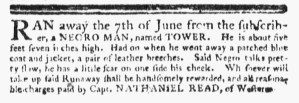
“RAN away … a NEGRO MAN, named TOWER.”

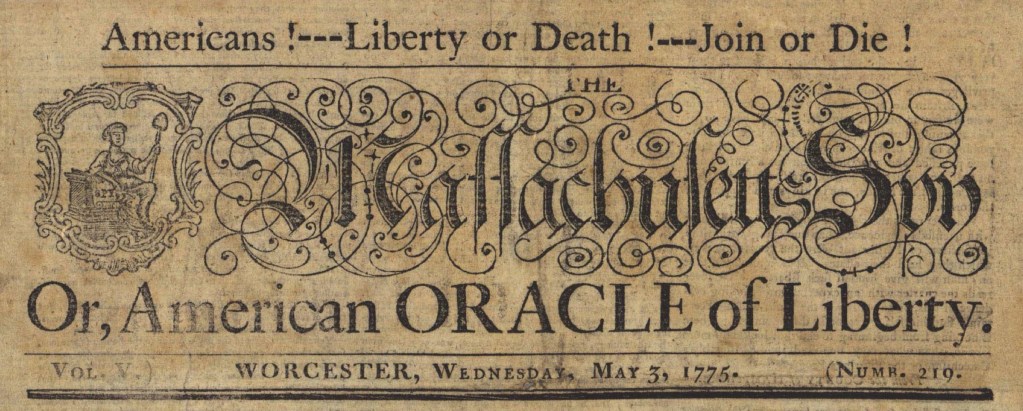
Isaiah Thomas, the printer of the Massachusetts Spy, left Boston just before the battles at Lexington and Concord in April 1775.  He had previously advertised that he intended to establish a printing office in Worcester and install a junior partner there to print the town’s first newspaper.  When he decided to leave Boston to escape the ire of British officials he had angered with his advocacy for the Patriot cause, however, he revised his plans.  Instead of a junior partner printing a new newspaper, Thomas moved the Massachusetts Spy to Worcester and continued publishing it there, safely beyond the reach of Tories in Boston.  Although the numbering of the newspaper continued uninterrupted, it gained a new subtitle, American Oracle of Liberty, and a warning that ran across the top of the masthead, “Americans! — Liberty or Death! — Join or Die.”

When published in Boston, the Massachusetts Spy carried advertisements that offered enslaved people for sale and notices that described enslaved people who liberated themselves by running away from their enslavers and offered rewards for their capture and return.  Despite the new subtitle and the admonitions in the masthead, Thomas continued to earn revenue for his newspaper by printing those advertisements in the Massachusetts Spy after moving it to Worcester.  Away from the colony’s largest urban port, colonizers did not resort to such notices as often, but they did submit them to the printing office and Thomas did publish them. The June 14, 1775, edition of the Massachusetts Spy, the seventh issue printed in Worcester, carried an advertisement about a “NEGRO MAN, named TOWER” who “RAN away” from Nathaniel Read of the nearby town of Western.  Read stated that “Whoever will take up said Runaway shall be handsomely rewarded.”  That advertisement appeared immediately below a news update that confirmed that residents of Charleston, South Carolina, had received word of “a skirmish, or in fact rather an engagement, which happened between his Majesty’s troops and the Provincials” on April 19.  The extract of the letter, written by a British officer in Boston and sent to a correspondent in Charleston, acknowledged that “On the whole the Provincials behaved with unexpected bravery.”  Tower also acted with courage, though not necessarily “unexpected bravery,” as he enacted his own plan for “Liberty or Death!”  Neither Read nor most readers allowed for that possibility, though an item that appeared in the next issue of the Massachusetts Spyindicated that some colonizers in Massachusetts did grapple with the meaning of freedom for enslaved people and the applied the rhetoric of the Revolution to them as well.  The Adverts 250 Project will feature that item next week.

May 31

What was advertised in a revolutionary American newspaper 250 years ago today?

Massachusetts Spy (May 31, 1775).

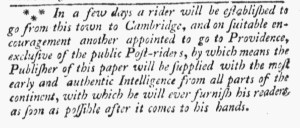
The Publisher of this paper will be supplied with the most early and authentic Intelligence from all parts of the continent.”

Four weeks after commencing publication of the Massachusetts Spy in Worcester at the beginning of May 1775, Isaiah Thomas continued building the infrastructure necessary to operate a successful newspaper.  The Massachusetts Spy had been published in Boston since July 1770, but Thomas removed his press from the city and sent it to Worcester shortly before the battles at Lexington and Concord.  He had previously intended to install a junior partner in a printing office in Worcester and oversee publication of a new newspaper from afar, but he became increasingly nervous about remaining in Boston since his ardent advocacy for the patriot cause drew the attention of British officials and Loyalist colonizers. Fearing for his safety, he revised his plans, removing the Massachusetts Spy to Worcester and giving it a new secondary title, American Oracle of Liberty.

In the May 31 edition, Thomas continued to run subscription proposals that gave information about the newspaper, including its size (“large folio”), day of publication (“every WEDNESDAY Morning, as early as possible), and price (“Six Shillings and Eight Pence per annum”).  He also solicited advertisements and listed about two dozen local agents who accepted subscriptions in various towns in Worcester County.  In addition to the subscription proposals, Thomas inserted a new notice that announced, “In a few days a rider will be established to go from this town to Cambridge,” where the Massachusetts Provincial Congress met during the siege of Boston, “and on suitable encouragement another appointed to go to Providence, exclusive of the public Post-riders.”  Why did Thomas hire his own riders?  He explained that “the publisher of this paper will be supplied with the most early and authentic Intelligence from all parts of the continent,” the latest news “which he will ever furnish his readers, as soon as possible after it comes to his hands.”  Although Worcester is the second largest city in New England today, it was a small town in 1775.  It was not a hub for collecting information about current events, but Thomas aimed to change that.  He devised a plan for getting letters from Cambridge and newspaper from throughout the colonies via Providence.  Moving the Massachusetts Spy to Worcester meant establishing new means of gathering the news to collate into the newspaper to keep readers well informed.  Thomas was so committed to that endeavor that he employed his own riders rather than depending solely on those who already had routes that connected Worcester to Cambridge or Providence.

May 3

What was advertised in a revolutionary American newspaper 250 years ago today?

Massachusetts Spy (May 3, 1775). Courtesy American Antiquarian Society.

“I beg the Assistance of all the Friends to our righteous Cause to circulate this Paper.”

When the patriot printer Isaiah Thomas revived the Massachusetts Spy, originally published in Boston, after fleeing to Worcester to evade “friends of the British administration” who “openly threatened him with the effects of their resentment,” the first issue published in that town opened with a notice to the public.[1]  He reminded readers that he had previously entered into an agreement to aid in establishing a press in Worcester, installing a junior partner to manage a printing office there while he oversaw the enterprise from Boston.  He had issued proposals for the newspaper, intending to name it the “WORCESTER GAZETTE, or AMERICAN ORACLE of LIBERTY.”  However, when Thomas determined that it became “highly necessary that I should remove my Printing Materials from Boston to this Place,” he decided to “continue the Publication of the well-known MASSACHUSETTS SPY, or THOMAS’S BOSTON JOURNAL.”  He continued the numbering but gave it a new title, combining elements of the existing one and the proposed one: Massachusetts Spy Or, American Oracle of Liberty.  In addition, the masthead proclaimed, “Americans! — Liberty or Death! — Join or Die!”

In his notice, Thomas reported that first he sent his “Printing Utensils” to Worcester and then “escaped myself from Boston on the memorable 19th of April, 1775, which will be remembered in the future as the Anniversary of the BATTLE of LEXINGTON!”  Elsewhere that first issue published in Worcester, Thomas provided a chronicle of the battle “collected from those whose veracity is unquestioned.”  That narrative likely incorporated elements drawn from the printer’s own firsthand account.  Several years later, he recorded that at daybreak on April 19 he “crossed from Boston over to Charlestown in a boat with Dr. Joseph Warren, went to Lexington, and joined the provincial militia in opposing the king’s troops.”[2]  The following day, went to Worcester to open the printing office and revive his newspaper.  He was proud of that work and the service he provided, making a note and signing his name in the margin at the bottom of the first page of the first issue published there: “This News-paper is the first Thing ever printed in Worcester – Isaiah Thomas.”

Massachusetts Spy (May 3, 1775). Courtesy American Antiquarian Society.

Having installed himself in that town, he made clear his purpose in publishing the Massachusetts Spy as such momentous events occurred.  He pledged to give “the utmost of my poor Endeavours … to maintain those Rights and Priviledges for which we and our Fathers have bled!”  To that end, he would “procure the most interesting and authentic Intelligence” to keep his readers in central Massachusetts and beyond informed of the latest news.  In addition, he called on “all the Friends to our righteous Cause” to aid in circulating the Massachusetts Spy.  Many had already enlisted in that endeavor, serving as local agents who collected the names of subscribers and forwarded them to the printing office.  In revised proposals that ran immediately below Thomas’s notice, he listed associates who accepted subscriptions in nearly three dozen towns in Worcester County and indicated that “many other Gentlemen in several parts of the province” did as well.

Of the five newspapers published in Boston at the beginning of April 1775, the Massachusetts Spy was the first to suspend publication, the decision resulting from Thomas leaving town rather than the outbreak of hostilities at Lexington and Concord.  It was also the first to resume circulating weekly issues on a regular schedule, a result of the printer’s foresight in relocating to Worcester.  Some of the other newspapers folded completely, but the Massachusetts Spy continued throughout the war and well beyond.

Massachusetts Spy (May 3, 1775). Courtesy American Antiquarian Society.

Click here to view the entire May 3, 1775, edition of the Massachusetts Spy, including Thomas’s note on the first page and the account of the Battle of Lexington on the third page.  That copy is in the collections of the American Antiquarian Society, founded by Thomas in 1812.

**********

[1] Isaiah Thomas, The History of Printing in America: With a Biography of Printers and an Account of Newspapers (1810; New York: Weathervane Books, 1970), 168

[2] Thomas, History of Printing, 168-9.

April 17

What was advertised in a colonial American newspaper 250 years ago today?

Boston Evening-Post (April 17, 1775).

“THE Massachusetts Spy … will be published … in the Town and County of Worcester.”

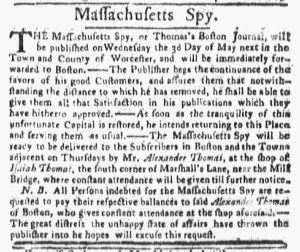
Isaiah Thomas published the last issue of the Massachusetts Spy in Boston on April 6, 1775.  Eleven days later, advertisements in the Boston Evening-Post and the Massachusetts Gazette and Boston Post-Boy informed readers that the “Massachusetts Spy, or Thomas’s Boston Journal, will be published on Wednesday the 3d Day of May next in the Town and County of Worcester, and will be immediately forwarded to Boston.”  Why did Thomas suddenly suspend publishing the Massachusetts Spy, founded in 1770, and relocate to Worcester with plans to revive the newspaper there?

In his History of Printing in America, published in 1810, Thomas declared, “It became at length apparent to all reflecting men that hostilities must soon take place between Great Britain and her American colonies.”  Through the editorial stance he took in the Massachusetts Spy, the patriot printer “had rendered himself very obnoxious to the friends of the British administration; and, in consequence, the tories, and some of the British soldiery in the town, openly threatened him with the effects of their resentment.”  Along with other residents of Boston, Thomas had endured all sorts of “Distresses,” as he called them, following the closure of the harbor in retaliation for the destruction of the tea, but now his own safety was at stake.  “For these and other reasons, he was induced to pack up, privately, a press and types, and to send them in the night over the Charles river to Charlestown, whence they were conveyed to Worcester.”  Thomas was smart with his timing for getting out of Boston: “This was only a few days before the affair at Lexington.”[1]  The printer smuggled a press out of Boston just before the Revolutionary War began with the skirmishes at Lexington and Concord followed by the siege of Boston.

Near the end of February, the Massachusetts Spy carried subscription proposals for a “New Weekly NEWS-PAPER … To be entitled, The WORCESTER GAZETTE.”  Thomas had made arrangements with “a number of gentlemen in the county of Worcester, zealously engaged in the cause of the country … to open a printing house, and to publish a newspaper there, in the course of the ensuing spring.”  It would be the town’s first printing office and first newspaper.  Thomas planned “to send a press, with a suitable person to manage the concerns of it,” having previously gained experience setting up Henry-Walter Tinges as a junior partner who oversaw their printing office in Newburyport and printed the Essex Journal.  “The war commencing sooner than expected,” however, Thomas “was obliged to leave Boston, and came himself to Worcester, opened a printing house, and on the 3d of May, 1775, executed the first printing done in the town.”[2]

As he prepared to open that printing office, his advertisement in newspapers still published in Boston advised the public that the “Publisher [of the Massachusetts Spy] begs the continuance of the favors of his good Customers, and assures then that notwithstanding the distance to which he has removed, he shall be able to give them all that Satisfaction in his publications which they have hitherto approved.”  Furthermore, he planned to return to Boston “[a]s soon as the tranquility of this unfortunate Capital is restored,” not knowing at the time that he would remain in Worcester after the war ended.  For the moment, he designated a local agent, Alexander Thomas, who oversaw his shop in Boston and saw to the delivery of new issues of the Massachusetts Spy on Thursdays, the day after the printer published them in Worcester.  He also requested that “All Persons indebted for the Massachusetts Spy … pay their respective balances.” Like other printers, Thomas extended credit to his customers, but the “great distress [of] the unhappy state of affairs” made it necessary to call on them to make payment.”  Thomas faced a new chapter, one that the Adverts 250 Projectwill chronicle as it examines advertisements placed in revolutionary American newspapers.

**********

[1] Isaiah Thomas, The History of Printing in America: With a Biography of Printers and an Account of Newspapers (1810; New York: Weathervane Press, 1970), 168.

[2] Thomas, History of Printing, 180-181.

March 23

What was advertised in a colonial American newspaper 250 years ago today?

Massachusetts Spy (March 23, 1775).

“A FINE mezzotinto print of that truly worthy Patriot S.A.”

When Charles Reak and Samuel Okey set about publishing a “FINE mezzotinto print of that truly worthy Patriot” Samuel Adams in the spring of 1775, they believed that they could generate interest in their project in Boston.  Accordingly, they placed advertisements in the March 23 edition of the Massachusetts Spy and the March 26 edition of the Boston-Gazette. Reak and Okey chose among the five newspapers published in Boston at the time, selecting the two that consistently took the strongest stance in favor of the American cause during the imperial crisis that eventually became a war for independence.  The savvy entrepreneurs knew which publications would put their notice before the eyes of readers most likely to form a market for a print of the influential and vocal advocate for American liberties.

The advertisement did not go into much detail about the print.  It did not even name Adams, trusting that prospective customers would recognize him from the description and his initials, “S.A.”  They did give the size, “fourteen inches by ten and an half,” so readers could envision framing and displaying the print.  A note at the end of Reak and Okey’s notice in the Massachusetts Spy suggested that they had provided more information to the printing office and “[t]he remainder of this advertisement [will appear] in our next [issue].”  The Boston-Gazette, however, carried the same copy without any additions.  The Massachusetts Spy did not run any version of the advertisement again, neither the original nor an updated variation.  Isaiah Thomas, the printer, published only two more issues in Boston before the political situation got too hot for him to remain there.  He re-established the Massachusetts Spy in Worcester, safely away from British authorities, in May.  The Boston-Gazette did run Reak and Okey’s advertisement one more time, on April 3, but Benjamin Edes and John Gill, the printers (and local agents designated to sell the print of Adams) suspended the newspaper after publishing the April 17 edition.  Following the skirmishes at Lexington and Concord on April 19, they dissolved their partnership.  Edes moved to Watertown and continued publishing the newspaper from there in June.  The outbreak of hostilities almost certainly disrupted Reak and Okey’s plans for advertising and distributing their print of Samuel Adams.