March 23

What was advertised in a colonial American newspaper 250 years ago today?
Massachusetts Spy (March 23, 1775).

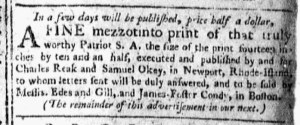
“A FINE mezzotinto print of that truly worthy Patriot S.A.”

When Charles Reak and Samuel Okey set about publishing a “FINE mezzotinto print of that truly worthy Patriot” Samuel Adams in the spring of 1775, they believed that they could generate interest in their project in Boston.  Accordingly, they placed advertisements in the March 23 edition of the Massachusetts Spy and the March 26 edition of the Boston-Gazette. Reak and Okey chose among the five newspapers published in Boston at the time, selecting the two that consistently took the strongest stance in favor of the American cause during the imperial crisis that eventually became a war for independence.  The savvy entrepreneurs knew which publications would put their notice before the eyes of readers most likely to form a market for a print of the influential and vocal advocate for American liberties.

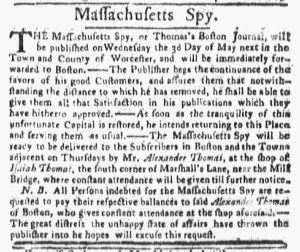
The advertisement did not go into much detail about the print.  It did not even name Adams, trusting that prospective customers would recognize him from the description and his initials, “S.A.”  They did give the size, “fourteen inches by ten and an half,” so readers could envision framing and displaying the print.  A note at the end of Reak and Okey’s notice in the Massachusetts Spy suggested that they had provided more information to the printing office and “[t]he remainder of this advertisement [will appear] in our next [issue].”  The Boston-Gazette, however, carried the same copy without any additions.  The Massachusetts Spy did not run any version of the advertisement again, neither the original nor an updated variation.  Isaiah Thomas, the printer, published only two more issues in Boston before the political situation got too hot for him to remain there.  He re-established the Massachusetts Spy in Worcester, safely away from British authorities, in May.  The Boston-Gazette did run Reak and Okey’s advertisement one more time, on April 3, but Benjamin Edes and John Gill, the printers (and local agents designated to sell the print of Adams) suspended the newspaper after publishing the April 17 edition.  Following the skirmishes at Lexington and Concord on April 19, they dissolved their partnership.  Edes moved to Watertown and continued publishing the newspaper from there in June.  The outbreak of hostilities almost certainly disrupted Reak and Okey’s plans for advertising and distributing their print of Samuel Adams.

March 9

What was advertised in a colonial American newspaper 250 years ago today?

Massachusetts Spy (March 9, 1775).

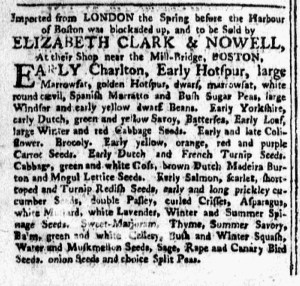
“Imported from LONDON the Spring before the Harbour of Boston was blockade up.”

Although marketing began a little later in the season than in recent years, several retailers placed advertisements for garden seeds in Boston’s newspaper in early March 1775.  The March 9 edition of the Massachusetts Spy, for instance, once again carried Susannah Renken’s advertisement as well notices placed by John Adams, Elizabeth Clark and Elizabeth Nowell, and Ebenezer Oliver.  Each of these purveyors of seeds took to the public prints as spring approached each year, though many familiar names did not yet appear.  More than half a dozen women usually advertised garden seeds that they sold in Boston, but the imperial crisis, especially the closing of the harbor because of the Boston Port Act, disrupted that annual ritual.

Renken, one of the most enterprising of those female seed sellers, apparently acquired her inventory from a ship that landed at Salem.  She identified the captain of the vessel that had transported them across the Atlantic.  Adams and Oliver both declared that they sold seeds “Imported from London,” but did not provide additional details to allow prospective customers in the eighteenth century (or historians in the twenty-first century) to reach conclusions about when and how they came into possession of those seeds.  Clark and Nowell, on the other hand, made clear that their seeds had been “Imported from LONDON the Spring before the Harbour of Boston was blockade up.”  They received their seeds at least nine months earlier, a factor that may or may not have been an advantage.  Adams declared that he “warrants [his seeds] good, and of the last Year’s Growth.”  Similarly, Renken described her seeds as “New and warranted of the last Year’s Growth.”  Clark and Nowell could not make such claims.  Instead, they attempted to leverage the date of delivery as a point in their favor.  Although not “new,” their seeds also were not so old that they would not germinate, especially if Clark and Nowell had stored them carefully.  They asked prospective customers to take into account the challenges that they all faced due to the blockade, hoping that a sense of mutual support would convince consumers to select their seeds over the ones offered by their competitors.

March 2

What was advertised in a colonial American newspaper 250 years ago today?

Massachusetts Spy (March 2, 1775).

“GARDEN SEEDS New and warranted of the last Year’s Growth.”

Although her advertisement appeared later than in some years, Susannah Renken was the first to advertise “GARDEN SEEDS” in Boston in 1775.  She had also been first in 1768, 1770, and 1773, commencing an annual ritual of seed sellers, most of them women, taking to the pages of Boston’s newspapers to hawk extensive selections of garden seeds.  In 1775, Renken’s first advertisements was brief, just two lines in the February 23 edition of the Massachusetts Spy: “SUSANNAH RENKEN, has received a fresh supply of Garden Seeds.  Particulars in our next.”  She may have been in such a rush to run any advertisement at all that she did not have time to prepare her usual list of seeds before Isaiah Thomas, the printer, took that issue to press, though Thomas may have opted to publish an abbreviated notice.  A note at the bottom of the column advised, “Advertisements omitted will be in our next.”  Renken may have been fortunate that even a short notice appeared.  The following week, her full advertisement, featuring dozens of varieties of seeds, ran in the Massachusetts Spy.

The copy of the March 2 edition digitized to grant greater access has been damaged, eliminating the first lines of Renken’s advertisement, but it ran again the following week.  That issue reveals that the notice began with a familiar introduction: “Imported in Capt, Shayler from LONDON, And to be Sold by SUSANNAH RENKEN.”  Merchants, shopkeepers, and other purveyors of goods often stated which vessels carried their merchandise, revealing to prospective customers when their wares had been shipped and delivered.  In this case, it meant that Renken’s seeds arrived in the colonies, but not in Boston, several months before she placed her advertisement; she may have acquired her seeds only recently.  With the city’s harbor closed to commerce because of the Boston Port Act, Shayler’s vessel arrived in Salem with “Fresh Advices from London” in late November 1774, according to the December 5 edition of the Boston-Gazette.  Shayler delivered goods as well as news, but Renken had to arrange to have her seeds transported from Salem to Boston.  Perhaps she had only just confirmed delivery when her brief notice appeared in the Massachusetts Spy.  When W.P. Bartlett advertised garden seeds in the February 21, 1775, edition of the Essex Gazette, published in Salem, he proclaimed that his wares were “JUST IMPORTED, in the Venus, from LONDON.”  In previous years, Renken and her sister seed sellers in Boston usually did not describe their seeds as “just imported.”  In 1775, the imperial crisis prevented them from even considering doing so.

February 23

What was advertised in a colonial American newspaper 250 years ago today?

Massachusetts Spy (February 23, 1775).

“A New Weekly NEWS-PAPER … The WORCESTER GAZETTE; OR, AMERICAN ORACLE of LIBERTY.”

Among the advertisements in the February 23, 1775, edition of the Massachusetts Spy appeared “PROPOSALS For … A New Weekly NEWS-PAPER … To be entitled, The WORCESTER GAZETTE; OR, AMERICAN ORACLE of LIBERTY.”  That newspaper would commence publication in Worcester, about forty miles west of Boston, “as soon as Seven Hundred Subscribers have entered their names.”  It would be the first newspaper published in that town, giving residents greater access to “the most early and authentic Intelligence, and such Political Essays, as are worthy of Public notice, with other matters interesting and entertaining.”

In his History of Printing in America (1810), Isaiah Thomas explained, “In 1774, a number of gentlemen in the county of Worcester, zealously engaged in the cause of the country, were from the then appearance of public affairs, desirous to have a press established in Worcester.”  In other words, supporters of the patriot cause wanted a local newspaper instead of relying on newspapers published in Boston, Salem, Newburyport, Providence, Portsmouth, Norwich, and Hartford.  Although newspapers from each of those towns served readers in larger, overlapping regions, Patriots in Worcester believed that a local newspaper would both serve their community and strengthen their position.  By the time they “applied to a printer in Boston” in December 1774, the “Worcester Revolution” had already closed the courts and removed British authority from that town.  Thomas, that printer in Boston, “engaged to open a printing house, and to publish a newspaper there, in the course of the ensuing spring.”  He initially intended to follow a model like the one for establishing the Essex Journal in partnership with Henry-Walter Tinges in Newburyport.  Tinges, the junior partner, managed the printing office there while Thomas remained in Boston.  As part of his preparations, Thomas published the proposals for the Worcester Gazette as he worked on recruiting “a suitable person to manage the concerns of it.” However, when the Revolutionary War began with the Battles of Lexington and Concord on April 19, Thomas “was obliged to leave Boston, and came himself to Worcester” and became the city’s first printer.[1]

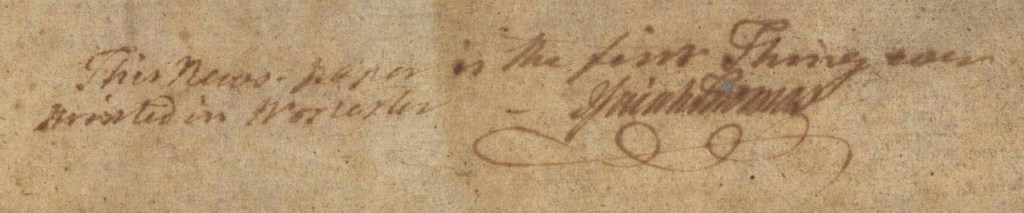
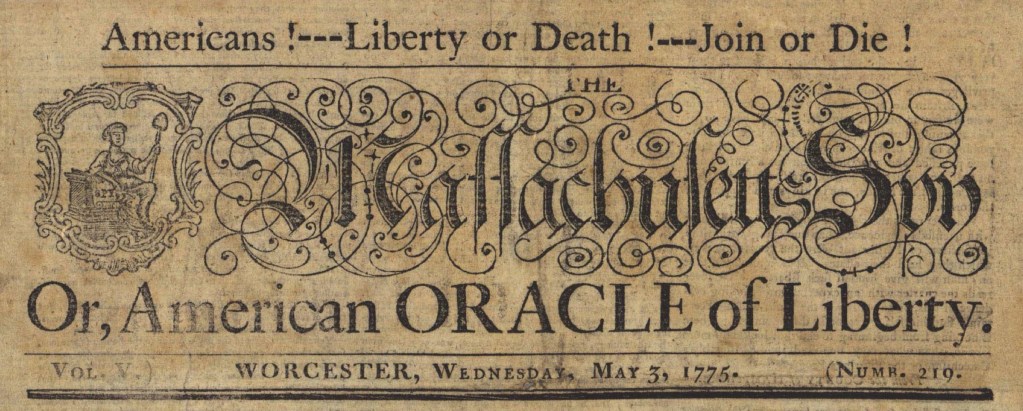
When Thomas disseminated the first issue on May3, he combined the name of the newspaper he published in Boston for several years, the Massachusetts Spy, and the intended name for the new newspaper, calling it the Massachusetts Spy or American Oracle of Liberty.  As outlined in the proposals from February, he published the newspaper “every WEDNESDAY Morning, as early as possible” so it could be “delivered to the Subscribers in Worcester at their houses, and sent by the first opportunity to such as are at a greater distance.”  The annual subscription fee in the colophon matched the proposals, “Six Shillings and Eight Pence per annum, the same as the Boston news-papers.”  The colophon did not list rates for advertising, though the proposals stated that they would be “inserted in a neat and conspicuous [manner], at the same rates as they are in Boston.”  Little did Thomas know when he published the “PROPOSALS [for] The WORCESTER GAZETTE” in February 1775 that he would soon relocate to that town and become one of its most prominent residents, establishing the first printing office and, eventually, founding the American Antiquarian Society in 1812.

**********

[1] Isaiah Thomas, The History of Printing in America: With a Biography of Printers and an Account of Newspapers (1810; New York: Weathervane Books, 1970), 180-181.

February 19

What was advertised in a colonial American newspaper 250 years ago this week?

Massachusetts Spy (February 16, 1775).

“THE PETITION of the American Continental Congress, to the KING.”

In February 1775, Isaiah Thomas, printer of the Massachusetts Spy, published and advertised “THE PETITION of the American Continental Congress, to the KING.”  During its meetings in Philadelphia in September and October 1774, the delegates to the First Continental Congress drafted several documents.  Almost as soon as they adjourned, William Bradford and Thomas Bradford, printers of the Pennsylvania Journal, advertised “EXTRACTS FROM THE VOTES AND PROCEEDINGS OF THE AMERICAN CONTINENTAL CONGRESS.”  Over the next several weeks, printers in towns throughout the colonies published local editions to supplement coverage in their newspapers.  By the end of November, the Bradfords published a more complete “JOURNAL OF THE PROCEEDINGS OF THE CONGRESS Held at PHILADELPHIA,” though not as many printers issued local editions of that pamphlet.  After all, the Extracts already contained “The BILL of RIGHTS; a List of GRIEVANCES; occasional RESOLVES; the ASSOCIATION; and ADDRESS to the people of Great-Britain; and a MEMORIAL to the Inhabitants of the British American Colonies.”

Yet neither the Extracts nor the Proceedings included all the work undertaken by the First Continental Congress.  In his advertisement, Thomas asserted that he published the Petition “For the benefit of those who have purchased the Votes and Proceedings of the Continental Congress, or the Extracts therefrom, as it is inserted in neither of said Pamphlets.”  He encouraged colonizers to complete their collections of these important documents.  As part of that marketing strategy, he noted that he printed the Petition “in a Pamphlet that it may be either bound of stitched up with the Votes and Proceedings.”  Buyers had the option to collect the several pamphlets together under a single cover, though few seem to have done so.  In a description of the copy now in the collections of the Princeton University Library, the William Reese Company declared, “We can locate only three copies of this rarity, those at the Library of Congress, Massachusetts Historical and American Antiquarian Society.”  That colonizers did not bind the Petition with other pamphlets, however, does not necessarily mean that they did not purchase or read it.  Thomas described the Petition as “Worthy the perusal of his Majesty and every subject in his dominions.”  As the imperial crisis intensified in the winter and spring of 1775, readers may have been eager to consume as much as they could about the positions taken by the First Continental Congress, including this eight-page pamphlet for “two coppers.”  In an advertisement for another political pamphlet claimed that such a “small price” made it affordable to “every person who is desirous” of reading about “our political Controversy.”

February 16

What was advertised in a colonial American newspaper 250 years ago today?

Massachusetts Spy (February 16, 1775).

“I have no connection with said SUMNER.”

Charles Willis needed to correct an error.  An advertisement in the February 13, 1775, edition of the Massachusetts Gazette and Boston Post-Boy proclaimed that “SUMNER and WILLIS … CARRY on the Sail-Making Business in all its Branches.”  It gave their location and listed prices.  Yet Willis had no knowledge of this partnership.  Rather than wait for the next issue of the Massachusetts Gazette and Boston Post-Boy on February 20, he submitted his own advertisement to the Massachusetts Spy for inclusion in its February 16 edition.

“WHEREAS an Advertisement appeared in Messrs. Mills & Hick’s paper of Monday last, notifying the Public, that SUMNER & WILLIS carried on the SAIL-MAKING business together,” the aggrieved Willis asserted, “This is to acquaint my Friends and the Public, that I have no connection with said SUMNER, that the advertisement abovementioned was published without my knowledge or consent, and was a gross imposition upon CHARLES WILLIS.”  The sailmaker was angry as he set the record straight.  Readers of the Massachusetts Spy, on the other hand, may have been mildly amused by the drama that unfolded in the public prints.  After all, a dispute between sailmakers could have been a welcome distraction from the hardships they encountered while the harbor remained closed to commerce because of the Boston Port Act.

Willis likely visited or contacted Mills and Hicks’s printing office about the offensive advertisement.  It did not appear a second time, though the standard fee for advertisements provided for inserting them in three consecutive issues.  Willis’s advertisement, for instance, ran in the Massachusetts Spy twice more before it was discontinued.  Willis opted not to run a similar notice in the Massachusetts Gazette and Boston Post-Boy, the newspaper that carried the original “SUMNER and WILLIS” advertisement.  That could have been because he did not wish to invest any more money on such notices in the public prints, yet it also suggests his confidence in the circulation of the Massachusetts Spy and ensuing conversations inspired by its contents, both news and advertisements.  Advertising in just one newspaper sufficiently clarified that “SUMNER and WILLIS” were not indeed partners in the “Sail-Making Business.”

February 12

What was advertised in a colonial American newspaper 250 years ago this week?

Massachusetts Spy (February 9, 1775).

“CORNISH’s New-England FISH HOOKS.”

Lee and Jones stocked a variety of merchandise at “their Store near the Swing Bridge” in Boston in February 1775, but they made “CORNISH’s New-England FISH HOOKS” the centerpiece of their advertisement in the February 9 edition of the Massachusetts Spy.  Not only did they list that product first and devote the most space to describing it, but they also adorned their advertisement with a woodcut depicting a fish.  That image previously appeared in advertisements that Abraham Cornish placed in the Massachusetts Spy in March 1772 and March 1773.  Either Lee and Jones acquired the woodcut from Cornish when they composed the copy for their notice or Isaiah Thomas, the printer of the Massachusetts Spy, held the woodcut for Cornish and determined that advertisers promoting his product could use it in their notices.  It was not the first time that Lee and Jones distributed “CORNISH’s New-England Cod-Fish HOOKS.”

By the time that Lee and Jones ran their advertisement, Cornish had established a familiar brand.  In addition to advertising in the Massachusetts Spy, he also advertised in the Massachusetts Gazette and Boston Weekly News-Letter and Salem’s Essex Gazette.  His marketing efforts regularly touted the approval he received when “Fishermen … made trial of his Hooks” and found them “much superior to those imported from England.”  Lee and Jones deployed similar appeals when they proclaimed that the hooks had been “Proved by several Years experience, to be much Superior to any imported.”  Such assertions held even greater significance with the Continental Association, a nonimportation pact, in effect and the imperial crisis becoming even more dire.  In protest of the Coercive Acts passed in response to the Boston Tea Party, colonizers vowed not to import good from Britain.  The Continental Association called for encouraging domestic manufactures or goods produced in the colonies as alternatives to imported items.  Cornish has been making that case for his product for several years, as many readers likely remembered when they saw Lee and Jones’s advertisement for “CORNISH’s New-England FISH HOOKS.”

February 5

What was advertised in a colonial American newspaper 250 years ago this week?

Massachusetts Spy (February 2, 1775).

“BUTTONS. MADE and sold … at the Manufactory-house, Boston.”

John Clarke’s advertisement for buttons that he “MADE and sold … at the Manufactory-house” in Boston was one of several in the February 2, 1775, edition of the Massachusetts Spy that hawked goods produced in the colonies.  He advertised at a time that the harbor had been closed and blockaded for more than eight months because of the Boston Port Act, one of several measures that Parliament enacted in response to the Boston Tea Party.  The other Coercive Acts included the Massachusetts Government Act, the Administration of Justice Act, and the Quartering Act.  In turn, the colonies refused to import British goods, having previously pursued that strategy in response to the Stamp Act in 1765 and the duties imposed on certain goods in the Townshend Acts in the late 1760s.  The Continental Association, devised by the First Continental Congress, went into effect on December 1, 1774.  In addition to prohibiting imports, it called on colonizers to encourage “domestic manufactures” or goods produced in the colonies.

Clarke not only made buttons in Boston, he made “two sorts of new fashioned buttons.”  One was a “plain flat Button, with a corded edge round it, either gilt or plated.  The other bore an inscription, “UNION AND LIBERTY IN ALL AMERICA,” that made a statement.  Consumers could express political sentiments and sartorial sensibilities simultaneously.  (Similarly, the Adverts 250 Project previously examined another newspaper notice that included “glass buttons having the word liberty printed in them.”)  Clarke’s “Liberty button,” well worth the investment, cost just a little more than the “plain flat Button,” at twenty shillings per dozen compared to eighteen shillings per dozen.  Clarke also gave “good allowance to shopkeepers to sell again.”  In other words, he offered discounts to retailers who purchased his buttons and presented them to their customers.  After all, shopkeepers had their own part to play in promoting American products to consumers and supplying them with alternatives to goods imported from Britain.  When it came to buttons, what better way to do that than with the inscribed “Liberty button” made in Boston?

February 2

GUEST CURATOR:  Ella Holtman

What was advertised in a colonial American newspaper 250 years ago today?

Massachusetts Spy (February 2, 1775).

“AMERICAN CAKE-INK.”

This advertisement is extremely interesting because we do not use the term or commonly understand what cake ink is today. As author Harry Schenawolf explains in his Revolutionary War Journal, the Nortons’ cake ink was most likely dried iron gall ink. With a dash of water, the powder became liquid and ready to use with a quill. Iron gall ink is made from a mixture of iron sulfate, oak galls, and tree gum, ensuring it to be long-lasting, adherent, and dark.

Samuel Norton produced his own dried iron gall cake ink. Anna Norton sold it in Boston. They offered their product to any patriotic supporter of America. In the advertisement, the Nortons also reminded the public that their cake ink went for “the same rates as the British Cake-Ink is sold at in London.” They offered an American product for the same prices charged in Britain, obeying a nonimportation agreement. This alludes to the growing tension between the American colonies and Britain’s perceived unjust control in February 1775.

When the Revolutionary War started a couple of months later, American soldiers went to fight, bringing few belongings and facing long travels. Officers and soldiers easily transported and utilized cake ink. They wrote home to loved ones and shared news. Purchasing and using cake ink, like that made and sold by the Nortons, aided in communication during the era of the American Revolution.

**********

ADDITIONAL COMMENTARY:  Carl Robert Keyes

As Ella notes, the Nortons advertised their cake ink at an important moment.  The Boston Port Act closed the city’s harbor on June 1, 1774, severely hampering commerce.  In response, the colonies enacted the Continental Association, a nonimportation agreement, on December 1.  In addition to boycotting imported goods, the Continental Association called on colonizers to “encourage Frugality, Economy, and Industry; and promote Agriculture, Arts, and the Manufactures of this Country.”

The Nortons did just that when they marketed “AMERICAN CAKE-INK” to “all true friends to America.”  They did so at a time when other advertisers also advanced “Buy American” messages or otherwise indicated their compliance with the Continental Association.  Consider some of the advertisements that ran alongside the Nortons’ notice in the February 2, 1775, edition of the Massachusetts Spy.  Henry Christian Geyer advertised printing ink that he “manufactured … at his Shop near Liberty Tree” in Boston’s South End.  A nota bene indicated that the Massachusetts Spy “has been printed with Ink made by said Geyer, for two months past.”  A similar nota bene appeared in his advertisement in the Massachusetts Gazette and Boston Post-Boy.  Enoch Brown’s notice sporting the headline “American Manufacture” ran once again, offering textiles produced in Massachusetts and glassware “manufactured at Philadelphia” as alternatives to imported goods.  Philip Freeman inserted an advertisement for gloves that had been running for six months, lamenting the “threatening” times and asking consumers to “encourage our own Manufactures” by purchasing the gloves that he made.  In a relatively new advertisement, John Clarke hawked the buttons that he produced “at the Manufactory-house, Boston,” each inscribed, “UNION AND LIBERTY IN ALL AMERICA.” Another advertisement notices announced the sale of “SUNDRY Goods … imported in the Brigantine Venus … from London” conducted under the supervision of the local Committee of Inspection according to the provisions of the tenth article of the “American Congress Association.”

The short advertisement for “AMERICAN CAKE-INK” that Ella selected for today’s entry played its part in disseminating messages about leveraging decisions about consumption to achieve political ends, especially when considered in concert with several other advertisements in the same issue of the Massachusetts Gazette.  Consumers, these notices reminded readers, participated in politics when they chose which items purchase.

January 29

What was advertised in a colonial American newspaper 250 years ago this week?

Massachusetts Spy (January 26, 1775).

“American Manufacture.”

An advertisement in the January 26, 1775, edition of the Massachusetts Spy informed readers of “SUNDRY Goods, Wares and Merchandize Imported in the Brigantine Venus … from London” that would be “SOLD agreeable to The American Congress Association.”  That nonimportation agreement included provisions for selling goods imported between December 1, 1774, and February 1, 1775, yet it also called for encouraging “domestic manufactures” as alternatives to items acquired from Britain.

Enoch Brown emphasized such wares in his own advertisement in that same issue of the Massachusetts Spy.  The headline proclaimed, “American Manufacture.”  Brown reported that he stocked several kinds of textiles, a “LARGE assortment of Sagathies, Duroys, … Camblets, Calamancoes, Serge-Denim, [and] Shalloons … all which were manufactured in this Province.”  Like many other retailers who encouraged consumers to “Buy American” during the imperial crisis, Brown emphasized that his customers would not have to make sacrifices when it came to price or quality for the sake of abiding by their political principles.  These textiles, he insisted, “are equal in quality to any, and superior to most imported from England.”  In addition, customers could purchase them “much cheaper than can be procured from any part of Europe.”

Yet that was not the extent of Brown’s wares produced in the colonies.  He also stocked an “assortment of Glass Ware, manufactured at Philadelphia.”  Perhaps he stocked some of the “AMERICAN GLASS” advertised by John Elliott and Company in the Pennsylvania Journal just as the Continental Association went into effect at the beginning of December 1774.  Brown listed a variety of items, including decanters, wine glasses, and mustard pots, underscoring that “he will sell extremely cheap.”

Only after detailing products made in the colonies did Brown also mention a “general assortment of English Goods,” naming several textiles, such as “fine printed linens,” not included among those “manufactured in this Province.”  He likely attempted to liquidate inventory that had been on his shelves before the nonimportation agreement commenced, intending to “quite business very soon, unless the times mend.”  To that end, he vowed to “sell his Goods extremely cheap indeed.”  In the process, he gave priority to “American Manufacture” in his advertisement, directing readers to options that would allow them to be responsible consumers who did their part in support of the Continental Association and the American cause.