October 29

GUEST CURATOR: Megan Watts

What was advertised in a colonial American newspaper 250 years ago today?

oct-29-10291766-georgia-gazette
Georgia Gazette (October 29, 1766).

“A PARCEL of TANNED SOLE LEATHER.”

I chose this advertisement because it dealt with a material whose impact on society I did not know a lot about overall: leather. This short advertisement attempted to sell “A PARCEL of TANNED SOLE LEATHER.” I did realize that throughout history leather played a role, but did not fully understand its importance in the colonial world. Obviously there was demand for it. But why was leather in demand? I engaged in some research to find out more about it. According to Colonial Williamsburg, leather was used for myriad of items: equestrian equipment, fashion items and storage products. It even was used for luxury items like “ fur and leather hand muffs” and “razor cases.”

The importance of equipment used in harnessing horses cannot be overstated. During the colonial period the primary mode of travel, other than walking, was horseback or a horse drawn vehicle. There would have been thousands of colonists using horses to travel across towns or colonies. None of that travel would have been possible without bridles, saddles, harnesses, and other leather goods. That is one of the main reasons leather was a commodity that was worth selling. It was a necessary component of colonial travel, as well as a resource used in fashion. A colonist reading this advertisement would have recognized the value of leather goods.

**********

ADDITIONAL COMMENTARY: Carl Robert Keyes

Megan has selected an advertisement that differs from many other advertisements for consumer goods and services in one significant aspect: “MATT. ROCHE, Prov. Mar.” signed this notice. Roche was not a producer, supplier, or retailer. Instead, he was a local official, a provost marshal (a law enforcement officer roughly equivalent to a sheriff). As part of their own institutional history, the U.S. Marshals Service states that “as soon as the colony of Georgia was founded in 1733, the office of provost marshal was established.” Other colonies, including Virginia, also had provost marshals. Their duties included collecting fines, apprehending and transporting criminals, and, most significantly for the purposes of understanding this advertisement, “taking inventory of a deceased person’s estate.”

Roche did not seek to sell his own goods or make a profit from transactions with customers. That was not his way of earning a living. Instead, in his official capacity he participated in settling the estate of “the late Mr. William Smith.” Note that Roche did not have his own shop, auction house, or warehouse for dispersing the “PARCEL of TANNED SOLE LEATHER.” Instead, those interested in purchasing this commodity needed to seek it out at “Joseph Pruniere’s store adjoining his house.” Notice as well that Roche did not announce an ongoing sale. The “PARCEL” had been divided into lots that were to be sold on a specific date (“Tuesday the 4th of November, 1766”) at a specific place. This was an auction intended to quickly and efficiently liquidate the deceased Smith’s inventory of sole leather in order to move forward with settling his estate. Roche inserted an announcement of the sale in the Georgia Gazette, but he did not attempt to incite demand by resorting to any particular appeals to entice buyers, unlike shopkeepers whose livelihoods depended on attracting customers.

Most likely many colonists eventually wore shoes constructed from this “PARCEL of TANNED SOLE LEATHER,” but the path from producer to consumer took unanticipated turns along the way.

October 28

GUEST CURATOR: Megan Watts

Who was the subject of an advertisement in a colonial American newspaper 250 years ago today?

oct-28-10281766-south-carolina-gazette-and-country-journal
South-Carolina Gazette and Country Journal (October 28, 1766).

“A CARGO consisting of about ONE HUNDRED and FORTY young and healthy new NEGROES.”

I chose this advertisement because it demonstrates the inhumane and terrible slave industry in colonial America. The advertisement demonstrates how racial barriers dehumanized Africans in the eighteenth century. Because of their skin tone and origin, Africans were thought of as commodities, not as human beings. This idea is horrifying and irrational to modern readers. However, the transatlantic slave trade was a reality of American culture for hundred of years. In fact, slavery persisted in Southern society until the end of the Civil War.

A contributing factor to colonial Americans attachment to slavery was the need for a large workforce to toil over the agricultural endeavors of Southern colonies. Slavery provided landowners with an inexpensive workforce that could be expanded at virtually any time. Thus the demand for slaves persisted throughout the colonial period and into the nineteenth century.

However slavery also occurred in the all the colonies. Slaves were utilized for domestic service Evidenced comes from multiple advertisements for slaves posted in newspapers printed in the New England and Middle Atlantic colonies. There were advertisements regarding slaves in the Connecticut Courant, the Providence Gazette, and the New-York Gazette, among others. In the fall of 1766, the Connecticut Courant included an advertisement that said “TO be sold for Cash or 6 Months Credit … One Negro Boy.” In the Providence Gazette there was a advertisement that stated: “To be sold at Public Vendue … A likely healthy active Negro Boy, about fourteen Years old.” The New-York Journal included this advertisement in one of its October issues: “TO BE SOLD, A fine Female Slave.” It is obvious from the widespread nature of these advertisements that slavery was an established part of society throughout all the colonies.

oct-28-1061766-connecticut-courant
Connecticut Courant (October 6, 1766).

**********

oct-28-10111766-providence-gazette
Providence Gazette (October 11, 1766).

**********

oct-28-10161766-new-york-journal
New-York Journal (October 16, 1766).

Thankfully, the practice of slavery was abolished in the 1800s, but the transatlantic slave trade shaped our country in ways no founding father could have imagined. The legacy of slavery persisted after its abolition, causing strife for descendants of slaves. That is why learning about the roots of slavery is important. It has contributed to years of human rights abuses, the rise of humanitarian movements, and important political change. Even though this part of our history is abhorrent, we need to remember our past in order to ensure justice and equality in the future.

**********

ADDITIONAL COMMENTARY: Carl Robert Keyes

Megan notes that slavery was not restricted to colonies in the Chesapeake and Lower South. Instead, as the advertisements she has chosen for today demonstrate, slavery and the slaver trade were part of colonial culture and economics in New England and the Middle Atlantic as well. I appreciate how she shows that advertisements for slavery were spread across newspapers printed in each region of colonial America in the fall of 1766. For my additional commentary, I am examining how such advertisements were concentrated in one particular issue.

According to the project’s methodology, Megan needed to select an advertisement from a newspaper printed exactly 250 years ago today. That gave her only one option in terms of choosing a newspaper: the South-Carolina Gazette and Country Journal was the only newspaper printed on October 28, 1766. It’s not surprising that when she consulted that issue that she chose an advertisement for an impending slave auction. In total, eighty-four advertisements appeared in that issue. Fourteen of them advertised slaves. Some offered dozens of slaves for sale, cargoes recently arrived from Africa, as was the case in the advertisement Megan chose. Others sought to sell individual slaves, sometimes as part of estate sales. Some warned against runaway slaves and offered rewards for their capture and return. Some notified masters that escaped slaves had been captured and told them where to retrieve their human property. It would have been practically impossible to look at this issue of the South-Carolina Gazette and Country Journal without noticing numerous advertisements explicitly connected to slavery and the slave trade.

The visual aspects of the advertisements made it even more likely that readers would focus on advertisements for slaves. Only ten advertisements featured any sort of image, a woodcut that would have been a standard part of any printer’s stock. These woodcuts included two ships (one for a departing vessel and another for imported goods), two houses (both for properties to be leased), and one horse (for a stolen gelding). The other five woodcuts all depicted slaves, three runaways and two Africans on display to promote auctions from cargoes recently arrived from Africa. The woodcuts depicting slaves were spread out over three of the four pages of the broadsheet newspapers. Considering the density of text in the South-Carolina Gazette and Country Journal, these advertisements were among the most prominent items that appeared in that issue.

Megan demonstrated the breadth of advertisements for slaves in newspapers printed in several regions during the fall of 1766. That is important, but it tells only part of the story. The depth of advertising in specific issues and particular newspapers also merits further investigation. That is part of the work my entire Colonial America class is doing with the Slavery Adverts 250 Project.

October 27

GUEST CURATOR: Megan Watts

What was advertised in a colonial American newspaper 250 years ago today?

oct-27-10271766-boston-gazette
Boston-Gazette (October 27, 1766).

“DRUGS and Medicines of the very best Kinds.”

This advertisement caught my attention because it is unique. In reading colonial newspapers I have not seen many advertisements for medical supplies. This one includes “Syringes of all kinds” and “Bateman’s Drops,” among other things.

The advertisement made me wonder about the realities of health in the 1700s. Colonists tried to do what we still strive for now, to live a healthy life. However, that was much more difficult to do in the 1700s. Fewer medical discoveries, poor hygiene practices, and contamination of water sources contributed to an unfavorable health environment. In eighteenth-century America a mild illness could turn into a fatal ailment. Diseases, like yellow fever, were always a threat and could cause epidemics.

One example of a disease causing havoc happened in Philadelphia in the late 1700s. As Simon Finger notes, “At the end of the eighteenth century, Philadelphia found itself in the grip of an implacable horror, wracked by ‘the hurricane of the human frame.’ Yellow fever loomed like the storm.”[1] The spread of illnesses wreaked havoc on the population. Not only were residents dying from illnesses, but the economy was also affected. Finger further states that: “yellow fever returned to terrorize Philadelphia six more times, taking thousands of lives, paralyzing the port economy, and sowing the seeds of a panic.”[2]

Americans now have access to properly educated doctors, hygiene education, and clean water sources. In 2016, not many people are worried about a lethal cough or a yellow fever epidemic occurring. However, it is important to recognize the unhealthy environment colonists lived in and the health threats they faced, as it was one of the characteristics of the 1700s.

**********

ADDITIONAL COMMENTARY: Carl Robert Keyes

Peter Roberts offered a variety of conveniences for customers who purchased his “DRUGS and Medicines of the very best Kinds.” Like many other druggists (as well as some shopkeepers), he provided mail order service for those who were unable to visit his shop “opposite the West Door of the Court-House Boston.” In a nota bene he announced that “Orders by Letters from Practitioners and others, in Town or Country, will be as faithfully complied with as if they were present.”

Roberts offered another convenience less commonly promoted in eighteenth-century advertisements. Before listing the various remedies and medical equipment he stocked, the druggist stated that he “carefully prepares and puts up in the best Manner, DOCTOR’s BOXES of all sizes, with proper Directions, for Ships or private Families.” In other words, Roberts produced and sold the early modern equivalent of the first aid kit. Given that customers could choose boxes of “all sizes,” Roberts most likely allowed them to choose specific items they wished included. On the other hand, some customers probably preferred readymade boxes that included the most popular and commonly used items, leaving it to the druggist to make the selections based on his experience and expertise.

While these “DOCTOR’s BOXES” represented a convenience for his customers, they presented an opportunity for Roberts, an opportunity to increase sales and move inventory more quickly. Customers purchased individual items from Roberts and other druggists as they needed them or in anticipation of need. When Roberts assembled one these boxes, however, he could include various products that customers were less likely to select on their own or that they were less likely to imagine that they might need at some point. He could include items that customers were much less likely to purchase separately but that they would accept as part of a larger package. He bundled his products in order to distribute them in greater numbers.

Note that Roberts also sold “DOCTOR’s BOXES” for vessels going to sea as well as to “private Families.” He recognized that the local market was comprised of more than the “Practitioners” who lived in Boston and its hinterland. The city was a busy port. Potential customers were arriving and departing by ship all the time. When they were in port, they needed a variety of supplies, including the “DRUGS and Medicines” that Roberts sold.

**********

[1] Simon Finger, The Contagious City: The Politics of Public Health in Early Philadelphia (Ithaca, NY: Cornell University Press, 2012), 120.

[2] Finger, Contagious City, 120.

October 26

GUEST CURATOR: Megan Watts

What was advertised in a colonial American newspaper 250 years ago this week?

oct-26-10251766-providence-gazette
Providence Gazette (October 25, 1766).

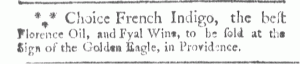
“Choice French Indigo.”

This advertisement only contained three items: “Choice French Indigo, the best Florence Oil, and Fyal Wine.” All three have something in common: they were exported from foreign countries. The indigo was French, the oil was Italian, and the wine was Portuguese. These products represented international trade. However, international trade meant competing suppliers.

One product that fostered competition was indigo. An important commodity, it was in high demand because it produced a specific dye. According to Kenneth H. Beeson, Jr., “Indigo was the most important vat dye used by the British in the eighteenth century.”[1] South Carolina focused on the indigo trade. Colonists there invested a significant amount of land and energy into producing indigo. The effort resulted in American indigo becoming a serious threat to foreign suppliers. As R.C. Nash notes, “Carolina indigo … succeeded in displacing French and Spanish indigo in the British and in some continental markets.”[2] The colony’s economy relied upon the value of indigo. When the indigo trade did well, South Carolina prospered.

American indigo did not, however, completely push out all other suppliers. The fact that French indigo was being advertised in a colonial newspaper is a testament to the continuing competition between different indigo suppliers. Regardless of the success of the competition, the South Carolina economy depended heavily on indigo and it played an important part in early American economics.

**********

ADDITIONAL COMMENTARY: Carl Robert Keyes

Recently several guest curators have commented on what eighteenth-century advertisements reveal about how colonists imagined urban spaces and navigated the cities where they resided or visited. In its starkness, today’s advertisement also demonstrates how much living, working, and shopping in cities has changed over the last three centuries.

This advertisement announced that readers of the Providence Gazette could purchase three popular commodities – indigo from France, olive oil from Italy, and wine from the Portuguese island of Faial in the Azores – “at the Sign of the Golden Eagle, in Providence.” Even by eighteenth-century standards this means of specifying the store’s location was quite sparse. The advertisement did not indicate the name of the seller who made these commodities available, nor did it list the street where customers could find “the Sign of the Golden Eagle.”

The advertiser apparently believed that “the Sign of the Golden Eagle” was such a well-known landmark that further directions were unnecessary. Presumably residents of Providence already knew where to find it, which suggests that the sign had been in place for quite some time. The proprietor may not have needed to include his (or possibly her) name in the advertisement because he (or she) was already so closely associated with the “Sign of the Golden Eagle” among the local populace.

In addition to giving the sign as the most significant landmark for locating the purveyor of indigo, “Florence Oil, and “Fyal Wine,” the advertisement included one piece of geographical information. The establishment could be found “in Providence.” Although neither the street nor the name of the proprietor was listed, it was necessary to specify the city or town since the Providence Gazette circulated throughout Rhode Island and beyond. Other businesses in other places had their own “Sign of the Golden Eagle.”

In modern advertisements entrepreneurs carefully specify where prospective customers can find their place of business. They list street addresses and significant landmarks. This advertiser may have been just as invested in readers knowing where to find the indigo, olive oil, and wine they needed or desired, but the nature of Providence as an urban space in 1766 required a different level of detail in providing directions for customers.

**********

[1] Kenneth H. Beeson, Jr., “Indigo Production in the Eighteenth Century,” Hispanic American Historical Review 44, no.. 2 (May 1964), 214.

[2] R.C. Nash, “South Carolina Indigo, European Textile, and the British Atlantic Economy in the Eighteenth Century,” Economic History Review 63, no. 2 (May 2010), 362.


October 25

GUEST CURATOR: Megan Watts

What was advertised in a colonial American newspaper 250 years ago today?

oct-25-10251766-providence-gazette
Providence Gazette (October 25, 1766).

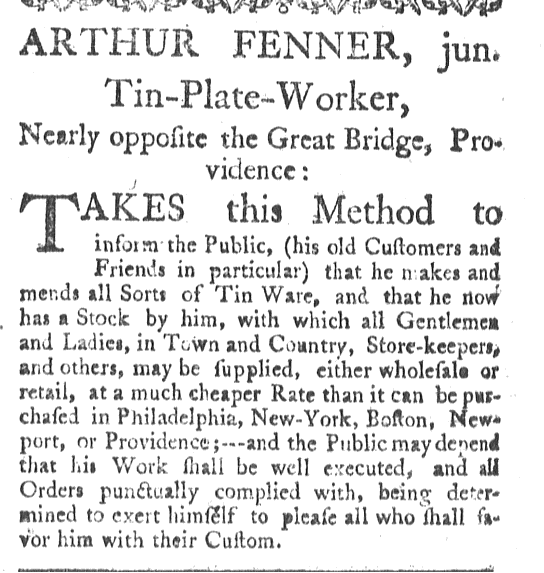
“Tin-Plate-Worker, Nearly opposite the Great Bridge, Providence.”

This advertisement was for a very specific service, tin smithing, done by “ARTHUR FENNER, jun. Tin-Plate-Worker.” This advertisement caught my eye because it was not advertising mass-produced goods; it advertised specific services done by an expert craftsman. Fenner announced that “he makes and mends all Sorts of Tin Ware” and that “the Public may depend that his Work shall be well executed.” The advertisement focused on the quality of the work.

This advertisement reminds modern readers that there was a different culture related to the creation of products in the eighteenth century. There were no factories in the 1700s. Everything pertaining to the manufacture of a good had to be passed down through the generations. Skilled craftsmen sold their wares to make a living. In order to be successful at a trade there was a prescribed course of training that started with an apprenticeship and ended with becoming a master craftsman. This process gave young men the opportunity to become experts in a trade. The idea of apprenticeship is foreign to most modern Americans; it does not have the same place in today’s society. However, it was a cultural norm and an important step in ensuring the continuity of trades in the eighteenth century. The practice of widespread apprenticeship in the colonies was an effect of British influence: “apprenticeship practices and associated legal arrangements were imported from Britain into the American colonies.”[1] Apprenticeship was a significant component of trade in America and that idea is reflected in this advertisement.

**********

ADDITIONAL COMMENTARY: Carl Robert Keyes

Megan notes the training that colonial craftsmen received before they established their own shops, contrasting the eighteenth-century system of apprenticeship to modern practices. Some occupations continue to refer to junior colleagues – those who have not yet completed their training or passed exams to become licensed or certified – as apprentices while they gain experience and learn from others who have already mastered a trade. Despite the name, however, today’s apprentices have very different experiences than those of the eighteenth century.

During the colonial era, apprenticeship usually began when a young man was in his early teens and lasted for several years. During that time the apprentice usually became a member of his master’s household: working and living with the man who assumed the responsibility of training him in a specific trade. Master and apprentice signed a contract that specified the obligations each had to the other. In addition to training an apprentice, the master provided room and board. As a member of the master’s household, an apprentice was subject to discipline (including corporal punishment) both in the workshop and in the home. Masters set curfews and oversaw apprentices’ activities during their free time. Modern systems for training young people in various trades differ quite significantly from eighteenth-century methods, despite the continued use of the word “apprentice” to denote someone in the process of learning a trade.

Arthur Fenner did not explicitly mention his training in this advertisement. Instead, he emphasized the quality and price of his work, leaving it to potential customers to draw their own conclusions about how he obtained his skills. Other colonial artisans and tradesmen, however, sometimes noted that they had completed an apprenticeship as a means of reassuring clients that they possessed the necessary skills. Fenner addressed “his old Customers and Friends in particular,” suggesting that he had worked in Providence for some time. Perhaps if he had been new to town he would have been more likely to promote his training as part of his marketing.

**********

[1] Bernard Elbaum, “Why Apprenticeship Persisted in Britain But Not in the United States” Journal of Economic History 49, no. 2 (June 1989): 338.

October 24

GUEST CURATOR: Megan Watts

What was advertised in a colonial American newspaper 250 years ago today?

oct-24-10241766-new-hampshire-gazette
New-Hampshire Gazette (October 24, 1766).

“Stephen Hardy, Taylor from London.

This advertisement starts off with the words: “Stephen Hardy, Taylor from London.” It originally caught my attention because it mentioned a specific line of products. Many newspaper advertisements were from the equivalent of general stores, shops where a variety of goods — from agricultural tools to alcohol to handkerchiefs — could be purchased. Yet this one is an advertisement for a very specific line of goods and services. Hardy “Makes Gentlemens Cloaths of all sorts” and “He has just Imported A variety of Remnants of Cloth.” The advertisement made me curious about clothing and fashions in Colonial America. I looked at the different terms used in the advertisement, including “Breeches,” “Ladies Riding Habets,” and “strip’d Linnen.”

Those lines got me thinking about what the everyday wear for colonists was and how clothing was important to colonial society. Even in the modern day, clothing can be interpreted as a symbol of socioeconomic status. This also proved true for the 1700s. Typically men of the middle to upper class wore breeches and shirt, not necessarily with a jacket nor necessarily of a matching pattern. Women’s fashions varied with social class in regard to fabric and style.

In addition, another thing very important to note about clothing and fashion during this time was the complex etiquette associated with clothes. There was a specific protocol, especially with the social elite, about what was acceptable in informal and formal situations. There were informal everyday garments, the “undress,” and formal garments, the “dress” clothing. In addition different accessories and fabrics were included in this silent protocol. A consumer from the upper classes who read the advertisement would know right away which things were appropriate for everyday use and what needed to be worn. These choices would not only appease their peers but showcase to the others that they enjoyed a privileged social position. This idea of social status and acting in a way that befits one’s station was an important component of early American society. Understanding colonial clothing helps modern day people understand colonial society overall.

**********

ADDITIONAL COMMENTARY: Carl Robert Keyes

Given the size of Portsmouth relative to other colonial cities, the New-Hampshire Gazette published fewer advertisements than newspapers from Boston, New York, Philadelphia, and Charleston. In any of those urban ports, Stephen Hardy’s advertisement would have competed with several others that offered similar goods and services. In the October 24, 1766, issue of the New-Hampshire Gazette, however, only one other advertisement bore any sort of resemblance to Hardy’s notice. Samuel Cutts promoted an array of imported textiles, but also listed “All sorts of Nails; Frying Pans; Shovels and Tongs, &c. &c. &c. &c.”

Hardy and Cutts certainly competed for some of the same customers, but several aspects of Hardy’s advertisement suggest that he enticed Portsmouth’s more genteel consumers (or those who aspired to gentility). Perhaps most significantly, Hardy, a “Taylor from London,” offered services to accompany the goods he sold. He not only imported textiles but also “punctually served” his clients who visited him to have “Gentlemens Cloaths of all sorts” and “Ladies Riding Habets” made to specification. Cutts, on the other hand, sold textiles but did not assist customers in transforming them into finished apparel. Cutts did sell pins and sewing needles so his customers could make their own clothing out of the fabrics they purchased from him.

In listing his occupation as a “Taylor” rather than a shopkeeper, Hardy also underscored that he was “from London.” He did not indicate how recently he had migrated to the colonies (though many readers of the New-Hampshire Gazette would have known approximately how long he had resided in Portsmouth), but listing his origins affiliated him with the Britain’s largest city and the cosmopolitan center of the empire. By implication, his textiles and the clothing he made from them aligned with the latest fashions of the transatlantic elite.

Hardy also addressed his prospective clients as gentlemen and ladies, suggesting the status of those who visited his shop. When customers did call on Hardy they found themselves surrounded with fine textiles and adornments, rather than the diversity of qualities (or the hardware and housewares) listed in Cutts’ advertisement. As Megan notes, Hardy specialized in his trade; the inventory in his advertisement and shop reflected his work as a tailor rather than a shopkeeper.


October 23

GUEST CURATOR: Megan Watts

What was advertised in a colonial American newspaper 250 years ago today?

oct-23-10231766-massachusetts-gazette
Massachusetts Gazette (October 23, 1766).

“West-India rum, Muscovado Sugars by the Hogshead, Spices of all sorts.”

One thing that has not changed in advertisements for hundreds of years is the purpose of gaining the attention of consumers. This advertisement for the Broker’s Store at the “Corner of Kilby-Street” strove to catch readers’ eyes with the myriad items listed, a tactic used by colonial advertisers. The long account of available items was supposed to intrigue readers and make them curious about the sundry different goods. There was something at the Broker’s Store for everyone. The items included varied from “Lisbon Wines” to “Carolina Sole-Leather” to “best refined Iron.”

Another element of this advertisement that would have warranted attention in 1766 was the incorporation of goods imported from faraway places, not just other North American colonies or England. The advertisement mentioned “a small Invoice of English Goods” as well as “West-India Rum.”

These products were noted because there was a demand for them in the colonies and that would have motivated some consumers to visit the store. These few lines are important because they speak to the demand and the availability of imported goods. The inclusion of these goods demonstrates that the North American colonies were not isolated from the motherland or other British colonies (like the West Indies); they were, in fact, engaged in political, social, and, especially, commercial exchanges within and beyond the British Empire.

T.H Breen, when analyzing the effects of peddlers in eighteenth-century America, recognizes the large network which was the colonial economy. Breen specifically comments on the extensive trade relations, in a section describing the activities of an unlicensed peddler who was prosecuted for selling goods in Maine in 1721. “This unfortunate peddler brought the settlers into contact with a vast market economy that linked them to the merchants of Boston and London, to the manufacturers of England, to the exploding Atlantic economy.”[1]

**********

ADDITIONAL COMMENTARY: Carl Robert Keyes

In his monumental study of the merchant community in Philadelphia during the decades on either side of the American Revolution, Thomas M. Doerflinger made a distinction between those that specialized in the dry goods trade and their counterparts who specialized in the provisions trade. The inventory at the “BROKER’S STORE” in Boston suggests that it operated primarily as part of the provisions trade. The items that received first billing and constituted the bulk of the advertisement included “Lisbon Wines,” “Florence Oil,” “Hyson and Bohea Teas,” and a variety of other imported spices and grocery items. A limited number of dry goods appeared near the end of the advertisement: “Men’s ready-made Camblet Cloaks lin’d with Baize” and “a small Invoice of English Goods.”

The proprietors of the “BROKER’S STORE” facilitated the distribution of these goods to colonial retailers and, ultimately, consumers. Doerflinger notes that “certain firms specialized in the collection and distribution of groceries imported by other firms from overseas.” They sometimes handled dry goods, but never extensively. The name of the establishment, the “BROKER’S STORE,” suggests that was the case for this advertisement. By breaking up large shipments into smaller lots, the merchants who operated the store provided a clearinghouse for others to move their goods off of incoming ships, through the busy port of Boston, and on to retailers and consumers. Doerflinger asserts that merchants from Philadelphia who pursued such ventures did not become “long-term specialists in this activity, but instead used it as a relatively low-risk entry into the mercantile world.”[2] They then invested their profits into other activities likely to generate even more significant returns.

Many eighteenth-century advertisements invited readers to visit shops that would cater to them as potential customers. Advertisements like this one, however, focused instead on moving inventory through warehouses, leaving it to the retailers who purchased these goods to nurture relationships with consumers.

**********

[1] T.H. Breen, “An Empire of Goods: The Anglicization of Colonial America, 1690-1776,” Journal of British Studies 25, no. 4 (October 1986): 468.

[2] Thomas F. Doerflinger, A Vigorous Spirit of Enterprise: Merchants and Economic Development in Revolutionary Philadelphia (Chapel Hill: University of North Carolina Press for the Omohundro Institute of Early American History and Culture, 1986). See Chapter 2. Both quotations appear on 125.

Welcome, Guest Curator Megan Watts

Megan Watts is a sophomore at Assumption College, where she is a History major and intends to pursue a minor in either Political Science or Women’s Studies. She has enjoyed participating in various educational programs offered at the Fairfield Museum and History Center in Fairfield, Connecticut. She plans to become a historian, believing that understanding the past leads to a better future for the world. She will be a guest curator for the Adverts 250 Project during the week of October 23 to 29, 2016, as well as curator of the Slavery Adverts 250 Project during the week of November 27 to December 3, 2016.

Welcome, Megan Watts!