January 7

What was advertised in a colonial American newspaper 250 years ago today?

jan-7-171767-georgia-gazette
Georgia Gazette (January 7, 1767).

“BLank bonds, bills of sale, mortgages, powers of attorney, bonds of arbitration, indentures.”

Variations of this advertisement for printed blanks that appeared in the Georgia Gazette have been featured on the Adverts 250 Project on a couple of occasions. Rather than focus on the advertisement itself, this presents an opportunity to discuss methodology and process instead. This notice was the only advertisement for any sort of new consumer goods in the January 7, 1767, issue of the Georgia Gazette, though several advertisements did announce secondhand goods to be sold at estate auctions.

Selecting advertisements to include in this project can sometimes be a case of feast or famine. On some days I encounter multiple advertisements that I would like to share with readers and explore in greater detail. On those occasions I look ahead to see if an advertisement of interest ran for multiple weeks and could be incorporated into the project at another time. On other days, like today, selecting an advertisement becomes much more challenging due to the scarcity of commercial notices that appeared in some newspapers. Throughout the colonial period advertising for consumer goods and services (as well as other sorts of advertising) was not evenly distributed across newspapers or days of the week.

Consider the newspapers published during the first week of January 1767. (This is not an exhaustive list but instead includes only those newspapers for which a digital surrogate is available via Accessible Archives, Colonial Williamsburg’s Digital Library, or Readex’s Early American Newspapers.)

Thursday, January 1, 1767

  • Massachusetts Gazette
  • New-York Gazette, or Weekly Post-Boy
  • New-York Journal
  • Pennsylvania Gazette
  • Virginia Gazette (Purdie & Dixon)

Friday, January 2, 1767

  • New-Hampshire Gazette
  • New-London Gazette
  • South-Carolina and American General Gazette

Saturday, January 3, 1767

  • Providence Gazette

Sunday, January 4, 1767

Monday, January 5, 1767

  • Boston Evening-Post
  • Boston Gazette
  • Boston Post-Boy
  • Connecticut Courant
  • New-York Gazette
  • New-York Mercury
  • South Carolina Gazette
  • Wochentliche Philadelphische Staatsbote

Tuesday, January 6, 1767

  • South-Carolina Gazette and Country Journal

Wednesday, January 7, 1767

  • Georgia Gazette

Newspaper publication clustered on particular days, especially Mondays and Thursdays. That means that there are some days that I may select advertisements from far more newspapers. As much as possible, I cycle through each publication. In addition, many of those newspapers were published in larger cities and included much more advertising than their counterparts in smaller towns. Some even expanded from four to six pages in order to insert greater numbers of advertisements.

On other days, however, I have no choice about which newspaper to consult. In general, I know that once a week I will examine advertisements from the South-Carolina Gazette and Country Journal, Georgia Gazette, and Providence Gazette because those were the only newspapers published on Tuesdays, Wednesdays, and Saturdays, respectively. For most weeks, I also expect to select a second advertisement from the Providence Gazette since no newspapers were published on Sundays and the project’s methodology requires consulting the most recently published newspaper in colonial America 250 years ago that day. On occasion all of the advertisements for consumer goods and services from the Providence Gazette have previously been featured in the project, which means that I have to go back a day earlier to select an advertisement.

Fortunately, the printers of the Providence Gazette and their advertisers created some interesting and significant advertisements in the 1760s, but there have been occasions that only one advertisement in a particular issue qualified for inclusion in the project. That made the choice easy while sometimes providing a challenge as far as research and writing was concerned. The same situation periodically presents itself on days that I consult the Georgia Gazette. According to the project’s methodology, technically I should not have once again selected the advertisement for printed blanks from the Georgia Gazette. However, it has been a while since I discussed methodology. I decided that this provided a helpful opportunity to share with readers a more complete accounting of newspapers published during this week in 1767 in order to provide more context for understanding advertisements otherwise removed from the publications in which they originally appeared.

November 19

GUEST CURATOR: Mary Williams

What was advertised in a colonial American newspaper 250 years ago today?

nov-19-11191766-georgia-gazette
Georgia Gazette (November 19, 1766).

“TO BE SOLD, A SMALL ISLAND or NECK of LAND … belonging to the estate of Col. Kenneth Bailie, deceased.”

This advertisement published in the Georgia Gazette is a description of Colonel Kenneth Baillie’s home and lands. After the death of the colonel, three executors and one executrix published this advertisement for the sale of his estate.

I already knew that executor is the term for someone who carries out instructions for a will. What I didn’t know, however, was that in colonial times women executors had their own term, which was “executrixes.” The executrix named in this advertisement, according to genealogists, was the Colonel’s wife, Elizabeth Baillie. In general, executors and executrixes were named in the will of the deceased, and they were often given specific items or property in the will. We can assume that some or all of the executors received some part of the Colonel’s estate, and they decided to sell the estate rather than keeping it.

This advertisement reveals a lot about the Colonel Bailie. First of all, we know something about his status and military service because he was addressed as a colonel. We also know how many acres of land he owned, which tells us a bit more about his status in colonial Georgia. He owned many acres for cattle, hogs, and sheep, as well as lots of space for gardening.

**********

ADDITIONAL COMMENTARY: Carl Robert Keyes

On rare occasions I allow guest curators to depart from the established methodology for the Adverts 250 Project. In general, the project features an advertisement only once. Today’s advertisement, however, was featured relatively recently. Two advertisements for consumer goods and services that have not yet been included in the Adverts 250 Project were printed in the same issue of the Georgia Gazette. Why not instruct Mary to choose one of those instead?

I approved today’s advertisement for second appearance because I wanted an opportunity to explore some of the opportunities and constraints of the project. First, I’ll acknowledge two aspects of Mary’s analysis that I especially appreciated. Women placed disproportionately few advertisements as shopkeepers and other sorts of purveyors of goods and services during the eighteenth century. They appeared with a bit more regularity in various legal notices, such as this advertisement placed by Colonel Kenneth Baillie’s executrix and executors. Mary used this notice to demonstrate one of the roles that many women assumed at some point in their lives during the colonial era. In addition, Mary incorporated a type of source only infrequently consulted for entries on the Adverts 250 Project: genealogical records. Professional historians do not always adequately recognize the efforts of family historians and amateur genealogists in reconstructing relationships that help all of us to better understand the past.

In selecting this advertisement to make a second appearance, Mary has also recovered an element of eighteenth-century advertising that sometimes gets overlooked as a result of insisting that any particular advertisement may only be featured once. That obscures the fact that a great many advertisements ran for weeks or even months at a time, often with no updates or revisions. Today’s advertisement may look familiar to those who visit the Adverts 250 Project regularly; it would have certainly looked familiar to readers of the Georgia Gazette who saw only a limited number of advertisements in the once-weekly four-page issues of that newspaper. The Adverts 250 Project moves from newspaper to newspaper, city to city, every day. Colonists, however, would have had access to far fewer newspapers and far fewer advertisements. Those that lived in cities with multiple newspapers with robust advertising, such as Boston, New York, and Philadelphia, would have encountered a fairly broad array of advertisements, but readers in other places would not have seen the same range of advertisements that the Adverts 250 Project features.

Mary’s examination of this advertisement accomplished one other significant objective. She and former guest curator Ceara Morse demonstrated to their peers that there is no single “correct” interpretation or analysis of an advertisement. They each consulted different sources and learned different lessons about colonial America. At the same time, they both addressed common themes about property and status in eighteenth-century America.

October 18

GUEST CURATOR: Lindsay Hajjar

What was advertised in a colonial American newspaper 250 years ago today?

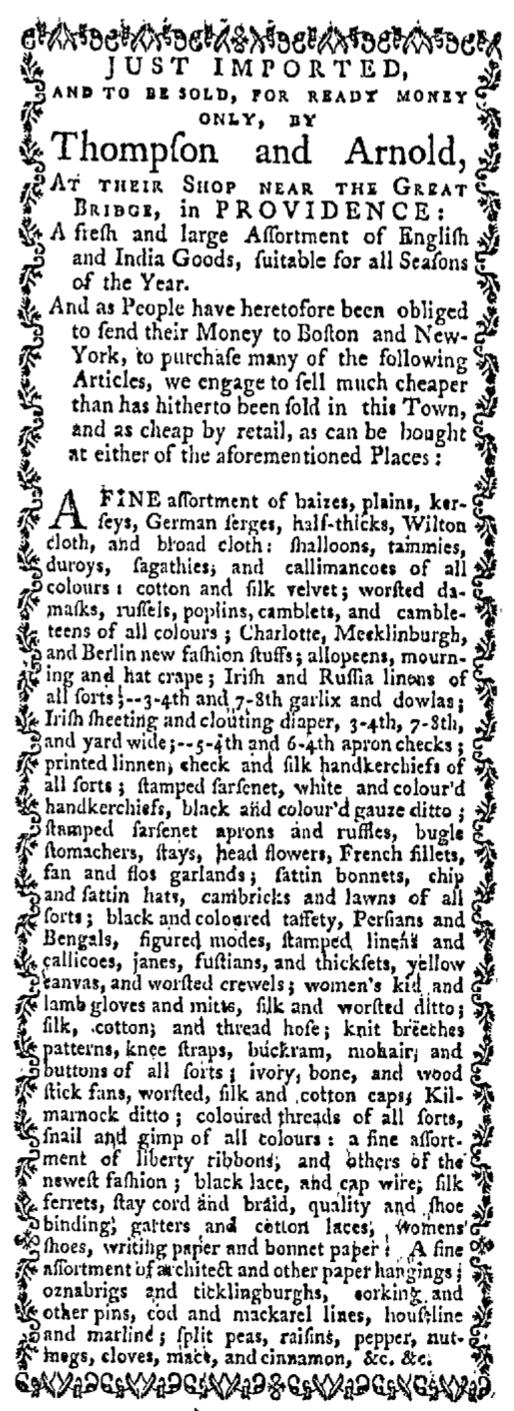
oct-18-10181766-providence-gazette
Providence Gazette (October 18, 1766).

“As people have heretofore been obliged to send their Money to Boston and New-York …”

This advertisement gave a long list of much of the merchandise sold by Thompson and Arnold at their shop in Providence. The shopkeepers were looking for customers who were in a financial position that they did not need to barter or buy on credit; their imported goods were “TO BE SOLD, FOR READY MONEY ONLY.” They stated that previously the residents of Providence would have had to travel to Boston and New York to acquire many of the goods in the advertisement, but now they could come to their shop and buy them in town and for a fair price, one that was cheaper than found in Boston or New York.

They tried to entice consumers in Providence with their abundance of goods that they sold and with two other advertising techniques that are very familiar today. First, they emphasized the fact that potential customers did not have to travel far to get them. They also promised low prices. Today consumers often expect prices to be more expensive in urban place. The same was true for the colonists; being able to get these goods close to home for a reasonable price was enticing.

As a second strategy, they compared their prices to other stores in Providence with the same goods. Today, consumers love comparing pricing and trying to get the best deals. Thompson and Arnold knew that this would be an effective tactic because it would draw people in and they could end up buying more than they originally intended.

American consumers have a long history of expecting to find what they need when they need it. T.H Breen confirms this: “after the 1740s American shoppers came to expect a much larger selection, and merchants had to maintain ever larger inventories.”[1] In colonial America consumers sometimes needed to make the compromise of either getting what they wanted close to home but at an escalated price or traveling and getting a better price. Thompson and Arnold made it possible for the consumers in Providence to get both convenience and low prices.

**********

ADDITIONAL COMMENTARY: Carl Robert Keyes

For my commentary on today’s advertisement, I must once again address the project’s methodology as well as my pedagogical goals. Once again one of the guest curators has selected an advertisement that should look very familiar to regular readers. At a glance, it appears that Lindsay has selected the same advertisement that guest curator Nicholas Commesso analyzed a few weeks ago. The same shopkeepers previously published the same list of goods with the same introductory remarks (the same copy from start to finish) and the same decorative border in the same publication. On closer inspection, I uncovered only one difference between the two advertisements: a colon substituted for a period at the end of the sentence immediately before the advertisement listed the goods available at Thompson and Arnold’s shop. (I have no ready explanation for why the printer would have made this change.) Technically, that single change qualifies this as a new advertisement.

That hardly seems like a satisfactory explanation or rationale for repeating an advertisement, deviating from the usual methodology and commitment to examining a new advertisement every day. Other factors played a more significant role in my decision. First of all, Thompson and Arnold published a very robust advertisement that made multiple implicit and explicit appeals to potential customers. Nick examined some of them when he selected this advertisement, but Lindsay picked up on others. Both students learned about aspects of colonial commerce and marketing; both contributed, in different ways, to the ongoing conversation at the Adverts 250 Project. One short entry about Thompson and Arnold’s advertisement was not sufficient to do it justice. In addition, featuring this advertisement a second time also underscores the frequency that some entrepreneurs resorted to advertising. Some shopkeepers ran an advertisement just once or for just a few weeks, but others, like Thompson and Arnold, ran their advertisements so many times that readers would have recognized them on sight. Repetition likely helped to cement Thompson and Arnold’s shop in the popular imagination around Providence.

The rhythm of newspaper publishing in colonial America also influenced my decision to allow Lindsay to feature this advertisement a second time. Nineteen newspapers (that have survived and have been digitized) were published during the week that Lindsay is serving as guest curator. Monday was the most popular day for publishing newspapers, with nine of the nineteen published on Monday. Saturday was one of the least popular days. The Providence Gazette was the only newspaper regularly published on Saturdays in 1766. That means that once a week the featured advertisement for the Adverts 250 Project should come from the Providence Gazette, the only newspaper published on that day 250 years ago. No newspapers were published on Sundays. The methodology for the project requires going back to the most recently published newspaper, which means that the featured advertisement should be drawn from the Providence Gazette twice a week. This places disproportionate emphasis on the Providence Gazette, a problem compounded by the fact that it included less advertising than some other newspapers (but more than others). Other newspapers, especially those printed in Philadelphia, New York, Boston, and Charleston, could better bear that burden, but between the relative scarcity of advertisements and the tendency to run them for weeks or months, the Adverts 250 Project has pretty much exhausted the advertisements for consumer goods and services printed in the Providence Gazette in the fall of 1766. I could have insisted that Lindsay go back one day earlier to select an advertisement from the New-London Gazette (which usually had even fewer advertisements), the New-Hampshire Gazette (which also had relatively few advertisements), or the Virginia Gazette (which typically ran many advertisements that have not yet been featured here). Future guest curators will have to do so, but I determined that even though today’s advertisement repeated an earlier one (except for that colon that replaced a period!) Thompson and Arnold still had something to tell us about colonial marketing and life in early America more generally.

**********

[1] T.H. Breen, “An Empire of Goods: The Anglicization of Colonial America, 1690-1776,” Journal of British Studies 25, no. 4 (October 1986): 489.

October 9

GUEST CURATOR: Jordan Russo

What was advertised in a colonial American newspaper 250 years ago today?

oct-9-1091766-boston-news-letter
Massachusetts Gazette (October 9, 1766).

“A large and general Assortment of silver and other Ribbons, Necklaces, Earings and Pendants.”

This advertisement caught my eye because Jolley Allen ran a store in Boston. I live nearby in Medway, Massachusetts. Allen probably thought the items he sold would be bought mostly by women. His advertisement lists many items that women would want to look more fashionable, including “silver and other Ribbons, Necklaces, Earings and Pendants.” As Linda Baumgarten, Curator of Textiles at the Colonial Williamsburg Foundation, explains, “Like us, eighteenth-century people needed clothing for warmth and comfort, but they quickly abandoned those needs if fashion or the occasion dictated.”

Another reason Allen directed his advertisement towards women was because “the exercise of choice in the marketplace may have been a liberating experience” for women.[1] The choice of where to shop and what to purchase allowed women to bring business where they wanted. Jolley Allen probably knew this was the case and listed so many items to attract women to his store.

**********

ADDITIONAL COMMENTARY: Carl Robert Keyes

This advertisement may look familiar to readers who visit the Adverts 250 Project regularly. Guest curator Nicholas Commesso selected an advertisement by Jolley Allen to feature and analyze on September 29, less than two weeks ago. Doesn’t this advertisement deviate from the methodology established for the project, a commitment to feature a new advertisement every day? Why did I allow Jordan to choose this advertisement instead of sending her back to the Massachusetts Gazette or either of the other two newspapers printed in colonial America on October 9, 1766?

I could justify that decision by noting that Allen’s extensive advertisement merits attention more than once. It possessed features commonly found across advertisements during the colonial period, such as the implicit emphasis on female consumers that Jordan examined today. Allen also incorporated a variety of distinctive features into his advertisement, such as the money-back guarantee that Nick examined or the unique decorative border that was the focus of my analysis. This single advertisement included a multitude of significant aspects that tell us about colonial culture and commerce and the development of marketing techniques in eighteenth-century America. Considering how much was “going on” in Allen’s advertisement, no short analysis by a guest curator (nor my own slightly extended additional commentary) could do this advertisement justice.

Still, that was not the deciding factor when Jordan submitted this advertisement for my consideration and I approved it and told her to move forward with research and writing. After all, I did not know at that time that she would take a different approach than Nick did in his analysis. Although this advertisement looks familiar, it is actually a different advertisement than the one Nick examined on September 29. The copy was almost identical, though today’s version added an additional sentence after the nota bene. In addition, careful analysis reveals that the type was set differently, both for the body of the advertisement and the decorative border, which should come as no surprise considering that today’s advertisement was printed in the Boston News-Letter, but Allen’s advertisement featured on September 29 came from the Boston Evening-Post. While this might seem like a technicality (after all, Allen composed only one advertisement but submitted it to multiple newspapers), that the “same” advertisement appeared in more than one publication tells us something interesting about colonial entrepreneurs attempting to maximize exposure for their advertisements, as guest curator Elizabeth Curley demonstrated with John Taylor’s advertisements last week.

**********

[1] T.H. Breen, “An Empire of Goods: The Anglicization of Colonial America, 1690-1776,” Journal of British Studies 25, no. 4 (October 1986): 489.