January 18

What was advertised in a revolutionary American newspaper 250 years ago today?

New-York Journal (January 18, 1775).

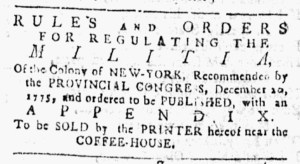
“RULES AND ORDERS FOR REGULATING THE MILITIA, Of the Colony of NEW-YORK.”

Advertisements for military manuals began appearing regularly in many American newspapers in 1775 and 1776.  They appeared most frequently in New England, where the first battles of the Revolutionary War occurred, and in Philadelphia, where the Second Continental Congress met, but not solely in those places.  On January 18, 1776, John Holt, the printer of the New-York Journal, ran an advertisement for “RULES AND ORDERS FOR REGULATING THE MILITIA, Of the Colony of NEW-YORK, Recommended by the PROVINCIAL CONGRESS, December 20, 1775, and ordered to be PUBLISHED, with an APPENDIX.”

That pamphlet presents a bibliographical mystery.  On September 24, 1775, the New-York Gazette and Weekly Mercurycarried the “RULES and ORDERS for regulating the Militia of the Colony of New-York, recommended by the Provincial Congress, August 22, 1775,” filling almost two columns on the first page and spilling onto the second page.  By then, Holt had been advertising a twelve-page pamphlet featuring the “RULES AND ORDERS” for nearly a month.  His first notice appeared in the August 31 edition of the New-York Journal.  He may not have appreciated Hugh Gaine’s decision to disseminate the same content for free, potentially undercutting sales of the pamphlet, yet the pamphlet offered a different format that readers, especially those who had cause the consult the manual regularly, likely found more convenient.  Gaine presented information as a service to the public, while Holt packaged the same content for practical use by officers and others.

The advertisements for Holt’s first edition of the “RULES AND ORDERS” did not mention an appendix.  That first appeared in his advertisement from January 18, 1776, along with an assertion that the “PROVINCIAL CONGRESS” adopted the “RULES AND ORDERS” on December 20, 1775, rather than August 22, 1775.  Had the provincial congress revisited the issue and recommended the same (or revised) “RULES AND ORDERS” after just four months?  Or did the new advertisement feature an error in the date?  What, if anything, did the appendix contain that was not part of the original pamphlet?  Unfortunately, no copy of a pamphlet with a title that includes the date December 20, 1775, survives.  Holt regularly inserted advertisements for it in the New-York Journal for three months, suggesting that he did indeed stock such a pamphlet (but not revealing how many he sold).  How and whether that pamphlet differed from the first one remains a mystery.

December 2

What was advertised in a revolutionary American newspaper 250 years ago today?

Pennsylvania Ledger (December 2, 1775).

“THE American Edition of SIMES’s MILITARY GUIDE.”

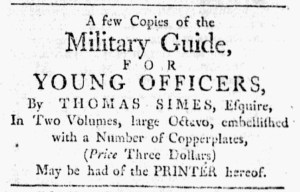
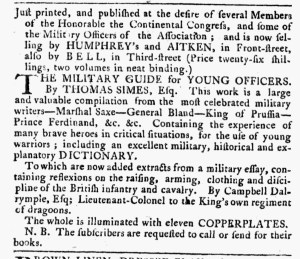
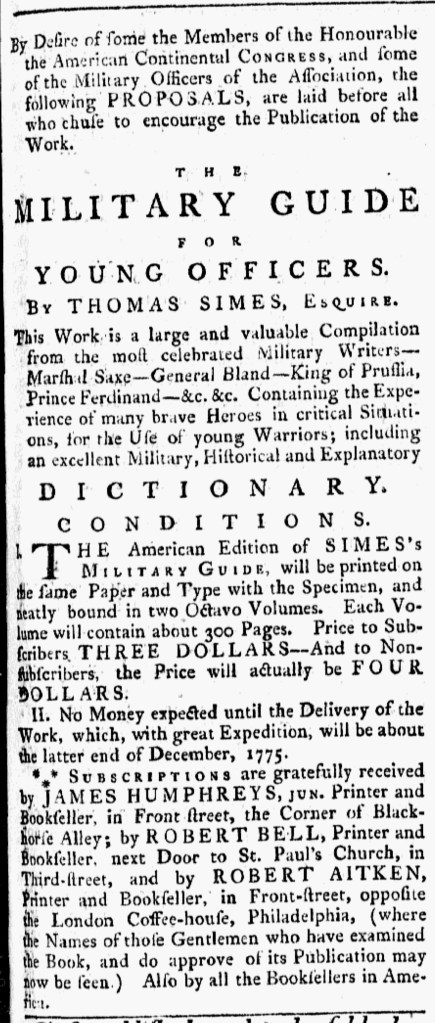
In December 1775, James Humphreys, Jr., Robert Bell, and Robert Aitken collaborated in advertising and publishing The Military Guide for Young Officers by Thomas Simes, making yet another military manual available to the public following the momentous events at Lexington and Concord the previous April.  More recent developments, both military and political, convinced printers that a market existed for military manuals.  According to the introduction to “Books in the Field: Studying the Art of War in Revolutionary America,” an exhibition sponsored by the American Revolution Institute of the Society of the Cincinnati, “a flood of printing began to appear from the American presses.  Much of this activity was centered in Philadelphia, where more than thirty works on military subjects were published in the years 1775 and 1776 alone.”

Of the three of the printer-booksellers who partnered in publishing Simes’s Military Guide, Humphreys was the only one who published a newspaper.  He gave their advertisement a privileged place at the top of the first column on the first page of the December 2, 1775, edition of the Pennsylvania Ledger.  Rather than advertising a book already available for sale, the printer-booksellers distributed subscription proposals, doing so, they claimed, “By Desire of some the Members of the Honourable American Continental CONGRESS, and some of the Military Officers of the Association.”  Readers who wished to reserve copies of the work became subscribers by submitting their names to any of those three printer-booksellers, though they also indicated that “SUBSCRIPTIONS are gratefully received … by all the Booksellers in America.”  Printers, authors, and others in the book trades had more than one reason for circulating subscription proposals.  They hoped to incite greater demand while also learning if sufficient interest existed to make a project viable and, if so, how many copies to produce.

This subscription proposal featured an overview of the contents of the military guide: “a large and valuable Compilation from the most celebrated Miliary Writers … Containing the Experience of many brave Heroes in critical Situations, for the Use of young Warriors” as well as “an excellent Military, Historical and Explanatory DICTIONARY.”  This “American Edition … will be printed on the same Paper and Type with the Specimen, and neatly bound in two Octavo Volumes.”  Apparently, Humphreys, Bell, and Aitken had specimens or samples of the paper and type on display at their printing offices so prospective subscribers could examine them and assess the material quality of the work for themselves before committing to ordering copies.  Printers often circulated specimens along with subscription proposals.  The partners planned to print some surplus copies, expecting that demand would warrant doing so, but encouraged subscribers with a discount.  Those who reserved their copies paid three dollars, but for “Non-subscribers, the Price will actually be FOUR DOLLARS.”  Subscribers did not need to part with their money “until the Delivery of the Work,” anticipated for “the latter end of December, 1775.”  Humphreys, Bell, and Aitken did not take the military manual to press as quickly as they expected.  The imprint on the title page gives the date of publication as 1776.  The partners made one final pitch in the subscription proposals, announcing that “the Names of those Gentlemen who have examined the Book, and do approve of its Publication may now be seen” at Aitken’s printing office.  These marketing efforts apparently helped the partners attract enough subscribers to publish the proposed work.  Not all subscription proposals met with such success.  Current events likely played a role in the outcome when Humphreys, Bell, and Aitken proposed an American edition of The Miliary Guide for Young Officers.

November 20

What was advertised in a revolutionary American newspaper 250 years ago today?

Boston-Gazette (November 20, 1775).

“MILITARY INSTRUCTIONS for officers Detached in the Field.”

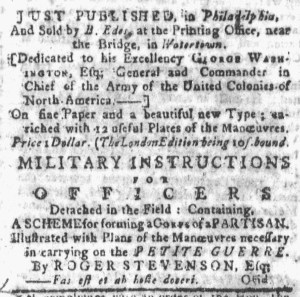
On November 20, 1775, Benjamin Edes, the printer of the Boston-Gazette, ran an advertisement for a military manual “JUST PUBLISHED, in Philadelphia,” and available at his printing office in Watertown.  The printer had relocated there shortly after the battles at Lexington and Concord, though he did not update the name of his newspaper.  He advertised an edition of Roger Stevenson’s Military Instructions for Officers Detached in the Field published by Robert Aitken.  Although the advertisement proclaimed that the book had been “JUST PUBLISHED,” another edition had been available in Philadelphia since June.  At the time that Aitken advertised it, he noted that “A new Edition of this Book, with some Additions, is now in the Press and will soon be published.”  That likely referred to the edition that Edes stocked, especially considering that the appeals in his advertisement paralleled the advertisement that Aitken published in the Pennsylvania Ledger in August.

Both advertisements opened with an announcement that the book had been published and where to acquire copies, followed by a note that this edition was “Dedicated to his Excellency GEORGE WASHINGTON, Esq; General and Commander in Chief of the Army of the United Colonies of North-America.”  Next, both advertisements commented on the material aspects of the book, noting the “fine Paper and a beautiful new Type” as well as the “12 useful Plates [or illustrations] of the Manœuvres.”  The price in the local currency followed, along with a comparison to the price of a bound London edition.”  As was so often the case in advertisements for books, all that preamble appeared before the title of the book.  Aitken’s much longer advertisement then presented an address “TO THE PUBLIC” drawn from the preface.  Edes did not devote that much space to his advertisement in the Boston-Gazette.  Instead, he inserted a quotation from Ovid: “Fas est et ab roste doceri” (It is right to be taught from the pulpit).  That phrase invoked Stevenson’s experience as a British officer.  Edes did not devise it on his own.  Instead, he borrowed it from the title page.  Overall, Edes did not generate original copy for his advertisement for a military manual printed in Philadelphia.  Instead, he borrowed heavily from Aitken’s advertisement, revising the location where customers could purchase the book and the price in local currency.  He also substituted the quotation on the title page for an excerpt from the preface but did not compose anything new for his advertisement.  The marketing for the book in the Boston-Gazette thus replicated the strategies that Aitken introduced in the public prints in Philadelphia months earlier.  He may even have dispatched a clipping of the advertisement with the copies he sent to Edes.

November 8

What was advertised in a revolutionary American newspaper 250 years ago today?

Pennsylvania Gazette (November 8, 1775).

“PROPOSALS FOR PRINTING BY SUBSCRIPTION, A TREATISE OF FORTIFICATION.”

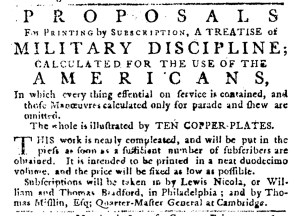
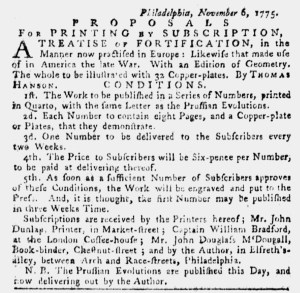
Thomas Hanson announced a new project in the November 8, 1775, editions of the Pennsylvania Gazette and the Pennsylvania Journal.  For several months he had been engaged in soliciting subscribers for his Prussian Evolutions in Actual Engagements, a military manual that garnered the support of both officers and politicians.  With that book “published … and now delivering out by the Author,” Hanson distributed subscription proposals for printing “A TREATISE OF FORTIFICATION, in the Manner now practiced in Europe: Likewise that made use of in America the late War.”  The Prussian Evolutions included thirty copperplate engravings; similarly, this new endeavor would be “illustrated with 32 Copper-plates.”

Hanson adopted a different method for publishing the proposed treatise than he had for the Prussian Evolutions.  Rather than produce a single volume, he planned for the “Work to be published in a Series of Numbers, printed in Quarto, with the same Letter as the Prussian Evolutions,” “Each Number to contain eight Pages, and a Copper-plate or Plates, that they demonstrate,” and “One number to be delivered to the Subscribers every two Weeks.”  Eighteenth-century readers would have been familiar with such “CONDITIONS” for publishing books.  Hanson planned to use the type (“same Letter”) as his first book, giving the two works a similar appearance.  Instead of taking the entire book to press at one time, Hanson planned to print and distribute two sheets (“eight Pages”) and the corresponding illustrations once every two weeks.  Each sheet would have four pages on it, creating a quarto sized book when folded by the printer, bookbinder, or subscriber.  Subscribers paid six pence “per Number” or set of eight pages with corresponding illustrations upon delivery.

Hanson declared that “the Work will be engraved and put to the Press” once “a sufficient Number of Subscribers approves of these Conditions.”  Why did he opt to publish his treatise on fortifications in smaller parts rather than all at once?  Perhaps Hanson had grown frustrated with the delays in publishing the Prussian Evolutions.  In an earlier advertisement, he noted that he first published subscription proposals on May 3, shortly after learning about the battles at Lexington and Concord.  In July, he thought that the book would be completed “in three or four weeks,” yet more than three months passed before the volume was published and ready for delivery.  Printing and distributing a new “Number” every two weeks would keep the project moving forward and the revenues collected upon delivery would likely help as well.  Hanson expected that “the first Number may be published in three Weeks Time,” but it seems that he was disappointed once again.  It does not appear that this proposed project met with the same success as the Prussian Evolutions.  Even if some “Numbers” went to press, no complete volume of the proposed treatise survives today.  Most likely, Hanson did not entice a “sufficient Number of Subscribers.”  According to the American Revolution Institute of the Society of the Cincinnati, he faced a lot of competition.  Presses in Philadelphia produced more than thirty works on military subjects in 1775 and 1776, including Hanson’s Prussian Evolutions.

November 4

What was advertised in a revolutionary American newspaper 250 years ago today?

Supplement to the Pennsylvania Evening Post (November 4, 1775).

“Those gentlemen who have taken subscriptions … are requested to return the lists speedily.”

A notice in the Supplement to the Pennsylvania Evening Post for November 4, 1775, advised that “THOSE gentlemen who intend to subscribe for HANSON’s EVOLUTIONS, and have not sent in their names, are requested to be speedy in forwarding them.”  Thomas Hanson, “Adjutant to the 2d Battalion” and author of the work, expected that the readers he addressed knew that he referred to The Prussian Evolutions in Actual Engagements; Both in Platoons, Sub, and Grand-Divisions; Explaining, all the Different Evolutions, and Manoeuvres, in Firing, Standing, Advancing, and Retreating, Which Were Exhibitted before His Present Majesty, May 8, 1769; and before John Duke of Argyle , on the Links, near Edenburgh, in 1771; with Some Additions, Since that Time, Explained with Thirty Folio Copper-Plates; To Which Is Added, the Prussian Manual Exercise; Also the Theory and Practices of Gunnery.  To include the entire title of the book would have doubled the length of the advertisement!  An advertisement published in July had included most of the title as a means of inciting interest among prospective subscribers.

Hanson had been marketing the book since early May, apparently embarking on the project almost as soon as residents of Philadelphia learned of the battles at Lexington and Concord that took place on April 19.  When he ran the newspaper advertisement in July, he anticipated that the “said work will be completed in three or four weeks from this date,” but it took longer than expected since more than three months later he ran a new advertisement that indicated the “first edition” had not yet been printed.  Subscribers needed to submit their names quickly, Hanson asserted, or else their names would not appear in the subscription list incorporated into the book with the other content.  That subscription list eventually filled five pages and included prominent military officers, such as “His Excellency George Washington” and “His Excellency Philip Schuyler,” and members of the Second Continental Congress, such as “The Honourable Benjamin Franklin” and “The Hon. John Hancock.”  Peyton Randolph also appeared among the list of subscribers, though he died before Hanson published the book.  In his newest advertisement, he once again instructed prospective subscribers to submit their names because “otherwise a list of them cannot be printed.”

In the earlier advertisement, Hanson listed about a dozen local subscription agents who collected orders, including merchants and printers.  This time, he told prospective subscribers that they could submit their names directly to him or “to the bar of the London Coffee-house,” a popular place for gathering to socialize, conduct business, and discuss politics.  Hanson did acknowledge those “gentlemen who have taken subscriptions” and requested that they “return the lists speedily” so he could compile them for publication.  It seemed to be the last chance to submit orders before the book was published.  The title page did not include a date, but historians believe it was printed in late 1775.

August 24

What was advertised in a revolutionary American newspaper 250 years ago today?

Pennsylvania Evening Post (August 24, 1775).

“A dictionary, explaining the most difficult terms made use of in fortification, gunnery, and the whole compass of the military art.”

It was one of the first mentions of an almanac for 1776 in an American newspaper.  The initial notices usually began appearing sometime in August, scattered here and there in different newspapers, and then more printers advertised almanacs for the coming year during the fall.  The number and frequency of advertisements accelerated each year as printers engaged in fierce competition to market and sell the popular reference manuals.

Benjamin Towne, the printer of the Pennsylvania Evening Post, inserted a notice about an almanac for 1776 in the August 24, 1775, edition of his newspaper, making him one of the first that year.  “In the press, and shortly will be published, by the Printer of this paper,” he announced, “The CONSTITUTIONAL ALMANACK.”  The notice appeared immediately after news from the Second Continental Congress, but without the usual line to separate it from other content.  An advertisement offering a reward for a runaway indenture servant ran below the notice about the almanac, a horizontal line demarcating where one ended and the other began.  Similar lines separated the advertisements on the final page of that edition.  Towne resorted to a tactic sometimes deployed by printers when they promoted their own work, placing his notice ahead of any of the paid advertisements and adopting a format that made it look like a news item.  Even if readers did not peruse all the advertisements, they likely read Towne’s notice about his almanac and then realized that they had reached the end of the news.

The printer’s notice included information that he considered newsworthy.  “As a dictionary, explaining the most difficult terms made use of in fortification, gunnery, and the whole compass of the military art, will be subjoined,” Towne declared, “it is presumed this Almanack will be considered a valuable VADE MECUM at this important juncture.”  Prospective customers would benefit from treating the combined almanac and dictionary as a handbook kept constantly at the ready for consultation as more news about the siege of Boston reached them and especially if the news included accounts of new encounters between British regulars and American soldiers.  Following the battles at Lexington and Concord in April and the Battle of Bunker Hill in June, colonizers did not know when they might need to consult a dictionary of “fortification, gunnery, and the whole compass of the military art” to understand the news they read or heard.  The dictionary that accompanied it certainly distinguished Towne’s almanac from others published in the past.

August 12

What was advertised in a revolutionary American newspaper 250 years ago today?

Pennsylvania Ledger (August 12, 1775).

“MILITARY INSTRUCTIONS FOR OFFICERS DETACHED IN THE FIELD.”

On August 12, 1775, Robert Aitken, a printer in Philadelphia, launched a new advertising campaign to promote his American edition of Military Instructions for Office Detached in the Field by Roger Stevenson.  He began with advertisements in the Pennsylvania Evening Post and the Pennsylvania Ledger.  Two days later, he placed the same advertisement in Dunlap’s Pennsylvania Packet and then in the Pennsylvania Gazette another two days after that. Aitken’s new advertisement significantly expanded on the notice that he had published in June.

This time, for example, the printer announced that his American edition was “Dedicated to His Excellency GEORGE WASHINGTON, Esq; General and Commander in Chief of the Army of the United Colonies of North-America.”  The book itself featured a short dedication essay that extended four pages.  In the new advertisement, Aitken promoted some of the usual qualities that printers, publishers, and booksellers often highlighted, noting that the book was printed “On fine Paper, [with] a beautiful new Type” and the “twelve useful Plates” or illustrations “of the Manœuvres” supplemented the text.  Each bound copy cost six shillings and six pence, though Aitken also marketed a “few copies on a superfine paper” for one dollar to those who desired even higher quality.  The price was a bargain, the printer noted, with a bound copy of the London edition selling for ten shillings.

Beyond those details, Aitken incorporated an address “TO THE PUBLIC” into this advertisement, though he did not generate the copy himself.  Instead, he borrowed liberally from the preface of the book, making minor revisions here and there.  In effect, he gave prospective customers a preview of what they would read once they purchased Military Instructions for Officers Detached in the Field.  In the preface, Stevenson lamented that “inferior officers have had no source from whence they could derive instruction on the duties of their sphere in the field,” but he aimed to remedy that with this volume.  He almost certainly had not intended, however, that it would be used by officers in the “Army of the United Colonies of North-America” as they defended their liberties in what would eventually become a war for independence.  Aitken saw an opportunity to generate revenues in the wake of the battles at Lexington and Concord.

In a nota bene, the printer added that he stocked “A complete and elegant MAP of the country, shewing the Seat of the present unhappy Civil War in North-America.”  Bernard Romans, a prominent cartographer, distributed broadside subscription proposals a month earlier, listing Aitken among the many local agents who collected names of subscribers who ordered copies in advance.   The printer gave details about the map not included in the broadside subscription proposal and that had not appeared in newspaper notices.  The map featured a “beautiful Draught of the Provincial CAMP: Likewise, A perspective View of BOSTON, and Gen. Gage’s LINE.”  Current events certainly shaped which items Aitken produced, advertised, and sold at his printing office in Philadelphia.

July 27

What was advertised in a revolutionary American newspaper 250 years ago today?

New-England Chronicle (July 27, 1775).

“An easy Plan of Discipline for a MILITIA. By TIMOTHY PICKERING.”

As the imperial crisis intensified when the Coercive Acts went into effect in 1774, the Massachusetts Provincial Congress recommended publication of a manual for training militia throughout the colony, The Manual Exercise as Ordered by His Majesty in 1764: Together with Plans and Explanations of the Method Generally Practis’d at Reviews and Field-Days.  Over the next several months, several printers in New England published their own editions.  Advertisements for The Manual Exercise appeared frequently in newspapers throughout the region.  Printers beyond New England followed their lead.  After the battles at Lexington and Concord, advertisements for other military manuals proliferated, including advertisements for Thomas Hanson’s Prussian Evolutions in Actual Engagements published by subscription in Philadelphia.

Samuel Hall and Ebenezer Hall, printers of the New-England Chronicle, published and advertised yet another military manual, An Easy Plan of Discipline for a Militia by Timothy Pickering, Jr.  An advertisement for the work appeared in the July 27, 1775, edition of their newspaper.  The Halls indicated that they had copies available at their printing office in Cambridge, where they had only recently moved from Salem and renamed and continued publishing the Essex Gazette. In addition, Joseph Hiller, a watchmaker in Salem, also sold the manual.  The advertisement consisted primarily of an extensive list of the contents, demonstrating to prospective customers what they could expect to find in the volume, followed by a short note that the “methods of performing the evolutions or manœuvres, wheelings, &c. are exhibited in 14 octavo copper-plate prints.”  The illustrations were an important addition that would aid readers in understanding the various maneuvers described in the book.

In addition to the advertisement the Halls inserted in the New-England Chronicle, Pickering pursued another means of marketing the book.  He sent a copy directly to George Washington with a request that he consider “recommending or permitting its use among the officers & soldiers under your command.”  Pickering flattered the commander of the Continental Army following his appointment to the post by the Second Continental Congress, declaring that the army had been “committed to your excellency’s care & direction” “to the joy of every American.”  Pickering asserted his own “duty & inclination” inspired him to compose the manual and present it to the general for his consideration.  He deemed it a “service [to] my country” that he hoped “may well prove advantageous in an army hastily assembled.”  Washington did indeed take note.  According to the American Revolution Institute, “Washington promoted the use of several published works, including Timothy Pickering’s An Easy Plan of Discipline for a Militia and Thomas Hanson’s The Prussian Evolutions” during the early years of the Revolutionary War.  In 1779, Baron von Steuben’s Regulations for the Order and Discipline of the Troops of the United States became the first official manual of the Continental Army.  Until then, Pickering’s manual was a popular choice for training American soldiers.

July 19

What was advertised in a revolutionary American newspaper 250 years ago today?

Pennsylvania Journal (July 19, 1775).

“PROPOSALS, For printing … The PRUSSIAN EVOLUTIONS In actual Engagements.”

The July 19, 1775 editions of the Pennsylvania Gazette and the Pennsylvania Journal carried “PROPOSALS, For printing by SUBSCRIPTION, The PRUSSIAN EVOLUTIONS In actual Engagements” by Thomas Hanson.  A synopsis indicated that the book included “all the different Evolutions and Manoeuvres in firing standing, advancing and retreating, which were exhibited before his present Majesty, May 8, 1769, and before John Duke of Argyle … in 1771; with some additions since that time, explained with thirty folio copper-plates.”  Three bonus images accompanied by descriptions depicted surveying, fortifications, and a gun and mortar.

The advertisement noted that the proposals “were first published May 3, 1775, by THOMAS HANSON, Adjutant for the Second Battalion.”  That means that Hanson proposed and marketed the work very shortly after receiving news of the battles at Lexington and Concord.  Such projects, however, took time.  “It is expected,” Hanson stated, that the “said work will be completed in three or four weeks from this date” or sometime in the middle of August.  To entice readers to reserve copies in advance, Hanson also promised that the “Subscribers names will be inserted, and those that choose to subscribe must do it speedily, otherwise their names will not be in the book.”  Prospective subscribers had an opportunity to demonstrate their support for the American cause and appear in the company of fellow Patriots, just as genteel advocates for improvements in architecture had their names listed in a recently published American edition of Abraham Swan’s British Architect.

Several prominent residents of Philadelphia lent their support to the work by collecting subscriptions on behalf of Hanson, including “John Dickinson, Esq; Thomas Mifflin, Esq; Daniel Roberdeau, John Cox, jun.[,] Samuel Meredith, and John Wilcocks, Merchants,” Benjamin Towne, printer of the Pennsylvania Evening Post; William Hall, David Hall, and William Sellers, printers of the Pennsylvania Gazette; William Bradford and Thomas Bradford, printers of the Pennsylvania Journal; Robert Bell, printer and bookseller; and Thomas Nevell, “at the sign of the Carpenter’s-Hall” (who simultaneously collected subscriptions for The Gentleman and Cabinet-Maker’s Assistant and an American edition of Swan’s Collection of Designs in Architecture).

George Washington had already joined the ranks of the subscribers to Prussian Evolutions by the time Hanson’s proposals ran in the Pennsylvania Gazette and the Pennsylvania Journal on July 19.  According to historians at Mount Vernon, Washington purchased eight copies of Hanson’s manual, “one of the earliest for the instruction of American officers,” on May 20 and “likely distribute[d] the copies among militia officers and other key figures preparing for the growing conflict.  Indeed, “His Excellency George Washington” appeared among the “LIST OF SUBSCRIBERS NAMES” inserted immediately after the “DEDICATION, TO THE PRESERVERS of LIBERTY,” with a notation that he ordered eight copies.  Other subscribers included “The Honourable John Adams,” “The Honourable Benjamin Franklin,” “The Hon. John Hancock,” “His Excellency Richard Henry Lee,” “The Hon. Peyton Randolph,” and “His Excellency Philip Schuyler.”  Washington was not alone in subscribing for multiple copies.  Captain Moore Furman subscribed for five, Lieutenant Colonel Abraham Hunt for six, Captain Joseph Moulder for two, Lieutenant John Patton for two, and Colonel Daniel Roberdeau for four.  The “Merchants” who collected subscriptions also appeared on the list, identified by their military ranks: “Col. John Dickinson, Esq,” “Quarter Master General, Thomas Mifflin,” “Major, John Cox,” “Major, Samuel Meridith,” and “Capt. John Wilcocks.”  Subscribers certainly found themselves in good company!

April 18

What was advertised in a colonial American newspaper 250 years ago today?

“An elegant Edition of the MANUAL EXERCISE [with] the various Positions of a Soldier under Arms.”

Pennsylvania Evening Post (April 18, 1775).

Advertisements for The Manual Exercise as Ordered by His Majesty in 1764: Together with Plans an Explanations of the Method Generally Practised at Reviews and Field-Days appeared in several newspapers printed in New England in 1774, one indication of how colonizers reacted to the trouble brewing with Great Britain.  Printers in five towns produced their own editions, including Ezra Lunt and Henry-Walter Tinges in Newburyport, Massachusetts, John Carter in Providence, Rhode Island, Judah Paddock Spooner in Norwich, and Thomas Green and Samuel Green in New Haven, Connecticut.  In Boston, Isaiah Thomas printed the book and Thomas Fleet and John Fleet issued three variant editions.  They may have also published a previous edition in 1773, based on an inscription that appears in one surviving copy.

In 1775, printers beyond New England produced other editions after the skirmishes at Lexington and Concord and the ensuing military actions.  In New York, Hugh Gaine published one edition; another printed by J. Anderson has been dated to that year.  William Bradford and Thomas Bradford issued the book in Philadelphia.  So did Robert Aitken, meeting with sufficient demand to issue a second edition.  Francis Bailey in Lancaster, Pennsylvania, James Adams in Wilmington, Delaware, and John Dixon and William Hunter in Williamsburg, Virginia, each published local editions in 1775.

Alexander Robertson, James Robertson, and John Trumbull in Norwich, Connecticut, were among the printers who published an edition in 1774.  In the October 13 edition of the Norwich Packet, they advertised that they had “Just published … THE MANUAL EXERCISE, AS ORDERED BY HIS MAJESTY, And now adopted in the Colonies of CONNECTICUT, RHODE-ISLAND, and Province of MASSACHUSETTS-BAY.”  On February 23, 1775, they ran much more elaborate subscription proposals for another edition, an “ELEGANT EDITION” that would include “38 Figures on 27 large Folioand Octavo Copper Plates” that depicted the “various POSITIONS of a SOLDIER UNDER ARMS.”  They explained that “Some Gentlemen, distinguished by their patriotic Principles and military Skill, have recommended this Undertaking to the Printers” as a service to the public.  In the interest of disseminating the book widely so “its Utility may be as universal as possible,” the printers set a low price, “only three Shillings … per Copy” for subscribers who ordered theirs in advance.  Those “who do not subscribe before the Book is published,” on the other hand, could expect to pay “a considerable Advance” (or higher price).  The Robertsons and Trumbull set the price such that “the Sale of 500 Copies” would defray “the very great Expence which will be incurred by the engraving and working the Copper Plates” and yield “but a slender Emolument to the Editors.”

In those proposals, the printers listed local agents who collected subscriptions in Boston, Chelsea, Newburyport, and Salem in Massachusetts, Portsmouth in New Hampshire, and Providence in Rhode Island.  In addition, three post riders also took orders from subscribers.  Eventually, a version of the proposals ran in the Pennsylvania Evening Post.  It did not include the lengthy list of local agents in New England, but instead specified that Benjamin Towne, the printer of the Pennsylvania Evening Post, and William Bradford and Thomas Bradford, the printers of the Pennsylvania Journal, collected subscriptions in Philadelphia.  Perhaps the Bradfords had not yet determined to publish their own edition.  Those proposals also doubled the number of subscribers necessary for “defraying the great Expence” of the engravings to one thousand.

Even though the Robertsons and Trumbull promoted the copper plates, asserting that they “will be engraved by an Artists who has already exhibited convincing Specimens of his Abilities, and great Care will be taken to have them executed in an elegant Manner,” they did not include those illustrations with the new edition they published in 1775.  That edition closely paralleled their previous edition, though it did have a new title page and “Instructions for young OFFICERS.  By GENERAL WOLFE” on the final page, which had been blank in the 1774 edition.  While it is possible that the engravings were removed from the copy in the collections of the American Antiquarian Society at some point over the past 250 years, it seems more likely that events overtook the printers.  Once the imperial crisis became a war, they may have been less concerned about commissioning copperplate engravings and more interested in issuing a new edition of the Manual Exercise to meet the demand of colonizers who believed more than ever that they needed the instructions in that volume.

Copies of The Manual Exercise printed by Robertsons and Trumbull in the collections of the American Antiquarian Society. Left: 1774 edition. Right: 1775 edition.