December 22

What was advertised in a revolutionary American newspaper 250 years ago today?
South-Carolina and American General Gazette (December 22, 1775).

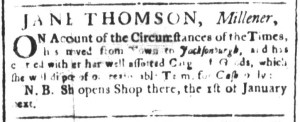
“JANE THOMSON, Millener, ON Account of the Circumstances of the Times, has moved from Town to Jacksonburgh.”

In December 1775, Jane Thomson, a milliner, had been running a shop in Charleston and occasionally placing newspaper advertisements for several years.  She likely followed news from Massachusetts about the hostilities that commenced at Lexington and Concord the previous April as well as updates from the meetings of the Second Continental Congress in Philadelphia.  She probably knew that residents of urban ports beyond New England felt anxious that the British would target their homes next, prompting some to move to the countryside for better security.  She apparently experienced the same anxiety and charted a new course accordingly.  In the December 22 edition of the South-Carolina and American General Gazette, the only newspaper still being published in the colony at the time, she announced that “ON Account of the Circumstances of the Times” she “has moved from Town [or Charleston] to Jacksonburgh,” nearly fifty miles to the west.  Thomson informed readers that she “has carried with her her well assorted [illegible] of Goods, which she will dispose of on reasonable Terms for Cash only.”  She planned to open her shop in her new location on January 1, 1776.

Thomson’s notice will be one of the last advertisements from the South-Carolina and American General Gazette featured on the Adverts 250 Project.  The newspaper continued publication until the end of February 1781, with some suspensions due to the Revolutionary War, and a complete run through December 1779 has been preserved buy the Charleston Library Society.  However, issues for 1776, 1777, 1778, and 1779 have not been digitized for greater accessibility.  In producing the Adverts 250 Project and the Slavery Adverts 250 Project, I have relied on the South Carolina Newspapers collection from Accessible Archives (now part of History Commons), yet that coverage ends with the issue for December 22, 1775.  Readex’s America’s Historical Newspapers has five more issues (September 4, 1776; April 10, 1777; February 19, June 4, and October 1, 1778) that I will incorporate into the project at the appropriate times, but the Adverts 250 Project and the Slavery Adverts 250 Project will not offer the same sustained look at advertising and the intersections of commerce, politics, and everyday life in Charleston during the Revolutionary War as I have attempted to provide for the period of the imperial crisis that ultimately led to that war.  The stories of that important urban port have always been truncated according to which advertisements I selected to feature.  Now they will be absent altogether.
December 4

What was advertised in a revolutionary American newspaper 250 years ago today?

Connecticut Courant (December 4, 1775).

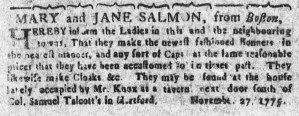
“Newest fashioned Bonnets … at the same reasonable prices that they have been accustomed to in times past.”

When they relocated to Hartford, milliners Mary Salmon and Jane Salmon placed an advertisement in the December 4, 1775, edition of the Connecticut Courant to introduce themselves to their new neighbors and, especially, to prospective customers.  They informed “the Ladies in this and the neighbouring towns, That they make the newest fashioned Bonnets in the neatest manner, and any sort of Caps.”  They also noted that they “make Cloaks” and other garments.  The milliners hoped to establish a clientele and earn their livelihood in a town new to them.  In the headline for their advertisement, they described themselves as “from Boston.”  The Salmons were not the only newcomers from Boston who ran an advertisement in that issue of the Connecticut Courant.  James Lamb and Son, tailors “From Boston” who had previously inserted a notice in that newspaper in September, ran a new advertisement that appeared in the same column as the Salmons’ notice.  Like the Lambs, the Salmons may have been refugees who left Boston following the outbreak of hostilities at Lexington and Concord in the spring.

In marketing their wares, the Salmons did not allow the difficulties of the war to overshadow prospective customers’ desire for hats that followed the latest styles.  They intentionally declared that they made “the newest fashioned Bonnets” and did so “in the neatest manner.”  They combined appeals to taste with a pledge about the quality of their hats and their skill as milliners.  The Salmons also incorporated promises regarding price into their brief advertisement, asserting that they charged “the same reasonable prices that [prospective customers] have been accustomed to in times past.”  The disruptions caused by the war did not cause them to raise prices.  In addition, they made a nod to the ninth article of the Continental Association: “That such as are Venders of Goods or Merchandise will not take Advantage of the Scarcity of Goods that may be occasioned by this Association, but will sell the same at the Rates we have been respectively accustomed to do so for twelve Months last past.”  The Salmons could not rely on their reputation among an existing clientele to generate business as they had done in Boston.  Instead, they devised an advertisement that said a lot in just a few lines, deploying appeals to fashion, quality, skill, and price.  They may have also expected that current events would resonate with their notice, anticipating that prospective customers would realize why they moved from Boston and their commitment to abiding by the Continental Association.

October 15

What was advertised in a revolutionary American newspaper 250 years ago this week?

Virginia Gazette [Dixon and Hunter] (October 14, 1775).

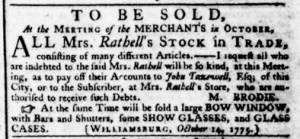
“Will be sold a large BOW WINDOW, with Bars and Shutters, some SHOW GLASSES, and GLASS CASES.”

In the spring of 1775, Catherine Rathell, a milliner in Williamsburg, advertised her intention to “dispose of my Goods” and go to England “till Liberty of Importation is allowed.”  The Continental Association, a nonimportation agreement devised by the First Continental Congress in protest of the Coercive Acts, disrupted trade for merchants, shopkeepers, and others who sold imported goods.  When she first placed her advertisement, Rathell and the rest of the residents of Williamsburg had not yet received word of the battles at Lexington and Concord.  The outbreak of hostilities may have prompted her to adjust her plans because she did not wait until she sold all her merchandise to depart.  Instead, she left her wares in the hands of Margaret Brodie, a mantuamaker who had worked with Rathell since 1771, to sell “At theMEETING of the MERCHANTS in OCTOBER.”  The milliner did not return to Williamsburg.  Unfortunately, she died when the ship taking her to England got caught in a hurricane and sank.

Brodie’s advertisement in the October 14, 1775, edition of John Dixon and William Hunter’s Virginia Gazette concerned more than just selling Rathell’s remaining merchandise.  It also called on those indebted to Rathell to settle accounts with Brodie.  A short note at the end of the notice, marked with a manicule to draw attention, noted that “a large BOW WINDOW, with Bars and Shutters, some SHOW GLASSES, and GLASS CASES” would be sold at the same time as “Mrs. Rathell’s STOCK in TRADE.”  That provides a glimpse of Rathell’s merchandising strategies.  By the early eighteenth century, bow windows became popular features of shops in London, so common that some critics complained about the way that they jutted into the street and made it more difficult for pedestrians to pass.  Yet that was one of the intended purposes, causing prospective customers to slow down and view the merchandise on display.  In addition, bow windows offered more space for displaying goods than windows flush with exterior walls.  Some American retailers, including Rathell, adopted this strategy for marketing their wares.  Rathell also invested in glass cases to showcase some of her merchandise for visitors to her shop.  She could protect valuable items from shoplifters while still making them visible to entice customers.  Similarly, the bars on shutters on the bow window protected goods from burglars when the shop was closed.  Without contemporary visual images of American shops, Rathell’s advertisement helps reconstruct their interiors and the experience of shopping in eighteenth-century America.

June 3

What was advertised in a revolutionary American newspaper 250 years ago today?

Providence Gazette (June 3, 1775).

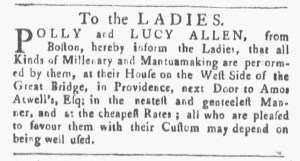
“POLLY and LUCY ALLEN, from Boston.”

On June 3, 1775, Polly Allen and Lucy Allen published an advertisement addressed “To the LADIES” in the Providence Gazette.  That notice served as an introduction upon their arrival in the city, informing prospective customers and the community that “all Kinds of Millenary and Mantuamaking are performed by them, at their House on the West Side of the Great Bridge.”  Since the Allens were new to town, they gave further directions that stated their location relative to a resident familiar to readers, stating that they could be found “next door to Amos Atwell’s, Esq.”  New on the scene, they could not rely on their reputation among an established clientele to generate business.  Instead, they assured prospective customers that they made hats and garments “in the neatest and genteelest Manner, and at the cheapest Rates.”  In addition to skillful work on fashionable clothing at the lowest prices, the Allens also pledged exemplary customer service, stating that “all who are pleased to favour them with their Custom may depend on being well used.”

As part of their introduction, the Allens described themselves as “from Boston.”  That made them refugees, of sorts, who had been displaced during the first weeks of the Revolutionary War.  Following the battles at Lexington and Concord on April 19, militias from throughout Massachusetts, joined by companies from other colonies, besieged Boston.  The Massachusetts Provincial Congress, meeting in Watertown, negotiated with General Thomas Gage, the governor, to allow Loyalists who wished to enter the city to do so.  In return, Patriots and other “Inhabitants of the Town of Boston” could leave.  In each case, they could take their effects with them, “excepting their Fire-Arms and Ammunition.”  The Allens apparently took advantage of safe passage out of the city, along with between 12.000 and 13,000 other residents.  When they introduced themselves in the Providence Gazette as “POLLY and LUCY ALLEN, from Boston,” they did not need to say more for readers to piece together why they chose to relocate at that moment.  The Allens may have hoped that their situation would evoke some sympathy among prospective customers or even some curiosity among those who wanted to hear for themselves what conditions had been like since the Boston Port Act closed the harbor a year earlier and, especially, during the siege in recent weeks.  Some clients may have headed to the Allens’ shop in hope of stories as well as new hats and dresses.

January 19

What was advertised in a colonial American newspaper 250 years ago today?

Pennsylvania Journal (January 19, 1774).

JEDIDIAH SNOWDEN … carries on his business of Cabinet and Windsor Chair-Making … The MILLINARY BUSINESS is carried on as usual, by ANN SNOWDEN.”

Jedidiah Snowden and Ann Snowden pursued different lines of business, but they placed a joint advertisement in the January 19, 1774, edition of the Pennsylvania Journal.  Jedidiah informed the public that he moved from Market Street to Front Street, “where he carries on his business of Cabinet and Windsor Chair-Making, and sells them at the most reasonable rates.”  For her part, Ann declared that the “MILLARY BUSINESS is carried on as usual” and she “has imported a large and general assortment of MILLINARY.”  She then listed dozens of items among her inventory, including “a genteel assortment of figured and plain ribbands,” “mens, womens, boys and girls white and coloured gloves,” “pearl, French and English white wax necklaces,” and “India, ivory, bone, and black fans.”

The Snowdens did not specify their relationship to each other in their advertisement.  Most likely they were husband and wife, though they could have been father and daughter, mother and son, brother and sister, cousins, or some other relations.  Whatever the case, Jedidiah was the head of household, so his name and information about his business came first.  Although Ann’s name ran in the same size font as Jedidiah’s name, “Cabinet and Windsor Chair-Making” appeared as a secondary headline, also in a larger font than the rest of the advertisement, while “MILLINARY BUSINESS” merely appeared in capital letters integrated into the regular copy rather than treated as another headline.  Still, Ann’s portion of the advertisement occupied the most space on the page, approximately four times as much as Jedidiah’s portion.  The Snowdens made a much larger investment in promoting Ann’s “MILLINARY BUSINESS” than Jedidiah’s “Cabinet and Windsor Chair-Making.”  Perhaps Jedidiah believed that he had established such a reputation for his work that he did not need to provide more details beyond telling readers that he had moved and sold the furniture he made “at the most reasonable rates.”  Ann, on the other hand, competed with merchants, shopkeepers, and milliners who constantly imported new wares and updated their advertisements in the several newspapers published in Philadelphia.  Demonstrating that she offered the same selection of merchandise as her competitors may have been imperative to the milliner.  Advertisements jointly placed by husbands and wives or other male and female relations rarely listed the female entrepreneur first, but no matter their format they did reveal that both advertisers contributed to the household economy through their participation in the marketplace.

September 7

What was advertised in a colonial American newspaper 250 years ago today?

South-Carolina Gazette and Country Journal (September 7, 1773).

“She expects a large and neat Assortment of Millinary from London soon.”

Jane Thomson, “SOLE-DEALER AND SEPARATE TRADER,” ran her own business in Charleston in the 1770s.  The milliner took to the pages of the South-Carolina Gazette and Country Journal to inform current and prospective clients that she “has removed from Tradd-Street to Old Church-Street, next Door to Mr. Sarazin, Silversmith,” and invited them to visit her at her new location.  She wished to maintain her clientele, expressing “grateful Thanks to her Friends and Customers for their past Favours” and stating that she “will be much obliged to her former Customers for the Continuance of their Commands.”  The milliner also hoped to expand her share of the market, promising “steady Attention” to all orders that would “give Satisfaction to all who are pleased to employ her.”

In addition to exemplary customer service, Thomson emphasized the hats as well as fabrics, ribbons, laces, other adornments, and supplies she stocked for making hats.  She declared that she “has a neat Assortment of Goods suitable for her Business.”  To further entice current and prospective clients, the milliner did not rely on her current inventory alone.  Rather than settle for leftovers that she moved from one shop to another, her customers would soon have access to a “large and neat Assortment of Millinary from London.”  Thomson expected a delivery that would replenish her supplies and keep her current with the latest fashions in the most cosmopolitan city in the empire.  On occasion, merchants, shopkeepers, tailors, milliners, and other advertisers previewed new merchandise as a means of generating excitement among prospective customers.  They leveraged anticipation to market goods not yet available, encouraging consumers to watch for subsequent advertisements or visit their shops frequently to find out what kinds of new goods recently arrived.  On another occasion, Thomson promoted “A fresh Supply of MILLINARY GOODS” that she imported from London, naming the ship and captain that delivered them to demonstrate that she did indeed carry goods recently arrived in the colony.  Like many other advertisers, she recognized that consumers placed a premium on the newest arrivals … and might even find promises of imminent arrivals even more alluring.

May 29

What was advertised in a colonial American newspaper 250 years ago today?

Providence Gazette (May 29, 1771).

POLLY CHACE … now carries on the Millinery Business.”

Purveyors of consumer goods and services placed advertisements in newspapers throughout the colonies.  Men constituted the vast majority of those advertisers.  In newspapers published in smaller towns, male merchants, shopkeepers, and artisans accounted for nearly all of the advertisers who hawked consumer goods and services, while in major urban ports – Boston, Charleston, New York, and Philadelphia – women, primarily shopkeepers and milliners, gained greater visibility in the marketplace via their newspaper advertisements.

Women rarely placed advertisements about consumer goods and services in the Providence Gazette in the early 1770s, but in late spring and early summer of 1773 Polly Chace published advertisements alongside those inserted by Jabez Bowen, Nicholas Brown and Company, Joseph Russell and William Russell, Ebenezer Thompson, John Updike, Nathaniel Wheaton, Samuel Young, and other men who frequently ran newspaper notices.  Chace informed the public that “she now carries on the Millinery Business, in the Shop formerly occupied by her Father.”  In addition, she sold a “large Assortment” of accessories and a “Variety of Goods suitable for the Season, either for Town or Country.”

Most printers ran advertisements for three or four weeks for a set fee and then continued them for as long as the advertiser desired at a weekly rate.  Most advertisers who ran notices in the Providence Gazette opted for the standard package rather than extending the run, but that was not the case for Chace.  Her advertisement appeared for nine weeks, starting with the May 8 edition and concluding with the July 3 edition, before she decided to remove it.  As advertisements for textiles, accessories, and other goods came and went in the public prints, Chace’s notice became a familiar sight for readers.  If her circumstances had recently changed, perhaps due to the retirement or death of her father who “formerly occupied” her shop, Chace may have considered the prolonged exposure necessary to establish herself.  If she had previously worked in the shop under her father’s supervision, she may have wished to advise former customers that she continued offering the same goods and services.

In Providence and elsewhere, women had less visibility as purveyors of goods and services in newspaper advertisements than their numbers merited.  Many women worked in stores, shops, and workshops associated with the male entrepreneurs whose names appeared in those advertisements.  That may have previously been the case for Polly Chace, but for nine weeks in 1773 her name boldly appeared as the headline of an advertisement that promoted the business that she operated.

March 2

What was advertised in a colonial American newspaper 250 years ago today?

South-Carolina Gazette and Country Journal (March 2, 1773).

“She carries on the MILLINARY BUSINESS in all its branches, and will be much obliged to her FRIENDS for a continuance of their favours.”

The Bowers continued their advertising efforts in the South-Carolina Gazette and Country Journal in March 1773. William gave directions to the new location for his shop and advised readers that he “continues to carry on the CLOCK and WATCH-MAKING BUSINESS in all its branches.”  Katharine, a milliner and shopkeeper, promoted the “very neat ASSORTMENT of MILLINARY GOODS” she recently imported and sold at the same location that William made and repaired clocks and watches.

The two previously placed a joint advertisement with the primary purpose of informing current customers and the general public of their new location.  William’s portion of the original notice was a little longer than Katharine’s portion, mostly as a result of providing more extensive directions to the new shop at “the fourth corner of Tradd-street and the Bay, lately possessed by Messrs. Mackenzie & Tunno, and next door to The Great Stationary and Book Store.”  In terms of describing the goods and services they provided, William and Katharine occupied similar amounts of space in that earlier notice.

Such was not the case with the new notice.  William’s portion of the advertisement repeated, the type still set from the previous iteration, but Katharine submitted entirely new copy that required twice as much space as William’s portion.  That made her business the focal point of the shared advertisement, especially since her headline for “MILLINARY GOODS,” in a larger font than anything else in the notice (including their names), appeared in the center of the advertisement.  In addition, Katharine adopted a strategy deployed by many merchants and shopkeepers.  She listed a “Neat assortment of fashionable CAPS, … a great variety of sash and other RIBBONS, fashionable FANS, women and girls white and coloured GLOVES,” and various other items.  In a nota bene, Katharine declared that she “carries on the MILLINARY BUSINESS in all its branches, and will be much obliged to her FRIENDS for a continuance of their favours.”  In other words, she hoped the clientele she cultivated would follow her to her new location.

Although William and his endeavors had a privileged place at the beginning of the shared advertisement, the length and format of their respective sections made Katharine’s business more prominent in this variation.  That may have been an indication that she contributed as much to the household income through her entrepreneurial activities as he did. William’s name appeared first, but not in a way that overshadowed Mary’s business.

January 19

What was advertised in a colonial American newspaper 250 years ago today?

South-Carolina Gazette and Country Journal (January 19, 1773).

“WILLIAM BOWER … continues to carry on the CLOCK and WATCH-MAKING BUSINESS.”

“KATHARINE BOWER … carries on the MILLINARY BUSINESS.”

When clock- and watch-maker William Bower moved to a new location, he placed an advertisement in the January 19, 1773, edition of the South-Carolina Gazette and Country Journal to inform current and prospective customers.  Now located “next door to The Great Stationary and Book Store,” he continued to offer the same services “as cheap and expeditiously done, as by any [other clock- and watchmaker] in the province.”  Katharine Bower, a milliner, also advised the public that she moved to a new location “where she carries on the MILLINARY BUSINESS in all its branches, and will be much obliged to her friends for a continuance of their favours.”  William and Katharine, presumably husband and wife, but possibly otherwise related, now ran businesses from the same location at “the store the fourth corner of Tradd-street and the Bay, lately possessed by Messrs. Mackenzie & Tunno.”  Previously, William had a workshop on Broad Street, while Katharine kept shop on Church Street.

In addition to sharing a store at the corner of Tradd Street and the Bay, William and Katharine also advertised together, purchasing a “square” of space in one of the local newspapers.  Husbands and wives (and other male and female relatives) who pursued separate occupations sometimes did so, especially in newspapers published in Charleston.  Those advertisements tended to adhere to certain patterns.  The husband or other male relative usually appeared first, followed by his wife or other female relative.  In some instances, the female entrepreneur appeared only in a brief note at the end of the advertisement.  In this case, however, both William and Katharine had headlines in larger fonts that made their names visible to readers.  William had a secondary headline that gave his occupation, “CLOCK and WATCH MAKER,” while Katharine did not.  Even when female entrepreneurs were not relegated to a short note, the amount of space devoted to promoting the husband’s business usually exceeded that amount of space for the wife’s business.  At a glance, that looked like the case in the Bowers’ advertisement.  However, much of the additional space in William’s portion of the notice gave extensive directions to the new shop, directions that Katharine did not need to repeat.  Katharine did not make as elaborate appeals about price and customer service as William, but she did encourage existing customers to visit her at her new location.

The Bowers pooled their resources to insert an advertisement in the South-Carolina Gazette and Country Journal.  Their notice gave preference to William by listing his business first and including a secondary headline that listed his occupation, but this did not overshadow Katharine’s enterprise as much as some other advertisements placed jointly by men and women.  Katharine’s name appeared as a headline in the same size font as William’s name and, aside from the directions to the new location, the details about her business occupied a similar amount of space.  In general, the notice communicated that both William and Katharine were competent entrepreneurs responsible for their own participation in the marketplace.

November 22

What was advertised in a colonial American newspaper 250 years ago this week?

Maryland Gazette (November 19, 1772).

“They are well acquainted with the newest Fashions.”

When they settled in Annapolis, Jane Nelson and Anne Nelson took out an advertisement in the Maryland Gazette to introduce themselves to the community and encourage “Ladies … to favour them with their Commands” or orders for “all Kind of Milliners and Mantua-makers Work.”  As newcomers to the colony, they could not rely on their reputations to market their services.  Instead, they emphasized their connections to London, the cosmopolitan center of the empire, and their knowledge of current styles there.

In the deadline for their advertisement, the Nelsons proclaimed that they “Just arrived from LONDON.”  Artisans, tailors, milliners, and others often trumpeted that they were “from London” in their advertisements, sometimes long after they crossed the Atlantic.  The Nelsons made it clear that they only recently made that journey.  Accordingly, prospective clients could trust that they were indeed “well acquainted with the newest Fashions” and capable of making hats, cloaks, and other garments “in the most elegant and fashionable manner.”  Having recently come from London, the Nelsons could also provide guidance about “Ladies fashionable dress and undress Caps” and other items.

The Nelsons also aimed to convince prospective clients that they offered exemplary customer service.  They asserted that “Ladies … may depend on having their Work neatly done, and with the utmost Dispatch.”  If given a chance, the Nelsons assured those ladies that “they will not be disappointed in their Endeavours to please, as it shall be their constant Study and greatest Ambition.”  In addition to serving clients who visited them in Annapolis, the Nelsons also took “Orders from the Country,” pledging to punctually complete them.

These “Milliners and Mantua-makers” deployed a two-pronged approach to marketing their services upon arriving in Annapolis.  They promoted their connections to London, underscoring their familiarity with the latest tastes there, while simultaneously vowing to meet and exceed the expectations of their clients in terms of customer service.  The Nelsons hoped that combination of appeals would entice the ladies of Annapolis to engage their services.