July 8

What was advertised in a colonial American newspaper 250 years ago today?
New-Hampshire Gazette (July 8, 1774).

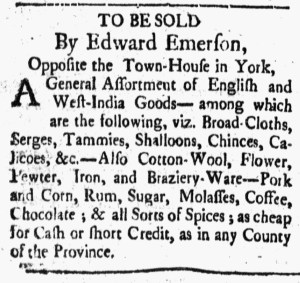
“Molasses, Coffee, Chocolate; & all Sorts of Spices.”

In the summer of 1774, Edward Emerson advertised that he sold a “General Assortment of English and West-India Goods” at his shop “Opposite the Town-House” in York.  At the time, his town, about ten miles northeast of Portsmouth, New Hampshire, was in that portion of Massachusetts that eventually became Maine in 1820.  When Emerson declared that he set prices “as cheap … as in any County of the Province” in the New-Hampshire Gazette, the local newspaper for York, he left it to readers to decide if he made the comparison to Massachusetts or New Hampshire or both.

Emerson likely considered current events in both colonies important in determining how to present his business in the public prints, making it notable that among the groceries he stocked he listed “Pork and Corn, Rum, Sugar, Molasses, Coffee, Chocolate: & all Sorts of Spices,” but not tea.  Merchants and shopkeepers who advertised coffee and chocolate very often promoted tea at the same time, though many had stopped doing so following the Boston Tea Party in December 1773.  Emerson had been no stranger to selling tea in the past, including “TEA by the dozen or smaller quantity” along with “Coffee, Chocolate, and all sorts of Spices” in February 1771 and “Bohea TEA, and all sorts of GROCERIES” in July 1772.  Yet tea had become a much more problematic commodity in recent months …

… so problematic that that Daniel Fowle, the printer of the New-Hampshire Gazette, devoted the entire front page of the July 8, 1774, edition to reporting on “TWENTY-SEVEN Chests of India TEA … consigned to Mr. Parry” and landed in Portsmouth “before it was in fact generally known that any Tea had arrived in the ship.”  The coverage documented the “peaceable and prudent conduct of the inhabitants of Portsmouth” in the face of this crisis, their actions almost certainly influenced by the repercussions that Boston faced following the destruction of the tea there.  At a town meeting, “a committee of eleven respectable inhabitants, were elected to treat with the consignee, and to deliberate what would be most expedient to be done in a cause of so much difficulty and intricacy.”  They also voted to establish “a watch of twenty-five men … to take care and secure the tea” and prevent disorder and disturbances until the committee could devise a method to remove the tea from Portsmouth.  Just as they sought to avoid destroying the tea, they realized that they could not allow any of it to be sold due to “the dependence state of this town and province upon our sister colonies, even for necessary supplies, which would undoubtedly and justly be denied” should they “suffer the sale and consumption of said Tea.”  Once the tea had been safely sent away, the town meeting voted to create “a committee of Inspection to examine and find out if any Tea is imported here” and another committee to draft a measure “against the importation, use, consumption or sale of all Teas, in this town while the same are subject to a duty.”

Given the circumstances, Emerson made a savvy decision not to market tea in his advertisement in the New-Hampshire Gazette.  Not all merchants and shopkeepers refrained from advertising and selling tea at the time, but many decided to discontinue trading that commodity even before boycotts officially went into effect.
June 10

What was advertised in a colonial American newspaper 250 years ago today?

New-Hampshire Gazette (June 10, 1774).

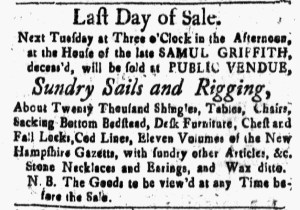
“Last Day of Sale.”

The executors for Samuel Griffith’s estate held a sale in Portsmouth on June 14, 1774, advertising a “PUBLIC VENDUE” in the June 10, 1774, edition of the New-Hampshire Gazette.  The sale included “Sundry Sails and Rigging” as well as “About Twenty Thousand Shingles, Tables, Chairs, [a] Sacking Bottom Bedstead, Desk Furniture, …with sundry other Articles” that prospective buyers could view prior to the sale.

Griffith had apparently kept abreast of the news.  His estate included “Eleven Volumes of the New Hampshire Gazette,” a “HISTORICAL CHRONICLE” (according to the masthead) of events in the colony and throughout the Atlantic world.  The executors considered Griffith’s collection of newspapers of significant enough interest to merit mention in the sale notice.  Griffith had not treated his copies of the New-Hampshire Gazette as ephemeral.  If those “Eleven Volumes” corresponded with the past eleven years, then buyers could acquire an account of the imperial crisis as it had unfolded with the Royal Proclamation of 1763, the passage and repeal of the Stamp Act in 1765 and 1766, the Townshend Acts and nonimportation agreements in the late 1760s, the Boston Massacre in 1770, and the Boston Tea Party in 1773.  Some colonizers, like Harbottle Dorr, revisited news and editorials to inform their understanding of current events.

To incite interest and increase the number of people in attendance, the executors included a headline that proclaimed, “Last Day of Sale.”  That alerted readers that they had limited opportunity to acquire any of the items from the estate, likely at bargain prices for secondhand wares compared to what they would pay retail for new items.  Those interested in the sails, rigging, and shingles for their own businesses also had the potential for lower prices than purchasing them elsewhere on the market, but not if they hesitated.  They needed to be present the following Tuesday when the sale commenced.  Many advertisements in the New-Hampshire Gazette did not feature headlines at all, so one announcing “Last Day of Sale” likely helped draw attention to an event soon to take place.

April 15

What was advertised in a colonial American newspaper 250 years ago today?

New-Hampshire Gazette (April 15, 1774).

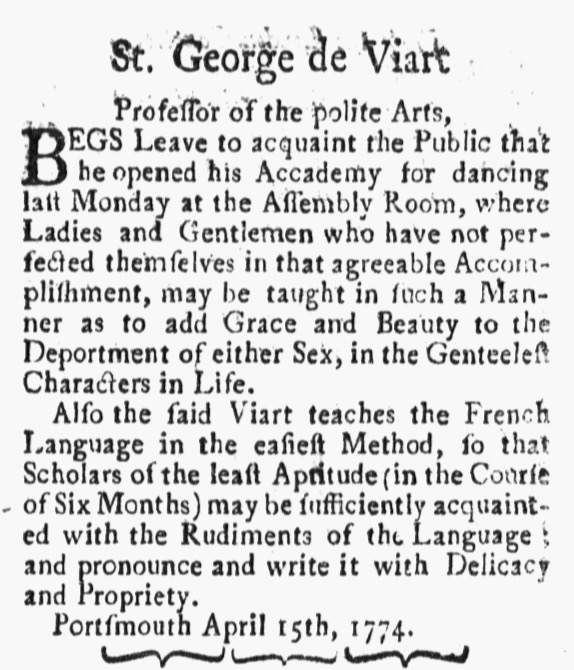
“Taught in such a Manner as to add Grace and Beauty to the Deportment of either Sex.”

Monsieur Viart once again took to the pages of the New-Hampshire Gazette in the spring of 1774, announcing that he “opened his Accademy for dancing last Monday at the Assembly Room” in Portsmouth.  Viart had previously advertised in that newspaper in the summer of 1772 and as spring approached in 1773, but by the end of the summer he was running notices in the Pennsylvania Journal.  Perhaps he had experienced too much competition with Edward Hackett and decided that he might have better prospects in Philadelphia, the largest and most genteel city in British North America.  Whatever his motivation, Viart’s time in the Quaker City did not last long.  That city had plenty of dancing masters and French tutors, a factor that may have influenced Viart’s decision to return to a place where he had cultivated a reputation among prospective students.

His presence in Portsmouth suggests a market for his services even in smaller towns, not just the largest urban ports like Boston, Charleston, New York, and Philadelphia.  Viart described himself as a “Professor of the polite Arts,” signaling that his instruction aided students in maintaining or improving their status as they strove to display their gentility to others.  He provided dancing lessons to “Ladies and Gentlemen who have not perfected themselves in that agreeable Accomplishment,” promising that he taught “in such a Manner as to add Grace and Beauty to the Deportment of either Sex, in the Genteelest Characters in Life.”  In addition to dancing, Viart “teaches the French Language in the easiest Method.”  He reassured even the most anxious prospective students, those “Scholars of the least Aptitude,” that in just six months they “may be sufficiently acquainted with the Rudiments of the Language” that they would “pronounce and write it with Delicacy and Propriety.”  Viart’s advertisements in the New-Hampshire Gazette demonstrate that just as the consumer revolution reached far beyond major port cities and into smaller towns and even the countryside, so too did concerns with refinement of character and comportment.  As colonizers acquired more goods and associated meaning with them, they also recognized that dancing well and speaking French testified to their gentility and validated their choices to wear fine clothing and purchase fashionable housewares.  As a “Professor of the polite Arts,” Viart marketed skills that helped his students complete the picture of their “Genteelest Characters.”

January 28

What was advertised in a colonial American newspaper 250 years ago today?

New-Hampshire Gazette (January 28, 1774).

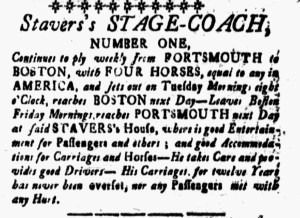
His Carriages, for twelve Years has never been overset, nor any Passengers met with any Hurt.”

John Stavers marketed experience when he advertised his stagecoach service between Portsmouth and Boston in the January 28, 1774, edition of the New-Hampshire Gazette, just as he had done in previous advertisements.  He proclaimed that “His Carriages, for twelve Years has never been overset, nor any Passengers met with any Hurt.”  That was quite the safety record.  The proprietor even invoked his experience in the name of his business, “Stavers’s STAGE-COACH, NUMBER ONE.”  That was not merely a ranking but also a reference to the fact that he had operated service between Portsmouth and Boston longer than any of his competitors.

Stavers also promoted the quality of that service, declaring that “FOUR HORSES, equal to any in AMERICA,” pulled the coach.  In addition, he “takes Care and provides good Drivers,” selecting only the best employees to represent the business he operated for more than a decade.  At the terminus in Portsmouth, Stavers ran an inn and tavern, where he provided “good Entertainment for Passengers and others” as well as “good Accommodations for Carriages and Horses.” Whether or not they rode his stagecoach, Stavers offered hospitality to travelers who visited Portsmouth.  For those who boarded in Boston or along the way to Portsmouth, he offered convenient lodging.

As was typical in advertisements for stagecoaches and ferries, Stavers provided a schedule so prospective clients could plan accordingly.  His service made the trip to Boston and back once a week.  “NUMBER ONE” departed Portsmouth at eight o’clock on Tuesday mornings and arrived in Boston the next day.  Passengers who planned to return to Portsmouth on the next trip had Wednesday evening and the entire day on Thursday to conduct business in Boston before the stagecoach left again on Friday morning and reached Portsmouth on Saturday.

Other operators also established service between Portsmouth and Boston, but Stavers most consistently advertised in the New-Hampshire Gazette and newspapers published in New England’s largest port city.  For instance, the February 3 edition of the Massachusetts Gazette and Boston Weekly News-Letter included the same advertisement with an additional nota bene to inform “Such as want a Passage from Boston, are desired to apply to Mrs. Bean’s in King-Street.”  Perhaps savvy advertising played a role in Stavers’s enterprise achieving such longevity.

January 7

What was advertised in a colonial American newspaper 250 years ago today?

New-Hampshire Gazette (January 7, 1774).

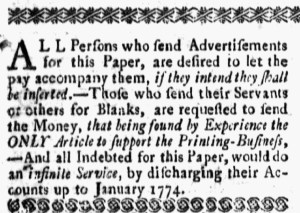
“ALL Persons who send Advertisements for this Paper, are desired to let the pay accompany them, if they intend they shall be inserted.”

Daniel Fowle, the printer of the New-Hampshire Gazette, frequently inserted notices that tended to the business of operating a newspaper.  He had also done so when in partnership with his nephew, Robert Fowle, with most such notices most often calling on subscribers to settle accounts.  Fowle commenced 1774 with an advertisement that addressed several services available at his printing office in Portsmouth.  He exercised his prerogative as proprietor to give that notice a privileged place on the page; it appeared as the first item in the first column on the first page of the first issue of the New-Hampshire Gazette published in the new year.

Fowle presented a variety of instructions to current and prospective customers.  “ALL Persons who send Advertisements for this Paper,” he advised, “are desired to let the pay accompany them, if they intend they shall be inserted.”  In other words, Fowle did not extend credit for advertising.  Most colonial printers likely required advertisers to pay in advance, securing revenues from advertising to balance the credit they allowed for subscriptions, though occasionally some placed notices that called on advertisers to pay overdue bills.  Whatever the policies at the New-Hampshire Gazette had been in the past, Fowle made clear that no advertisements would make it into the pages of his newspaper before receiving payment.  He concluded his notice with a familiar appeal to subscribers to pay what they owed: “all Indebted for this Paper, would do an infinite Service, by discharging their Accounts up to January 1774.”

In addition, Fowle addressed another aspect of his business between his directions about advertisements and subscriptions.  “Those who send their Servants or others for Blanks,” he declared, “are requested to send the Money, that being found by Experience the ONLY  Article to support the Printing-Business.”  Fowle and other printers frequently advertised blanks or printed forms for common commercial and legal transactions.  In the January 7 issue, Fowle ran a short advertisement, “Blanks of most sorts, sold cheap At the Printing Office in Portsmouth,” on the final page.  He suggested that printing and selling blanks represented the only lucrative element of his business, provided that customers paid for them at the time of purchase.  He implied that he only broke even, at best, on advertisements, while the chronic tardiness of subscribers meant that he lost money on subscriptions.  In that case, printing the New-Hampshire Gazetteamounted to a public service rather than a profitable venture for Fowle.  He may have exaggerated whether he made money on anything other than blanks, but Fowle’s exasperation with advertisers and subscribers who did not pay their bills was unmistakable.

December 24

What was advertised in a colonial American newspaper 250 years ago today?

New-Hampshire Gazette (December 24, 1773).

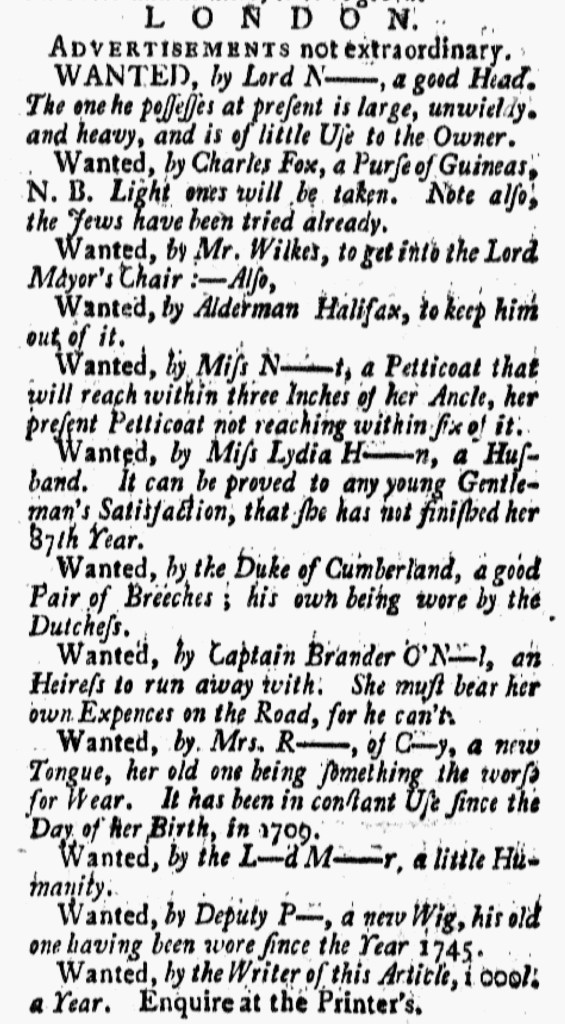
“WANTED, by Lord N—, a good Head.  The one he possesses at present, unwieldy, and heavy, and is of little Use to the Owner.”

Printers, authors, and others sometimes played with advertisements, adapting the format for unintended ends.  In recent weeks, the Adverts 250 Project has examined purported advertisements that delivered opinions about society and politics, made all the more powerful because they initially looked like they had been placed for one purpose but upon closer examination achieved another.  On November 22, 1773, for instance, the Pennsylvania Packet published more than a dozen advertisements submitted by an anonymous correspondent who believed that genre could be better perfected by extending them “to more of the different arts, professions, wants, losses, &c. of mankind.”  Several other newspapers subsequently reprinted the letter from the correspondent and the advertisements.  A few weeks later, the Connecticut Gazette carried a WANTED” advertisement that described an ideal husband.  While several of the advertisements in the piece in the Pennsylvania Packet critiqued women, this notice instead lectured men on how they should treat women.

As a transition between news, much of it about the crisis over tea, and advertising, the December 24, 1773, edition of the New-Hampshire Gazette published “ADVERTISEMENTS not extraordinary,” all of them “wanted” notices supposedly reprinted from newspapers in London.  Like the advertisements in the Pennsylvania Packet, this collection included some that expressed political views and others that provided social commentary.  In this instance, each of them invoked or alluded to the name of a real person, someone prominent enough that readers in England and the colonies would have recognized them.  The first advertisement proclaimed, “WANTED, by Lord N—, a good Head.  The one he possesses at present, unwieldy, and heavy, and is of little Use to the Owner.”  Readers did not need Lord North’s full name to recognize a jab at the prime minister.  Another advertisement stated, “Wanted, by the Duke of Cumberland, a good Pair of Breeches; his own being wore by the Dutchess.”  The writer apparently considered it well known that the duchess did not abide by her expected role but instead ruled her husband.  Yet another scolded a woman who did not demonstrate appropriate decorum in how she dressed.  “Wanted, by Miss N—t,” it declared, “a Petticoat that will reach within three Inches of her Ancle, her present Petticoat not reaching within six of it.”  The litany of advertisements concluded with one placed by the author: “Wanted, by the Writer of this Article, 1000l. a Year.  Enquire at the Printer’s.”  Those final instructions echoed the directions given in so many advertisements.  Printers often served as intermediaries who supplied additional information beyond what appeared in the advertisements published in their newspapers.  These “ADVERTISEMENTS not extraordinary” provided a platform for the anonymous author to become a pundit, each notice making a biting remark about contemporary politics and culture.

November 19

What was advertised in a colonial American newspaper 250 years ago today?

New-Hampshire Gazette (November 19, 1773).

Printer, Bookseller, Provedore to the SENTIMENTALISTS, and Hand Servant to the FRIENDS of LITERATURE.”

Robert Bell became one of the most influential American booksellers and publishers during the second half of the eighteenth century in part due to his lively marketing efforts.  He developed a flamboyant personality that made him memorable and, simultaneously, made the books he advertised memorable.  Based in Philadelphia in 1773, he placed notices in newspapers from New England to South Carolina.  Two advertisements in the November 19 edition of the New-Hampshire Gazette demonstrate his unique style.

Both featured headlines that addressed prospective customers in a manner meant to flatter them and encourage them to identify with a peer group that they imagined buying the books that Bell presented to them.  For instance, one alerted the “SAGES, and STUDENTS of the LAW, in AMERICA” that they could find subscription proposals for several different law books, including “BACON’s new abridgment of the law” and a “second American edition of Judge BLACKSTONE’s Commentaries on the laws of England,” at their local “booksellers shops.”  The other advertisement promoted Bell’s first American edition of Blackstone’s Commentaries to the “Sons of Science in America.”  In it, Bell described himself as “Printer, Bookseller, Provedore to the SENTIMENTALISTS, and Hand Servant to the FRIENDS of LITERATURE.”  When he named those fanciful occupations, he also depicted his ideal customers.

Bell also insisted that readers envision a community that extended throughout the colonies.  His advertisements ran in newspapers published in many cities and towns, but they did not address the “SAGES, and STUDENTS of the LAW, in PORTSMOUTH” or the “Sons of Science in New Hampshire.”  Instead, Bell treated readers near and far as an integrated market.  In his “SAGES, and STUDENTS of the LAW” advertisement, he advised that prospective subscribers “now have an opportunity of seeing at most of the booksellers shops in the capital towns and cities on the Continent, printed proposals with conditions and specimens” for publishing several books.  In his “Sons of Science” advertisement, Bell credited the “auspicious influence” of those subscribers for making the first edition of Blackstone’s Commentariespossible.  In the other advertisement, he portrayed subscribers as “Encouragers” who “greatly contribute towards the elevation, and enlivening of Literary Manufactures in America.”

Printers, booksellers, and publishers often placed subscription proposals in newspapers in multiple colonies in their efforts to generate sufficient demand to make their projects viable.  Bell was especially proficient at disseminating advertisements and subscription papers throughout the colonies.  When he did so, he devised advertising copy that emphasized that customers were members of communities not bounded by geography.  Their interests rather than their location defined them as they joined other “Sons of Science,” “SAGES, and STUDENTS of the LAW,” and “FRIENDS of LITERATURE” in creating a common American experience.

October 22

What was advertised in a colonial American newspaper 250 years ago today?

New-Hampshire Gazette (October 22, 1773).

“A neat and elegant Assortment of MERCERY, HABERDASHERY, and WOOLEN GOODS.”

Daniel Fowle, the printer of the New-Hampshire Gazette, apparently experienced some sort of disruption in his paper supply in the fall of 1773.  For several weeks, he issued a broadsheet newspaper with four columns on each side rather than the usual standard edition that consisted of three columns on each of four pages.  That meant that he delivered eight columns of news, advertising, and other contents rather than twelve.  It was not the first time in recent years that Fowle made some sort of substitution when he did not have access to sheets of the usual size.

In this instance, that meant Thomas Achincloss’s lengthy advertisement in the October 22 edition accounted for an even greater proportion of the space on the broadsheet than if it had appeared in a standard issue at some other time.  It filled half a column.  Achincloss advised readers that he recently imported and offered for sale a “neat and elegant Assortment of MERCERY, HABERDASHERY, and WOOLEN GOODS,” though most of the advertisement consisted of an extensive list of his wares.  He stocked “Calicoes, newest Patterns,” a “Genteel Assortment of Chintzes,” and “Laces, Knee Straps, [and] Necklaces, different qualities, newest and most fashionable,” along with a variety of other textiles and accessories enumerated in his notice.  Achincloss supplemented that merchandise with a “neat Assortment of Hardware,” an “assortment of Bibles and Testaments, also of various Books and Stationary Ware,” and “Men’s Saddles” and “Riding Whips.”  He presented a multitude of choices to consumers in Portsmouth and nearby towns.

Achincloss realized that promoting this selection may not have been enough to draw prospective customers to his shop.  To incite demand, he made appeals to price before and after describing his inventory.  He initially stated that he sold his goods “at a very low advance” (or only a small markup), but went into more detail in a nota bene at the end of the advertisement.  “The Public may depend, and be assured,” Achincloss declared, “that the Goods being from first Hands and Manufacturers, will be afforded upon as low terms, as any in the place can.”  In other words, Achincloss claimed that he acquired these goods directly from the producers rather than middlemen merchants.  That kept his costs low, allowing him to pass along the savings to his customers.  In turn, he set competitive prices that matched the best deals available in Portsmouth.

The amount of space that Achincloss’s advertisement occupied may have attracted attention.  Once readers perused it, they encountered an array of choices, especially among the dozens of textiles that the shopkeeper listed, as well as assurances of low prices.  In crafting this notice, Achincloss deployed some of the most common marketing strategies in use throughout the colonies.

September 24

What was advertised in a colonial American newspaper 250 years ago today?

New-Hampshire Gazette (September 24, 1773).

“Send or bring the Receipts they have received, that a final Settlement may be made.”

Daniel Fowle, printer of the New-Hampshire Gazette, marked the seventeenth anniversary of the newspaper with a note running across the bottom margin of the first page of the September 23, 1774, edition.  A manicure directed readers to an announcement that “This Paper completes the seventeenth Year since its first Publication.”  In addition, Fowle inserted an advertisement calling on “Customers who are in Arrears for one Year or more” to pay their bills.  Colonial printers often inserted notices in their own newspapers for the purpose of encouraging their customers to pay, especially those who had not done so for several years.  Printers typically extended credit to subscribers, anticipating that increasing their circulation numbers would yield more advertisements and more advertising revenue.  (Some of the notices placed by printers, however, also called on advertisers to settle accounts, though not nearly as often as they singled out subscribers.  Apparently, not all printers required payment for advertisements in advance.)  Like merchants, shopkeepers, and other entrepreneurs who allowed credit for consumers, printers regularly resorted to advertisements requesting payment.  For many newspaper printers, this became part of an annual ritual upon completing another year of publication.

In addition to dealing with him directly, Fowle instructed customers who lived at a distance and “have sent by, or paid any Money to Post-Riders, or others,” to inform him that was the case and submit “the Receipts they have received” in order “that a final Settlement may be made, and the proper Persons charg’d.”  Fowle would consult his ledgers to confirm that post riders who carried the New-Hampshire Gazette to distant towns and received payment for both their services and the newspapers made the proper remittances to the printing office.  To that end, he expressed his desire that “there may be no Misunderstanding.”  That phrase, however, did not apply solely to reconciling accounts with post riders.  Regular readers likely would have recognized the implicit threat of legal action in that phrase.  Fowle was not as assertive as he and his nephew, Robert, had sometimes been when they ran similar advertisements during their partnership.  They explicitly threatened to sue and once even suggested that they would publish the names of subscribers who were delinquent in paying their bills.  Fowle did not resort to those measures this time, but he did make it clear that “Attendance will be given at the Printing-Office” with the expectation that customers would make overdue payments.

September 17

What was advertised in a colonial American newspaper 250 years ago today?

New-Hampshire Gazette (September 17, 1773).

It is hoped will induce all Book-buyers to look at those cheap Editions, before they lay out their Money elsewhere.”

Colonial newspapers circulated throughout entire regions rather than just the towns where they were published and nearby villages.  In the 1770s, many bore the names of a colony, such as the New-York Journal or the Pennsylvania Packet, as a testament to their dissemination far beyond the busy urban ports of New York and Philadelphia.  More elaborate titles, such as the South-Carolina Gazette and Country Journal and Rivington’s New-York Gazetteer; or the Connecticut, New-Jersey, Hudson’s-River, and Quebec Weekly Advertiser, also suggested the reach of those newspapers.  Accordingly, advertising in colonial newspapers was not exclusively local to the town of publication.  Instead, newspapers ran advertisements from purveyors of goods and services throughout the regions they served, though the vast majority did originate in the place of publication.  Readers would not have been surprised, for instance, to see an advertisement from Lancaster, Pennsylvania; Baltimore, Maryland; Wilmington, Delaware; or Trenton, New Jersey, in any of the several newspapers published in Philadelphia.

Advertisements that originated on the other side of the Atlantic, however, rarely appeared in colonial newspapers.  Merchants, shopkeepers, and artisans certainly hawked imported goods in the public prints, but they assumed responsibility for their own marketing.  The producers of those goods usually did not participate in advertising to American consumers.  That made J. Donaldson’s advertisement in the New-Hampshire Gazette and other newspapers published in New England all the more noteworthy.  Donaldson promoted “NEW BOOKS” that he sold at “the only Shop for cheap Books” in London.  To demonstrate the bargains, he devised columns for “Donaldson’s Prices,” the titles of books he sold, and “London Prices.”  An edition of “Mr. Pope’s Works, with all his Notes” in six volumes typically sold for eighteen shillings, but Donaldson charged only fourteen shillings.  Similarly, Milton’s Paradise Lostsold for three shillings and six pence, but Donaldson’s customers saved a shilling.  He charged only two shillings and six pence for the same book.

In total, the bookseller listed twenty-six titles that amounted to more than £27 if purchased at “London Prices” but just over £14 at “Donaldson’s Prices,” approximately half the price.  Donaldson prefaced his list with an explanation that “many People are not acquainted with the Prices Books are commonly sold for” so “by reading what follows, they will see it their Interest to buy at his Shop.”  Below the list, he further elaborated that “By the above Comparison of Prices, it is evidence that you can buy of J DONALDSON for Fourteen Pounds and Six Pence, the same Articles which the London Booksellers charge at Twenty-seven Pounds two Shillings and six Pence.”  Donaldson calculated the savings: “in this small Parcel, Thirteen Pounds and two shillings are saved.”  He considered that argument enough to “induce all Book-buyers to look at those cheap Editions, before they lay out their Money elsewhere.”  Although Donaldson may have welcomed orders from individual consumers in the colonies, he more likely hoped to attract the attention of printers and booksellers looking to import quantities of books.  American printers produced a limited number of titles; printers, booksellers, and others who stocked books in their shops imported the vast majority of books.  Donaldson offered them a means of acquiring their inventory at lower prices and increasing sales by passing along the savings to their own customers.