September 10

What was advertised in a colonial American newspaper 250 years ago today?

New-Hampshire Gazette (September 10, 1773).

“Our PROFESSOR of MUSIC, Theoretical, Rudimental and Practical, absconded.”

Whether they taught reading and writing, dancing and fencing, French and Latin, or singing and playing musical instruments, sometimes itinerant tutors meant trouble for the communities they visited.  That seems to have been the case with William Crosbey, “PROFESSOR of MUSIC, Theoretical, Rudimental and Practical,” in Portsmouth in the fall of 1773.

Crosbey first introduced himself to prospective students and the public in a lengthy advertisement in the August 13 edition of the New-Hampshire Gazette.  He proclaimed that the “Charms, Beauties and Advantages of MUSIC are so universally known, that it is quite unnecessary to say any Thing for recommending it,” but also cautioned that music “looses most of it’s Beauties when not performed under the proper Restrictions of Rule and Judgment.”  To help prospective students elevate their abilities and, in turn, avoid embarrassment in social settings that involved music, Crosbey “proposes to teach Psalmody in it’s various Branches,” naming a variety of composers in his repertoire, and “teaches all Sorts of Dramatic Miusuc, such as Songs, Airs, Solo’s, Duett’s, [and] Dialogues.”  To that end, he anticipated receiving “a choice Collection of vocal Music … consisting of the newest and best Songs, as they are now sung at the Mary-Bone, Vaux-Hall and Covent Garden” in London.  Crosbey cited entertainment venues in the most cosmopolitan city in the empire, situating himself and his pupils within contemporary transatlantic popular culture.

In his initial advertisement, the tutor presented several opportunities for lessons.  He ran a singing school in the evening and private lessons in the homes of students during the day.  In addition to singing, he also “teaches the Scale of the Violin, Flute, Harpsichord and Organ.”  In a subsequent advertisement on August 27, Crosbey declared that he would open “his School for Music at the Assembly Room” the next day.  He detailed the rates for instruction by the quarter and by the month, at the school and at home, noting that “One third of the Money for each Condition to be paid at Entrance.”  To get a sense of total enrollments, he requested that “whatever Gentleman or Lady intends to Honor him with the Care of their Tuition, would attend at the Assembly Room” the following day.  He planned to open the school “with a Dissertation on Music, in general, which will be beneficial to every young Beginner.”  A week later, he placed the same advertisement with a small revision.  The first day of classes had been “deferred last Week,” though the tutor did not specify why.  The inaugural lesson would take place on Saturday, September 4.

The next issue of the New-Hampshire Gazette featured another advertisement concerning Crosbey, this one placed by “The SUFFERERS” that he apparently duped.  The day after Crosbey held his first class and presumably delivered his “Dissertation on Music” and collected the entrance fees from his students, he absconded.  The “SUFFERERS” lamented the “Damage the Public must sustain by his unexpected Retreat” and offered a reward to anyone who apprehended the Crosbey and delivered him to Portsmouth.  In a short description, the advertisers informed readers that Crosbey “had on when he went away, a green Coat, white Waistcoat and Breeches, and has a peculiar Mark, which Time will ne’er deface.”  Did that “peculiar Mark” refer to a birthmark or scar?  Or did it refer to a figurative stain resulting from an inappropriate interaction with one or more of his students?  Whatever other misconduct Crosbey committed, he apparently collected tuition from his students and then ran away before giving them lessons.  His advertisements had been part of a scam perpetrated on the people of Portsmouth.  Rather than a “PROFESSOR of MUSIC, Theoretical, Rudimental and Practical,” Crosbey was a swindler who took advantage of students who aspired to improve their musical skills.

August 13

What was advertised in a colonial American newspaper 250 years ago today?

New-Hampshire Gazette (August 13, 1773).

“Country Traders … will, perhaps, never again have an Opportunity of purchasing so cheap.”

For nearly two years, Ebenezer Bridgham pursued a regional advertising campaign for his “Staffordshire & Liverpool Warehouse, In King-Street, BOSTON.”  In addition to placing notices in newspapers published in Boston, he also advertised in the Essex Gazette (published in Salem), the Providence Gazette, the New-Hampshire Gazette (published in Portsmouth), the Connecticut Courant (published in Hartford), and the New-London Gazette.  He initially ran the same notice in several newspapers, but later his efforts became more sporadic.  An advertisement often appeared in newspapers in one or two towns, but not in all locations that Bridgham attempted to cultivate a clientele among consumers and, especially, retailers.  Overall, he was one of the few advertisers who attempted to serve a regional market by placing notices in newspapers in several towns in the early 1770s.

As fall approached in 1773, he once again advertised in the New-Hampshire Gazette, alerting prospective customers to the “very large and full ASSORTMENT of CROCKERY WARE” available at his warehouse.  He stocked “almost every Kind of CHINA, GLASS, DELPH, … and many other Kinds of FLINT WARE” in various colors.  To entice customers, he proclaimed that he set prices “little more than the Sterling Cost.”  In other words, when they made purchases at the Staffordshire and Liverpool Warehouse they did not pay a significant markup for imported goods.  Consumers regularly encountered claims about low prices, so Bridgham demonstrated his motivation to offer bargains.  He announced that he was “Intending soon for GREAT-BRITAIN” and wished to settle accounts before his departure.  That also meant reducing his inventory as much as possible, prompting him to offer good deals to his customers.

Bridgham concluded with a note to “Country Traders” in New Hampshire, informing them that they “would find a very great Advantage in immediately supplying themselves from said Store.”  The merchant asserted that retailers “will, perhaps, never again have an Opportunity of purchasing so cheap.”  With such bargains, they could increase their own sales and generate more revenue as they passed along the savings to their own customers.  Bridgham combined appeals to price and consumer choice in his advertisement in hopes of convincing shopkeepers and others to acquire “CROCKERY WARE” and other items from him rather than other merchants.

August 6

What was advertised in a colonial American newspaper 250 years ago today?

New-Hampshire Gazette (August 6, 1773).

“RAN-AWAY … a Sailor, named John Morgan … Portsmouth, Aug. 5.”

The notice arrived in the printing office too late to appear in the August 6, 1773, edition of the New-Hampshire Gazette… almost.  John Morgan, a sailor, deserted or “RAN-AWAY from the Ship Exeter Galley” and William Pearne offered a reward to “Whoever will bring the said Man” to him in Portsmouth.  Readers could recognize Morgan, “pretty tall, well built, about 30 Years of Age,” by his “dark Complexion, & black short Hair” as well as his “blue Jacket, check Shirt, Oznabrigs Trousers, and a new Pair of Shoes.”

The advertisement was dated “Portsmouth, Aug. 5.”  The August 6 edition was already in production when Pearne delivered the notice to the printing office.  Like other colonial newspapers, the New-Hampshire Gazette consisted of four pages created by printing two pages on each side of a broadsheet and then folding it in half.  Daniel Fowle, the printer, and others in the printing office would have selected the contents, set the type, and printed the first and fourth pages on one side of the broadsheet in advance of working on the second and third pages on the other side.  They needed to hang the incomplete newspapers to dry after the first printing.  Fowle and the rest apparently had the type set for the second and third pages and were ready to take it to press when Pearne’s advertisement arrived.  Pearne may have pleaded or insisted that it needed to appear in the August 6 edition rather than wait an entire week for the next issue.  That would have given Morgan even more time to make good on his escape.

Fowle or one of the compositors made room for the advertisement in the margin at the bottom of the second page.  It consisted of nine lines, too many to appear together, but there was enough space to add three lines below each of the three columns of news on that page.  The text of the advertisement featured a larger font, a subtle visual cue to alert readers that they encountered content that was not part of the news items originally planned for that page.  The following week, the advertisement did appear as a single piece along with other paid notices on the third page of the August 13 edition.  For immediate publication, however, the printing office resorted to the margin to satisfy a customer who submitted a time-sensitive advertisement at the last minute.

July 30

What was advertised in a colonial American newspaper 250 years ago today?

New-Hampshire Gazette (July 30, 1773).

“Just Published, The PARTICULARS of the late Melancholy and Shocking TRAGEDY, which happened at Salem.”

The account of the “most distressing and melancholy Affair” of the drowning of three men and seven women, five of them reportedly pregnant, when their boat sank near Salem during a sudden storm on June 17, 1773, first appeared in the Essex Gazette on June 22 and then in the Boston Evening-Post on June 28 and the Massachusetts Gazette and Boston Weekly News-Letter on July 1.  News also spread beyond the colony where the tragedy occurred.  On June 25, Daniel Fowle reprinted the account from the Essex Gazette in the New-Hampshire Gazette, though some readers likely already heard some of the details via word of mouth.

As was the case in Boston, commemoration and commodification of the drownings, entwined so tightly as to render them inseparable, soon appeared in the public prints.  Ezekiel Russell first advertised a broadside “Decorated with the Figures of Ten Coffins” that related “The Particulars of the late melancholy and shocking TRAGEDY, which lately happened at SALEM” in the July 12 edition of the Boston Evening-Post.  Just three days later, Russell inserted the same advertisement in the Massachusetts Spy, adding a brief note about a second broadside, “An ELEGY on the affecting Tragedy at Salem.”  Fowle apparently acquired copies of the first broadside, which Russell sold “by the Groce,” to sell at his printing office.  A brief advertisement in the July 30 edition of the New-Hampshire Gazette announced, “Just Published, The PARTICULARS of the late Melancholy and Shocking TRAGEDY, which happened at Salem, near Boston, on Thursday, the 17th Day of June, 1773.”

Fowle did not include any of those “PARTICULARS” in the advertisement, nor did he publish any of the extensive memorial that previously appeared in the advertisements in the other newspapers.  Between the account in the New-Hampshire Gazette and conversations about the drownings, he may have thought that the broadside did not need additional explanation.  He also did not have the same financial stake in marketing the broadside that Russell did, likely accepting only as many as he anticipated he could sell.  Russell played on the proximity of the tragedy to Boston in marketing the broadside to readers of newspaper published in that city, though he did proclaim that it “is recommended as very proper to be posted up in every House in New-England, to keep in Remembrance the most sorrowful Event.”  Fowle, on the other hand, did not assert such urgency to readers of his newspaper.  He presented the broadside for prospective customers who might be interested, but did not make the same hard sell in Portsmouth as Russell did in Boston.

July 16

What was advertised in a colonial American newspaper 250 years ago today?

New-Hampshire Gazette (July 16, 1773).

“DANCING SCHOOL For Young GENTLEMEN and LADIES.”

Edward Hacket (sometimes Hackett) announced that he “Has open’d his DANCING SCHOOL For Young GENTLEMEN and LADIES” in Portsmouth in the July 16, 1773, edition of the New-Hampshire Gazette.  The advertisements he previously placed in that newspaper may have helped the dancing master recruit enough students to make the endeavor viable.  He first advertised in March, four months earlier, placing himself in competition with Monsieur De Viart, another dancing master who advertised in the New-Hampshire Gazette at about the same time.  Hacket initially hoped to open his school “At the New ASSEMBLY HOUSE” in three weeks “on the First Tuesday in APRIL,” but he may not have acquired enough students to do so.  He envisioned offering lessons at the school on “Tuesdays in the Afternoon, and Wednesdays in the Forenoon” as well as private lessons for “Gentlemen or Ladies, either at the Assembly Houses, at such Hours as may be agreed on.”  He eventually gave lessons “On Thursdays in the Afternoon, and Fridays in the Forenoon,” perhaps choosing those times to match the preferences of his pupils.

By the time he opened his dancing school in July, Hacket apparently believed that prospective students and their families were familiar with his approach and his background.  He published a much shorter advertisement than the one in which he introduced himself in March.  Hacket initially described himself as “From EUROPE,” suggesting he passed along the same level of sophistication to his students as the French dancing master, Monsieur de Viart, did for his pupils.  He also listed other credentials, stating that he “has taught Dancing in many of the principal Towns in England, Ireland, and America.”  In addition, he confided to parents and guardians that those “who send their Children, may depend that great Care will be taken of their Education, and good Order observed.”  Hacket tended to developing appropriate personal comportment beyond learning the steps of the dances he taught.  By the time he opened his school, however, he did not consider it necessary to provide any of those details in his new advertisement.  The previous advertisement circulated widely over the course of several weeks, plus Hacket had opportunities to meet prospective students and their families to make overtures in person.  He may have considered a brief announcement in the colony’s only newspaper enough to rally any prospective pupils who had not yet committed.  Instead of a hard sell, this light tough may have suggested that his students needed his services more than he needed their patronage.

June 25

What was advertised in a colonial American newspaper 250 years ago today?

New-Hampshire Gazette (June 25, 1773).

“All the PATENT MEDICINES.”

In the summer of 1773, Joseph Tilton took to the pages of the New-Hampshire Gazette to advertise a “large and fresh Assortment of Druggs, Medicines, and Groceries” that he recently imported and stocked at his shop in Exeter.  He offered abrief overview of some of those groceries, such as “fresh Raisins, Turkey Figgs, Currants, [and] Olive Oil.”  Tilton also listed a variety of medical equipment, including “SURGEON’s pocket Instruments, best London Lancetts, … ivory Syringes, … [and] Apothecaries Scales and Weights.”  This gave prospective customers some sense of his merchandise, even if Tilton did not supply an exhaustive catalog.

When it came to that “Assortment of Druggs, [and] Medicines,” however, Tilton succinctly stated that he stocked “all the PATENT MEDICINES commonly Advertised” and did not go into further detail.  He expected that prospective customers were already familiar with the many different kinds of patent medicines frequently imported from England and the uses for each, making it unnecessary to name Keyser’s Pills, Daffy’s Elixir, James’s Fever Powder, Godfrey’s Cordial, Stoughton’s Bitters, Turlington’s Balsam, or any of the other patent medicines frequently listed in advertisements placed by apothecaries and shopkeepers.

The partnership of Munson and Mather adopted the same approach in their advertisement that appeared in the Connecticut Journal and New-Haven Post-Boy on June 25, the same day that Tilton’s notice ran in the New-Hampshire Gazette.  Munson and Mather declared that they carried a “fresh and universal Assortment of Drugs and Medicines” that included “Most of the Patent Medicines” familiar to consumers throughout the colonies.  Those patent medicines were so well known by their brands and their distribution in major ports and smaller towns so ubiquitous in eighteenth-century America neither Tilton nor Munson and Mather considered it necessary to exert much effort in marketing them beyond informing “Customers in Town and Country” where they could purchase “all the PATENT MEDICINES.”

June 18

What was advertised in a colonial American newspaper 250 years ago today?

New-Hampshire Gazette (June 18, 1773).

“(6 w.)”

In the spring and summer of 1773, George Deblois ran an advertisement to inform readers of the New-Hampshire Gazettethat he stocked a ‘GENERAL ASSORTMENT of English, India and Hard Ware GOODS” at his shop in Newburyport, Massachusetts.  Like many other merchants and shopkeepers of the era, he listed a variety of items in an effort to demonstrate the array of choices he made available to consumers.  One element of his advertisement, however, was not intended for prospective customers.  A notation, “(6 w.),” on the final line provided the compositor and others working in the printing office information about how long Deblois’s advertisement should appear in the New-Hampshire Gazette.  The merchants made arrangements for it to run for six weeks.

Curiously, the advertisement did not appear in six consecutive issues.  Dated May 5, it first ran in the May 14 edition.  It then appeared in the next two issues on May 21 and May 28, but did not run on June 4 and June 11.  The newspaper revived the advertisement for another three consecutive issues, June 18, June 25, and July 2, before discontinuing it following the sixth insertion.  One the type had been set, the compositor could include the advertisement (or not) and move it around within each edition.  An error, “the SIGN of the GOLNEN EAGLE,” remained consistent throughout the run of the advertisement.

The publication history of this advertisement raises questions about the business of advertising and communications between advertisers and printing offices.  Did Deblois intend for his advertisement to appear in six consecutive issues?  Or did he send instructions to Daniel Fowle, the printer of the New-Hampshire Gazette, that he wished for it to run six times over the course of a couple of months but not necessarily for six consecutive weeks?  Did Deblois consult the New-Hampshire Gazette each week to confirm whether his advertisement appeared?  If so, did he note the error in the name of his shop sign?  How accommodating would the printing office have been to fixing such an error at the request of an advertiser, especially one who placed such a lengthy advertisement for so many weeks?  What kind of bookkeeping system did the Fowle and others in the printing office use to keep track of how many times each advertisement appeared?  What kind of system, such as entering that information into a ledger or adding it to a running list of recent advertisements, became part of the weekly ritual of publishing the New-Hampshire Gazette?  When it came to adding and removing advertisements, what kind of coordination among the printer and other workers occurred within the printing office? Surviving primary sources may provide partial answers to some of these questions, but other aspects of the day-to-day operations of colonial printing offices, especially the business of advertising, may never have definitive answers.

June 11

What was advertised in a colonial American newspaper 250 years ago today?

New-Hampshire Gazette (June 11, 1773).

“They are determined to sell as low for Cash as can be bought in any Part of the Province.”

George Bell and Company sold a variety of goods at their shop in Newmarket.  In an advertisement in the June 11, 1773, edition of the New-Hampshire Gazette, Bell and Company promoted a “large and general Assortment of English, India and Scotch Goods” recently imported into the colony.  To entice prospective customers, they listed some of those items, including textiles (“Calicoes, Crapes, Taffity’s, Cambricks, and Lawns, flower’d and plain”), “a fine Assortment of Ribbons of the newest Patterns,” and a “fine Assortment of crockery and hard Ware.”  Bell and Company could have published an even more extensive catalog of their inventory, but they instead confided that they stocked “many other Articles, too tedious to mention” … but not too tedious for consumers to browse in their shop.

In addition to emphasizing such an array of choices, Bell and Company made an appeal to price, asserting that they “are determined to sell as low for Cash as can be bought in any Part of the Province.”  Located in Newmarket, a bit to the west of Portsmouth, they sought to assure prospective customers, especially those in the countryside, that they did not need to visit the colony’s primary port to get the best bargains.  Although Bell and Company may have assumed some additional expenses in transporting the imported goods to Newmarket compared to their competitors in Portsmouth, they aimed to convince consumers that they absorbed those costs rather than passing them along to their customers.  Their proclamation also served as an invitation to haggle over the prices to give Bell and Company opportunities to match the deals offered at shops in Portsmouth and elsewhere in the colony.  They did not explicitly state that they matched prices, but declaring that they “are determined to sell as low … as can be bought in any Part of Province” suggested that they would at least consider adjusting their prices if customers alerted them to better deals.

As was often the case in newspaper advertisements placed by colonial merchants and shopkeepers, appeals to low prices and consumer choice appeared in combination in Bell and Company’s advertisement.  They gave prospective customers multiple reasons to visit their shop as part of their shopping experience.

May 14

What was advertised in a colonial American newspaper 250 years ago today?

New-Hampshire Gazette (May 14, 1773).

“Will be sold … as low as at any Store or Shop in America.”

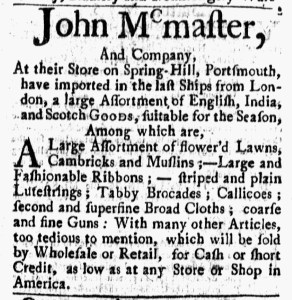
Among the advertisements and notices in the May 14, 1773, edition of the New-Hampshire Gazette, John McMaster and Company promoted a “large Assortment of English, India, and Scotch GOODS” recently received via “the last Ships from London.”  They invited prospective customers to visit their store in Portsmouth to examine their “Large Assortment of flower’d Lawns, Cambricks and Muslins,” “striped and plain Lutestrings,” and “Tabby Brocades.”  In addition to textiles, McMaster and Company stocked “Large and Fashionable Ribbons,” “coarse and fine Guns,” and “may other Articles, too tedious to mention.”  Advertisers often used that phrase to entice curious readers to browse their merchandise.

Beyond providing an array of choices to consumers, McMaster and Company called attention to their prices, proclaiming that their customers could acquire these goods “as low as at any Store or Shop in America.”  They did not merely compare their prices to those set by local competitors in and near Portsmouth.  Instead, they boldly declared that neither consumers who purchased on their own behalf nor retailers who bought to sell again would not find better deals anywhere else, not even in the much larger ports of Boston, Charleston, New York, and Philadelphia.  McMaster and Company were not alone in making that claim.  In another advertisement, an entrepreneur who identified himself as McIntyre but did not give a first name hawked “CHINA and EARTHEN WARE” available at “his Store near the Market.”  He asserted that he charged prices “as cheap as sold in America.”

Both McMaster and Company and McIntyre attempted to leverage promises of good deals, indeed the best deals possible, to induce prospective customers to imagine themselves purchasing their wares.  They whet readers’ appetites with allusions to a “large Assortment” or “Good Assortment” of merchandise and then presented their low prices, the lowest anywhere, as the means of satisfying those appetites.

April 9

What was advertised in a colonial American newspaper 250 years ago today?

New-Hampshire Gazette (April 9, 1773).

“The Partnership Of JAMES & MATHEW HASLETT is dissolv’d.”

The partnership of James Haslett and Mathew Haslett came to an end with little fanfare in the public prints.  The leather dressers inserted a short notice in the April 9, 1773, edition of the New-Hampshire Gazette, just two lines that announced, “The Partnership Of JAMES & MATHEW HASLETT is dissolv’d.”  They did not call on customers and other associates to settle accounts, nor did one or the other of them indicate that he intended to continue in the trade and would appreciate the continued patronage of former customers.

The quiet conclusion to this partnership differed from some of the flashy advertisements that the Hasletts previously placed in the New-Hampshire Gazette.  When they relocated to Portsmouth from Boston seven years earlier, they informed “Town and Country, That they have set up their Business at their Factory at the Sign of the BUCK and GLOVE … Where they carry on the [leather dressing] Business, in all its Branches, in the neatest and best Manner.”  The Hasletts deployed formulaic language, but doing so signaled that they were familiar with the advertising conventions of the era.  In the late 1760s and early 1770s, they placed advertisements of various lengths, though their longer advertisements coincided with the years that they were new to Portsmouth and still building their reputations in the region.

During that time, they commissioned woodcuts that depicted the “Sign of the BUCK and GLOVE” (and included breeches for good measure).  Those woodcuts all bore the date 1766, the year that the Hasletts established their workshop or “Factory” in Portsmouth.  Some, but not all, featured some variation of their names.  Although their shop sign no longer exists, the woodcuts in their newspaper advertisements testify to its likely appearance, like so many other woodcuts that depicted signs displayed by artisans and shopkeepers in eighteenth-century America.

For the Hasletts, their final notice in the New-Hampshire Gazette belied the visual feast and extensive copy that they previously presented to prospective customers.  On the other hand, they had been in business in Portsmouth long enough that merely glimpsing their names in the newspaper may have conjured images of the “Sign of the BUCK and GLOVE” for many readers.