December 10

What was advertised in a colonial American newspaper 250 years ago today?
New-London Gazette (December 10, 1773).

“Forward their Watches to me … by applying to Mr. JOSEPH KNIGHT, Post-Rider.”

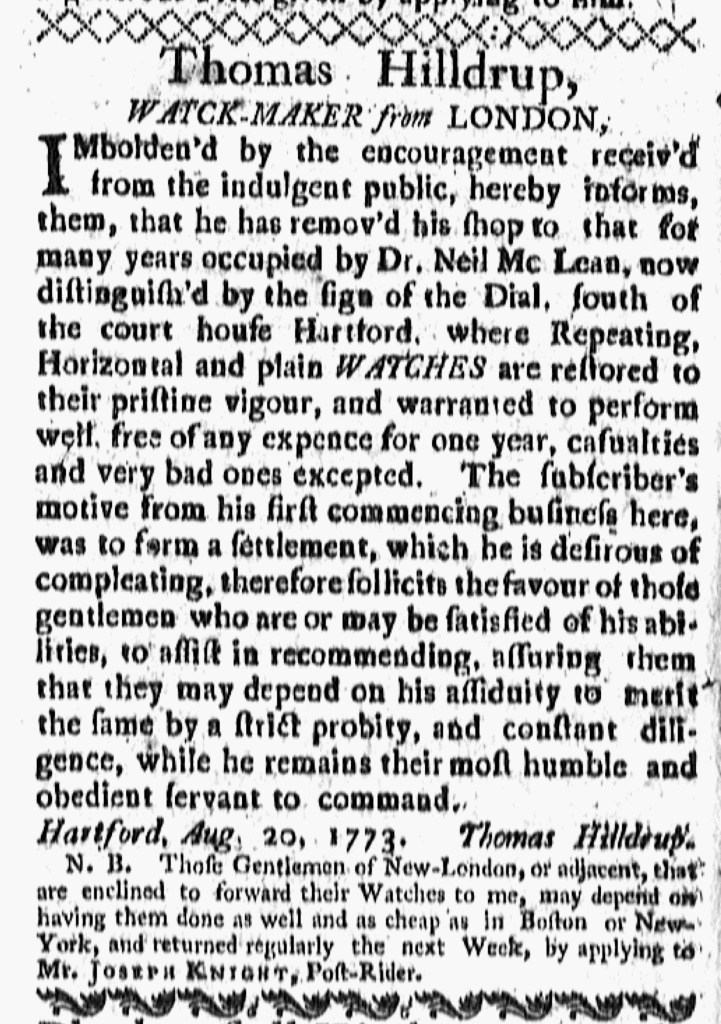
Thomas Hilldrup, “WATCK-MAKER from LONDON,” continued his advertising campaign in the fall of 1773.  Having settled in Hartford the previous year, he first set about cultivating a local clientele with advertisements in the Connecticut Courant, that town’s only newspaper.  Over time, he expanded his marketing efforts to include the Connecticut Journal and New-Haven Post-Boy and the New-London Gazette.  That meant that he advertised in every newspaper published in Connecticut at the time.  In an advertisement that ran for several months, Hilldrup declared that he had been “IMbolden’d by the encouragement receiv’d from the indulgent public” to move to a new location “now distinguish’d by the sign of the Dial.”  In other words, business had been good, customers had entrusted their watches to the enterprising newcomer for cleaning and repairs, and that demand for his services meant that others should engage him as well.

To that end, Hilldrup presented instructions for sending watches to his shop.  He appended a nota bene to his advertisement in the New-London Gazette, stating that the “Gentlemen of New-London, or adjacent, that are inclined to forward their Watches to me, may depend on having them done as well and as cheap as in Boston or New-York.”  In addition, Hilldrup offered speedy service, promising to return watches “the next Week.”  Clients could take advantage of these services, including a one-year warranty, “by applying to Mr. JOSEPH KNIGHT, Post-Rider.”  Knight did far more than deliver letters and newspapers from town to town.  He also contracted with various entrepreneurs to facilitate their businesses.  In addition to transporting watches for Hilldrup, Knight also sold “An ORATION, Upon the BEAUTIES of LIBERTY,” a popular political tract, in collaboration with Timothy Green, the printer of the New-London Gazette, and Nathan Bushnell, Jr., another post rider.  In forming a partnership with Knight, Hilldrup established an infrastructure for transporting watches to and from his shop, one that he could promote to prospective clients who might have otherwise been anxious about sending their watches over long distances.  Enlisting an associate already familiar in several towns in Connecticut, Hilldrup marketed an approved and secure method for sending watches to him to restore “to their pristine vigour.”

December 3

What was advertised in a colonial American newspaper 250 years ago today?

New-London Gazette (December 3, 1773).

Hill’s Balsam of Honey, Ditto Elixir Bardana.”

Simon Wolcott advertised a “fresh and general Assortment of DRUGS and MEDICINES” in the December 3, 1773, edition of the New-London Gazette.  The merchandise that he “Just IMPORTED from LONDON” and sold “as cheap as in New-York or Boston” included a dozen popular “PATENTED MEDICINES,” such Bateman’s Drops, Godfrey’s Cordial, and Turlington’s Balsam of Life.  The copy of the New-London Gazette digitized for inclusion in America’s Historical Newspapers, the most extensive database of eighteenth-century newspapers, includes manuscript additions.  At some point, someone crossed out four of the patent medicines: Hill’s Balsam of Honey, Hill’s Elixir Bardana, Jesuit’s Drops, and Mountpelier Drops.  Why?

This could have been done in the printing office, especially if Wolcott wished to update his advertisement to exclude those medicines.  However, Wolcott’s notice ran in the next five issues of the New-London Gazette (which became the Connecticut Gazette with the December 17 edition) without any changes before he discontinued it in the middle of January 1774.  Such marks could have also been made in the printing office if Wolcott ordered handbills but for some reason wished to feature only some of the patent medicines.  Any handbills, trade cards, or other advertisements that Wolcott commissioned to supplement his newspaper notices have not survived.

Alternately, a reader may have crossed off those patent medicines for their own purposes.  For instance, an apothecary or shopkeeper looking to restock their own supplies could have crossed out those that they did not wish to acquire before writing a letter and sending an order to Wolcott or taking the newspaper to his shop to guide their purchases.  Similarly, someone managing a household or putting together a box of commonly used medicines for traveling could have made similar notations to indicate which medicines they needed and which they did not.  Someone else may have crossed out those patent medicines for some other reason, perhaps indicating which they had tried and found ineffective.

Whatever the reason for the manuscript additions to Wolcott’s advertisement in this copy of the New-London Gazette, the marks indicate that someone engaged with the newspaper beyond merely perusing its contents.  The notations indicate something of some significance to the person who made them, though their purpose remains a mystery to readers who encounter the newspaper notice centuries later.

November 12

What was advertised in a colonial American newspaper 250 years ago today?

New-London Gazette (November 12, 1773).

“A COMPLEAT and ENTIRELY NEW Assortment Of the best PRINTING MATERIALS.”

Timothy Green, the printer of the New-London Gazette, made an important announcement about his business in the November 12, 1773, edition of his newspaper.  He proclaimed that he “Has just IMPORTED from LONDON, A COMPLEAT and ENTIRELY NEW Assortment Of the best PRINTING MATERIALS.”  New type and other equipment would enhance not only the newspaper, making it more attractive for both subscribers and advertisers, but also books, pamphlets, almanacs, and blanks produced in his printing office.  In addition, he sought orders for broadsides, handbills, and other job printing.  With the arrival of these “best PRINTING MATERIALS,” Green “hopes that the kind of Encouragement of the PUBLIC will not be wanting.”  He was ready to serve clients, giving “his constant Attention to please them.”

The savvy printer just happened to place the most ornate of all the advertisements in that issue of the New-London Gazetteimmediately below his own notice.  A border made of decorative type enclosed an advertisement in which David Gardiner, Jr., offered cash for “Small Furrs, Bees-Wax, old Brass, Copper, and Pewter” and hawked a “good ASSORTMENT of Ship-Chandlery Ware, Groceries of all Kinds, an Assortment of Glass and Stone Ware,” and other merchandise.  The distinctive advertisement demonstrated to prospective clients that they could place their own notices that featured visual elements designed to attract attention.  It also presented possibilities for broadsides, handbills, catalogs, billheads, blanks, and other job printing orders.

New-London Gazette (November 19, 1773).

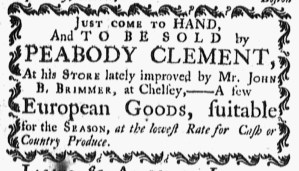
Gardiner’s advertisement ran in the next issue of the New-London Gazette, but it was no longer the only one with a decorative border.  In a new advertisement, Peabody Clement promoted imported goods “JUST COME TO HAND.” Green or one of the compositors in his shop selected different printing ornaments for Clement’s advertisement than those in Gardiner’s notice.  That distinguished the notices from each other, while also displaying some of the range of new types in Green’s printing office.  Perhaps Clement saw the printer’s announcement and Gardiner’s advertisement in the November 12 edition and that helped convince him to place his own notice and influenced his decision about the format.

November 5

What was advertised in a colonial American newspaper 250 years ago today?

New-London Gazette (November 5, 1773).

“HAVING perused all the most material parts of Mr. Gale’s manuscript copy of the complete surveyor, I beg leave to recommend it.”

Samuel Gale, the deputy surveyor general of New York, tried once again.  He had written a manual, “the COMPLEAT SURVEYOR,” that he wished to publish, but first he needed to find a sufficient number of subscribers to make it a viable venture for both the author and the printer, presumably Hugh Gaine in New York.  Gale had previously advertised in Gaine’s newspaper, the New-York Gazette and Weekly Mercury, in June 1773.  In November, he placed an advertisement with identical copy in the New-London Gazette.  It filled nearly an entire column, starting in one and overflowing into another.

Approximately half of the lengthy advertisement consisted of five “RECOMMENDATIONS” for the proposed book. William Alexander, the Earl of Stirling, a member of the American Philosophical Society in Philadelphia, stated that the manual “will be a very useful work to most of the surveyors in North-America, as well as others who are desirous of making themselves acquainted with both the theory and part of that art.”  Alexander Colden, the Surveyor General of New York, testified that he “perused such parts of Mr. Gale’s manuscript copy, as relates to practical surveying in America (which has been omitted in the former authors) and I find it well handled, and worthy of the encouragement of the public.  Similarly, David Rittenhouse, a prominent astronomer, mathematician, and surveyor in Philadelphia, reported that he read the manuscript and “recommend it as a work, in my opinion, well deserving the encouragement of the public.”  John Lukens, the Surveyor General of Pennsylvania, asserted that the work “deserves public encouragement” because “the rules therein laid down in practical surveying, … especially that part relating to surveying our rough lands in America, may be of great advantage to those concerned in surveying, as well as others.” John A. De Normandie, a prominent physician and scientist, proclaimed that Gales’s “rules are extremely good, and his demonstrations easier and better adapted to the understanding of mankind, than any I have ever met with.”  The first four of those testimonials also appeared on a handbill that Gale distributed the previous year.

New-London Gazette (November 5, 1773).

In addition to these endorsements, Gale recruited printers and other local agents to collect subscriptions in more than a dozen cities and towns from Boston to Savannah.  Those included Timothy Green, the printer of the newspaper carrying the surveyor’s subscription proposal.  Gale also indicated that “all the Booksellers and Printers in America and the West-India Islands” accepted and forwarded subscriptions.  Anyone who wished to contact Gale directly could do so “by applying to Hugh Gaine, at New York.”

Gale managed to enlist some subscribers but still needed to entice more.  His advertisement served as an update for “the PUBLIC in general, and to the SUBSCRIBERS in particular,” alerting them that he had “not yet been favoured with a sufficiency of the subscribers to enable me to carry it into immediate execution, without running too great a hazard.” He needed to entice more subscribers among the “well-wishers to mathematical learning among the public.” Apparently, Gale did not manage to do so, despite his advertisements in the New-York Gazette and Weekly Mercury and the New-London Gazette, his handbill, the endorsements for his manual, and the network of local agents collecting subscriptions.  The surveyor deployed a variety of marketing strategies, but that did not guarantee success.

October 15

What was advertised in a colonial American newspaper 250 years ago today?

New-London Gazette (October 15, 1773).

“Begs the Favour of those who are acquainted with his Abilities and Veracity in Business, to recommend him to Others.”

John Champlin, a goldsmith and jeweler, ran a shop near the courthouse in New London in the early 1770s.  In the fall of 1773, he advertised his services and merchandise in an advertisement that ran for several weeks in the New-London Gazette.  To entice prospective customers, he declared that he “makes and sells all Kinds of Gold-Smith, Silver-Smith, and Jeweller’s Work as cheap as is sold in this Colony.”

Champlin shared his shop with Daniel Jennings, an artisan who pursued an adjacent trade.  Jennings advised readers that he “repairs and hath to sell, all Kinds of Utensils for repairing Clocks and Watches.”  Recognizing that he operated within a regional marketplace, he asserted that he set prices “as cheap as can be had in New-York or Boston.”  Prospective customers, he suggested, did not need to send their clocks and watches to artisans in either of those urban ports.

Jennings did not mention, perhaps intentionally, the prices for similar goods and services in Hartford, though Thomas Hilldrup, a competitor in that town, had advertised extensively in the New-London Gazette and the Connecticut Journal and New-Haven Post-Boy as well as in the Connecticut Courant, the newspaper published in Hartford.  Perhaps Jennings did not mention Hartford because he did not wish to call any more attention to Hilldrup, a relative newcomer whose aggressive advertising campaign targeted prospective customers well beyond the town where he settled.

To secure his share of the market, Jennings issued a plea for “those who are acquainted with his Abilities and Veracity in his Business, to recommend him to Others.”  He considered such recommendations as effective or even more effective than the lengthy advertisements that Hilldrup ran in several newspapers.  After all, even though Hilldrup was industrious with his advertising he had only begun to establish his reputation in Connecticut.  Enlisting satisfied customers could work to Jennings’s advantage if prospective customers trusted word-of-mouth endorsements over flashy newspaper notices.  Whether or not Jennings had Hilldrup in mind when he composed his advertisement, he understood that the power of testimonials from colonizers who had engaged his services in the past.

October 1

What was advertised in a colonial American newspaper 250 years ago today?

Connecticut Journal and New-Haven Post-Boy (October 1, 1773).

“WATCHES are restored to their pristine vigour, and warranted to perform well, free of expence for one year.”

Thomas Hilldrup, “WATCH MAKER from LONDON,” apparently considered his advertising campaign effective.  On October 1, 1773, his notice with the dateline, “Hartford, July 20, 1773,” once again appeared in the Connecticut Journal and New-Haven Post-Boy and the New-London Gazette.  Four days later, the same notice ran once again in the Connecticut Courant, the only newspaper printed in Hartford at the time.  When Hilldrup first arrived in Hartford in 1772 he commenced advertising in the Connecticut Courant, but it did not take long for him to surmise that he might benefit from advertising more widely.  He soon placed notices in the other two newspapers published in the colony.  Other watchmakers inserted their own advertisements in hopes of maintaining their share of local markets, but none of them advertised in multiple newspapers.  Hilldrup’s competitors also discontinued their advertisements after a few insertions, while the newcomer’s notices became a consistent feature in the three newspapers.

Hilldrup likely thought he made a wise investment by marketing his services in all three newspapers.  After all, those publications circulated widely throughout the colony.  Even if residents of New Haven or New London were unlikely to send their watches to Hilldrup at “the sign of the Dial” in Hartford, the watchmaker may have believed that prospective customers in other towns served by the Connecticut Journal and the New-London Gazette would find it as convenient to hire his services as those of his competitors … but only if Hilldrup made the effort to inform the public of his “constant diligence” in restoring watches “to their pristine vigour.”  In addition, his repeated advertisements in the three newspapers highlighted the guarantee he extended to clients, a promise that watches he fixed were “warranted to perform well, free of any expence for one year.”  In placing advertisements so widely and so often, Hilldrup reasoned that he could entice prospective clients beyond Hartford to give him a chance to serve them when they needed “Repeating, Horizontal and plain WATCHES” cleaned and repaired.

August 27

What was advertised in a colonial American newspaper 250 years ago today?

New-London Gazette (August 27, 1773).

“WATCHES are restored to their pristine vigour.”

A month had passed since Thomas Hilldrup, a “WATCH MAKER from LONDON” who recently relocated to Hartford, inserted an advertisement that originally ran for several weeks in the Connecticut Courant, published in Hartford, in the Connecticut Journal and New-Haven Post-Boy as well.  When he did so, he revised the dateline to “July 20, 1773,” but did not otherwise alter his advertising copy.  Near the end of August, he decided that he wished for the same notice to run in the New-London Gazette.  He once again altered the dateline, this time to “Aug. 20, 1773,” but did not make other changes.  Apparently, the watchmaker felt confident in his address to prospective customers as it appeared in the Connecticut Courant for the past two months.

By the time he placed that notice in the New-London Gazette, Hilldrup had been in Connecticut for the better part of a year.  He had been there long enough that it was not the first time that he attempted to extend his share of the market by saturating the newspapers published in the colony with his advertisements.  He initially published an advertisement in the September 15, 1772, edition of the Connecticut Courant and then revised it a month later.  Over time, he placed the revised advertisement in the Connecticut Journal on January 8, 1773, and in the New-London Gazette three weeks later.  The watchmaker established a pattern of starting with a single newspaper, the one printed in his own town, and then attempting to reach other prospective customers in the region though the same advertisement in other newspapers.

Such industriousness may have caught the attention of John Simnet, a watchmaker in New York, as newspapers published in Connecticut circulated beyond that colony.  Simnet learned his craft in London and had decades of experience working with clients there, a point of pride that he frequently highlighted in his advertisements.  Given his background, Simnet also promoted himself as the only truly skilled watchmaker in the area.  He had a long history of denigrating his competitors in his advertisements.  The cantankerous Simnet may have taken exception to Hilldrup’s arrival on the scene, considering Hartford too close for a competitor who listed similar credentials in his advertisements.  He had not previously placed notices in any of the newspapers printed in Connecticut, but decided to run an advertisement in the January 26, 1773, edition of the Connecticut Courant.  In choosing the newspaper published in Hartford, Hilldrup’s new location and a town more distant from New York than New Haven and New London, Simnet increased the chances that Hilldrup would see his advertisement.

For his part, Hilldrup did not respond directly to Simnet in the public prints, but he did follow the other watchmaker’s lead in making veiled references to competitors in an advertisement in the April 27 edition of the Connecticut Courant.  The headline for that advertisement, “WATCHES! only,” seemed to comment on a notice in which Enos Doolittle offered his services repairing clocks and watches in the previous issue.  In addition, Hilldrup included a nota bene that seemingly mocked Doolittle for hiring a journey who completed an apprenticeship in London, proclaiming that “I am capable of going through the business myself without any assistance.”  That nota bene also appeared in the original iteration of Hilldrup’s second advertisement that eventually found its way into multiple newspapers, though he removed it after several weeks in the Connecticut Courant.

As Hilldrup worked to cultivate a clientele that would secure his position in Hartford, he published advertisements in newspapers in several towns.  Achieving that kind of reach with his notices was only part of his marketing strategy.  In addition to engaging prospective customers, those advertisements put Hilldrup in conversation with competitors, directly and indirectly.  Rather than mere announcements that readers might easily dismiss, the watchmaker crafted messages that resonated beyond any single issue of a colonial newspaper.  In an advertisement that eventually appeared in all three newspapers published in Connecticut, he requested “the favour of those gentlemen who are or may be satisfied of his abilities, to assist in recommending” his services to others.

July 9

Who was the subject of an advertisement in a colonial American newspaper 250 years ago today?

New-London Gazette (July 9, 1773).

“Ran away … a NEGRO Man Slave named PRINCE.”

When “a NEGRO Man Slave named PRINCE” liberated himself by running away from his enslave, John Mulford “of East-Hampton, on Long Island,” in June 1773, the story became frontpage news in the New-London Gazette.  Timothy Green, the printer, did not actually treat the story as news, but he did run Mulford’s advertisement describing Prince and offering a reward for his capture and return on the front page of the July 9 edition of his newspaper.  Prince may have been familiar to some readers since he previously “lived about Six Years with Mr. Daniel Denison, at Stonington, in New-London County,” a roundabout way of saying that Denison enslaved Prince before Mulford did.  Like many other advertisements – from legal notices and estate notices to advertisements about burglaries and thefts to notices about wives who “eloped” from their husbands to advertisements about apprentices, enslaved people, and indentured servants who “ran away” to notices about lotteries that funded public works projects – this one delivered news to readers.  In many instances, advertisements provided more local news than printers inserted elsewhere in their newspapers.

Mulford’s advertisement about Prince was not the only paid notice on the first page of the July 9 edition of the New-London Gazette.  Green (or a compositor who worked in the printing office) positioned a real estate notice, an advertisement for a “variety of Goods suitable for the SEASON” available at a shop in Norwich, and the notice describing Prince as the first items in the first column.  An editorial “Continued from our last” issue filled the rest of the column and the remainder of the page.  Additional advertisements, including one about “two melatto men slaves,” Edward Peters and Rufus Cooper, who liberated themselves from Ezekiel Root of Pittsfield, Massachusetts, appeared on the third and fourth pages.  How did any advertisements land on the front page?  A standard edition of the New-London Gazette and other colonial newspapers consisted of four pages created by printing two on each side of a broadsheet and folding it in half.  Printers usually printed the first and fourth pages on one side, let the ink dry, and then printed the second and third pages on the other side.  Since many advertisements ran for several weeks, printers used type already set when they printed the first and fourth pages, reserving the second and third pages for the latest news that arrived in the printing office.  In this instance, Green selected advertisements and the continuation of an editorial to take to press while he figured out the content for the remaining two pages.  As a result, Prince’s escape and liberation from his enslaver became frontpage news.

July 2

What was advertised in a colonial American newspaper 250 years ago today?

New-London Gazette (July 2, 1773).

Also at the Printing-Office in Norwich, and by Nathan Bushnell, jun. and Joseph Knight, Post Riders.”

In early July 1773, Timothy Green, the printer of the New-London Gazette, ran an advertisement for a pamphlet that he “Just Publish’d” and sold at the printing office.  He noted that it was the “Third EDITION corrected.”  The Adverts 250 Project has traced the marketing of earlier editions of that pamphlet, John Allen’s “ORATION, Upon the BEAUTIES of LIBERTY, Or the essential Rights of the AMERICANS,” a publication that John M. Bumsted and Charles E. Clark have described as “one of the best-selling pamphlets of the pre-Revolutionary crisis, passing through seven editions in four cities between 1773 and 1775.”[1]

In advertisements in the Massachusetts Gazette and Boston Weekly News-Letter and the Massachusetts Spy on January 14, 1773, Benjamin Kneeland and Nathaniel Davis announced that the pamphlet was “Now in the press, and will be published in a few days.”  A week later, the printers announced “This Day was published” the “SECOND EDITION.”  Newspaper advertisements did not account for the first edition.  It did not take long for Samuel Hall and Ebenezer Hall, the printers of the Essex Gazette, to advertise that they sold the pamphlet at their printing office in Salem.  Copies of the Oration circulated beyond Boston.

Green … or Joseph Knight, a post rider … apparently acquired the pamphlet and determined that the conditions were right to market a third edition in Connecticut.  The imprint on the title page stated, “Printed by T. Green, for Joseph Knight, post-rider.”  The efforts of the printer and the post rider to disseminate Allen’s Oration extended beyond the printing office in New London to include the printing office in Norwich, Knight, and another post rider, Nathan Bushnell, Jr.  Printer-booksellers frequently stocked books and pamphlets published by their fellow printer-booksellers.  They also served as local agents who collected subscriptions for proposed publications.  Newspaper advertisements, however, rarely mentioned post riders as publishers or even as local agents responsible for selling and distributing books and pamphlets.  Green and Knight devised an innovative method for marketing and disseminating this pamphlet, perhaps increasing its circulation and contributing to the popularity that led to four other editions appearing in the next two years.

**********

[1] John M. Bumstred and Charles E. Clark, “New England’s Tom Paine: John Allen and the Spirit of Liberty,” William and Mary Quarterly, 3rd ser., 21, no. 4 (October 1964): 562.

June 4

What was advertised in a colonial American newspaper 250 years ago today?

New-London Gazette (June 4, 1773).

“LONDON Coffee-House, Kept by THOMAS ALLEN.”

“THOMAS ALLEN’s Marine List.”

In the early 1770s, Thomas Allen operated the “LONDON Coffee-House” in New-London, Connecticut.  In an advertisement in that ran in the New-London Gazette in May and June 1773, he offered “genteel Entertainment … for Gentlemen Travellers.”  He also sold a variety of “Choice old Spirits by the Gallon” in addition to “Genuine” wines imported from Madeira, Faial, and Tenerife “By the Gal. or Quart.”  Presumably, he also served those wines and spirits as well as coffee, tea, and chocolate to “Gentlemen Travellers” and other patrons.

Like other coffeehouses, Allen’s establishment also served as a gathering place for merchants to conduct business and share information.  Allen likely subscribed to the New-London Gazette as well as newspapers printed in other colonies, making them available to patrons interested in all sorts of news and especially the shipping news that concerned networks of commerce that crisscrossed the Atlantic.

New-London Gazette (June 4, 1773).

In addition to that valuable service, Allen established himself as a purveyor of such information in the public prints.  Starting with the April 30 edition, the printer of the New-London Gazette supplemented the lists of ships “ENTERED IN” and “CLEARED OUT” of the customs house with “THOMAS ALLEN’s Marine List” that provided details about the location and progress of vessels.  Presumably, Allen spoke with captains when they arrived in port, then relayed the news to the printer, thus bolstering the kind of coverage offered by the newspaper.  The entry in the June 4 edition, for instance, included this news: “Capt. Newson in 21 Days from Nevis spoke with the following Vessels, viz. May 26th, Sloop Sally, Capt. Campbell, from Nevis, bound to Casco-Bay, Lat. 34 43. Long. 68 6.  May 29th, Ship Sally, Capt. Samuel Young, from Bristol, bound to Philadelphia, Lat. 38 10. Lon. 70. who had a number of Passengers on board.”  The “Marine List” also gave details about one other ship that Newsom encountered during the voyage from Nevis.  Not only merchants valued these updates; families of sailors did so as well.

Allen provided this service for more than fifteen years, bolstering his own reputation as a purveyor of shipping news.  The local newspaper benefited from his efforts, as did merchants and families who consulted “THOMAS ALLEN’s Marine List” in addition to the entries from the customs house.  The news that appeared in the public prints may have convinced some readers to visit Allen’s coffeehouse to see if they could glean more information from the proprietor, additional details that did not appear in the newspaper.