November 21

What was advertised in a colonial American newspaper 250 years ago today?

New-York Gazette and Weekly Mercury (November 21, 1774)

“A General and compleat assortment of muffs and tippets in the newest taste.”

As winter approached in 1774, Lyon Jonas, a “FURRIER, from LONDON,” took to the pages of the New-York Gazette and Weekly Mercury to advertise the “General and compleat assortment of muffs and tippets in the newest taste” available at his shop on Little Dock Street.  He also “manufactures and sells gentlemens caps and gloves lined with furr, very useful for travelling,” “trims ladies robes and riding dresses,” and “faces and lappels gentlemens coats and vests.”  In addition to those services, Jonas “buys and sells all sorts of furrs, wholesale and retail.”

To attract attention to his advertisement, the furrier adorned it with a woodcut that depicted a muff and a tippet (or scarf) above it with both enclosed within a decorative border.  It resembled, but did not replicate, the woodcut that John Siemon included in his advertisements in the New-York Journal, the Pennsylvania Chronicle, and the Pennsylvania Journal three years earlier.  That image did not include a border, but perhaps whoever carved Jonas’s woodcut recollected it when the furrier commissioned an image to accompany his notice.

Whatever the inspiration may have been, Jonas’s woodcut represented an additional investment in his marketing efforts.  First, he paid for the creation of the image.  Then, he paid for the space it occupied each time it appeared in the newspaper.  Advertisers paid by the amount of space rather than the number of words.  The woodcut doubled the amount of space that Jonas required in the New-York Gazette and Weekly Mercury, incurring additional expense.  Jonas presumably considered it worth the cost since the woodcut distinguished his notice from others.  In the November 21 edition and its supplement, five other advertisements featured stock images of ships and Hugh Gaine, the printer, once again ran an advertisement for Keyser’s “Famous Pills” with a border composed of ornamental type.  Beyond that Jonas’s notice was the only one with an image as well as the only one with an image depicting an aspect of his business and intended for his exclusive use.  Readers could hardly have missed it when they perused the pages of the New-York Gazette and Weekly Mercury.

July 4

Who was the subject of an advertisement in a colonial American newspaper 250 years ago today?

New-York Gazette and Weekly Mercury (July 4, 1774).

“RAN AWAY … a Negro Man named GEORGE.”

On June 4, 1774, a “Negro Man named GEORGE” liberated himself from his enslaver, Abraham Lawrence of “Flushing on Long-Island,” by running away.  In hopes of recovering George and returning him to slavery, Lawrence ran an advertisement in the New-York Gazette and Weekly Mercury.  It first appeared in the June 13 edition and continued for several issues, including the one published on July 4.  The enslaver hoped to enlist the aid of the public, offering “FIVE DOLLARS Reward” and providing a description of George so readers could identify him as they engaged in surveillance of Black men they encounter.  Lawrence also issued a standard warning: “All Masters of Vessels and others, are forbid carrying off, or harbouring said Run-away, as they will be dealt with according to Law.”  Already utilizing the power of the press, Lawrence was prepared to deploy the power of the state to return George to slavery and punish anyone who assisted this fugitive from slavery.

Lawrence’s description of George differed significantly from how George would have described himself, focusing on physical characteristics.  According to the enslaver, George “is of a yellowish Complexion, has black bushy Hair, which he commonly wears tied behind; 5 feet 8 Inches high.”  Lawrence did not indicate George’s approximate age, which language(s) he spoke, any skills he possessed or trades he followed, or whether he had been born in the colonies or Africa, nor did he mention any relations with other enslaved people.  Other advertisements often included such details.  Lawrence devoted the most attention to George’s clothing: “a whitish Linen Coat, a grey homespun Coat, blue Jacket, Buff coloured half-worn Velvet Breeches, with some Patches, black Stockings, and old Shoes.”  The enslaver reporter that George “most commonly wears his Hat cocked” and suspected that he “may change his Coat to a brown.”  In so doing, Lawrence acknowledged that George was clever, but condemned him for applying his intelligence to what the enslaver considered nefarious purposes.

Quite possibly, this may be the only trace of George that survives in the historical record, an account of his escape from slavery written not by himself but by an enslaver seeking his capture and return.  It tells an exceptionally truncated account of George’s life.  Despite the intentions of its author, this advertisement tells a story of courage, resilience, and resistance during the era of the American Revolution.  News coverage and editorials elsewhere in the July 4, 1774, edition of the New-York Gazette and Weekly Mercury focused on the imperial crisis, especially the aftermath of the Boston Port Act devised as punishment for the Boston Tea Party.  George may or may not have heard rumblings about that.  Either way, he made his own declaration of independence on June 4, 1774, much to the dismay of his enslaver.

For other stories of enslaved people liberating themselves originally published on July 4 during the era of the American Revolution, see:

June 6

What was advertised in a colonial American newspaper 250 years ago today?

New-York Gazette and Weekly Mercury (June 6, 1774).

Stove Grate Warehouse, in Beaver-street, (late Parker’s printing-office).”

William Bayley hawked a variety of merchandise to decorate a home according to the latest styles at his “Stove Grate Warehouse” in New York, far more than the name of his shop suggested.  In an advertisement in the June 6, 1774, edition of the New-York Gazette and Weekly Mercury, he listed an array of items recently imported from London, including a “New and general assortment of hard-ware, toys and trinkets; plated, japan’d and brown tea urns and coffee pots of the newest fashions; [and] a large assortment of paper hangings [or wallpaper] of the newest patterns.”  Bayley also stocked a “small assortment of china” and “a number of other articles too tedious to mention.”  He catered to taste while giving consumers choices for outfitting their homes for their own comfort and to impress visitors.

To give prospective customers a glimpse of what they might encounter at his “Warehouse” of decorative arts, Bayley adorned his advertisement with a woodcut depicting an ornate mantel with a stove grate.  Perhaps a similar image appeared on a sign that marked the location of his shop.  The border that enclosed it suggested that might have been the case. Incorporating such an image into his advertisement represented a significant investment for Bayley.  He had to commission the woodcut plus pay for twice as much space in the newspaper, yet he must have considered it worth the expense to increase the chances that customers would come to his new store in the space previously occupied by Samuel F. Parker’s printing office.  Given that the “Stove Grate Warehouse” was a new endeavor, Bayley may have considered even more necessary to make an impression in the public prints, strategically choosing a visual image over the lengthy lists of their inventories that other entrepreneurs, including James Morton and Richard Sause, published in the June 6 edition of the New-York Gazette and Weekly Mercury.  In the early twentieth century advertising executives coined the phrase “a picture is worth a thousand words,” but Bayley and other advertisers already deployed that concept during the era of the American Revolution.
April 4

What was advertised in a colonial American newspaper 250 years ago today?

New-York Gazette and Weekly Mercury (April 4, 1774).

“West-India and New-York rum.”

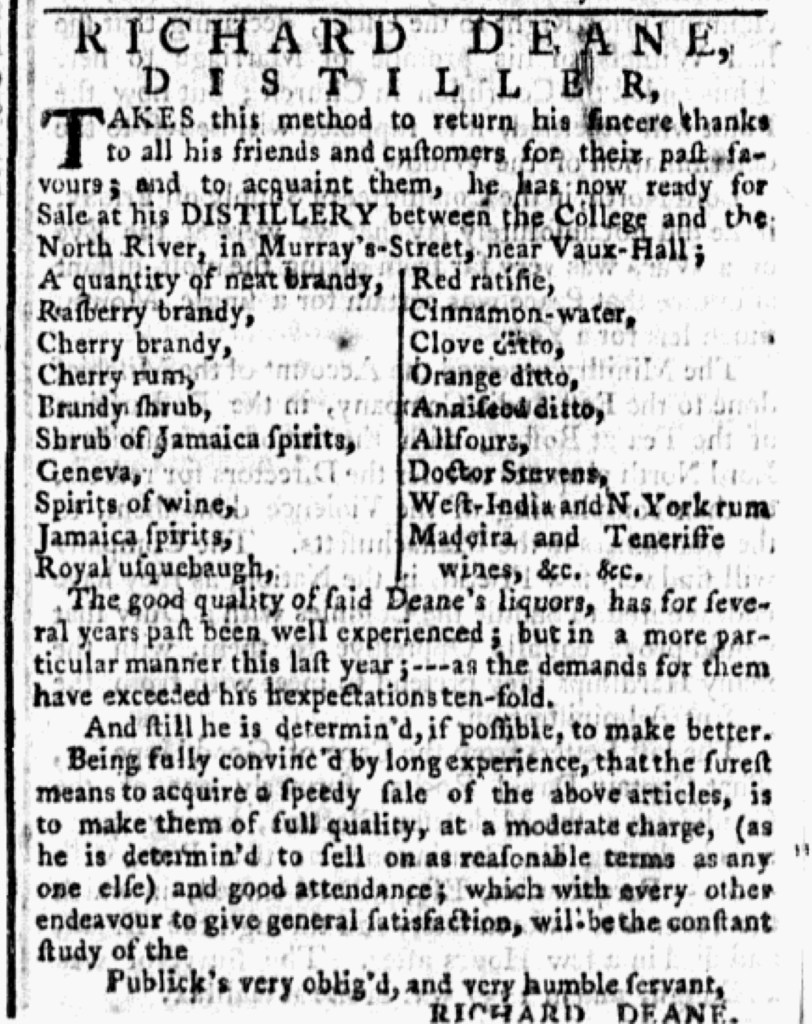
Delia Lee, a student in my Revolutionary America class, selected advertisements placed by local distillers in the April 4, 1774, edition of the New-York Gazette and Weekly Mercury to feature today.  Richard Deane frequently placed advertisements in the public prints.  The Adverts 250 Project previously examined one of his advertisements that he ran in the New-York Journal in 1772.  Philip Kissick, “DISTILLER and VINTNER,” on the other hand, is making his first appearance among on the Adverts 250 Project.

New-York Gazette and Weekly Mercury (April 4, 1774).

Delia, who was enrolled in business courses at the same time she was studying Revolutionary America, was interested in the production, distribution, and consumption of alcohol in early America.  When she set about her research, she consulted W.J. Rorabaugh’s overview of “Alcohol in America” in the OAH Magazine of History.[1]  According to Rorabaugh, “By 1770 Americans consumed alcohol, mostly in the form of rum and cider, routinely with every meal.”  Deane and Kissick stood ready to meet that demand.  Both included “West-India and New-York rum” among the lists of spirits that they sold.  Rorabaugh also notes that each colonizer “consumed about three and a half gallons of alcohol per year.”  Deane asserted that demand for his “Rasberry brandy,” “Cherry rum,” “Shrub of Jamaica spirits,” and other products “exceeded his expectations ten-fold,” suggesting a brisk market, especially for his wares.

Over the next couple of decades, the American Revolution and its aftermath “drastically changed drinking habits.  When the British blockaded the seacoast and thereby cut off molasses and rum imports, Americans looked for a substitute.”  Whiskey, distilled by Scot-Irish immigrants on the western frontier, replaced rum at the end of the eighteenth century “since the British refused to supply it and the new federal government began to tax it in the 1790s.”  Neither Deane nor Kissick included whiskey among the many spirits they advertised on the eve of the American Revolution.  Their advertisements provide a snapshot of the alcohol industry in the colonies at that time, an industry that politics and war would soon alter in significant ways.

**********

[1] W.J. Rorabaugh, “Alcohol in America,” OAH Magazine of History 6, no. 2 (Fall 1991): 17-19.

March 28

What was advertised in a colonial American newspaper 250 years ago today?

Supplement to the New-York Gazette and Weekly Mercury (March 28, 1774).

“The Sign of the SUN and BREECHES.”

Cornelius Ryan, “LEATHER DRESSER and BREECHES MAKER,” pursued his trade at “the Sign of the SUN and BREECHES, IN THE BROADWAY” in New York.  Residents and visitors to the busy port likely glimpsed his sign as they traversed the streets of the city.  Readers of the New-York Gazette and Weekly Mercury almost certainly noticed the woodcut that adorned the advertisements he ran in that newspaper.  It included the same elements as the sign that marked his location, a sun above a pair of breeches.  The sun had a face that stared directly at readers as well as eight rays enclosed within a corona.  In addition, the initials “CR,” for Cornelius Ryan, appeared between the legs of the breeches.  The woodcut may or may not have replicated Ryan’s sign; at the very least, it strengthened the association that the leather dresser and breeches maker wanted consumers to have with his business and visual representations of it.

To achieve that, Ryan invested in commissioning a woodcut stylized for his exclusive use.  Most entrepreneurs did not go to such lengths when they advertised in colonial newspapers, though Smith Richards, who kept shop “At the Tea canister and two sugar loaves,” once again included a woodcut depicting those items in his notice in the same supplement that carried Ryan’s advertisement.  Nesbitt Deane advertised hats he “Manufactured,” but did not adorn his notice with the image of a tricorne hat and his name within a banner that he had included in other notices on several occasions over the years.  Since advertisers paid by the amount of space their notices occupied rather than the number of words, woodcuts amounted to significant additional expense beyond the costs of producing them.  For Ryan, the woodcut accounted for nearly half of his advertisement, doubling the cost of running it in the New-York Gazette and Weekly Mercury.  He may very well have considered it worth the investment if the striking image prompted prospective customers to read the copy more closely.  The visual image served as a gateway for the appeals to skill, quality, price, consumer choice, and customer satisfaction that followed.

March 14

What was advertised in a colonial American newspaper 250 years ago today?

New-York Gazette and Weekly Mercury (March 14, 1774).

“ANNIVERSARY of the REPEAL of the STAMP-ACT … will be celebrated.”

Many colonizers commemorated events associated with the American Revolution even before the Revolutionary War.  During the years of the imperial crisis, residents of Boston staged annual commemorations honoring those killed in the Boston Massacre and residents of New York held annual dinners to mark the anniversary of the repeal of the Stamp Act. To mark the eighth anniversary of the latter, colonizers in New York had choices about which celebration to attend in 1774.  Advertisements for two of those events appeared in the March 14 edition of the New-York Gazette and Weekly Mercury.

For one, “18th of MARCH” served as the headline.  Many readers certainly recognized that date without having to peruse the rest of the advertisement.  For those who did not, the notice provided a reminder of its significance: “ON Friday next … at the house of Mr. DE LA MONTAGNIE, will be celebrated the ANNIVERSARY OF THE REPEAL OF THE STAMP-ACT, by those gentlemen, and their friends, who associated there last year.”  De la Montagnie hosted a celebration each year, promoting it in the public prints.  In 1774, he served dinner three hours earlier than the previous year.  Given recent developments, including the destruction of tea in Boston, perhaps he determined that his guests needed more time to commemorate the repeal of the Stamp Act and air their grievances about new abuses perpetrated by Parliament.

New-York Gazette and Weekly Mercury (March 14, 1774).

The other advertisement also deployed the date as the headline: “FRIDAY next, The 18th of MARCH.”  It also clarified that was “the ANNIVERSARY of the REPEAL of the STAMP-ACT.”  In this instance, the event “will be celebrated at PROTESTANT-HALL” and “all the SONS of LIBERTY are heartily invited.”  While the two celebrations competed for guests, they worked in concert in cultivating a culture of commemoration among colonizers in New York.  Many years after those events, John Adams famously asked in a letter to Thomas Jefferson, “What do WE mean by the Revolution?”  Answering his own question, Adams asserted, “The Revolution was in the Minds of the People, and this was effected, from 1760 to 1775.”  That occurred, in part, through the annual commemorations of significant events and promoting them in the public prints.

February 21

What was advertised in a colonial American newspaper 250 years ago today?

New-York Gazette and Weekly Mercury (February 21, 1774).

“☛K ☛E ☛Y ☛S ☛E ☛R’s Famous Pills.”

Hugh Gaine, “PRINTER, BOOKSELLER, and STATIONER” (as he described himself in the masthead of the New-York Gazette and Weekly Mercury), continued marketing “KEYSER’s Famous Pills,” a remedy for syphilis, in the February 21, 1774, edition of his newspaper.  He gave his advertisement a privileged place.  It was the first item in the first column on the first page, making it difficult for readers to miss.  The advertisement consisted of several portions, collectively extending half a column.  The first two portions, enclosed within a border composed of decorative type, provided a description of the efficacy of the pills in “eradicating every Degree of a certain DISEASE” and curing other maladies and offered an overview of “a Letter from the Widow Keyser, and a Certificate from under her own Hand” testifying to the “Genuineness” of the pills Gaine sold.  In recent months, both apothecaries and printers in New York and Philadelphia engaged in public disputes about who stocked authentic pills and who peddled counterfeits.  Even though Gaine invited the public to examine the letter and certificate at his store in Hanover Square (where they could shop for “Books and Stationary Ware”), the final two portions of his advertisement consisted of transcriptions of those items and a representation of the widow’s “Seal of my Arms.”

The decorative border, the only one in that issue of the New-York Gazette and Weekly Mercury, made Gaine’s advertisement more visible among the contents of the newspaper, yet that was not his only innovative use of graphic design.  For several weeks he had been playing with manicules as a means of drawing attention to his advertisements.  In this instance, a manicule appeared before each letter of “KEYSER,” pointing to the right.  Such had been the case when the advertisement ran on January 24 and 31 and February 7 and 14.  The first time he incorporated manicules into his advertisement for “KEYSER’s FAMOUS PILLS,” however, he had twelve pairs pointing at each other, six pairs above the name of the product and six pairs below the name of the product.  That version appeared just once, on November 1, 1773.  Subsequently, Gaine positioned manicules above each letter of “KEYSER,” pointing down, in six issues.  That arrangement ran on November 8, 15, and 22 and December 6 and 13, each time with a border.  When Gaine used it again on January 17, 1774, he did not include a border but once again had six manicules pointing down, one above each letter of “KEYSER.”  He apparently did not expect the appeals in his advertisements to do all the work of marketing the patent medicine.  Instead, Gaine believed that graphic design aided his efforts to reach prospective customers who much preferred fingers literally pointing at the name of the pills in advertisements over fingers figuratively pointing at them by others who suspected them of being afflicted with “a certain DISEASE.”

New-York Gazette and Weekly Mercury (November 1, 1773).

**********

New-York Gazette and Weekly Mercury (January 17, 1774).

November 22

What was advertised in a colonial American newspaper 250 years ago today?

New-York Gazette and Weekly Mercury (November 22, 1773).

“A Certificate from under her own Hand of the Genuineness of the above Pills.”

Hugh Gaine, the printer of the New-York Gazette and Weekly Mercury, and James Rivington, the printer of Rivington’s New-York Gazetteer, competed to sell subscriptions, to sell advertising, to sell books, to sell stationery, to sell printed blanks, to do job printing orders, … and to sell patent medicines.  In particular, they marketed and sold “KEYSER’s FAMOUS PILLS” for “perfectly eradicating every Degree of a certain Disease.”  Eighteenth-century readers understood that those code words referred to syphilis.

In November 1773, Gaine published a new salvo in the ongoing advertising war over Keyser’s Pills.  He expanded on his earlier advertisements, noting that he now “has in his Hands a Letter from the Widow Keyser, and a Certificate under her own Hand of the Genuineness of the above Pills.”  Furthermore, he declared that “any Person may have the Perusal of [those documents] by applying to him at his Book Store and Printing Office.”  That portion of the advertisement appeared within a decorative border.  Gaine also called attention to his notice with six manicules, one pointing to each letter of “KEYSER.”

Yet he still did not consider that sufficient to attract the attention of prospective customers and convince them to purchase the remedy from him rather than from Rivington or other purveyors.  Gaine’s primary competitor had been publishing advertisements that included descriptions of patients successfully treating that “DISEASE, not to be mentioned in a News-Paper” as well as rheumatism, apoplexies, asthma, and a “WHITE SWELLING.”  Rivington has also supplied William Bradford and Thomas Bradford, printers of the Pennsylvania Journal in Philadelphia, with a letter attesting that he supplied them with Keyser’s Pills imported “immediately from Mr. Keyser himself,” the son of the late doctor, “at Paris.”  That answered claims by Speakman and Carter, “Chemists and Druggists,” that they acquired their supply of Keyser’s Pills from James Cowper, “the only importer in London.”  In his most recent advertisement, Rivington proclaimed that he had “Certificates and Letters of the old Doctor, and Madame W. KEYSER, his Widow, and likewise of their Son, the present Monsieur Keyser, who has many Years prepared all the Pills sold by his Father.”  Like Gaine, Rivington invited the public to examine those documents at his printing office.

That apparently prompted Gaine to expand his advertisement once again.  Instead of merely presenting the option of seeing the letter and certificate he received from Keyser’s widow at his shop, he published transcriptions of both documents in his newspaper notice.  In the letter, Madame Keyser acknowledged her correspondence with Gaine and explained that the certificate “proves that the Polls I now send are of my Composition.”  The certificate was “Sealed with the Seal of my Arms, at Paris.”  Gaine included a representation of the seal to underscore the authenticity of the medicines he peddled.

When it came to advertising the goods and services available at their printing offices, Gaine and Rivington invested a significant amount of time and energy in promoting a particular patent medicine.  Their efforts suggest that Keyser’s Pills accounted for an important revenue stream to supplement their earnings from selling newspapers, advertising, books, stationery, blanks, and job printing.  They also seemed to follow and respond to advertisements placed by each other as well as others who sold the famous patent medicine.

October 28

What was advertised in a colonial American newspaper 250 years ago today?

New-York Journal (October 28, 1773).

“Gentlemen’s caps, and gloves, lined with fur, very useful for travelling, and sleighing.”

During the final week of October 1773, John Siemon, a furrier, inserted advertisements in three newspapers published in New York, placing his notices before the eyes of as many readers in and near the city as possible.  He hawked a “General and complete assortment, of new fashion’d muffs & tippets, ermine, cloak linings, … gentlemen’s caps, and gloves, lined with fur,” and other items.  In addition, he “trims Ladies robes and riding dresses” and “faces and lapels Gentlemen’s waistcoats.”  As an ancillary service, Siemon provided directions “to rub the furs in summer” to keep them in good condition when not being worn.

Although Siemon submitted nearly identical copy to the three printing offices, his advertisements had very different formats when they appeared in the newspapers.  Arguably the one that best represented Siemon’s brand, the notice in the New-York Journal featured a woodcut depicting a muff, an image that regularly accompanied the furrier’s advertisements.  Siemon apparently considered it worth the investment to commission a single woodcut for the exclusive use of his business, but did not realize the potential of purchasing multiple woodcuts with the same image in order to achieve visual consistency and product recognition across several publications.

Rivington’s New-York Gazetteer (October 28, 1773).

Siemon’s advertisement in Rivington’s New-York Gazetteer had a different kind of visual appeal.  The furrier joined the ranks of advertisers who enclosed their notices within borders comprised of decorative type, including Crommelin and Horsfield, bakers, John J. Roosevelt, a merchant, Richard Sause, a cutler.  James Rivington and the compositors in his printing office made such borders a regular part of advertisements for consumer goods and services.  Those borders helped to draw attention to certain advertisements while also giving the pages of Rivington’s newspaper a distinctive look.  In contrast, no images or decorative type adorned Siemon’s advertisement in the New-York Gazette and Weekly Mercury.  It consisted solely of text with the typography determined by the compositor to match other advertisements in that publication.

New-York Gazette and Weekly Mercury (October 25, 1773).

In most instances, advertisers submitted copy to printing offices and then compositors determined the format of the advertisements.  Siemon’s advertisements suggest that was indeed the case when advertising in the New-York Gazette and Weekly Mercury, yet he offered specific directions, in the form of the familiar woodcut, for his advertisement in the New-York Journal.  His advertisement in Rivington’s New-York Gazetteer demonstrates the greatest level of collaboration between advertiser and compositor.  Siemon either requested or agreed to include a distinctive visual element associated with notices in that newspaper.  The furrier took graphic design into account to varying degrees in his efforts to disseminate his advertisements in multiple newspapers.

October 18

What was advertised in a colonial American newspaper 250 years ago today?

New-York Gazette and Weekly Mercury (October 18, 1773).

“Every particular in repairing at HALF the price charg’d by others.”

John Simnet regularly advertised his services as a watchmaker in newspapers published in New York in the early 1770s.  Several of his competitors also ran advertisements, but Simnet placed notices so frequently that he achieved a much greater level of visibility in the public prints than other watchmakers in the city.  In the early 1770s, only Thomas Hilldrup’s notices in several newspapers published in Connecticut rivaled the dissemination of Simnet’s notices, a development that may have prompted Simnet to advertise in the Connecticut Courant.  Simnet’s advertisements were often so lively (or so cantankerous) that the Adverts 250 Project has traced his marketing efforts, especially his feuds with other watchmakers, for nearly five years, beginning with his first advertisements in the New-Hampshire Gazette in 1769 and continuing with his notices in New York after he relocated in 1770.  Considering how much money he invested in marketing, the watchmaker apparently believed that his advertisements yielded results.

Supplement to the New-York Gazette and Weekly Mercury (October 18, 1773).

For instance, Simnet ran two advertisements in the October 18, 1773, edition of the New-York Gazette and Weekly Mercury, one in the standard issue and one in the advertising supplement.  The one in the supplement had been running for quite some time, but the one in the standard issue was new.  The watchmaker deployed some of the same appeals in both advertisements, especially underscoring that he undertook “every particular in repairing [watches] at HALF the price charg’d by others, and will keep them in proper order in future, gratis.”  Simnet believed that the combination of bargain prices and additional services at no charge cultivated and secured relationships with customers.  Perhaps he even discovered during his conversations with clients that was indeed the case, a rudimentary form of research into the effectiveness of his marketing strategies.  Simnet also listed his prices for cleaning watches to make comparison shopping easier for prospective clients.  In the new advertisement, he once again incorporated a claim that he frequently made about his status as the “only regular London watch-maker” in New York.  He received his training in London and had decades of experience as a watchmaker there.  Simnet often implied that made his skills superior to competitors who only had experience working in the colonies; on occasion, he explicitly stated that was the case.  Compared to some of his notices, the two advertisements in the October 18 edition of the New-York Gazette and Weekly Mercury were rather placid.  For the moment, Simnet did not seek to benefit from creating controversy.  Instead, he used multiple advertisements to keep his name and his services in front of the eyes of prospective customers as they perused the newspaper.