July 16

What was advertised in a revolutionary American newspaper 250 years ago this week?

New-York Gazette and Weekly Mercury (July 10, 1775).

“He therefore hopes for the countenance of those who wish to encourage their own manufactures.”

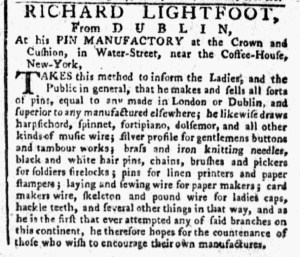
In the summer of 1775, Richard Lightfoot placed a newspaper advertisement to promote his “PIN MANUFACTORY at the Crown and Cushion” in New York.  In addition to “all sorts of pins,” he also produced a variety of other wirework, including “harpsichord, spinnet, fortepiano, dolsemor, and all other kinds of music wire,” “brass and iron knitting needles,” “pins for linen printers and paper stampers,” and “laying and sewing wire for paper makers.”

Lightfoot addressed “the Ladies,” who presumably constituted a significant portion of his customers, yet also directed his advertisement to “the Public in general.”  After all, he had an interest in the entire community knowing about the work undertaken at his “PIN MANUFACTORY” and his contributions to the American cause through his participation in the marketplace.  Lightfoot proclaimed that “he is the first that ever attempted any of said branches,” the production of the various kinds of wirework, “on this continent.”  He did so at a time that colonizers observed the Continental Association, a nonimportation agreement devised by the First Continental Congress in response to the Coercive Acts.  That pact called for encouraging “Industry” and “the Manufactures of this Country” as alternatives to imported goods.  Under those circumstances, Lightfoot hoped “for the countenance of those who wish to encourage their own manufactures.”  That meant that “the Public in general” should support his enterprise by recommending it to “the Ladies” who purchased and used the pins and other items he made.

When they did so, they could depend on the quality of those products.  Lightfoot asserted that his pins were “equal to any made in London or Dublin, and superior to any manufactured elsewhere.”  He was qualified to make that claim, indicating that he was “From DUBLIN” and likely learned and practiced his trade there before migrating to New York.  Claiming that authority, Lightfoot assured prospective customers that they did not sacrifice quality when they applied their political principles to their decisions about which pins to purchase.  It did not matter that the Continental Association prohibited buying imported pins because Lightfoot made and sold pins that were just as good as (or even better than) pins produced elsewhere!

July 10

What was advertised in a revolutionary American newspaper 250 years ago today?
New-York Gazette and Weekly Mercury (July 10, 1775).

“Children educated … at a distance from probable, sudden danger and confusion.”

In July 1775, Andrew Wilson, a schoolmaster in Morristown, New Jersey, attempted to leverage current events to enroll students in his school “about twenty-seven miles from Powles-Hook, and eighteen miles from Elizabeth-Town.”  In the late spring and early summer, colonizers in New York followed the news about the battles at Lexington and Concord, the siege of Boston, and the Battle of Bunker Hill.  In addition to updates from Massachusetts, they read and discussed actions taken by the Second Continental Congress, meeting in Philadelphia, and provincial congresses throughout the colonies.  While the fighting had been confined to Massachusetts so far, colonizers anticipated that it would spread.

In such an environment, Wilson saw an opportunity to market his school to parents and guardians in New York City and other coastal towns.  “IN these dangerous and alarming times,” he declared, “the inhabitants of large cities, and other places on the sea coast, may wish to have their children educated in the interior parts of the country, at a distance from probably, sudden danger and confusion.”  He acknowledged that they likely weighed tuition and the quality of instruction against the prospects of danger, suggesting that they would send their children to such a school “if the expence was reasonable, and they could depend on the fitness of the teacher.”  Wilson confidently stated that he could alleviate both concerns.  He claimed that he “was recommended by Dr. Witherspoon, of New-Jersey College, and the Rev. Mr. Mason, in New-York.”  Furthermore, he had experience.  When he ran his advertisement in the July 10, 1775, edition of the New-York Gazette and Weekly Mercury, he had “taught [in Morristown] upwards of ten months, to the satisfaction of his employers.”  When it came to expenses, lodging and board amounted to “much less money than is generally given for the same in other places.”  His pupils did not reside at the school; instead, Wilson placed them in the homes of “good families.”  In addition, the schoolmaster described Morristown and a “healthy place” as well as an accessible one.  “[O]n three different days of the week,” he noted, “a stage goes from it to New-York.”

As resistance to imperial overreach became a revolution, the crafty schoolmaster portrayed Morristown, New Jersey, as a relatively safe place to send children to school.  Parents and guardians could remove their charges from danger while still attending to their education and development, alleviating at least some of the worry they experienced during uncertain times.

May 22

What was advertised in a revolutionary American newspaper 250 years ago today?

New-York Gazette and Weekly Mercury (May 22, 1775).

“Shop-keepers and traders, who are under disadvantages by reason of the non-importation.”

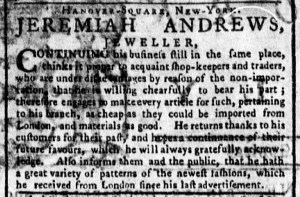
The Continental Association, a nonimportation agreement devised by the First Continental Congress in response to the Coercive Acts, created an opportunity for Jeremiah Andrews, a jeweler in New York, to market his services in the spring of 1775.  In the May 22 edition of the New-York Gazette and Weekly Mercury, he announced that he “CONTINU[ED] his business still in the same place” and “thinks it proper to acquaint shop-keepers and traders, who are under disadvantages by reason of the non-importation, that he is willing chearfully to bear his part.”  How would Andrews help them with that burden?  By supplying retailers with items that they could not import while the Continental Association remained in effect!

He explained that he could “make every article … pertaining to his branch,” jewelry, “as cheap as they could be imported from London, and materials as good.”  Andrews expected that he offered an attractive alternative.  After all, he used quality materials in crafting his jewelry and set prices comparable to those previously charged for imported items.  His appeals resonated with various articles of the Continental Association, including the eighth article that called for “promot[ing] Agriculture, Arts, and the Manufactures of this Country” and the ninth article that prohibited “tak[ing] Advantage of the Scarcity of Goods” by increasing prices for those “Goods or Merchandise” available for sale.

Andrews also informed both retailers and the public that “he hath a great variety of patterns of the newest fashions, which he received from London since his last advertisement.”  Assessing the situation, he realized that consumers still valued connections to the largest and most cosmopolitan city in the empire.  The Continental Association made importing textiles, accessories (including jewelry), housewares, and other goods from there off limits, but it did not proscribe replicating the styles currently in fashion.  Andrews presented retailers and consumers with a means of keeping up with the latest trends for jewelry without sacrificing support for the American cause.  After all, most colonizers still valued being part of the British Empire, despite the imperial crisis and the battles between regulars and colonial militia in Massachusetts in April and the ongoing siege of Boston.  They thought of themselves as British and hoped for a redress of grievances.  Andrews provided a means for minimizing the disruptions that consumers experienced, his way “chearfully to bear his part” while expanding his business.

April 10

What was advertised in a colonial American newspaper 250 years ago today?

New-York Gazette and Weekly Mercury (April 10, 1775).

“Turn them speedily into cash, before the trade opens with Great-Britain.”

In the spring of 1775, Samuel Loudon, a bookseller and stationer, took to the pages of the New-York Gazette and Weekly Mercury to promote his current inventory.  His advertisement included a catalog listing many of the titles currently in stock as well as “a Variety of Religious books too tedious to mention” and “a variety of History and Romance.”  He also carried writing supplies, including “Quills, Writing Paper, Blank Books, Wafers and Sealing Wax.”

Loudon hoped to make a deal with customers “who take a quantity,” whether for themselves or to retail at their own shops, offering to sell the books “nearly at prime cost” or just a small markup.  He stated that he wished to “turn them speedily into cash, before the trade opens with Great-Britain” because he wanted to be in a better position to “lay in a fresh assortment.”  Despite the volume of newspaper advertisements and subscription proposals for books and pamphlets published by American printers, most books purchased and read by colonizers were printed in England and imported to the colonies.  At that moment, however, Americans participated in a nonimportation agreement, the Continental Association, enacted in response to the Coercive Acts.  Loudon acknowledged that he did not currently have access to new books, yet he looked to the future with optimism and planned to place orders as soon as Parliament repealed the offensive legislation and trade returned to normal.

In that regard, his advertisement echoed the one that John Minshull placed for looking glasses and engravings in the New-York Journal a few days earlier, though Minshull, likely a Loyalist, may have adhered to the nonimportation agreement out of necessity rather than enthusiasm.  Loudon “was decidedly a whig,” according to Patriot printer Isaiah Thomas, so his support may the Continental Association could have been more genuine despite any frustration with the disruptions it caused for his business.  Not long after he placed his advertisement in the New-York Gazette and Weekly Mercury, he purchased “printing materials, and opened a printing house.”  He commenced publishing “a newspaper devoted to the cause of the country” in January 1776.[1]  Neither Loudon nor Minshull saw trade resume with Britain in the way they imagined.  They did not know when they submitted their advertisements to the printing offices that resistance would soon become revolution following the battles at Lexington and Concord in Massachusetts.

**********

[1] Isaiah Thomas, The History of Printing in America: With a Biography of Printers and an Account of Newspapers (1810; New York: Weathervane Books, 1970), 482.

March 27

What was advertised in a colonial American newspaper 250 years ago today?

Newport Mercury (March 27, 1775).

“Worth the Perusal of each TRUE SON OF LIBERTY.”

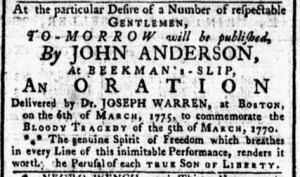
In the years after British soldiers fired into a crowd of protestors and killed several colonizers on March 5, 1770, the residents of Boston staged an annual commemoration of the “horrid MASSACRE.”  They called on a prominent patriot to give an “ORATION” about what occurred and the dangers of having British soldiers quartered in urban ports during times of peace.  Colonizers did not need to be present for the oration to experience it for themselves.  Each year, printers published and marketed the oration, commodifying an event that played an important role in the imperial crisis becoming a revolution.

New-York Gazette and Weekly Mercury (March 27, 1775).

In the first several years, printers in Boston published the oration and newspapers in Massachusetts carried advertisements for it.  In 1775, however, printers in other colonies produced their own editions of Joseph Warren’s oration commemorating the fifth anniversary of the Boston Massacre.  Benjamin Edes and John Gill, the printers of the Boston-Gazette, and Joseph Greenleaf, the publisher of the Royal American Magazine, partnered in printing and advertising a Boston edition.  Not long after, Solomon Southwick, the printer of the Newport Mercury, advertised his own edition, giving the notice a privileged place as the first item in the first column on the first page of the March 27 edition of his newspaper.  On that same day, John Anderson inserted a notice in the New-York Gazette and Weekly Mercury to alert readers of the imminent publication of a local edition undertaken “At the particular Desire of a Number of respectable GENTLEMEN.”  Patriots expressed intertest in obtaining their own copies of Warren’s oration; in turn, printers believed they could generate even greater demand.  To that end, Anderson declared, “The genuine Spirit of Freedom which breathes in every Line of this inimitable Performance, renders it worth the Perusal of each TRUE SON OF LIBERTY.”

The political climate had shifted since printers in Boston disseminated John Hancock’s oration commemorating the fourth anniversary of the Boston Massacre.  Since then, colonizers experienced how Parliament reacted to the destruction of tea during what has become known as the Boston Tea Party.  The Coercive Acts, including the Boston Port Act that closed the harbor until residents paid restitution, prompted delegates from throughout the colonies to gather in Philadelphia for the First Continental Congress in the fall of 1774.  They adopted a nonimportation agreement, the Continental Association, that remained in effect in the spring of 1775.  Given the events that transpired in 1774 and early 1775, it made sense that the anniversary of the “BLOODY TRAGEDY of the 5th of MARCH, 1770” garnered greater attention beyond Massachusetts.

March 6

What was advertised in a colonial American newspaper 250 years ago today?

New-York Gazette and Weekly Mercury (March 6, 1775).

Will be celebrated the Anniversary of the repeal of the STAMP-ACT.”

A manicule directed readers to take note of upcoming festivities to commemorate the “18th of MARCH” as they perused the advertisements in the March 6, 1775, edition of the New-York Gazette and Weekly Mercury.  Although that date is not familiar to most Americans in the twenty-first century, it certainly resonated with colonizers who associated it with the repeal of the Stamp Act on March 18, 1766.  Just as Americans today recognize the “4th of July” as Independence Day, “9/11” as the day terrorists hijacked four airplanes and used them as weapons to kill thousands of people, and “January 6” as the day insurrectionists attacked the United States Capitol at the bidding of a demagogue who refused to participate in a peaceful transfer of power after losing a free and fair election, colonizers knew the significance of the “18th of MARCH” without further explanation.

The Sons of Liberty and other supporters of the American cause had been gathering to celebrate “the Anniversary of the repeal of the STAMP-ACT” for many years, including in 1770, 1771, 1772, 1773, and 1774.  As the ninth anniversary approached, they prepared to dine “at the house of Mrs. De La Montagnie” with “those gentlemen and their friends, who associated there last year.”  The tavern operated by the De La Montagne family had often been the site of these commemorations.  “Mr. DE LA MONTAGNIE” served as host in 1774; following his death, his widow continued the tradition.  The celebrants did not know it at the time, but it would be the last time they commemorated the repeal of the Stamp Act before what would eventually become a war for independence began.  Just a month and a day later, the skirmishes at Lexington and Concord would occur.  While “those gentlemen and their friends” who marked the anniversary of the repeal of the Stamp Act did not yet know the significant of the “19th of April,” they did understand that the imperial crisis had intensified.  For many years they had already been commemorating the events that precipitated the American Revolution.  As John Adams suggested after the war, “The Revolution was in the Minds of the People … before a drop of blood was drawn at Lexington.”

February 13

What was advertised in a colonial American newspaper 250 years ago today?

Supplement to the New-York Gazette and Weekly Mercury (February 13, 1775).

“Orders for the West-Indies and elsewhere, compleated on the shortest notice.”

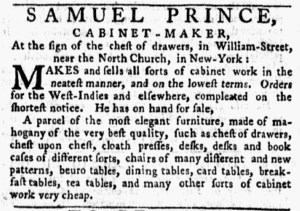
Samuel Prince, a cabinetmaker, produced furniture in his workshop “At the sign of the chest of drawers, in William-Street, near the North Church, in New-York” in the 1770s.  In February 1775, he took to the pages of the New-York Gazette and Weekly Mercury to promote a “parcel of the most elegant furniture, made of mahogany,” imported from the West Indies, “of the very best quality.”  In addition to the “chest of drawers, … desks and book cases of different sorts, [and] chairs of many different and new patterns” that he had on hand, Prince made “all sorts of cabinet work in the neatest manner, and on the lowest terms.”

While he certainly sought customers in New York, he also indicated that he accepted “Orders for the West-Indies and elsewhere” and shipped the furniture to his clients.  That Prince addressed prospective customers in the West Indies testified to the circulation of the New-York Gazette and Weekly Mercury and other colonial newspapers.  The cabinetmaker had a reasonable expectation that prospective customers in faraway places would see his advertisement.

Prince promised that he “completed” orders “on the shortest notice, an appeal with additional significance since the Continental Association went into effect.  Devised by the First Continental Congress, that nonimportation, nonconsumption, and nonexportation agreement was designed to use commerce as leverage for convincing Parliament to repeal the Coercive Acts.  The fourth article specified that the “earnest Desire we have not to injure our Fellow Subjects in Great Britain, Ireland, or the West Indies, induces us to suspend a Non-exportation until the tenth Day of September 1775.”  If Parliament did not take satisfactory action by that time, “we will not, directly or indirectly, export any Merchandise, or Commodity whatsoever, to Great Britain, Ireland, or the West Indies.”  In other words, Prince and prospective clients in the West Indies had a short window of opportunity for placing orders, producing the furniture, and shipping it.  Prince did not violate the provisions of the Continental Association, but he likely had that looming deadline in mind when he pledged to fill orders “on the shortest notice.”

December 19

What was advertised in a colonial American newspaper 250 years ago today?

New-York Gazette and Weekly Mercury (December 19, 1774).

“He will undertake to make middle-siz’d men cloaths at the under-mentioned prices.”

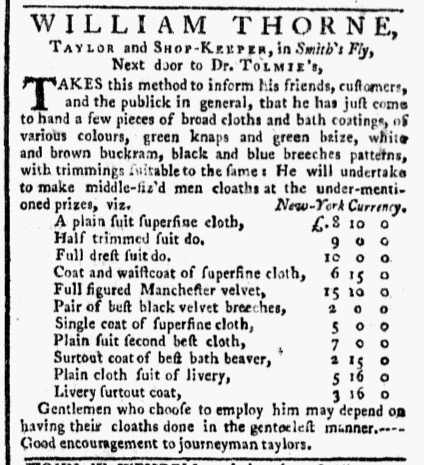
William Thorne, a tailor, took to the pages of the New-York Gazette and Weekly Mercury to advertise his services in late December 1774.  He began his notice with an announcement that he had recently acquired various textiles, trimmings, and patterns, though he devoted half of the space to a list of prices that he charged for “middle-siz’d men cloaths.” Presumably he adjusted the prices accordingly depending on whether a client was tall or short or stout.  The “middle-siz’d” prices at least gave prospective customers an estimate of what they could expect to pay for an array of garments.

For instance, a ”Full figured Manchester velvet,” the most genteel item on the list, cost fifteen pounds and ten shillings “New-York Currency.”  For some items, the list revealed a progression of prices.  A “plain suit [made of] superfine cloth” cost eight pounds and ten shillings, a “Half trimmed suit” of the same material cost nine pounds, and a “Full drest suit,” also of the same material, cost ten pounds.  Clients interested in just a “Coat and waistcoat of superfine cloth” paid only six pounds and fifteen shillings, with a “Single coat of superfine cloth” costing five pounds.  For those of more modest means, a “Plain suit [made of] second best cloth” cost seven pounds.  The prices for the “Half trimmed” and “Full drest” suits made of superfine cloth suggested the likely increase in price for such items made of “second best cloth.”  Thorne also made other garments.  A “Surtout coat” or overcoat “of best bath beaver” cost two pounds and fifteen shillings and a “Pair of best black velvet breeches” went for two pounds.

Tailors only occasionally listed prices in their advertisements.  The list that Thorne published allowed “his friends, customers, and the publick in general” to do some comparison shopping without needing to visit his shop of contact him directly.  Readers could determine for themselves how Thorne’s prices compared to what they paid their own tailors for similar garments, perhaps prompting them to recognize bargains that made Thorne’s services attractive to them.

December 12

What was advertised in a colonial American newspaper 250 years ago today?

New-York Gazette and Weekly Mercury (December 12, 1774).

“He will meet with due encouragement … by every real friend to American manufactures.”

Nicholas Cox, a hatter, made several appeals to consumers in his advertisement in the December 12, 1774, edition of the New-York Gazette and Weekly Mercury.  He commenced with a standard expression of gratitude for “the encouragement he had met with from the respectable publick since he commenc’d business.”  Many purveyors of goods and services did so in their advertisements, signaling to readers that other consumers already considered them worthy of their business.  It was a familiar means of bolstering an advertiser’s reputation.

The hatter also incorporated commentary specific to his trade, proclaiming that he “manufactures the new invented and greatly approved of CAP-HATS.”  For those unaware of this innovation, eh explained that by “outward appearance they are entirely like other hats, having only the addition of a cap fix’d in the bowl, which can be drawn out occasionally.”  In such instances, it “buttons under the chin, keeping the neck and ears entirely free from rain or snow.”  Cox marketed this new style, a very practical element, as “so very necessary for all those whose business exposes them to the inclemency of the weather.”  According to Kate Haulman, colonizers debated whether they should carry umbrellas, “stylistic spoils of empire hailing from India,” in the 1760s and 1770s.  “Some regarded umbrellas as ridiculous and frivolous,” she notes, “serving no purpose that a good hat could not supply.”[1]  Cox produced and sold such hats for men of business who sought to eschew the effeminacy and luxury associated with umbrellas.

His next appeal made an even more explicitly political argument to prospective customers.  He made “the best black and white superfine FELT and WOOL HATS,” like the tricorne hat depicted in the woodcut that adorned his advertisement.  Cox asserted that patriotic consumers had a duty to support his business when they made choices about where to acquire their hats.  He expressed confidence that he “will meet with due encouragement at this spirited time, by every real friend to American manufactures.”  The Continental Association, a boycott of British goods adopted in response to the Coercive Acts, had recently gone into effect.  Cox offered an alternative to colonizers who desired to acquire hats yet wished to remain patriotically correct, either according to their own principles or at least to avoid the ire of others who observed the purchases they made.  Furthermore, his customers did not have sacrifice quality for principles.  The hatter pledged that “he will warrant [his hats] to be far superior to the best imported from England.” That being the case, the crown that appeared above the tricorne hat at the top of his advertisement may have testified to the superior quality of his hats, a general sense of pride in being part of the British Empire, or reverence for the monarch whom many colonizers still hoped would intervene on their behalf in their altercation with Parliament.

In addition to those appeals, Cox included two more common marketing strategies.  He promised a “[g]reat abatement … to those who take a quantity at a time.”  In other words, he gave discounts for buying multiple hats, both for consumers and for retailers who intended to sell them in their own shops.  He also provided a free ancillary service: “Customers hats brush’d at all times, gratis.”  Cox saw to the care and maintenance of the hats he made and sold long after the time of purchase.  He cultivated relationships with customers by encouraging them to return to his shop for assistance in keeping their hats in good order.  Overall, Cox resorted to a variety of familiar and specific appeals when advertising his hats, distinguishing him from competitors who did not put as much effort into marketing their wares.

**********

[1] Kate Haulman, “Fashion and the Culture Wars of Revolutionary Philadelphia,” William and Mary Quarterly, 3rd ser., 62, no 4 (October 2005): 632.

November 28

What was advertised in a colonial American newspaper 250 years ago today?

Supplement to the New-York Gazette and Weekly Mercury (November 28, 1774).

“All sorts of organs, harpsichords, spinnets and Fortepianoes.”

In the fall of 1774, John Sheybli, an “ORGAN-BUILDER,” took to the pages of the New-York Gazette and Weekly Mercury to advise the public that he “MAKES, repairs and tunes all sorts of organs, harpsichords, spinnets and Fortepianoes, on the most reasonable terms.”  In addition, he “has now ready for sale, one neat chamber organ, one hammer spinnet, [and] one common spinnet” at the workshop he shared with Samuel Prince, a cabinetmaker.

Readers of the New-York Gazette and Weekly Mercury likely perused the copy in Sheybli’s advertisement only after noticing the visual image that accompanied it.  A woodcut featured a scene with two men within an oval frame.  The man on the left stood at a workbench with an array of tools hanging on the wall over it and the man on the right was seated at an organ, maybe tuning it or maybe playing it.  Perhaps it was a depiction of the workshop where Sheybli built organs and other instruments on Horse and Cart Street, though it may have been an idealized portrait of the artisan at work and a customer enjoying the product of those labors.  Readers could determine for themselves how they wished to interpret it.

No matter which narrative they imagined, Sheybli treated them to a visual image unlike others they encountered in the New-York Gazette and Weekly Mercury and other newspapers.  Advertisers sometimes included woodcuts that represented some aspect of their business, but they focused on specific goods or replicated their shop signs.  They almost never showed people, neither at work producing the items offered for sale nor at leisure enjoying their purchases.  The November 28, 1774, edition of the New-York Gazette and Weekly Mercury and its supplement had three advertisements with woodcuts commissioned by the advertisers.  Lyon Jonas, a furrier, once again ran his notice with an image of some of the goods he produced, a muff and a tippet, while Nicholas Cox, a hatter, incorporated what may have been a variation of the sign that marked his location.  His woodcut showed a crown above a tricorne hat.  Readers were accustomed to those kinds of images, but much less often saw the sort of scene that Sheybli presented in his advertisement.  That almost certainly helped in making it memorable.