December 31

What was advertised in a colonial American newspaper 250 years ago today?
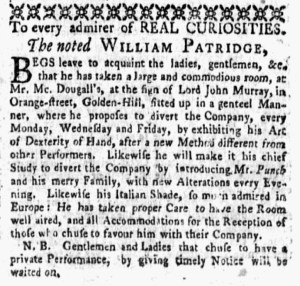
New-York Gazette and Weekly Mercury (December 31, 1770).

“Exhibiting his Art of Dexterity of Hand.”

As 1770 came to an end and 1771 began, William Patridge, an itinerant performer, took to the pages of the New-York Gazette and Weekly Mercury to inform residents of the busy urban port that he provided entertainments for “every admirer of REAL CURIOSITIES.”  Patridge rented “a large and commodious room … fitted up in a genteel Manner” for giving performances on Mondays, Wednesdays, and Fridays.

His show consisted of several acts, including “Dexterity of Hand,” “Mr. Punch and his merry Family,” and an “Italian Shade.”  Patridge included additional details about each in his efforts to entice audiences to attend his performances.  He described his “Italian Shade,” mostly likely some sort of illumination, as “so much admired in Europe.”  Audiences on the other side of the Atlantic had been impressed and delighted by this portion of his show, Patridge seemed to suggest, so residents of New York would not want to miss such an acclaimed exhibition.  The portion of the evening devoted to “Mr. Punch and his merry Family” presumably involved a puppet show.  Patridge incorporated “new Alterations every Evening,” making each performance different from any other.  Members of the audience who attended more than one performance would experience something new each time.  When it came to the “Art of Dexterity of Hand,” Patridge declared that he practiced “a new Method different from other Performers.”  Even if readers had seen Hyman Saunders perform when he spent several weeks in New York in November, they supposedly had not seen anything like Patridge’s sleight of hand.

Patridge also saw to the comfort of his audience.  In addition. To selecting a “commodious room … fitted up in a genteel Manner,” he also pledged that he had “taken proper Care to have the Room well aired” for those who saw his show.  He offered “all Accommodations,” though he did not go into greater detail.  He likely expected that residents of the city would already be familiar with “Mr. Mc. Dougall’s” establishment “at the sign of Lord John Murray, in Orange-street, Golden-Hill.”  For those “Gentlemen and Ladies” who did not wish to mix with crowd at one of Patridge’s performances at that location, he also gave private performances in their homes, provided that they gave “timely Notice.”  Patridge hinted at a higher level of refinement and status; rather than attending a performance, those “Gentlemen and Ladies” could have a performer attend on them.

Eighteenth-century newspaper advertisements reveal a variety of entertainments and amusements available to colonial consumers, a range of popular culture options available to them.  Itinerant performers depended on those advertisements to make the public aware when they arrived in town and what kinds of diversions they offered.  Although Patridge did not do so, many also declared that they would be in town for only a short time, attempting to incite greater demand by making their performances scarce commodities.  Still, Patridge did not merely announce his presence in New York.  Instead, he resorted to other kinds of appeals to attract audiences for his shows.

December 17

What was advertised in a colonial American newspaper 250 years ago today?

New-York Gazette and Weekly Mercury (December 17, 1770).

“Beds and window curtains in the newest taste, as practised in London.”

An array of merchants and shopkeepers placed advertisements for imported goods in the December 17, 1770, edition of the New-York Gazette and Weekly Mercury.  For instance, John Schuyler, Jr., announced that he “just imported in the last vessels from London and Bristol, a neat assortment of goods.”  Many of them asserted that their new inventory reflected current fashions in England.  Artisans who offered their services to colonial consumers made similar appeals in their advertisements.

George Richey, who described himself as an “UPHOLSTERER and TENT-MAKER,” did so.  He informed “ladies and gentlemen that will favour him with their custom” that he “MAKES all sorts of upholstery work in the newest fashions” for beds, chairs, couches, and other furniture.  He also made curtains for both windows and beds, stressing that his wares followed “the newest taste, as practised in London.”

Richey and others who advertised consumer goods and services in the 1760s and 1770s frequently assured prospective customers that they provided products that matched current fashions in London, the cosmopolitan center of the empire.  Such appeals tapered off when nonimportation agreements went into effect, but they were quite common at other times.  Even as colonists sparred with Parliament over increased regulation of commerce, collecting duties on certain imported goods, quartering soldiers in port cities, and other matters, they continued to look to London for the latest fashions.

Newspaper advertisements published throughout the colonies made overtures concerning current trends and tastes in London, but such appeals most often appeared in advertisements placed by merchants, shopkeepers, and artisans in the largest port cities.  Residents of Boston, Charleston, New York, and Philadelphia experienced urban life, though on a much smaller scale than their counterparts in London.  Still, advertisers sought to assure potential clients and customers that they could acquire the same goods and, in the process, embody the same sophistication even though they lived on the other side of the Atlantic.  Richey the upholsterer joined a chorus of advertisers who invoked “newest fashions” and “newest taste, as practised in London.”

December 12

What was advertised in a colonial American newspaper 250 years ago this week?

Supplement to the New-York Gazette and Weekly Mercury (December 10, 1770).

“Goods of the best qualities, and newest patterns.”

George Fenner stocked a variety of textiles and clothing at his store on Broad Street in New York.  In an advertisement that he inserted several times in both the New-York Gazette and Weekly Mercury and the New-York Journal in November and December 1770, he listed “PRINTED cottons and lines of the finest colours,” “handkerchiefs of all sorts,” “linen and cotton checks,” “men and boys ready made clothes,” “womens scarlet cardinals,” and “felt and castor hats” along with an array of other merchandise.  Yet that was not an exhaustive catalog of his inventory.  Fenner advised prospective customers that he also carried “many other articles in the linen and woollen draper, too tedious to insert.”  If readers wanted to know what other items the merchant made available then they would have to visit his store.  He whetted their appetites by mentioning only some of his wares.

Fenner directed his advertisement to shopkeepers and others who wished to purchase by volume.  He noted that he sold his goods wholesale “at a very small profit.”  In other words, his markup was low enough that his buyers could still charge competitive retail prices at their retail shops.  He also attempted to incite interest in his merchandise by declaring that his customers “may depend upon having goods of the best qualities, and newest patterns.”  He realized that retailers would reiterate such appeals to their own customers when they marketed clothing and textiles.  To convince prospective buyers that he did indeed provide the “newest patterns,” Fenner opened his advertisement with a proclamation that he had “Just arrived from LONDON,” the largest and most cosmopolitan city in the empire.  Accordingly, he had been on the scene to assess for himself which patterns were currently in fashion.  Retailers who dealt with him could assure their own customers that they could choose from among the latest trends.

Fenner had several goals in constructing his advertisement.  He sought to convince retailers that he had an impressive inventory that warranted a visit to his store to select among the clothing and textiles he offered at wholesale prices.  At the same time, he needed to convince prospective buyers that these wares had good prospects for retail sales.  In so doing, he made appeals to price, quality, and fashion to reassure retailers that they would be able to sell these items to consumers.

December 3

What was advertised in a colonial American newspaper 250 years ago today?

Supplement to the New-York Gazette and Weekly Mercury (December 3, 1770).

“Any quantity of seedling plants of the different species, can be got ready at a short notice, to be shipped to any Part of the World.”

Thomas Vallentine wanted his clientele in New York and beyond to feel important.  In an advertisement in the supplement that accompanied the December 3, 1770, edition of the New-York Gazette and Weekly Mercury, he addressed potential clients as “The NOBILITY, GENTRY, AND others employ’d in botany and gardening.”  The “nursery and seedsman” advised such illustrious prospective patrons that he “collects and keeps for sale, assortments of most kinds of seeds of trees, shrubs, and flowers, produced by this country.”  To further underscore both his own importance and the importance of those who purchased seeds from him, he declared that his “care and assiduity, have been experienced by some of the first personages in Europe and America.”  His clients may have included colonial elites who planted decorative gardens as well as others who participated in transatlantic scientific discourses about the natural world.  At least that was the impression he wanted to give.

To generate greater demand for his services, Vallentine described some of his business practices and offered a guarantee.  He assured prospective customers that he could supply “the largest orders.”  He gave special attention to cones, pods, and other kinds of seeds that were “liable to germinate or lose their vegetative qualities” before customers received them.  To prevent either of those misfortunes, those items were “carefully preserved in sand.”  Furthermore, he pledged that “if any of the seeds he may dispose of should happen to miscarry” then he would “supply the purchaser with an equal quantity of such seeds” free of charge.  That guarantee came with an additional provision; Vallentine provided replacement seeds only when clients had not “sowed and attended as directed by Mr. Philip Miller’s gardeners dictionary.”  In stating that condition, he further described his clientele as gardeners and botanists familiar with a particular publication and the guidelines it provided for raising a variety of plants.

Vallentine also noted that he provided “Any quantity of seedling plants of the different species … to be shipped to any Part of the World” on short notice.  That made the packaging all the more important, but it also testified to the types of clients he anticipated attracting with his advertisement.  Colonists who corresponded with botanists in other parts of the Atlantic world could acquire North American seeds and seedlings from Vallentine and then arrange to have them transported to distant destinations.  As Chris Parsons and Kathleen S. Murphy have described in “Ecosystems under Sail:  Specimen Transport in the Eighteenth-Century French and British Atlantics,” botanists and their correspondents on both sides of the Atlantic invested significant time and effort in devising the best methods for shipping flora from one place to another for further study.[1]  Vallentine did not go into great detail about his methods, but those he did briefly describe in his advertisement made clear his familiarity with best practices in the field.  The “nursery and seedsman” was prepared to serve a specialized clientele.

**********

[1] Chris Parsons and Kathleen S. Murphy, “Ecosystems under Sail: Specimen Transport in the Eighteenth-Century French and British Atlantics,” Early American Studies 10, no. 3 (Fall 2012): 503-29.

November 21

What was advertised in a colonial American newspaper 250 years ago this week?

New-York Gazette and Weekly Mercury (November 19, 1770).

“SCONCES.”

The partnership of Abeel and Byvanck regularly advertised in the New-York Gazette and Weekly Mercury in 1770.  While it is difficult to determine the effectiveness of their marketing efforts, the fact that they repeatedly placed new advertisements advising consumers about the merchandise they offered for sale suggests that they considered advertising a good investment.  Like other merchants and shopkeepers, they often listed items currently in stock, though sometimes they instead merely emphasized that shoppers had many choices among a “general Assortment” or “very large ASSORTMENT.”

Most purveyors of consumer goods tended to place a single advertisement to promote all of them.  Such advertisements often attracted attention due to the amount of space they occupied on the page.  Abeel and Byvanck, on the other hand, experimented with placing multiple advertisements in a single issue.  Rather than the length of their notices drawing the eye, instead it was the repetition intended to attract attention.  Abeel and Byvank’s enterprise became more memorable as a result of repeatedly encountering their advertisements.

New-York Gazette and Weekly Mercury (November 19, 1770).

Readers of the November 19, 1770, edition of the New-York Gazette and Weekly Mercury spotted advertisements placed by Abeel and Byvank on the first and last pages.  An advertisement for ironmongery ran on the first page followed by another for looking glasses on the final page.  In addition to placing multiple advertisements, the partners also relied on headlines in oversized fonts drawing the eyes of prospective customers.  The word “SCONCES” in the notice about looking glasses appeared in a font larger than any other on the page.  Similarly, the word “NAILS” used a font that dwarfed any other on the first page except for the title of the newspaper in the masthead.  In each instance, the large font helped to create white space that further distinguished Abeel and Byvanck’s advertisements from news items and other advertisements on pages that consisted of dense paragraphs of text.

Viewed through twenty-first-century eyes, Abeel and Byvanck’s advertisements do not appear particularly sophisticated.  Considered in the context of eighteenth-century advertising practices, however, their notices possessed elements that made them notable.  Placing multiple advertisements in a single issue helped to establish name recognition, enhancing their reputation as purveyors of goods through repetition.  Savvy choices about font size increased the likelihood that readers would spot their advertisements and take note that Abeel and Byvanck actively participated in the marketplace, especially as it was represented on the printed page.

November 12

What was advertised in a colonial American newspaper 250 years ago today?

New-York Gazette and Weekly Mercury (November 12, 1770).

“Two valuable negro men, and a negro wench with a female child.”

Auctioneers Thomas William Moore and Company regularly advertised in the New-York Gazette and Weekly Mercury, advising prospective bidders of a constantly changing array of new and secondhand goods for sale at their “AUCTION-ROOM.”  On November 12, 1770, for instance, they ran advertisement announcing that the next day they would continue “the sale of a large parcel of dry goods” that included textiles, ribbons and trimmings, “printed handkerchiefs,” and “ladies gloves.”  They also had “a quantity of ironmongery” that included “scythes, frying pans, [and] wool cards” for the highest bidder.

In addition to the sales at their Auction Room, Moore and Company also sponsored other sales “On the Bridge, At the Coffee-House,” a popular meeting place for transacting business.  The auctioneers advised that a “large parcel of genteel furniture” would be sold the same day that their advertisement ran in the New-York Gazette and Weekly Mercury.  In addition, “two valuable negro men, and a negro wench with a female child” would go on the auction block the following day.  The notice did not elaborate on the men and child, but did state that the woman was “honest, sober and good tempered.”

Enslaved people comprised a significant portion of the population of New York City during the era of the American Revolution.  Advertisements offering enslaved men, women, and children for sale as well as notices offering rewards for capturing enslaved people who liberated themselves from those who held them in bondage frequently appeared in the New-York Gazette and Weekly Mercury and other newspapers published in the busy urban port.  Some advertisements focused on enslaved people exclusively, such as a notice offering a “LIKELY young NEGRO MAN” for sale in the New-York Gazette or Weekly Post-Boy on the same day that Moore and Company ran their auction notice.  Other advertisements, like the one placed by the auctioneers, embedded the sale of enslaved people among other aspects of daily life, like buying clothing and housewares.  At a glance, it was not immediately apparent that Moore and Company’s advertisement was part of the infrastructure of the slave trade.  That only became apparent on closer inspection, but offering two Black men, a Black woman, and a Black girl for sale would not have surprised newspaper readers.  Casually inserting enslaved people among goods for sale was both insidious and ubiquitous, even in newspaper advertisements published in northern colonies.  The consumer revolution of “printed handkerchiefs” and “ladies gloves” operated in tandem with the transatlantic slave trade and the maintenance of a system of exploitation in eighteenth-century America.

October 22

What was advertised in a colonial American newspaper 250 years ago today?

New-York Gazette and Weekly Mercury (October 22, 1770).

All Sorts of Gold, Silver, and Silk.”

Barnaby Andrews, an “IMBROIDERER,” placed a notice in the October 22, 1770, edition of the New-York Gazette and Weekly Mercury to advertise his many services.  He described four different branches of his business to attract prospective customers.  Andrews commenced with the most obvious, proclaiming that he “MAKES all Sorts of Gold, Silver, and Silk for Men and Womens Ware” as well as “Pulpit Cloths, Tassels and Fringes.”  As a related service, he informed the public that he “cleans all Sorts of Gold and Silver Lace.”  These were the types of work expected of embroiderers.

Yet Andrews provided two other services beyond making and maintaining embroidery.  He offered to impart his skills to “Any Lady” who wished to take lessons.  When it came to leisure activities and household production, after all, embroidery was predominantly a feminine pastime.  Prospective pupils had two option when it came to the location for their lessons.  They could choose to have Andrews visit them at home, certainly a convenience, but they could also opt for the embroiderer’s lodgings on Broad Street.  Either way, the advertisement suggested that they would receive more personalized attention from Andrews than they would from schoolmistresses who included sewing and simple embroidery in their curriculum for girls and young women.

In addition to embroidery, Andrews also made “all Sort of Paper Work” and “Hat, Patch and Bonnet Boxes” for storing some of the items that women used to adorn their faces and heads.  Madeline Siefke Estill explains that patch boxes were “indices of gentility” similar to snuff boxes and tobacco boxes.  Patches were made from “a wide range of materials – black silk, velvet, paper, or red leather – and cut into a variety of shapes and sizes” to be “applied to the face or bosom with mastic.”  Patches served several purposed, including lending “an impression of formal distinction and enhanc[ing] one’s beauty and desirability.”  While patches could be used to disguise blemishes, women also wore them to “appear younger and more fashionable.”  Andrews asserted that he made his boxes “in the neatest and best Fashion,” suitable accouterments for genteel women to collect, display, or even give as gifts.

Andrews aimed his advertisement primarily at the local gentry, those who had the means to acquire silks and lace as well as the leisure time to learn embroidery as a diversion.  Like many other artisans, he provided the means for his clients to perform gentility though he could not claim admission to the ranks of the genteel himself.

October 15

What was advertised in a colonial American newspaper 250 years ago today?

New-York Gazette and Weekly Mercury (October 15, 1770).

Hutchin’s Improved:  BEING AN ALMANACK … For the Year of our LORD 1771.”

By the middle of October 1770, advertisements for almanacs for 1771 began appearing in newspapers throughout the colonies.  Such notices were a familiar sight to readers of the public prints who encountered them every fall.  Just like the changing of the seasons, the appearance of advertisements for almanacs followed a similar pattern from year to year.  In the late summer and early fall printers first announced that they would soon publish almanacs for the coming year.  Those were usually short notices that listed little more than the titles that would soon become available.  As fall continues, the number and frequency of advertisements for almanacs increased, as did the length of advertisements for particular titles.  This continued into the new year before the advertisements tapered off in late January and early February.

Hugh Gaine’s advertisement for Hutchin’s Improved Almanack in the October 15, 1770, edition of the New-York Gazette and Weekly Mercury was one of the first of the lengthy notices in the fall of 1770.  It extended more than half a column, making it the longest advertisement in that issue.  In promoting the almanac, Gaine proclaimed that the “usual Astronomical Calculations” had been “laid down with as great Accuracy as in any Almanack in America.”  In addition, Hutchin’s Improved Almanack contained a variety of other useful items, including a calendar of “Court Terms,” a guide to “Post Roads and Stages through every Settled Part of the Continent,” and instructions for remedies “to preserve Health” and “to cure Disorders incident to the Human Body.”  Gaine devoted most of the advertisement to short descriptions of twenty “select Pieces, instructing and entertaining” that ranged from “Moral Reflections” to “Historical Remarks” to “entertaining Anecdotes, Similies, Aphorisms, [and] Epitaphs.”  Among the “Moral Reflections,” readers would find “Rules for preserving HEALTH in eating and drinking.”  Gaine opined that “An Observance of these Rules will bring us to Temperance.”  The “Historical Remarks” included “An Extract from Mr. Anderson’s History of the Rise and Progress of Commerce,” while the “entertaining Anecdotes” featured “A diverting Tale” of “The Sausage Maker raised to a Prime Minister” and “the Pastor and his Flock; a droll, but True Story.”

Almanacs accounted for a significant portion of popular print culture in eighteenth-century America.  Consumers from the most humble households to the most grand acquired almanacs each year.  Printers competed with each other for their share of the market, aggressively advertising their titles in newspapers.  In doing so, they sought to distinguish their almanacs from others and convince prospective customers that their version included the most extensive, most useful, and most entertaining contents.

September 24

What was advertised in a colonial American newspaper 250 years ago today?

New-York Gazette and Weekly Mercury (September 24, 1770).

“He has made a considerable Improvement in the Construction of those Shears.”

When he started a new business in 1770, Cornelius Atherton placed an advertisement to alert prospective customers.  He deployed several appeals to entice them to purchase the clothier’s shears that he manufactured.

Readers of the New-York Gazette and Weekly Mercury learned that Atherton claimed his shears were “equal in Goodness to any imported, and are sold upon as good Terms.”   New York’s merchants had resumed trading with their counterparts on the other side of the Atlantic earlier in the year, following the repeal of most of the duties imposed on imported goods by the Townshend Acts.  Entrepreneurs like Atherton, however, did not surrender to the influx of manufactured goods from England, often perceived as being higher quality, but instead defended their role in the American marketplace.  A movement to encourage “domestic manufactures” accompanied the nonimportation agreements adopted in the late 1760s.  Atherton and others who made goods in the colonies heeded that call and then continued to promote their wares when trade resumed.  When it came to quality and price, Atherton proclaimed, his clothier’s shears could not be beat by imported alternatives.  He hoped that would be “an Inducement” to buy from him.

If that was not sufficient, Atherton offered another reason.  He devoted the second half of his advertisement to describing an innovation in the construction of his shears.  Emphasizing innovation was the most innovative part of his advertisement.  Atherton explained that he “has made a considerable Improvement in the Construction of these Shears, so that they may be taken a part with a Screw, to be ground without putting them out of their proper Order.”  This required “additional Workmanship” (that did not make the shears more expensive than imported ones), but resulted in “great Conveniency” when it came to maintenance and durability.  This innovative construction made Atherton’s shears “something higher than the Common.”  Such ingenuity merited attention from prospective customers.

In as short advertisement for clothier’s shears made in the colonies, Atherton brought together multiple marketing appeals.  He resorted to some of the most common, quality and price, but expressed them in comparison to imported alternatives.  In turn, this supported an implicit “Buy American” argument that would have been familiar to consumers in the late 1760s and early 1770s because it had been so frequently made, both implicitly and explicitly, in the public prints, including in advertisements.  Atherton may have considered the innovation in constructing his shears the most compelling of the appeals he presented to prospective customers.  That innovation contributed to quality and durability while also yielding greater convenience for his customers.

September 10

What was advertised in a colonial American newspaper 250 years ago today?

Supplement to the New-York Gazette and Weekly Mercury (September 10, 1770).

“To be SOLD … Best PORTER.”

Colonial printers often devoted as much space to advertising as news, editorials, and other content in their newspapers.  Advertisements often overflowed from standard issues into supplements devoted entirely to paid notices.  Consider, for instance, Hugh Gaine’s New-York Gazette and Weekly Mercury.  Gaine published a standard issue once a week in 1770.  It consisted of four pages created by printing two on each side of a broadsheet and then folding it in half.  Those standard issues usually included a significant proportion of advertisements in relation to news.  In addition, a two-page supplement often accompanied the standard issue.  Such was the case on September 10.  This did not, however, increase the contents by half since Gaine used a smaller sheet for the supplement.  Still, the supplement accounted for a considerable amount of additional material disseminated to readers.

Notably, the supplement contained advertisements and nothing else, with the exception of the masthead.  Gaine inserted more than three dozen advertisements that did not fit in the standard issue.  This was not a case of separating news from advertising, saving the latter for the supplement.  Instead, paid notices appeared throughout the standard issue as well.  One advertisement ran at the bottom of the first page.  Every other page featured a greater number of advertisements:  nearly two of the four columns on the second page, a column and a half on the third page, and the entire fourth page.  Before turning to the supplement, advertising filled nearly half of the standard issue.

Advertising generated revenues for Gaine, making publishing the New-York Gazette and Weekly Mercury a viable enterprise.  Then, as now, advertising revenues contributed to the dissemination of the news, though sometimes their volume may have seemed to overwhelm the other content of the newspaper.  Joseph Lawrence’s advertisement for “Best PORTER” in the supplement, one example among many, helped to underwrite news from London and Constantinople on the first page and news from other colonies on the second and third pages.