September 30

GUEST CURATOR: Nicholas Commesso

What was advertised in a colonial American newspaper 250 years ago today?
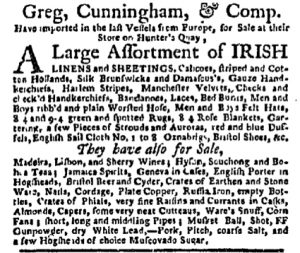
sep-30-9301766-supplement-new-york-gazette
Occasional Supplement to W. Weyman’s Gazette of Yesterday [New-York Gazette] (September 30, 1766).
“LINENS and SHEETINGS, … Russia Iron, … Ware’s Snuff.”

Today’s advertisement features Greg, Cunningham, & Company and their vast assortment of all different types of goods recently “imported in the last Vessels from Europe.” Fairly unlike any other advertisements I have looked at this week, this shop offered more than a surplus of different textiles and clothing materials, such as “LINENS and SHEETINGS,” laces, velvets, and handkerchiefs, Greg, Cunningham, and Company also carried products that would be found in a modern hardware and sporting goods store. Materials like “Russia Iron,” gunpowder and musket balls were available as well as “Plate Copper” and “dry White Lead.” I had not seen these products advertised before; they stood out because they show that colonists needed supplies that allowed for expansion, growth, and opportunities for new development. From the hardware products to clothing to even a selection of medicines, Greg, Cunningham, and Company offered a diverse selection of goods to consumers.

The advertisement also listed “Ware’s Snuff.” Since it was listed with “middling pipes” and different alcoholic beverages, at first glance I assumed “Ware’s Snuff” was just another pleasure for adults. In fact snuff was extremely popular among men, not only as a product to enjoy, but as a social measure as well. According to Edwin Tunis, “Nearly every man carried the most expensive [snuff box] he could afford.” Some had a different box for every day. Even women took advantage of the readily available product, but only in private.[1] However, after researching further, I found that “Ware’s Snuff” was actually used as a cure for some sicknesses as well. Taking this up the nose would often lead to “a very large discharge of mucus.”[2]

**********

ADDITIONAL COMMENTARY: Carl Robert Keyes

Nick focused on the content of the advertisement he selected for today, but I am also interested in the context in which it appeared. Today’s advertisement was included in a half sheet Occasional Supplement to W. Weyman’s Gazette of Yesterday. Like nearly half of colonial American newspapers published in 1766, William Weyman distributed the New-York Gazette on Mondays – and, usually, only Mondays. Typically, each issue consisted of four pages, two printed on each side of a broadsheet that was then folded in half. In most cases, that was the extent of the news and advertising made available by any particular newspaper during any particular week.

At this time the Pennsylvania Gazette did provide a notable departure. It frequently inserted an additional half sheet in its standard four-page issue, bringing the entire issue to a total of six pages. Even with this additional content, however, the Pennsylvania Gazette did not attempt to distribute additional full issues more than once a week. In the 1770s some newspapers experimented with printing two or three issues per week, but it was not until after the Revolution that newspapers in the largest cities began daily publication.

This brings us back to Greg, Cunningham, and Company’s advertisement and the Occasional Supplement to the New-York Gazette in which it appeared. Why deviate from the usual publication schedule? Considering the amount of labor involved in producing an additional half sheet, why have an Occasional Supplement appear just one day after Monday’s regular issue, rather than later in the week? The “Subject of the Day is quite altered,” the first line of the Occasional Supplement proclaimed, due to “the Arrival of the Lord Hyde Packet” and the news it carried “with regard to the Change in the Ministry.” At the end of July, Lord Rockingham had been dismissed as prime minister. The king instructed William Pitt the Elder to form a government and granted him a title, making him the first Earl of Chatham. Pitt was popular among American colonists, both for his incisive leadership during the Seven Years War and, especially, for his opposition to the Stamp Act. Yet the Occasional Supplement noted that in Britain “there is pro and con, for and against Mr. PITT.” Weyman selected excerpts from letters that arrived on the packet ship “to give both Sides a Chance, and must leave our Readers to judge for themselves.” This news was too significant to wait an entire week to report it in the next issue of the New-York Gazette, hence Weyman’s decision to rush to press with an Occasional Supplement.

This news filled almost the entire first page of the Occasional Supplement, but the other side featured advertisements (including Greg, Cunningham, and Company’s advertisement) exclusively. Sometimes supplements and additional half sheets (like those that accompanied the Pennsylvania Gazette in 1766) were mechanisms for distributing additional advertising, the demand for advertising space exceeding the what was available in regular issues. In this case, however, we see that political reporting opened an opportunity to distribute greater numbers of advertisements. Weyman and others who worked in his shop could have cut their work in half by printing a broadside that reported the news, but instead chose to print advertising on the other side before distributing the Occasional Supplement on September 30, 1766.

**********

[1] Edwin Tunis, Colonial Craftsmen and the Beginnings of American Industry (New York: World Publishing Company, 1965), 53.

[2] Thomas John Graham, Modern Domestic Medicine (London: Published for the Author, 1827), 369.

September 1

What was advertised in a colonial American newspaper 250 years ago today?

Sep 1 - 9:1:1766 New-York Gazette
New-York Gazette (September 1, 1766).

“THOMAS MORE’S ALMANACK, For the Year 1767. Is in the Press at W. Weyman’s.”

When it came to the printers and booksellers in colonial America, almanacs were a staple among the merchandise they produced and sold. These inexpensive pamphlets were in great demand, finding their way into the hands of readers from all kinds of backgrounds, from the elite to the most humble. In the 1960s Milton Drake compiled a bibliography of hundreds of almanacs printed in America in the eighteenth-century. Printers met the high demand for these calendars that doubled as reference periodicals by delivering an extensive supply to colonial customers, competing with each other in the process.

Given the diversity of almanacs available for public consumption, printers (as well as the authors of the almanacs themselves) needed to direct potential customers to the volumes they produced. Among the most common appeals, they promoted the accuracy of their almanacs, sometimes underscoring the education or other qualifications of the author or compiler. Benjamin Franklin’s almanacs, authored under the pseudonym Richard Saunders or Poor Richard, gained popularity for the aphorisms the astute printer inserted. (Arguably, those aphorisms made Franklin’s almanacs the most famous of the eighteenth century. Poor Richard’s almanacs remain well known in popular culture today, not just among scholars of early American print culture, thanks not only to their connection to one of the founders but also because the aphorisms have become nuggets of wisdom passed down from one generation of Americans to the next.) The authors and compilers of almanacs, like “Poor Richard,” became brands in and of themselves, contributing to the popularity of certain almanacs and forging a loyalty that predisposed colonists to continue purchasing familiar publications.

William Weyman devised another strategy for placing his almanacs in the hands of readers. He advertised them early (indeed, very early!), which allowed him to bring his almanacs to the attention of potential customers before they even considered others printed by competitors. “THOMAS MORE’S ALMANACK, For the Year 1767” was not yet ready for sale at the time that Weyman placed today’s advertisement. It was merely “in the Press … and will be published in due Time.” This advertisement appeared on September 1, a full four months ahead of the year covered in the almanac, but Weyman was priming customers to consider his almanac. They might not have needed it yet, but it was a product many of them knew that they would purchase eventually.

Modern retailers engage in similar practices. This year many stores started stocking Halloween items in August. Thanksgiving and Christmas merchandise will be available soon, if it is not on shelves already. Today’s merchants did not invent promoting seasonal goods well before customers needed them. William Weyman and others were already doing that in the eighteenth century.

August 11

What was advertised in a colonial American newspaper 250 years ago today?

Aug 11 - 8:11:1766 New-York Gazette
New-York Gazette (August 11, 1766).

“As soon as the Season will permit, they will brew Spruce again.”

Brewers George Harison and James Leadbetter were savvy marketers. They informed the public “that their ALE is now fit to deliver,” but they also stoked anticipation for another product, spruce beer, that was not yet available but would be brewed again “As soon as the Season will permit.” In a single advertisement they attempted to move their current inventory and create demand for another product that would be in stock in the near future. By drawing attention to their spruce beer even before it had been brewed, they prompted potential customers to associate that product with their brewery rather than settle for similar beverages that competitors might deliver before theirs was ready for market.

Aug 11 - American Cookery
Amelia Simmons, American Cookery (Hartford, Connecticut:  Hudson and Goodwin, 1796).  American Antiquarian Society.

Spruce beer, which came in both alcoholic and non-alcoholic varieties, was quite common in colonial America. Harison and Leadbetter did not address any particular sort of customer in their advertisement, but merchants and captains who provisioned ships that passed through New York’s busy harbor may have counted among their clients. As part of the Columbian Exchange of resources and knowledge, French and British explorers had learned from indigenous Americans that beverages made with spruce could be used to ward off scurvy. Spruce beer became an important component of the rations doled out to European sailors. One correspondent in the September 1764 issue of the London Magazine indicated that when he owned a ship that traded between New England and the West Indies he always instructed the captain to take along spruce beer as a means of safeguarding the health of the crew. Not only did spruce beer ward off scurvy, it was also safer to drink than some of the water.

So common was this drink in eighteenth-century America that in 1796 a recipe “For brewing Spruce Beer” appeared on the final page of Amelia Simmons’ American Cookery, the first cookbook written by an American.

July 29

What was advertised in a colonial newspaper 250 years ago today?

Jul 29 - 7:29:1766 New-York Gazette
New-York Gazette (July 19, 1766).

“He also makes Wyer Cages for Parots, Rivets China, and hangs Bells in Gentlemen’s Houses.”

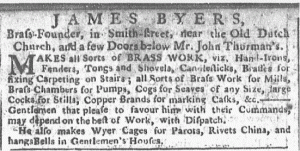
James Byers, a “Brass-Founder, in Smith-street,” advertised that he “MAKES all Sorts of BRASS WORK” and then proceeded to list a vast array of examples, from candlesticks to chambers for pumps to “Brands for marking Casks” (particularly of interest as a means of marking and marketing products). He concluded his advertisement by listing three other services he provided: “He also makes Wyer Cages for Parots, Rivets China, and hangs Bells in Gentlemen’s Houses.”

It was that short list that convinced me to choose Byers’ advertisement to feature today, especially the “Wyer Cages for Parots.” I loved imagining colonial New Yorkers with parrots as exotic pets. I was also intrigued that most of Byers’ interaction with customers took place in his shop or workshop, but on occasion he visited clients’ homes to hang bells. Apparently he was responsible not only for making or selling bells but also for installing systems that allowed visitors to alert residents they were at the front door or means for summoning servants.

I’ll confess, however, that I was initially confused by his claim that he “Rivets China,” but I ended up learning the most from that portion of the advertisement. I have seen museum pieces with rivets, but I chose to overlook them, preferring instead to imagine porcelain in its pristine condition. In researching today’s entry, however, I have realized that this attitude caused me to overlook important aspects of the history of objects and their use by consumers.

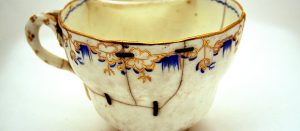
I started by seeking a basic explanation of “Rivets China,” which led me to this: “Riveted chinaware is any china (pottery, porcelain and bone china) that has been cracked and repaired by means of a staple repair.” This is the kind of repair undertaken before epoxies were available.

tea-cup-mended-1400
China cup showing cracks and rivets.  National Trust.

From there I found an article on “Old Repairs of China and Glass” by Isabelle Garachon that appeared in the Rijks Museum Bulletin. Garachon reported that riveting was a “mechanical joining technique … used very widely to repair china and porcelain in the eighteenth, nineteenth and twentieth centuries, and is actually still in use in China today.” Riveting throughout the ages has been so commonly practiced, Garachon continued, that a 1963 book on China Mending and Restortation “devoted no fewer than 170 pages to describing all the variations of the riveting method, which had meanwhile developed into a complex art.” Garachon’s article includes several color photos of china repaired by rivets as well as diagrams detailing this method of repairing broken and cracked pieces.

Finally, Andrew Baseman’s blog, “Past Imperfect: The Art of Inventive Repair,” features photos of a variety of items repaired with staples or rivets in the eighteenth and nineteenth centuries. Baseman argues for finding the beauty in the repairs and recognizing how treasured these items must have been for their owners to seek to preserve them after suffering damage.

Byers’ customers likely had different reasons for bringing their broken china to his shop. Some may have wanted to maintain the functionality of housewares they used regularly. Others may have wanted to preserve the aesthetic qualities of pieces on display in their homes. Some may have had sentimental attachments to certain pieces and felt heartbroken when they were damaged. Byers’ advertisement challenges us to think about how consumers used the goods they purchased and the emotional attachments they developed.

July 8

What was advertised in a colonial newspaper 250 years ago this week?

Jul 8 - 7:7:1766 New-York Gazette
New-York Gazette (July 7, 1766).

“The better to entertain the Company, there will be two or three Songs sung during the Evening’s Amusement.”

Last month the Adverts 250 Project featured three advertisements for houses of entertainment. Daniel Ocain operated one in Savannah. Samuel Fraunces operated another “at the Sign of Queen Charlotte” in Philadelphia. On the outskirts of Philadelphia, in the Northern Liberties, William and Ann Johnson ran their own “AT the Sign of the Globe.” The two enterprises in Philadelphia offered much more extensive amenities and services than Ocain’s establishment in Savannah. Philadelphia was an older, wealthier, and much larger city. Fraunces and the Johnsons appeared to support themselves primarily by operating their houses of entertainment, while Ocain continued to work as a saddler on the side.

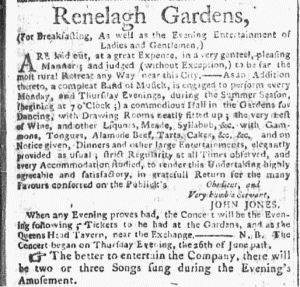
Not to be outdone by his counterparts in Philadelphia, John Jones offered a similar array of services and amenities to entertain guests at his establishment near New York City. His “rural Retreat” even had an impressive name to help advertise the amusements that took place there, Renelagh Gardens. Residents weary of the crowded streets in the city were sure to enjoy the gardens, “laid out … in a very genteel, pleasing Manner” and “judged … to be far the most rural Retreat.” In addition to the gardens, guests could enjoy music and dancing, “the very best of Wine, and other Liquors,” and an assortment of entrees and desserts.

With the Independence Day holiday falling at the beginning of this week, many Americans are in the midst of vacations and summer travel. In addition, others are likely taking advantage of longer summer evenings to make the most of their leisure time. Municipalities and various organizations also host festivals, outdoor concerts, fairs, and other events throughout the summer months, drawing crowds looking for entertainment. Today’s advertisement offers a glimpse of some of the amusements available in colonial America and the methods for promoting them to the public.

June 23

What was advertised in a colonial newspaper 250 years ago today?

Jun 23 - 6:23:1766 New-York Gazette
New-York Gazette (June 23, 1766).

“Having served a regular Apprenticeship to the Business, he flatters himself he cannot fail of giving general Satisfaction.”

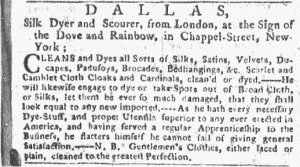
“DALLAS, Silk Dyer and Scourer, from London” had a lot going for him and he wanted potential customers to know it. Being a “Silk Dyer and Scourer” required particular skills; novices or pretenders might end up ruining any garments turned over to their care, but Dallas had “served a regular Apprenticeship to the Business.” He had received the training necessary for his occupation. As a result, clients could trust the other claims he made in his advertisement. Dallas did not just market the services he provided or the products he sold. He also marketed himself, especially his expertise and training, much as many modern advertisers list their qualifications, certifications, or degrees when promoting their businesses.

Dallas “clean’d or dyed” a variety of textiles, sometimes seeming to work magic on them. No matter how damaged they happened to be when delivered to his shop “at the Sign of the Dove and Rainbow,” Dallas was able to remove spots and otherwise clean fabrics so “they shall look equal to any new imported.” He pledged that he did this work “to the greatest Perfection.” He was able to accomplish this in part because of his specialized training, but also because he learned during his apprenticeship that it was necessary to have the proper supplies and equipment. Accordingly, “he hath every necessary Dye-Stuff, and proper Utensils superior to any ever erected in America.”

Apparently Dallas was so skilled as a “Silk Dyer and Scourer,” a celebrity in his occupation, that he needed only one name!

May 14

What was advertised in a colonial newspaper 250 years ago this week?

May 14 - 5:12:1766 New-York Gazette
New-York Gazette (May 12, 1766).

“The whole are made from Patterns of the newest Fashion.”

Last week I argued that when Stephen Hardy introduced himself as “TAYLOR from LONDON” that he suggested to potential customers that they could depend on him to outfit them in the latest fashions from the cosmopolitan center of the British Empire. Joseph Beck, “STAYMAKER, from LONDON,” deployed the same strategy, though he did so much more explicitly. Rather than expect readers to make the connection on their own, he stated that the stays (eighteenth-century undergarments similar to corsets) he made were of a fashion “now preferred by Ladies of the first Distinction in London.”

An ocean separated Beck and other New Yorkers from London, but the staymaker assured potential customers that all of his wares were “made from Patterns of the newest Fashion.” This was possible because he remained in contact with others who pursued his occupation in the empire’s largest city: the patterns were “constantly sent him by some of the most eminent Staymakers in London.” Beck had connections. Those connections gave him access to the latest fashions and, in turn, gave cachet to the stays he made and sold.

After establishing that his stays were quite fashionable, Beck made an interesting pivot. He combined a “Buy American” appeal with his promises of London cosmopolitanism. Not only did he sell his stays at a lower price than those imported from England, since they were “made in this City, and the Stuff mostly of the Product of America, it’s hoped the Ladies will give the Preference on that Account.”

American colonists did not smoothly break away from Britain, politically, economically, or culturally. Beck’s advertisement transmitted competing messages about the economic independence of the colonies while shoring up British identity and fashion.

May 7

What was advertised in a colonial newspaper 250 years ago this week?

May 7 - 5:5:1766 New-York Gazette
New-York Gazette (May 5, 1766).

“He upholds and warrants their Performance for one Year.”

Isaac Heron made, sold, and repaired watches. He was proud of his work and stood behind, as the assurances in this advertisements demonstrate. This was not only a point of pride in a job well done, however, but also a strategy for encouraging potential clients to visit his shop.

Heron offered several guarantees in his advertisement. If he repaired a watch, he pledged that it would work correctly for at least a year (though he excluded accidents and “Mismanagement” on the part of the owner). For watches that he made and sold, he guaranteed that they would work correctly for several years. The greater the value of the watch, the longer the period before this warranty expired.

To prove that these were not hollow promises, Heron called on former customers from the past year to bring in their watches if his work had failed. Just as he expected “to receive his Money when earn’d,” he acknowledged his obligation to “Rectify” any of his work that did not live up to the promises he had made.

From start to finish, Heron stressed that his customers “may depend on their [watches] being carefully repair’d, justly charg’d for, and return’d” in a (ahem) timely manner.

April 30

What was advertised in a colonial newspaper 250 years ago this week?

Apr 30 - 4:28:1766 New-York Gazette
New-York Gazette (April 28, 1766).

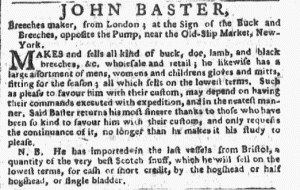
“May depend on having their commands executed with expedition, and in the neatest manner.”

Breechesmaker John Baster understood the importance of customer service, and he wanted potential customers to know that he would treat them well if they called on him. He promised that his clients “may depend on having their commands executed with expedition, and in the neatest matter.” In other words, he did the job quickly but well, not sacrificing quality for speed.

In choosing to use the word “commands” rather than “orders” or “instructions,” he also established the relationship between artisan and customer. Whether elite, middling, or more humble, all customers could expect deference from Baster throughout their commercial interaction, regardless of their relative status and relationship to each other beyond his shop at the Sign of the Buck and Breeches.

Baster thanked former customers for their patronage (letting potential customers know that others had visited his shop) before stating that he “only requests the continuance of it, no longer than he makes it his study to please.” This convoluted passage was the eighteenth-century method of assuring customers that he understood that if he failed to offer good customer service that he realized that they would seek out other breechesmakers. Not only did he realize that was the case, he expected it.

Customer service is a major aspect of running a retail enterprise today, but colonial Americans understood its value as well, though they may have expressed it differently.

April 15

GUEST CURATOR:  Kathryn J. Severance

What was advertised in a colonial newspaper 250 years ago this week?

Apr 15 - 4:14:1766 New-York Gazette
New-York Gazette (April 14, 1766).

“A parcel of HOUSEHOLD AND KITCHEN FURNITURE.”

This advertises goods, more specifically, household furniture and kitchen items from the home of the late Captain Morley Harison. This “public Vendue” was different from some others due to the fact that an individual had passed away, which contrasts with “public Vendue” of goods in the scenario when people were moving away. This advertisement does not provide a complete listing of the “HOUSEHOLD AND KITCHEN FURNITURE” that would be sold, unlike the advertisement from February 10 for “House Furniture” that I previously featured.

Both modern-day and eighteenth-century kitchens contained tools that can be used to prepare food and aid in cooking. Modern technologies have changed the nature of kitchens and changed the processes involved in food preparation, meaning that unlike in the eighteenth century, women are not forced to spend all day in the kitchen to provide meals for the family. Innovations such as ovens, crockpots, and microwaves mean that food can be heated up and ready to serve without someone having to stir a pot all day.

Instead of having a stove to cook the meals, boil water, and heat things up, eighteenth-century kitchens were outfitted with a hearth for cooking. The hearth was a recess in the wall that was placed at the bottom of a chimney. Colonists used a contained fire in the hearth to cook food. A spit, a tool that held a pot or tea kettle over a fire, aided in boiling water. Flavor could be added to foods because of the mortar and pestle, a tool comprised of a sturdy bowl and a heavy stick that was used to crush and grind dried herbs and corn for meal preparation.

To share this information with young historians, here’s a lesson plan that outlines how to make historically-accurate comparisons between colonial and modern-day American kitchens.

**********

ADDITIONAL COMMENTARY:  Carl Robert Keyes

I appreciate the way that Kathryn uses a brief reference to “HOUSEHOLD AND KITCHEN FURNITURE” to explore how kitchens have changed since the colonial period, in terms of both the types of equipment found in them and the labor involved in meal preparation. As she notes, a variety of technologies have reduced the amount of time we devote to preparing food.

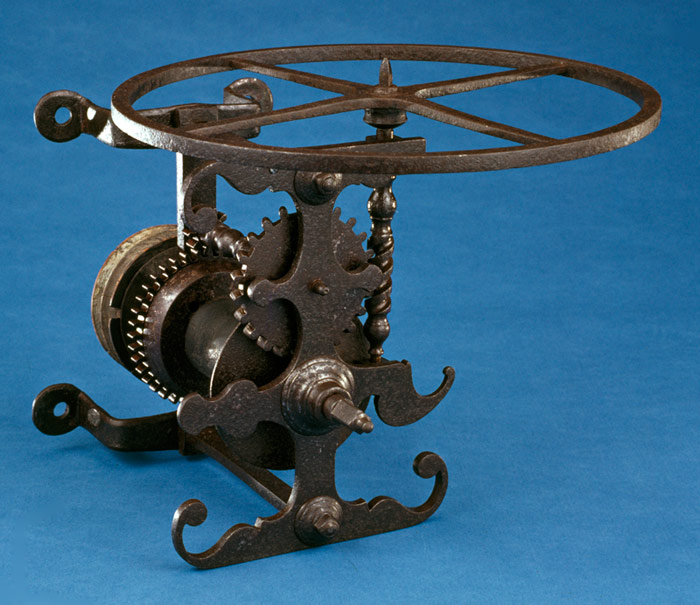
We should not assume, however, that modern Americans hold a monopoly on devising ways to save time and reduce labor in the kitchen. Colonists also relied on a variety of technological innovations, though some of them seem quite antiquated or quaint to us today. Every time I have visited Fortress Louisbourg I have been mesmerized by the eighteenth-century spit jack in the kitchen of one of the homes in the village – and I was not only the one. Many visitors seemed as interested by everyday life and the tools used by settlers as they were excited to explore the military aspects of the fortress.

Apr 15 - Spit Jack
Spit Jack from the Collections of Colonial Williamsburg.

So, what is a spit jack? Meat was often cooked on a spit, but the spit had to be turned constantly in order to evenly cook the meat. (Think of rotisserie cooking today). This involved a fair amount of labor. Somebody from the household – the wife, a child, or a servant or slave – had to spend hours turning the spit. Mechanization made this unnecessary, freeing up that labor to be directed elsewhere. A mechanized spit turner – known as a spit jack – used a system of pulleys and weights to accomplish what otherwise would have done manually.

To see a spit jack in action, watch this video from Thomas Ironworks.