April 14

GUEST CURATOR:  Kathryn J. Severance

What was advertised in a colonial newspaper 250 years ago today?

Apr 14 - 4:14:1766 New-York Gazette
New-York Gazette (April 14, 1766).

This advertisement is not for goods or services, but instead a runaway advertisement. William Darlington hoped that someone would find his twenty-six-year-old “Irish Servant Man, Named CONNOR O“ROURK”. He went on to describe the servant’s physical features, which brings up the fact that missing person advertisements from the eighteenth century could not actually feature a photo of the missing person. You can probably understand the limitations that this posed. Today’s society is often very visual, but in the eighteenth century it was common for advertisements to not have any visuals to accompany them.

The Irish man in the advertisement was an indentured servant, whose labor was owned by the man who put out the advertisement. The concept of indentured servitude is that an individual or an individual’s family member agrees, through the signing of a contract, to give a person’s labor (and personal freedoms) over to a “master” for a certain period of time, in which the servant was to provide service, which would help pay off a debt. During the seventeenth century, the Virginia Company was responsible for founding indentured servitude as a means of payment for transportation of those who could not afford to pay for their own way to North America. Colonial indentured servitude and the slave trade were both forms of labor in which individuals could not choose to stop working for their master. This means that they were also not allowed to leave their master’s location, meaning that many indentured servants and slaves who went missing had attempted to escape the limitations of their conditions by running away.

For a lesson designed to introduce middle school students to indentured servitude and slavery, check out this link from Teaching American History in South Carolina.

**********

ADDITIONAL COMMENTARY:  Carl Robert Keyes

Indentured servants are part of my world. Not literally, of course, but to me they are a familiar part of the American colonial experience and the past that has unfolded into the present. I sometimes forget just how foreign the past can be to others who do not spend as much time in the eighteenth century as I do. The differences between then and now manifest themselves in so many different ways, from something as mundane as the long S in eighteenth-century texts (which I no longer notice, but the guest curators brought to my attention earlier this week as a challenge they encountered in just reading advertisements and other parts of the newspaper for this project) to entire systems of economic and social organization that structured everyday life and interaction in the colonies.

Systems of unfree labor – slavery, indentured servitude, apprenticeships – fall into that latter category. They offer potent evidence of change over time. We live and work in a much different world today than our eighteenth-century ancestors. Our memories of that world have faded unevenly. From our readings (from the excellent Slavery and Public History) and discussions about slavery in our Public History course throughout the semester, we have reached the conclusion that most Americans are aware that slavery existed at some point in the American past, but, for the most part, they do not know much about slavery and its impact on slaves and slaveholders or the major political, social, and economic contours of American history.

Anecdotally (based on both everyday conversations and nearly a decade of teaching), it seems that the average person on the street knows even less about other forms of unfree labor, including indentured servitude. (Even the program I am using to compose this passage does not recognize “unfree” as a real word. Scholars of early America use it regularly, once again demonstrating that we sometimes live in a very different world.) As other scholars have noted, all too often people imagine a stark divide between European settlers and enslaved Africans in colonial America, not realizing that many of the “lower sorts” among European colonists were exploited for their labor and (temporarily) belonged to masters. We may not know all of the details of Connor O’Rourk’s story – why he became an indentured servant and why he chose to run away from his master – but, as Kathryn notes, both slaves and indentured servants sought freedom by running away. Many students are surprised to learn that indentured servants existed at all. Their presence certainly complicates the story of the colonial experience.
March 10

What was advertised in a colonial newspaper 250 years ago today?

Mar 10 - 3:10:1766 New-York Gazette
New-York Gazette (March 10, 1766).

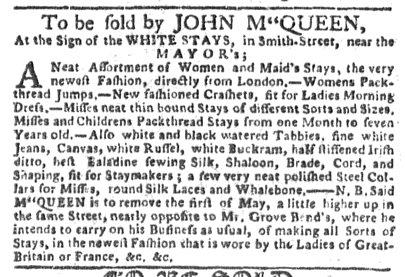
“To be sold by JOHN M”QUEEN, At the Sign of the WHITE STAYS.”

Staymaker John M”Queen was concerned with fashion – and from start to finish his advertisement suggested that his potential customers should be as well. He opened with a summary of his wares (“A Neat Assortment of Women and Maid’s Stays, the very newest Fashion, directly from London”) and concluded with a reassurance (“all sorts of Stays, in the newest Fashion that is wore by the Ladies of Great-Britain or France”). What is a stay? Colonial Williamsburg offers “A Glossary of Terms” describing women’s clothing in the colonial era: stays were the eighteenth-century version of what became corsets in the nineteenth century, but visit the glossary for a much more complete examination.

New York was one of the largest cities in the colonies in the 1760s, but it was a provincial outpost. M”Queen incited anxieties that residents did not want to be seen as inhabitants of some backwater village. Instead, his advertisement suggests, they wanted full membership in British (and European) fashion and culture. His stays were not merely of the “newest Fashion” in the colonies. Instead, they had arrived “directly from London” and were the same style as those “wore by the Ladies of Great-Britain or France.” Not just an importer, M”Queen was a staymaker himself, but as he produced stays locally he kept his eyes on changing fashions in London.

As an aside, it is worth mentioning that this advertisement linking consumption and fashion was aimed at female customers, but that should not be misinterpreted as evidence that eighteenth-century women placed more emphasis on fashion than men. Given the nature of the product he marketed, M”Queen addressed women, but advertisements for men’s garments during the period were just as likely to invoke a language of fashion and cosmopolitan connections to European metropolitan centers.

February 25

GUEST CURATOR:  Mary Aldrich

What was advertised in a colonial newspaper 250 years ago this week?

Feb 25 - 2:24:1766 New-York Gazette
New-York Gazette (February 24, 1766).

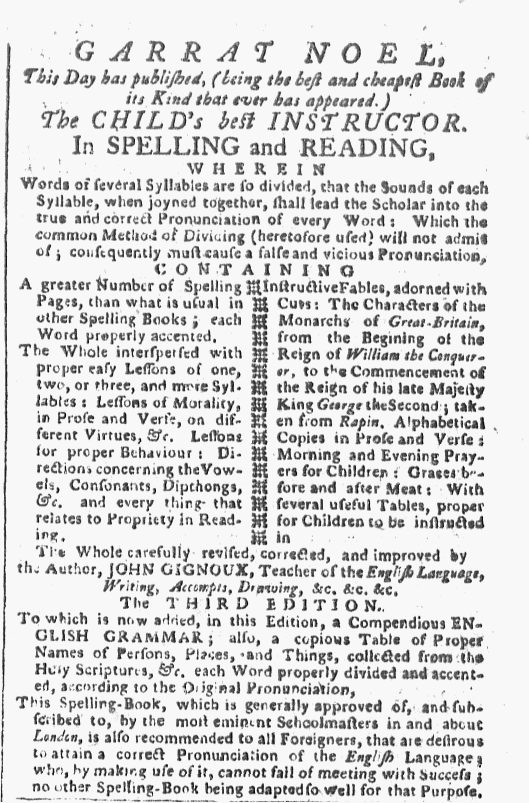
This Day has published … The CHILD’s best INSTRUCTOR. In SPELLING and READING.”

This advertisement for a child’s spelling and reading book consists of instruction in the “true and correct pronunciation of every word.” According to E. Jennifer Monaghan and Arlene L. Berry, children were mainly taught to read before they could even write because the majority of reading was done orally. This particular book caters to that method of teaching by including words that are broken up into syllables so that the child will learn to pronounce words correctly.

Within the book, there are lessons on morality. In a time when faith was very much a part of people’s lives, whether they went to church or not, teaching one’s children to be virtuous was encouraged. They also mention the presence of historical events from England. It is interesting that the history of Britain is mentioned as a selling point because of the colonies eroding relationship with Britain.

This book was not just aimed at children. At the end of the advertisement, foreigners are invited to use it as well in order to learn the proper pronunciation of words.

**********

ADDITIONAL COMMENTARY:  Carl Robert Keyes

Mary correctly notes that the relationship between Britain and the colonies was eroding in 1766. The Stamp Act was still in effect (and would not be repealed until March 20, 1766, almost simultaneously with passage of the Declaratory Act). I have previously featured several advertisements that reacted to the Stamp Act in one way or another, often encouraging consumers to purchase locally produced goods rather than imported wares.

In selecting this advertisement, Mary helps to provide balance in the narrative and interpretation. Colonists were engaged in resistance to what they considered abuses perpetrated by Parliament, but most were not yet prepared to advocate revolution and separation from Britain. Indeed, many objected to the Stamp Act and other measures because they believed they departed from traditional British liberties.

Even as political tensions rose, Americans continued to feel connected to Britain culturally. They believed that they shared a common past. As a result, it did not seem odd to colonists to oppose the Stamp Act imposed by Parliament while simultaneously celebrating the feats of William the Conqueror and other monarchs through seven centuries. Note that Noel also marketed this book by stating that it was used “by the most eminent Schoolmasters in and about London.” Noel likely believed that such connections to the metropolitan center of the empire imbued the book with greater cachet among potential readers.

(As an aside, Garrat Noel placed the first advertisement featured on the Adverts 250 Project when it started publication as a blog.)

February 23

GUEST CURATOR:  Mary Aldrich

Who were the subjects of advertisements in a colonial newspaper 250 years ago this week?

Feb 23 - 2:20:1766 Massachusetts Gazette
Massachusetts Gazette (February 20, 1766).

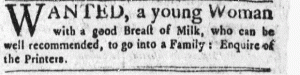
“WANTED, a young Woman with a good Breast of Milk.”

“A Very good WET-NURSE is willing to take a Child.”

These two advertisements are interesting in the fact that they relate to the same service but come from different angles. The first is an advertisement for a wet nurse while the second is advertising a woman’s willingness to be a wet nurse. Using a wet nurse was a common practice among European elite women that was not as popular across the pond in the colonies.

Feb 23 - 2:24:1766 New-York Gazette
New-York Gazette (February 24, 1766)

There were cases when a wet nurse was needed, such as the death of the mother or if she was too busy to take care of her child or some kind of ailment that prevented her from breastfeeding. Women generally used breastfeeding as a form of contraception, albeit unreliable, but it did give them some control over the spacing of their pregnancies.

The first advertisement is looking for “a young woman with a good breast of milk” to “go into a family.” It is interesting that this advertisement is seeking to incorporate this wet nurse into the family whereas the second gives the option of nursing “abroad,” which meant not in the house.

**********

ADDITIONAL COMMENTARY:  Carl Robert Keyes

I noted last week that women offering goods and services (shopkeepers, milliners, schoolmistresses, and the like) were disproportionately underrepresented in newspaper advertisements in colonial America. Today, Mary has selected two notices that illustrate the most common reason women were featured in advertisements for goods and services during the eighteenth century: offering or seeking assistance from wet nurses.

Note that even though both advertisements testify to labor (pun not necessarily intended) undertaken by women, they both also obscure the identity of the woman seeking or offering this service. Instructions to “Enquire of the Printers” or “Inquire of W. Weyman” (the printer of the New-York Gazette) rendered these women anonymous, perhaps by their own choice as a means of retaining their privacy. These advertisements figuratively put women’s bodies on display for public consumption, making it understandable why the advertisers might not have desired further identifying information.

Mary notes that these advertisements speak about two sides of the same transaction. I would like to suggest that each also incorporates concerns specific to the woman who placed the notice. For the first, seeking a wet nurse, it is quite possible that the advertisement was a last resort. A woman and her family may have first exhausted a network of family and trusted friends and neighbors before looking more broadly for a wet nurse. For the second, offering services as a wet nurse, Mary comments on the distinction between “in the House or abroad.” The advertiser demonstrated her willingness to adapt to conditions set by a potential employer. In looking for employment, she likely had to acclimate to the wishes of potential employers, whereas those seeking to hire wet nurses may have felt that they had more flexibility to set the terms.

February 18

GUEST CURATOR:  Elizabeth Curley

What was advertised in a colonial newspaper 250 years ago this week?

Feb 18 - 2:18:1766 New-York Gazette
New-York Gazette (February 21, 1766).

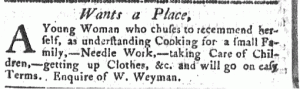
“Wants a Place, A Young Woman that is capable to attend Children.”

A woman looking for placement was not an uncommon thing in early American newspapers. Young women usually would look to be a housekeeper or cook, to care for children, or assist the women of the house. This young woman described her skills as “capable to attend Children, make up small Clothes,” and be all around helpful to the family. Our generation would describe her as a nanny.

In the American colonies, the number of servants a family had often depended on their economic status. Like the size and grandeur of a family’s house, the number of servants could be a status symbol. Not much has changed today.

Feb 18 - Masthead New-York Gazette 2:17:1766
Masthead for New-York Gazette (February 17, 1766).

For me, this advertisement was also an interesting find because normally the New-York Gazette published on Mondays. This week they published both a Monday (February 17) and a Tuesday (February 18) edition, which is were I found this advertisement. Normally for the Adverts 250 Project I would have had to go back to a Monday edition, but for this week I did not have to.

Feb 18 - Masthead New-York Gazette 2:18:1766
Masthead for New-York Gazette Extraordinary (February 18, 1766).

**********

ADDITIONAL COMMENTARY:  Carl Robert Keyes

“Not much has changed today.” Indeed, conspicuous consumption was not an invention of the twentieth or twenty-first centuries. It existed before the consumer revolution of the eighteenth century and genteel colonists engaged in it as a means of further differentiating themselves from each other as the middling and lower sorts gained greater access to consumer goods throughout the 1700s.

I believe that Elizabeth is the first guest curator to comment explicitly on the methodology used in selecting the featured advertisement for each day. She notes the same methods that I have described elsewhere in extended commentary about the project’s methodology and how it shapes the scope of the project.

As an instructor, this is an important behind-the-scenes element of students’ work. Each guest curator has compiled a census of newspapers published during his or her week based on the calendars generated by Early American Newspapers. As a result of supplements and extraordinary (“extra”) issues as well as publications starting or stopping in response to the Stamp Act or other reasons, the list of newspapers published in one week often differs from the list for the next week.

As Elizabeth indicates, many colonial American newspapers were published at the beginning of the week, on Mondays, but in most weeks no newspapers were printed on Tuesdays. As we examined this more closely, we discovered that William Weyman actually published the New-York Gazette three times during this week in 1766: the regular issue on Monday, February 17; a broadside (one-page) “Extraordinary” issue on Tuesday, February 18; and a two-page “2d Extra” on Friday, February 21.

Feb 18 - Masthead New-York Gazette 2:21:1766
Masthead for New-York Gazette 2d Extra (February 21, 1766).

This was not immediately apparent, however, due to a coding error in the metadata. The two extraordinary issues were treated as one in Early American Newspapers. As I have noted elsewhere, researchers need to be aware of faulty metadata (background information or “data that provides information about other data”) that may lead them to incorrect conclusions about digitized sources.

Feb 18 - Readex Calendar
Note that the calendar of issues generated by Early American Newspapers does not indicate that the New-York Gazette was published on February 21, 1766.  That “2d Extraordinary” has been conflated with the Extraordinary issue of February 18, 1766.

Elizabeth’s advertisement was actually published in the “2d Extra” on February 21. The February 18 Extraordinary did not include any advertisements. That means that today’s featured advertisement technically departs from the established methodology for this project.

I asked Elizabeth not to edit her original submission when we discovered this. Together we have fast forwarded three days to February 21, but this allows us to make a valuable point about the shortcomings that sometimes emerge when relying on digitized sources.

(Besides, February 18 is my birthday. I’m glad that we found a way to incorporate at least a masthead from a newspaper published 250 years ago on February 18, 1766, into the project.)

February 12

GUEST CURATOR:  Kathryn J. Severance

Who was the subject of an advertisement in a colonial newspaper 250 years ago this week?

Feb 12 - 2:10:1766 New-York Gazette
New-York Gazette (February 10, 1766).

“TO BE SOLD, For Want of Employ.”

This advertisement was put forth by a master looking to sell a slave due to the fact that they no longer could use their work.  Advertisements for slaves were common since slaves were commodities during the Colonial period.  In the eyes of many at the time, selling slaves was not much different than selling oxen or horses.

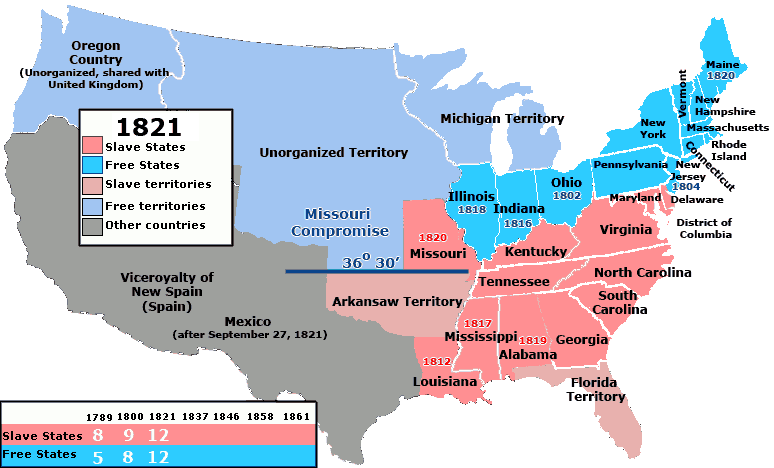
Feb 12 - Abolition Map
Map of Slave States and Free States in 1800.

The slave featured within this particular advertisement seems to be nineteen years old.  At twenty myself, I took a look at this advertisement and, for a second, imagine my own life.

I imagine that many members of the public would be interested to know that a newspaper in what came to be known as the North, advertised slavery in the 1760s.  These types of advertisements also continued in New England’s newspapers for at least 10 years until Vermont, inspired by the Declaration of Independence, was the first to ban slavery in its 1777 state constitution.  Other New England states followed suit.  By 1800 all the states within New England’s borders abolished slavery.

**********

ADDITIONAL COMMENTARY:  Carl Robert Keyes

Today Kathryn has selected a type of advertisement that surprises many students who enroll in my courses on early America, whether the introductory survey or advanced electives on colonial and Revolutionary America or the capstone research seminar on slavery in America. As Kathryn points out, many are shocked when looking through the pages of eighteenth-century newspapers to discover just how often enslaved men, women, and children were advertised, either to be bought and sold or because they ran away from their masters.

Many students (and I would venture to guess many New Englanders as well as other Americans) imagine a strict North-South divide. Slavery as an institution was something that existed in the South, they assume, but not in the North. Such assumptions conflate nineteenth-century America and earlier periods by grafting the antebellum era over the realities of seventeenth- and eighteenth-century America.

Feb 12 - Abolition Map 1821
Map of Slave States and Free State in 1821.  Note that New Jersey and New York merit additional explanation and clarification due to gradual emancipation.

Even the history of abolition is messier than simply stating that after a certain year slavery had been abolished in Northern states. Not every state adopted immediate abolition. New York (1799) and New Jersey (1804) each enacted gradual emancipation intended to phase out slavery over time. As a result, slaves resided in New York as late as 1824 and in New Jersey until the Civil War ended in 1865.

This advertisement reminds us of a history of slavery that is all too often hidden: its widespread practice throughout all the colonies in the seventeenth and eighteenth centuries and its continuation in some Northern states well into the nineteenth century.

February 5

GUEST CURATOR:  Maia Campbell

What was advertised in a colonial newspaper 250 years ago this week?

Feb 5 - 2:3:1766 New-York Gazette
New-York Gazette (February 3, 1766).

Wants a Place, a Young Woman who chuses to recemmend herself, as understanding Cooking for a small family.”

This advertisement does not sell a good, per se, but a young woman is “selling” her services. I found it interesting that this sort of advertisement would be included in a colonial newspaper. To me, it is an example of a woman having a level of freedom in the colonial area. This woman was able to put herself out there to do work for others. Now, she is still doing work associated with women and the household during the colonial period, but she now has the freedom to choose who she wants to employ her. Also, she has already chosen what work she will do for whoever hires her. She has, in a sense, laid out a contract for herself.

I do not usually associate the colonial period with women having the freedom to choose any sort of work that they will do, which is why I found this advertisement to be interesting.

**********

ADDITIONAL COMMENTARY:  Carl Robert Keyes

Several scholars have demonstrated that advertisements help us to glimpse women’s work and the role of women in the marketplace in colonial America. I first began examining advertising in early America after reading Frances Manges’ “Women Shopkeepers, Tavernkeepers, and Artisans in Colonial Philadelphia” (a Ph.D. dissertation completed at the University of Philadelphia in 1958). Manges scoured newspapers published in colonial Philadelphia to find evidence of women pursuing a variety of occupations, culling a significant amount of her evidence from advertisements for goods and services. (Other sorts of advertisements, including legal notices and announcements by executors, also fleshed out women’s visible participation in commerce in colonial Philadelphia.)

Manges focused primarily on women identified by name in their advertisements and other parts of the newspaper. This anonymous “Young Woman,” however, certainly would not have been alone among the many job seekers, female and male, throughout the colonial period who placed advertisements seeking employment, listing their skills and qualifications, and giving directions for how to contact them.

Like so many other advertisements, this one hints at a story that will likely never be fully recovered. Compiling similar advertisements can produce a general sense of what some young women experienced and the labor they performed in colonial America, but broad patterns are not the same as individual stories. What kind of circumstances led this particular “Young Woman” to seek employment in someone else’s household?

January 27

What was advertised in a colonial newspaper 250 years ago today?

Jan 27 - 1:27:1766 New-York Gazette
New-York Gazette (January 27, 1766)

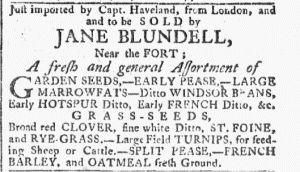
“To be SOLD by JANE BLUNDELL, Near the FORT; A fresh and general Assortment of GARDEN SEEDS.”

Eighteenth-century advertisements make it clear that women did not act solely as consumers during the period.  They were also producers, suppliers, and retailers who marketed goods and services to the general public.

It is difficult, however, to describe how frequently they placed commercial notices in the public prints.  It seems to vary from place to place, from newspaper to newspaper.  Women rarely resorted to advertising in smaller cities and towns.  They were more likely to use advertising to attract potential customers in larger port cities:  Philadelphia, Boston, Charleston, and New York.  Even in those urban centers, however, women were underrepresented on the advertising pages.  By numbers, they operated a significant proportion of shops, yet their male counterparts were more likely to place advertisements.

Jane Blundell not only advertised, she offered specialized merchandise that set her apart from the female shopkeepers, seamstresses, and milliners more likely to market their goods and services.  Advertisements like this one demonstrate what was possible (rather than what was most probable) for women in the commercial realm in eighteenth-century America.  Jane Blundell and other “she-merchants” pursued many different kinds of entrepreneurial activities, even as men outnumbered them.  Perhaps advertising helped Blundell to operate a viable business in the face of competition from male competitors.

January 6

What was advertised in a colonial newspaper 250 years ago today?

Jan 6 - 1:6:1766 New-York Gazette
New-York Gazette (January 6, 1766)

“Right Yorkshire MUFFINS, hot twice a Day.”

This anonymous advertiser most likely sold what is today known as Yorkshire Pudding.  These “muffins” were made from a batter of eggs, flour, and milk or water, cooked beneath meat (usually beef) roasting on a spit above a fire, thus allowing fats and juices to drip into the muffins and flavor them.  William Kenrick’s The Whole Duty of a Woman included a recipe, called “Dripping Pudding,” in 1737.  Hannah Glasse published a similar recipe in The Art of Cookery, Made Plain and Easy a decade later, bestowing the name “Yorkshire Pudding.”

Yorkshire_Pudding
It’s easy to see why Yorkshire Pudding could sometimes be called “Right Yorkshire MUFFINS.”

I would hazard to guess that Yorkshire Pudding is not a familiar food for most Americans today, though it seems to be quite common, even a traditional part of Sunday dinner, in England.  On both sides of the Atlantic, it is no longer known as “Right Yorkshire MUFFINS” or “Dripping Pudding.”  Today’s featured advertisement helps to evoke not only the smells and flavors of foods sold in colonial New York, but also the sounds of what they could have been called in the eighteenth century before “Yorkshire Pudding” became the standardized name.

Ellen Castelo offers this history of Yorkshire pudding, including a recipe.

*****

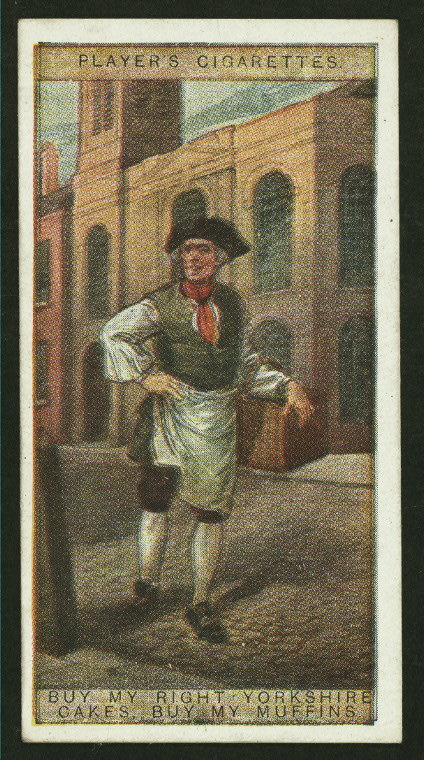
nypl.digitalcollections.510d47de-4a0b-a3d9-e040-e00a18064a99.001.w

In researching this entry, I was delighted to discover that Yorkshire Muffins made an appearance in a late-nineteenth- or early-twentieth-century advertising campaign:  on a cigarette card included in the “Cries of London” series issued by John Player & Sons, a branch of the Imperial Tobacco Company of Great Britain and Ireland.  A street vendor hawked his wares, exclaiming, “Buy My Right Yorkshire Cakes.  Buy My Muffins.”

Visit the New York Public Library Digital Collections for more information and to view both sides of the cigarette card.

January 1

What was advertised in a colonial newspaper 250 years ago this week?

Jan 1 - 12:30:1765 New-York Gazette
New-York Gazette (December 30, 1765)

“GARRAT NOEL, BOOKSELLER and STATIONER; According to his annual Custom, begs Leave to offer to the Public, the following List of Books, as proper for Christmas Presents and New-Year’s Gifts.”

At this time of the year we often hear laments that Christmas has become too secularized, evidenced in particular by the commercialization of the holiday.  The appropriately-named Noel, however, demonstrates that some advertisers developed a marketing strategy that linked consumption and Christmas in the eighteenth century.

And, since everyone loves a bargain at Christmas and New Year, Noel promised “extraordinray low Prices” to “those who are willing to be generous on the Occasion.”  For those who may not have considered giving gifts during the season, Noel planted the idea that they could confirm their benevolence and thoughtfulness by presenting books and stationery wares to family and friends.